
Which Cell Phone Repair Parts Should a Small Repair Shop Keep in Stock in 2026?
Every small repair shop faces the same inventory problem: stock too many cell phone repair parts and your cash is sitting on a shelf. Stock too few and you're turning away walk-ins or making customers wait while you order. The difference between a profitable parts inventory and a money pit comes down to knowing exactly which models and parts categories generate enough repair volume to justify carrying stock.
In 2026, the repair landscape has shifted. iPhone models from 13 through 16 dominate walk-in traffic. Samsung Galaxy S and A series cover most Android repairs. Batteries are replacing screens as the fastest-growing repair category as phones age past their second birthday. And non-screen parts — charging ports, back glass, cameras — are becoming a bigger share of revenue as repair shops expand their service menu.
This guide gives small shop owners (under 50 repairs per week) a practical framework for deciding what to stock, how much, and when to order on-demand instead.
Looking for a Reliable Wholesale Parts Supplier?
Factory-direct from Shenzhen — transparent grades, invoices & 12-month warranty.
Get Wholesale QuoteThe 80/20 Rule of Repair Shop Inventory
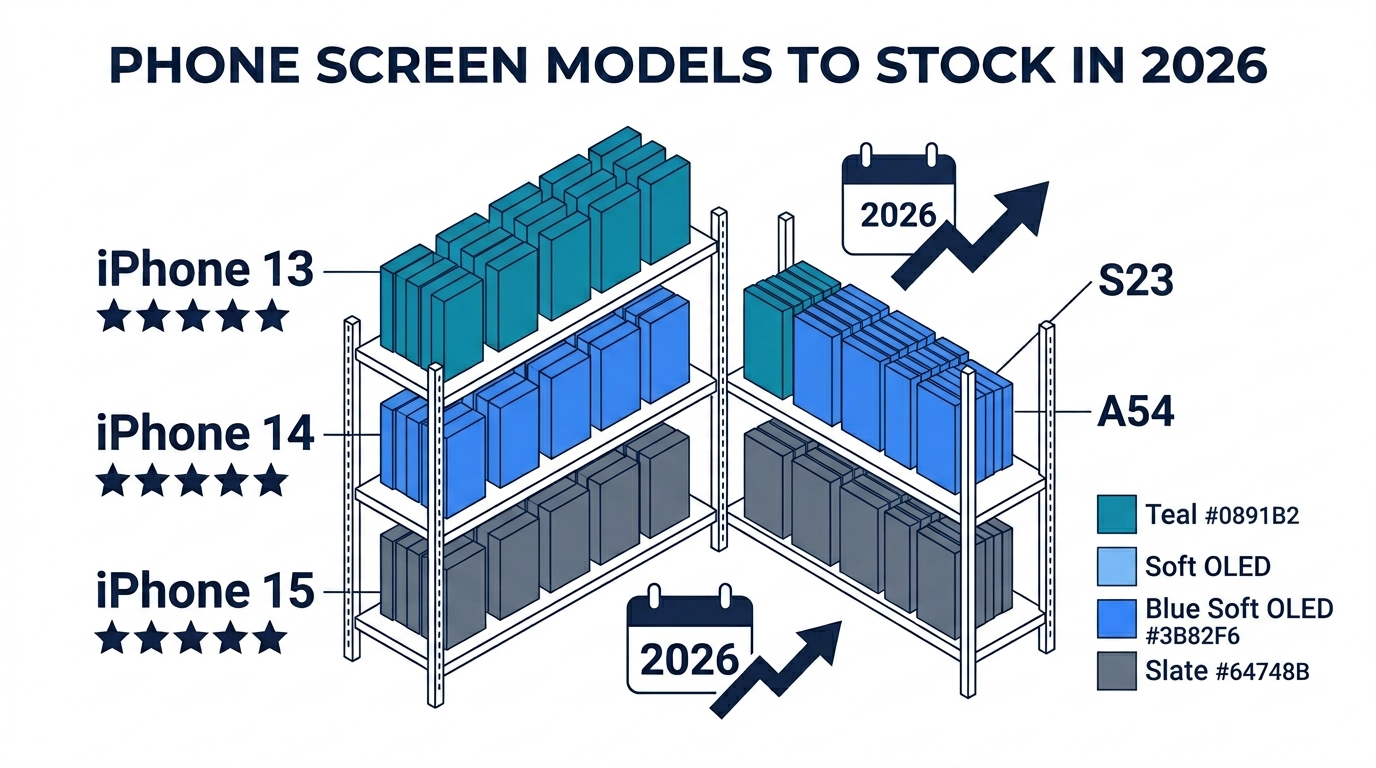
Before diving into specific parts, understand the fundamental pattern: roughly 80% of your repairs will come from 20% of the models you could potentially service. For most shops in 2026, those high-volume models are:
iPhone (typically 50–70% of repairs):
- iPhone 13 / 13 Pro / 13 Pro Max
- iPhone 14 / 14 Pro / 14 Pro Max
- iPhone 15 / 15 Pro / 15 Pro Max
- iPhone 12 / 12 Pro (declining but still significant)
Samsung (typically 15–25% of repairs):
- Galaxy S23 / S24 series
- Galaxy A14 / A15 / A54 / A55 (budget models with high repair volume)
Everything else (10–20%):
- Google Pixel 7/8/9, OnePlus, Xiaomi — varies by local market
Stock aggressively for your top 20% models. Order on-demand for everything else. This approach keeps your inventory investment focused on parts that actually move.
Category 1: Screens — Your Biggest Inventory Investment
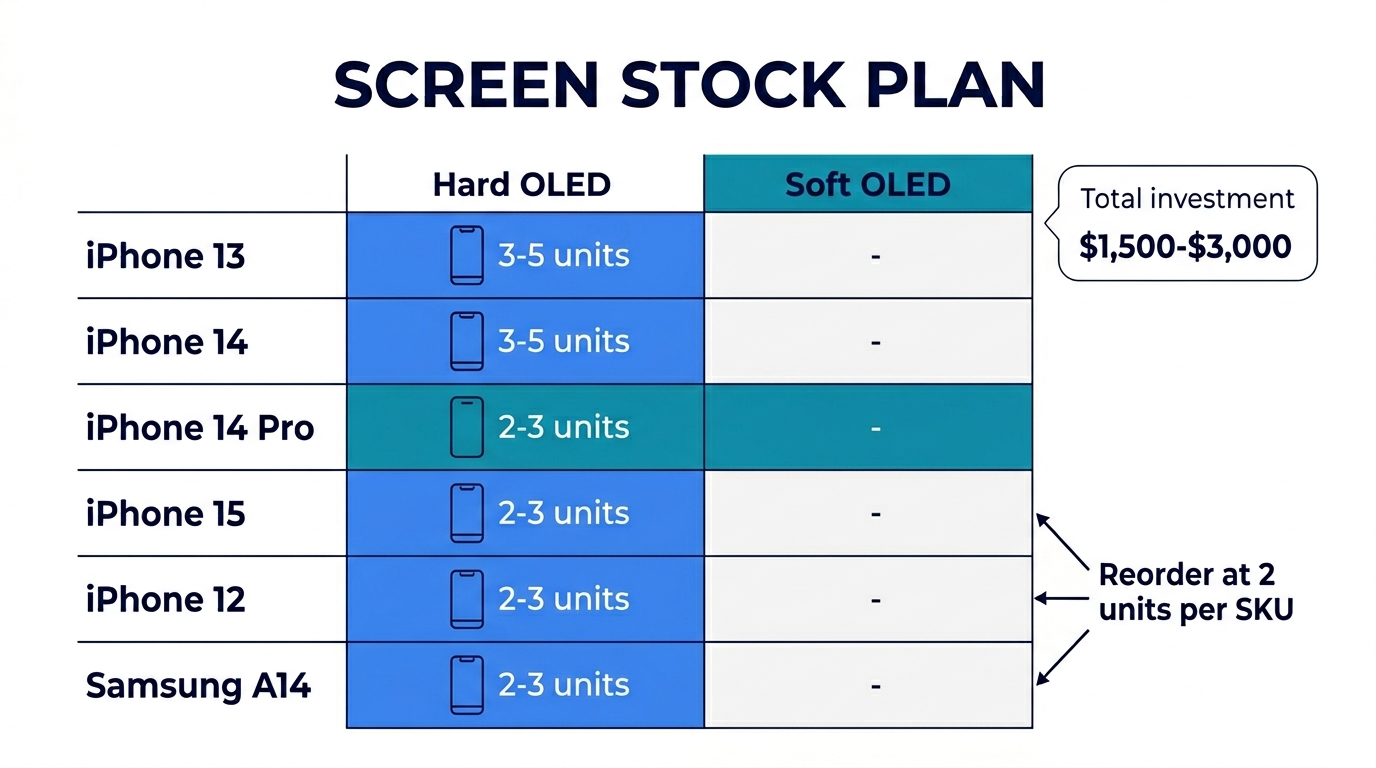
Screens are still the most common repair and the most expensive inventory item. Getting the model/grade mix right here has the biggest impact on your cash flow.
What to Stock
For a small shop doing 15–30 screen repairs per week:
| Model | Grade to Stock | Quantity | Why |
|---|---|---|---|
| iPhone 13 | Hard OLED + Soft OLED | 3–5 each | Highest volume, proven demand |
| iPhone 14 | Hard OLED | 3–5 | Standard model, 60Hz — Hard OLED is sufficient |
| iPhone 14 Pro / Pro Max | Soft OLED only | 2–3 each | Must support 120Hz ProMotion |
| iPhone 15 | Hard OLED | 2–3 | Growing volume as warranties expire |
| iPhone 15 Pro / Pro Max | Soft OLED only | 1–2 each | Lower volume but high margin |
| iPhone 12 | Hard OLED | 2–3 | Still common, declining |
| Samsung Galaxy A14/A15 | LCD | 2–3 | Budget phones, high repair volume |
| Samsung Galaxy S23/S24 | OLED | 1–2 | Order on-demand for Ultra models |
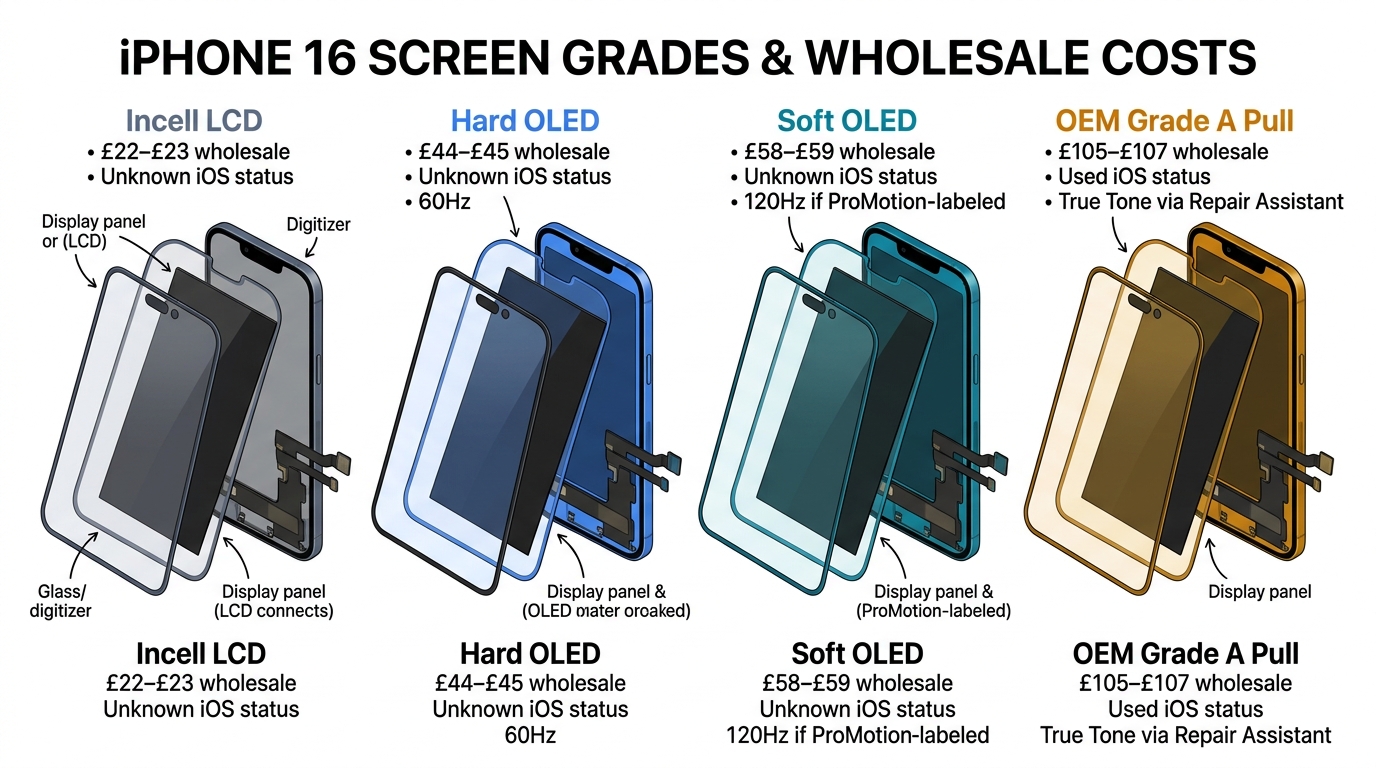
See the full four-grade comparison with live wholesale prices: iPhone Screen Grade Guide
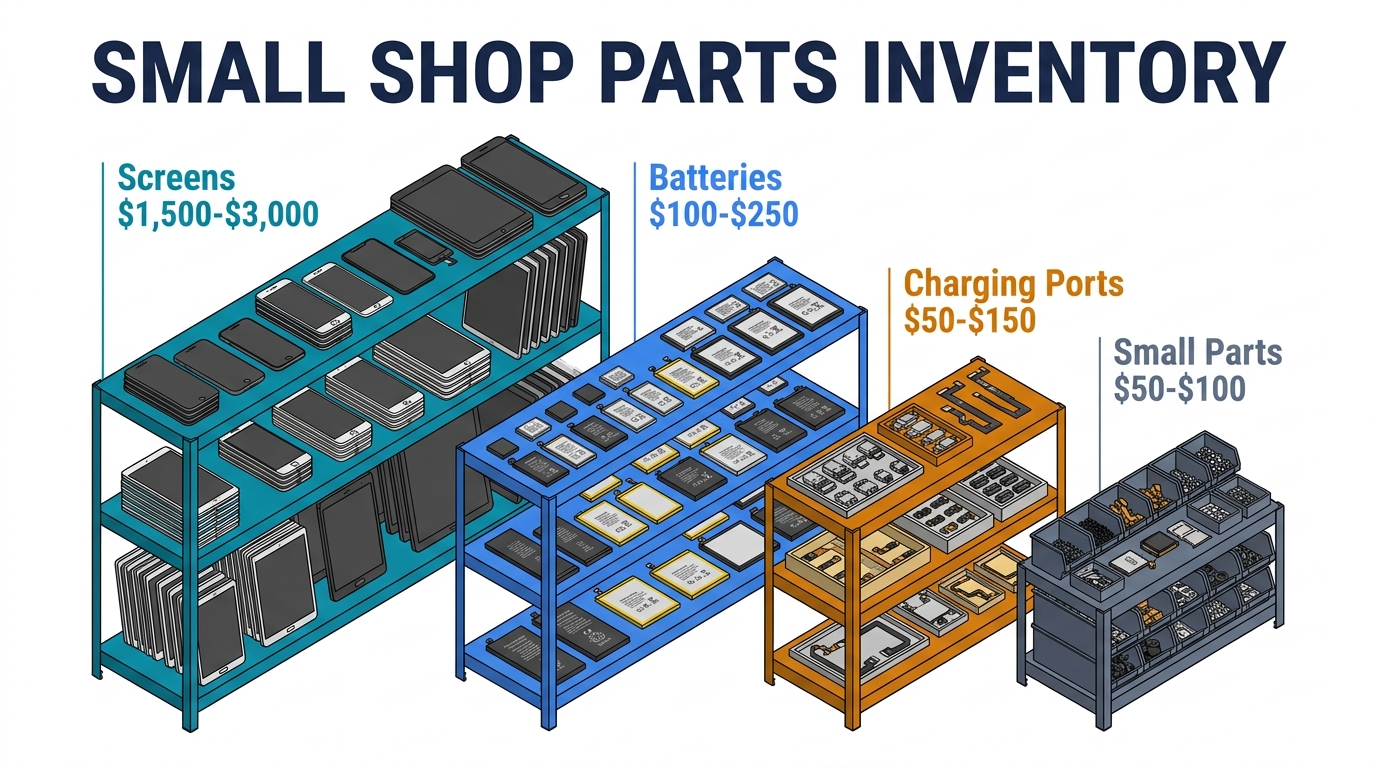
Total screen investment: Roughly $1,500–$3,000 for initial stock, depending on grade mix.
Key principle: Stock mid-tier grades (Hard OLED) for standard models and premium grades (Soft OLED) for Pro models. Keep Incell LCD only if you specifically serve budget customers. For a detailed breakdown of grade selection by model, see our guides on iPhone 13 screen grade economics and iPhone 14 screen grade selection.
For guidance on which specific screen models to prioritise for bulk ordering, see our best phone screen models to stock in bulk guide.
Reorder Strategy
Don't wait until you're out of stock. Set a reorder point at 2 units per model/grade combination. When you drop below 2, place your next order. This gives you a buffer for walk-in demand while the new shipment arrives (typically 3–7 days for domestic suppliers, 10–20 days for direct-from-China orders).
Category 2: Batteries — The Fastest-Growing Repair Category
Battery replacements are growing faster than any other repair category. As the iPhone 12 and 13 generations age past their third year, battery health drops below the 80% threshold and customers start looking for replacements.
What to Stock
| Model | Quality Tier | Quantity | Notes |
|---|---|---|---|
| iPhone 12 | Mid-range | 3–5 | High demand, phone is 4+ years old |
| iPhone 13 | Mid-range + Premium | 3–4 each | Peak battery replacement age |
| iPhone 14 | Premium | 2–3 | Entering battery replacement cycle |
| iPhone 11 | Budget or Mid | 2–3 | Declining volume but still common |
| Samsung Galaxy S22/S23 | Standard | 1–2 each | Lower volume than iPhone |
Total battery investment: Roughly $100–$250 for initial stock — batteries are cheap.
Key principle: Stock at least two quality tiers (mid-range and premium) so you can offer customers a choice. The wholesale cost difference between tiers is only $3–$7 per unit, but the customer price difference is $15–$25, making tiered pricing an easy margin booster. For detailed guidance on battery quality tiers, see our iPhone battery quality guide for repair shops.
Category 3: Charging Ports — Low Cost, High Margin
Charging port flex assemblies are cheap to stock and produce excellent margins. Every small shop should carry the most common models.
What to Stock
| Model | Quantity | Wholesale Cost | Notes |
|---|---|---|---|
| iPhone 12 | 2–3 | $5–$10 | Common charging issues at 4+ years |
| iPhone 13 | 2–3 | $6–$12 | Entering charging port failure age |
| iPhone 14 | 1–2 | $8–$15 | Lower volume but growing |
| iPhone 11 | 1–2 | $4–$8 | Still in rotation |
| iPhone 15 (USB-C) | 1–2 | $10–$18 | Newer, fewer failures — stock light |
Total investment: $50–$150. Charging port parts are the cheapest inventory category.
For diagnostic guidance on when a charging port actually needs replacement (vs. just a cleaning), see our iPhone charging port replacement guide.
Category 4: Back Glass, Cameras, and Other Parts
These are lower-volume repairs that most small shops should order on-demand rather than keeping in stock.
Back Glass
iPhone back glass replacement has grown significantly since iPhone 12 introduced MagSafe. Aftermarket back glass panels with pre-installed adhesive cost $5–$15 wholesale. Stock 1–2 units of your highest-demand model (usually iPhone 13 or 14) and order the rest on-demand. The repair charges $60–$120 with strong margins.
Cameras
Rear camera module replacements are occasional repairs. Camera parts are model-specific and range from $15–$60 wholesale. Unless you see regular camera repair demand, order these on-demand. Keep one iPhone 13 rear camera module in stock if you want to offer same-day camera repairs — it's the most commonly requested model.
Small Parts and Consumables
These are the parts you go through constantly and should always have on hand:
- Adhesive strips (battery and screen) — $0.50–$1.50 each, keep 20+ in stock
- Pentalobe and tri-point screws — keep spares, they're easy to lose
- Screen protectors (tempered glass) — $1–$3 wholesale, sell for $10–$20. Easy upsell on every screen repair
- Battery pull tabs — $0.20 each, stock 50+
- Waterproof gaskets (for iPhone 12+) — $0.50–$1 each, stock by model
- Display adhesive — $0.50–$1 per set
- Isopropyl alcohol (99%) — for cleaning connectors and removing adhesive residue
Total small parts investment: $50–$100. This is the category where running out costs you time and professionalism.
How Much Cash Should a Small Shop Tie Up in Inventory?
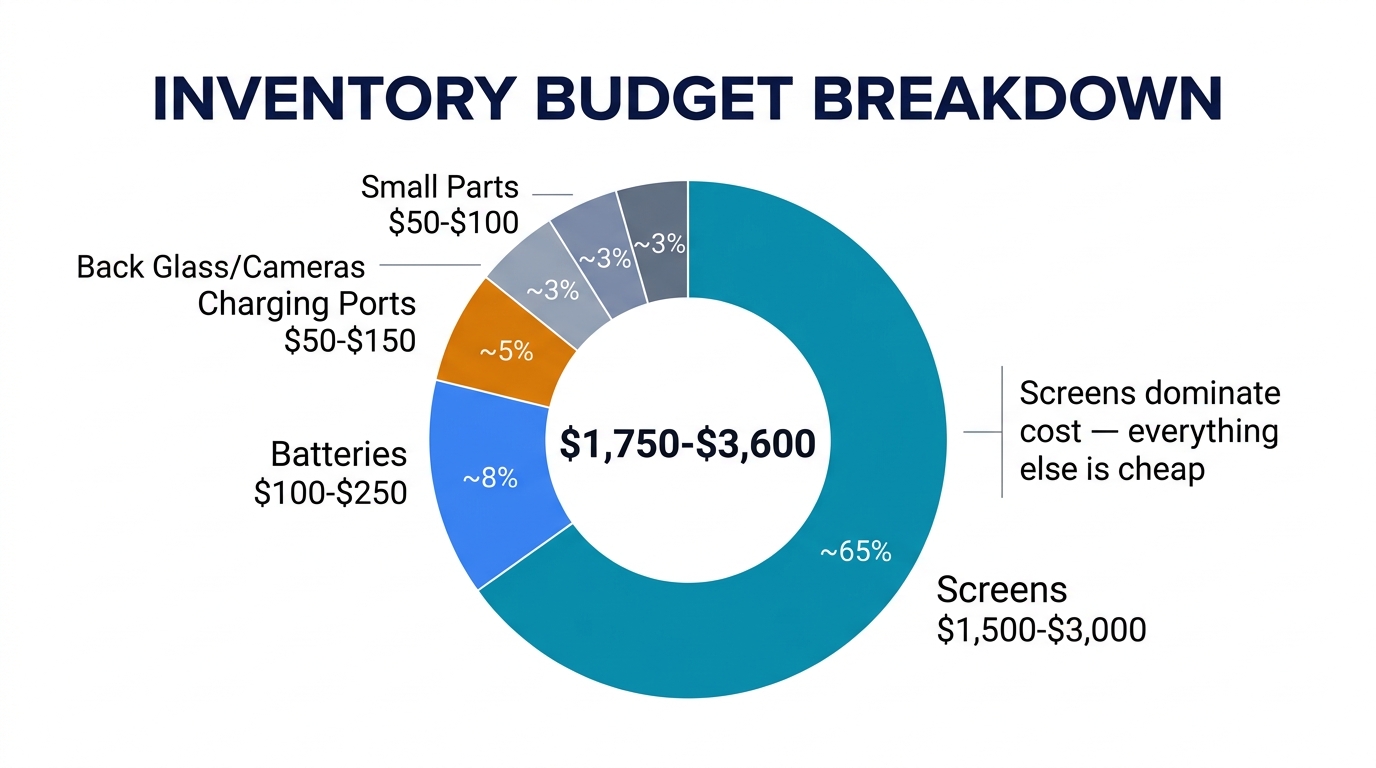
Here's a realistic budget breakdown for a small shop (15–30 repairs/week):
| Category | Initial Stock Investment | Restock Frequency |
|---|---|---|
| Screens | $1,500–$3,000 | Weekly or bi-weekly |
| Batteries | $100–$250 | Monthly |
| Charging ports | $50–$150 | Monthly |
| Back glass / cameras | $50–$100 | On-demand + small buffer |
| Small parts / consumables | $50–$100 | Monthly |
| Total | $1,750–$3,600 | — |
That's a total inventory investment of roughly $2,000–$3,500 to cover 90%+ of walk-in repair demand. The screens dominate the cost — everything else is relatively cheap.
Cash Flow Management
- Don't overbuy. It's tempting to order 20 units of a popular screen to get a bulk discount. But if those screens sit on the shelf for 3 months, the discount is cancelled out by the cash you couldn't use elsewhere.
- Match order size to your weekly volume. If you do 5 iPhone 13 screen repairs per week, ordering 10 units every two weeks keeps stock fresh without over-committing.
- Track dead stock. If a part hasn't moved in 30 days, it's tying up cash. Consider dropping the reorder quantity or switching to on-demand for that model.
- Negotiate payment terms. Some wholesale suppliers offer net-15 or net-30 payment terms for established accounts. This means you can sell the part before you pay for it — the best possible cash flow position.
For more on wholesale ordering strategies, see our cell phone parts wholesale sourcing guide.
Common Cell Phone Repair Parts Inventory Mistakes
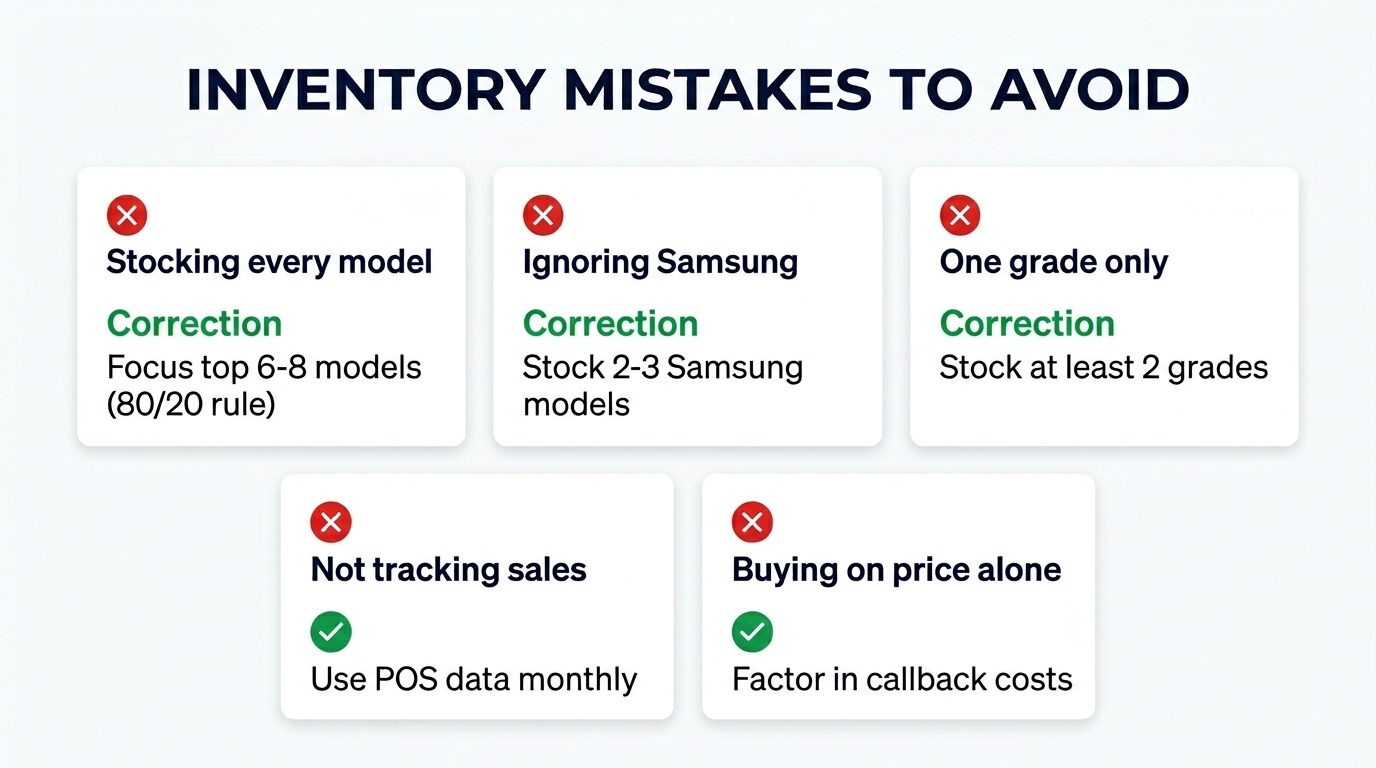
Stocking Every iPhone Model
You don't need screens for iPhone 8 through iPhone 16 Pro Max. That's 20+ SKUs per grade. Focus on the 6–8 models that cover 80% of your repairs. Order everything else on-demand.
Ignoring Samsung and Android
In many markets, Samsung repairs make up 15–25% of walk-in traffic. Completely ignoring Android means turning away revenue. Stock screens and batteries for the 2–3 most common Samsung models in your area — usually Galaxy A14/A15 (budget) and Galaxy S23/S24 (flagship).
Only Stocking One Screen Grade
Offering only Incell (cheapest) limits your revenue per repair. Offering only Soft OLED (premium) prices out budget customers. Stock at least two grades for your highest-volume models. The price difference gives customers a choice and lets you serve both segments.
Not Tracking What Sells
Keep a simple spreadsheet or use your POS system to track which parts you sell each week. After one month, the data tells you exactly what to stock more of and what to cut. Gut feeling is less reliable than actual sales data.
Buying Only on Price
The cheapest parts aren't always the most profitable. A $15 Incell screen that generates a callback costs you more than a $45 Hard OLED that the customer never brings back. Factor in callback rates, labour cost of redoing repairs, and the reputation damage from unhappy customers. When evaluating cell phone repair parts suppliers, quality consistency matters more than the lowest per-unit price.
For a complete comparison of screen quality grades and their impact on profitability, see our Soft OLED vs Hard OLED vs Incell guide.
Forgetting Seasonal Patterns
Repair volume isn't flat throughout the year. Expect spikes after new iPhone launches (September–October, when older models get handed down and dropped), during holidays (November–December, when gifted phones get broken), and after summer (phones exposed to water, sand, and heat). Increase your screen stock by 20–30% before these periods to avoid running out during peak demand.
Building your first parts inventory — or optimising an existing one? We supply screens, batteries, and charging ports for the most in-demand iPhone and Samsung models, with no single-model MOQ — mix models and categories to reach the 10-piece order minimum. Request a quote with your top 10 models and we'll put together a starter package.
Frequently Asked Questions
How much inventory should a new phone repair shop start with?
Start with $1,500–$2,500 covering screens, batteries, and charging ports for your top 6–8 models. Focus on iPhone 12 through 15 and 1–2 Samsung models. Expand inventory based on actual demand data after your first month. Over-investing in stock before you know your local repair mix is the most common cash flow mistake for new shops.
Which phone models generate the most repair revenue in 2026?
iPhone 13 and iPhone 14 series generate the highest combined volume and revenue for most repair shops. The iPhone 13 has the highest volume (it's the most popular phone in the repair cycle). The iPhone 14 Pro Max generates the highest per-repair margin due to premium screen pricing. Samsung Galaxy A14/A15 are high-volume but lower-margin repairs.
Should I stock Samsung parts or just focus on iPhone?
Stock Samsung if your area has demand. In most Western markets, Samsung represents 15–25% of repair traffic. Carrying screens and batteries for 2–3 Samsung models (one budget like A14/A15, one flagship like S23/S24) captures this revenue without excessive inventory investment. If your first month shows fewer than 2 Samsung repairs per week, switch to on-demand ordering.
How do I avoid dead stock in my repair shop?
Set a 30-day rule: if a specific part hasn't sold in 30 days, reduce your reorder quantity or switch to on-demand. Track sales by model and grade weekly. Start with small quantities (2–3 units) for new models and increase based on actual demand. Avoid large bulk orders for models you haven't yet validated with your customer base.
Where should small repair shops buy cell phone repair parts?
Source from wholesale suppliers who offer small MOQ (10–25 units), consistent quality, and responsive support. Avoid random marketplace sellers — quality varies wildly. Key factors: do they test parts before shipping? Do they offer returns for defective units? Can they supply multiple quality grades? For a detailed supplier evaluation framework, see our how to choose a phone parts supplier guide.
Start Lean, Stock Smart, Scale With Data
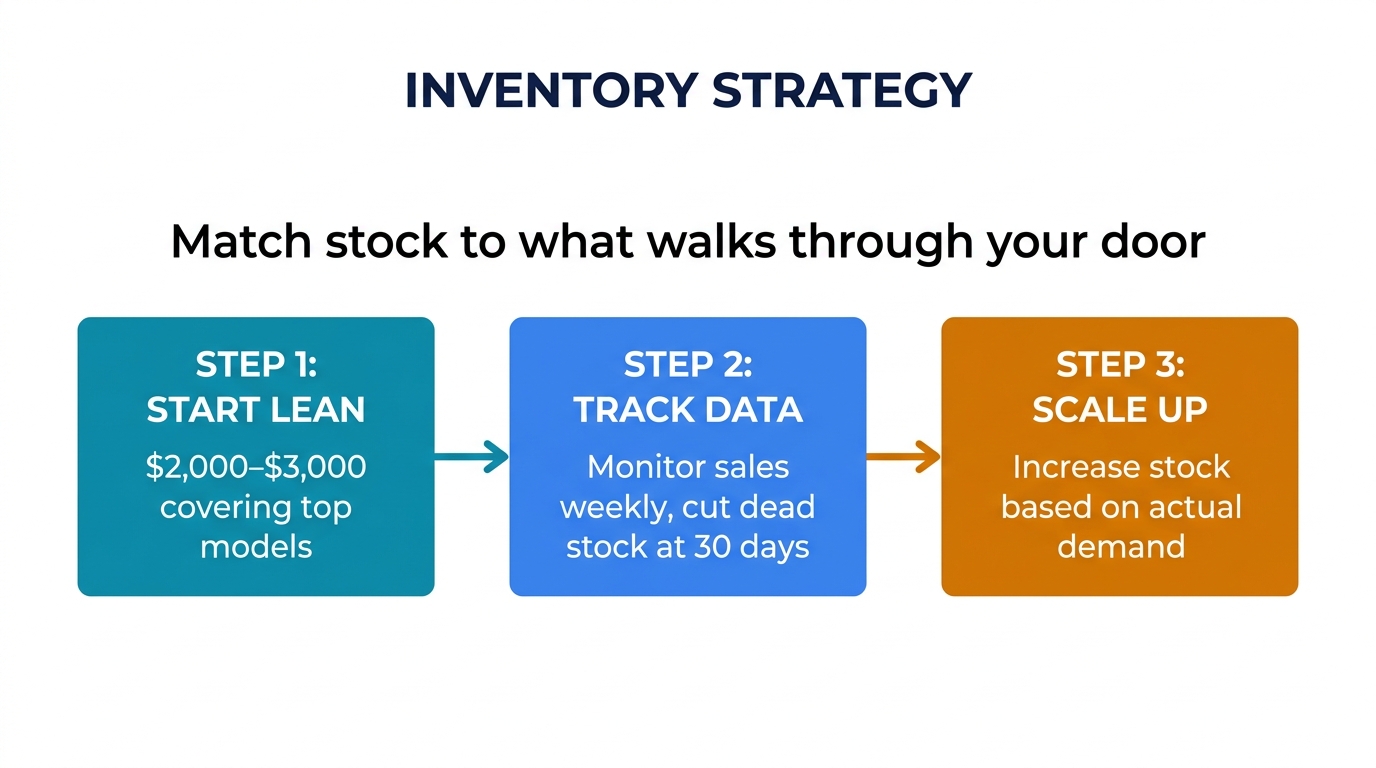
The best inventory strategy for a small repair shop is simple: stock your top models across three categories (screens, batteries, charging ports), keep quantities low enough to maintain cash flow, and let actual sales data drive your restock decisions. A $2,000–$3,000 initial investment covers 90% of walk-in demand without overcommitting.
The most profitable shops aren't the ones with the biggest inventory — they're the ones that match their stock to what actually walks through the door.
Need a parts supplier who works with small shops? We apply no single-model MOQ (a mixed order that includes screens qualifies at 10 pieces; battery-only or small-parts-only orders start at 20), stock multiple quality grades, and quote your model list within 24 hours so you can test before committing. Get wholesale pricing for your specific model list.