
Which Phone Screen Models Should Repair Shops Stock in Bulk in 2026?
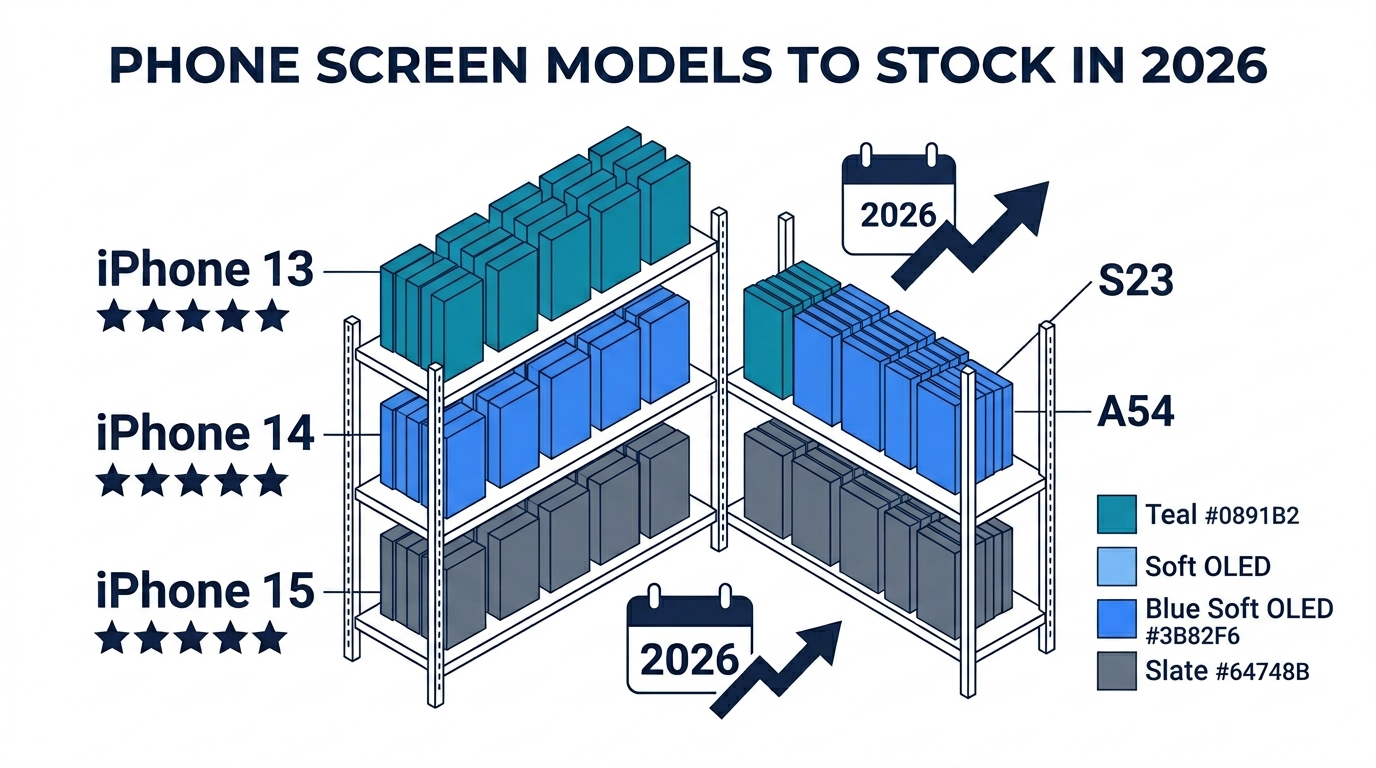
Choosing the right phone screen models wholesale 2026 inventory is the difference between fast-turning stock and cash sitting on a shelf. A repair shop that stocks the wrong models ties up thousands of dollars in screens that move once a month — while running out of the screens customers actually need.
This guide breaks down which iPhone and Samsung screen models are worth stocking in bulk right now, which ones are declining in demand, and how to build an inventory strategy that matches your repair volume without overcommitting capital.
Sourcing Replacement Screens in Bulk?
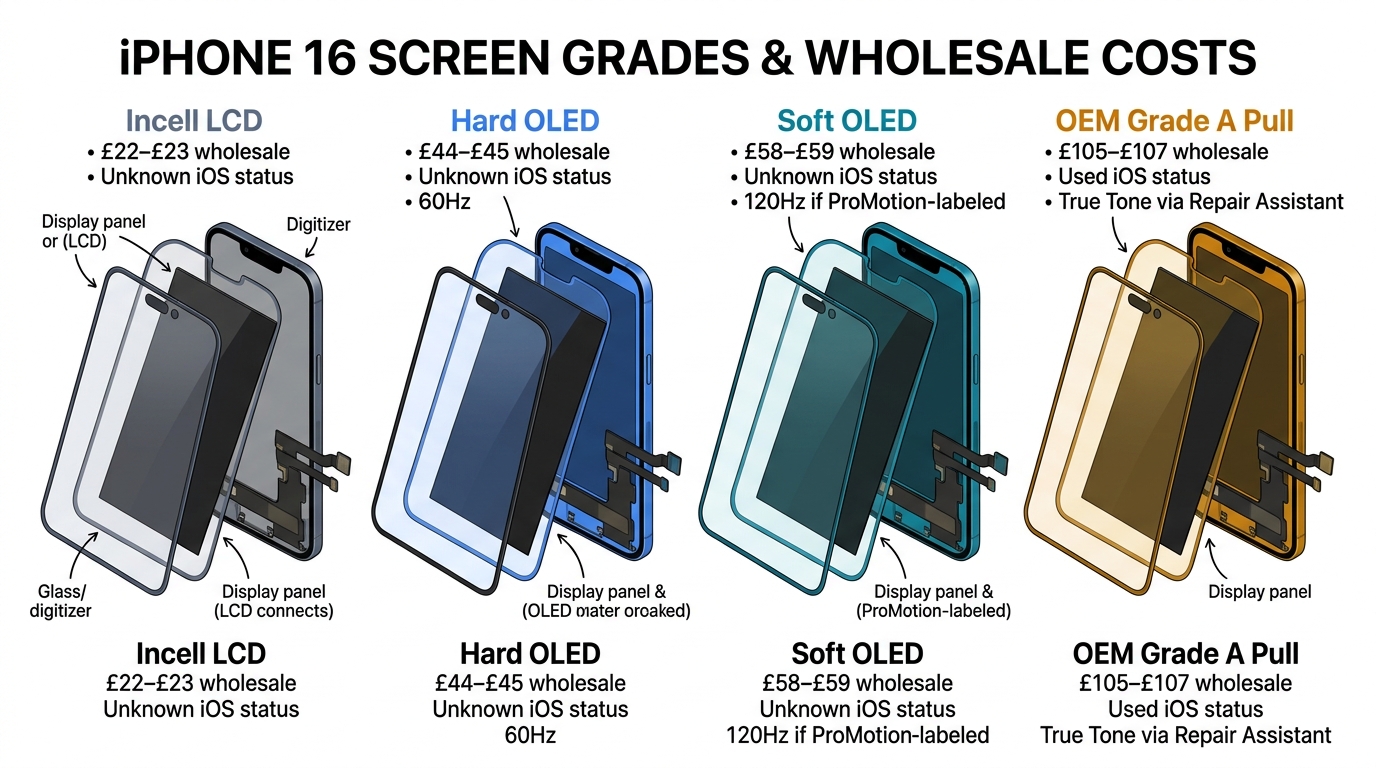
Incell / Hard OLED / Soft OLED grades — wholesale pricing, grade comparison on request.
Get Wholesale QuoteHow to Decide Which Screens to Stock: The 3 Factors
Before jumping to specific models, understand the three factors that drive screen repair demand:
1. Installed base size. A phone that sold 80 million units has more screens to break than one that sold 20 million. iPhones from 2–3 years ago have the largest active installed base — they're past the warranty period but still in heavy daily use.
2. Screen fragility and repair economics. Phones with all-glass designs and thinner bezels break more often. And repair only makes sense when the repair cost is significantly less than the phone's current value. A $150 screen repair on a phone worth $400 makes sense. The same repair on a phone worth $150 doesn't.
3. Aftermarket parts availability and margin. Some models have mature aftermarket supply chains with multiple screen grades at competitive prices. Others — especially very new models — have limited supply, higher costs, and lower margins.
The sweet spot for stocking is models that score high on all three: large installed base, reasonable repair economics, and a well-supplied aftermarket.
Top Phone Screen Models Wholesale 2026: iPhone Priority List
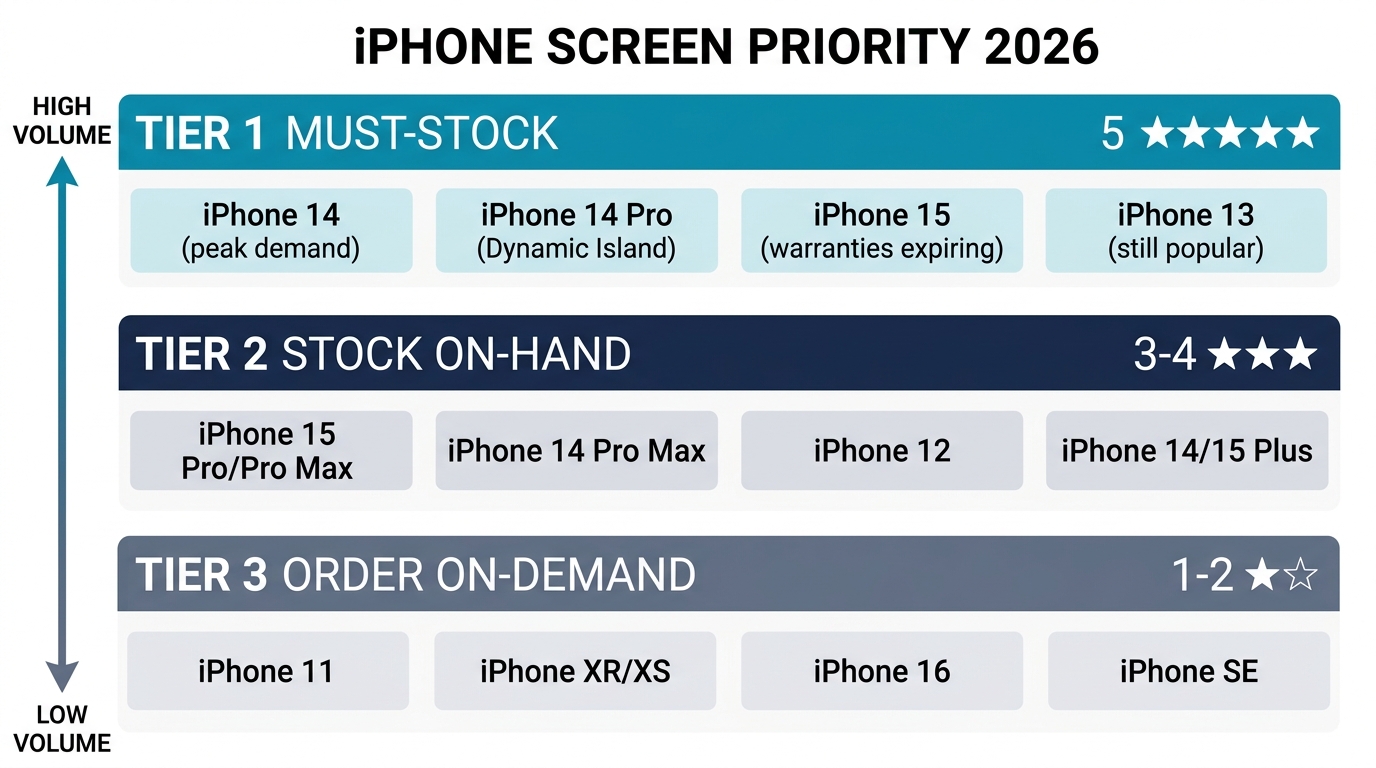
iPhone screen repairs account for 60–70% of revenue at most repair shops in the US and UK. Here's the model-by-model breakdown for 2026:
Tier 1: Must-Stock (High Volume, Strong Margins)
| Model | Screen Type | Why Stock It | Recommended Grade | Stock Priority |
|---|---|---|---|---|
| iPhone 14 | OLED 6.1" | Massive installed base, peak repair demand in 2026 | Incell + Soft OLED | ★★★★★ |
| iPhone 14 Pro | OLED 6.1" (ProMotion) | Dynamic Island models still under heavy use | Soft OLED | ★★★★★ |
| iPhone 15 | OLED 6.1" | Growing repair volume as warranties expire | Incell + Soft OLED | ★★★★★ |
| iPhone 13 | OLED 6.1" | Still hugely popular, entering peak repair window | Incell + Soft OLED | ★★★★☆ |
See the full four-grade comparison with live wholesale prices: iPhone Screen Grade Guide
These four models will generate the bulk of your iPhone screen repair revenue in 2026. Stock them in both Incell (for budget repairs) and Soft OLED (for premium repairs).
Why iPhone 14 is the top pick: Released in September 2022, the iPhone 14 is now 3.5 years old — the prime window where warranties have expired, the phone is still worth repairing, and screen breakage has accumulated across millions of users. It's the highest-volume iPhone repair model of 2026.
Tier 2: Stock On-Hand (Steady Demand)
| Model | Screen Type | Why Stock It | Recommended Grade | Stock Priority |
|---|---|---|---|---|
| iPhone 15 Pro / Pro Max | OLED 6.1" / 6.7" | High-value repairs, customers expect premium | Soft OLED | ★★★★☆ |
| iPhone 14 Pro Max | OLED 6.7" | Pro Max users invest in repairs due to phone value | Soft OLED | ★★★☆☆ |
| iPhone 12 | OLED 6.1" | Declining but still significant volume | Incell | ★★★☆☆ |
| iPhone 14 Plus / 15 Plus | OLED 6.7" | Plus models have growing market share | Soft OLED | ★★★☆☆ |
Tier 3: Order On-Demand (Low Volume, Keep Minimal Stock)
| Model | Notes |
|---|---|
| iPhone 11 | LCD model, cheap repairs but declining demand. Stock 5–10 if you still see regular requests |
| iPhone XR / XS | End of lifecycle for most markets. Order as needed |
| iPhone 16 / 16 Pro | Too new — most are under warranty, aftermarket supply limited and expensive. Stock only if you see specific demand |
| iPhone SE (2nd/3rd gen) | Low repair value, customers often replace instead of repair |
For a complete breakdown of iPhone screen grades and pricing by model, see our wholesale iPhone screens pricing guide.
Samsung Screens to Stock in 2026
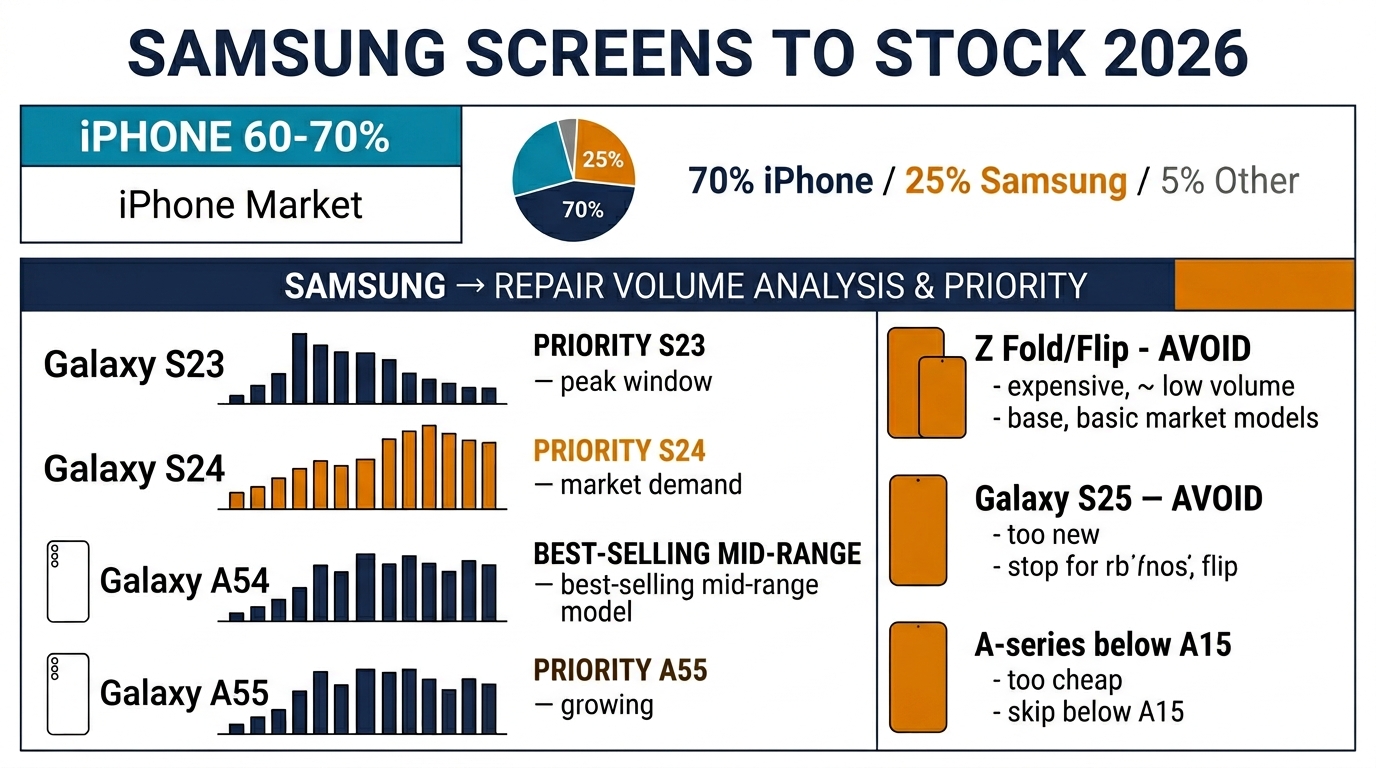
Samsung screen repairs make up 15–25% of most US/UK repair shops' volume. Samsung margins are trickier — original AMOLED panels are expensive, and the aftermarket offers fewer grade options compared to iPhone.
Priority Samsung Models
| Model | Screen Type | Why Stock It | Notes |
|---|---|---|---|
| Galaxy S23 / S23+ | AMOLED 6.1" / 6.6" | Peak repair window in 2026 | Aftermarket OLED available |
| Galaxy S24 / S24+ | AMOLED 6.2" / 6.7" | Growing volume as warranties expire | Limited aftermarket, stock original refurbished |
| Galaxy A54 / A55 | AMOLED 6.4" / 6.6" | Samsung's best-selling mid-range globally | Affordable aftermarket screens |
| Galaxy S22 / S22+ | AMOLED 6.1" / 6.6" | Still steady demand, declining through 2026 | Good aftermarket supply |
| Galaxy A15 / A25 | LCD/AMOLED 6.5" | Very high volume in developing markets | Ultra-low-cost aftermarket |
Samsung Models to Avoid Stocking
- Galaxy Z Fold / Z Flip series: Extremely expensive screens ($300+), very low repair volume, and complex installation. Order only on specific customer request.
- Galaxy S25 series: Too new for significant repair volume. Aftermarket supply hasn't matured.
- Galaxy A-series below A15: Phones are too cheap to justify repair for most customers.
Samsung vs. iPhone: A Margin Comparison
Samsung screen repairs typically offer lower margins than iPhone repairs because:
- Samsung original AMOLED panels cost more relative to the repair price customers expect
- Aftermarket Samsung OLED quality is less consistent than aftermarket iPhone OLED
- Samsung phones depreciate faster, narrowing the window where repair makes economic sense
For most repair shops, Samsung screens should be 20–30% of your screen inventory — matching the proportion of Samsung repairs you actually do.
Samsung Screen Grade Strategy
Unlike iPhone screens where you have clear Incell/Hard OLED/Soft OLED tiers, Samsung aftermarket grades are less standardized. Here's what works:
- Galaxy S-series (S22, S23, S24): Stock original refurbished AMOLED panels when possible. Aftermarket Samsung OLED quality varies more than iPhone aftermarket, and S-series customers expect premium displays. The price difference between a mediocre aftermarket and a good refurbished original is $10–15 per unit — worth it for customer satisfaction.
- Galaxy A-series (A15, A25, A54, A55): Aftermarket screens work well here. A-series customers are more price-sensitive, and the quality gap between aftermarket and original is smaller on these mid-range displays. Stock aftermarket to maximize margins.
For detailed grade comparisons across both brands, see our guide on OEM vs aftermarket phone screens.
Planning your 2026 screen inventory? We can build a custom stock list based on your repair volume and market. Tell us your top 5 repair models and we'll send a tailored quote.
Beyond iPhone and Samsung: Other Models Worth Considering
Depending on your market, these brands may deserve shelf space:
Google Pixel 7 / 8 / 8a: Growing repair demand in the US as Pixel market share increases. Aftermarket OLED screens are becoming available but supply is still limited. Stock if Pixel repairs make up more than 10% of your volume.
Xiaomi / Redmi (Note 12, 13 series): Dominant in Latin America, South Asia, and parts of Europe. If you serve these markets, Xiaomi screens are essential. Very affordable aftermarket supply from China.
Huawei (P-series, Nova series): Relevant mainly in Europe, Middle East, and Africa. Aftermarket screens widely available at low cost.
OnePlus (11, 12): Niche but loyal customer base. Stock if you see consistent demand — don't speculate.
Building Your Phone Screen Models Wholesale 2026 Inventory Plan
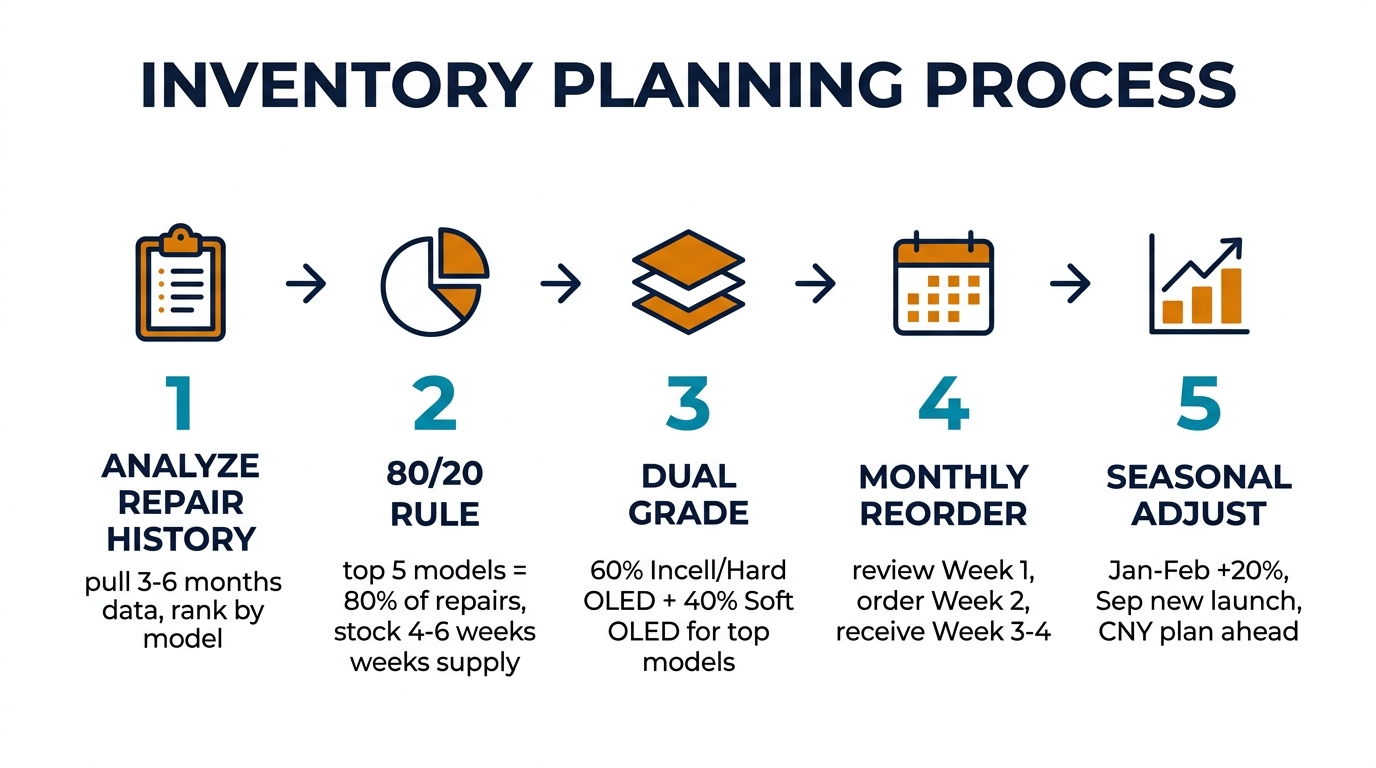
Here's a practical framework for deciding quantities:
Step 1: Analyze Your Repair History
Pull your repair records from the last 3–6 months. Count repairs by phone model and rank them. Your top 5 models likely account for 70–80% of all screen repairs. This is your must-stock list.
Step 2: Apply the 80/20 Rule to Inventory
- Top 5 models (80% of repairs): Stock 4–6 weeks of supply based on average monthly repair volume
- Models 6–10 (15% of repairs): Stock 2–3 weeks of supply
- Everything else (5% of repairs): Don't stock. Order on-demand from a supplier with fast shipping
Step 3: Dual-Grade Stocking for High-Volume Models
For your top 3 iPhone models, stock two grades:
- 60% Incell / Hard OLED: For budget-conscious customers ($60–90 repair range)
- 40% Soft OLED: For customers who want near-original quality ($100–150 repair range)
This two-tier approach maximizes revenue per customer. Instead of turning away customers who think your price is too high, offer them a choice. Our guide on OEM vs aftermarket phone screens explains the grade differences in detail.
Step 4: Monthly Reorder Cycle
Don't order 3 months of inventory at once. Monthly orders keep your cash flow healthy and let you adjust based on actual demand:
- Week 1: Review last month's repair count by model
- Week 2: Place order to replenish stock to target levels
- Week 3–4: Receive and QC the shipment (see our incoming QC guide)
For a detailed guide on negotiating order quantities, see our article on MOQ, sample orders, and lead time.
Step 5: Seasonal Adjustments
Phone screen repair demand isn't flat year-round:
- Post-holiday spike (January–February): New phones received as gifts start breaking. Also, people drop phones more in winter (cold fingers, gloves, icy conditions). Increase stock by 15–20%.
- Back-to-school (August–September): Students prepping devices. Moderate demand increase.
- New iPhone launch (September): Temporary dip in older iPhone repairs as some users upgrade. But within 2–3 months, the new model starts generating repair demand.
- Pre-Chinese New Year (January): If ordering from China, place your February order by mid-January. The supply chain goes quiet for 2–4 weeks during CNY.
Common Inventory Mistakes to Avoid
Stocking too many models: A shop stocking screens for 20 iPhone models and 15 Samsung models has too much capital in slow-moving inventory. Focus on 8–10 models that cover 90% of your repairs.
Ignoring grade mix: Stocking only Incell screens means losing premium repair customers. Stocking only Soft OLED means pricing out budget customers. Two grades per top model is the right balance.
Ordering based on supplier deals, not demand: A "great price" on 200 iPhone 11 screens is worthless if you only repair 5 iPhone 11s per month. That's 40 months of inventory. Order based on your repair data, not on supplier promotions.
Not tracking slow-moving stock: If a screen has been on your shelf for 60+ days, it's tying up cash. Mark it down, sell it to another shop, or adjust your next order. Screens don't improve with age — some grades develop storage-related issues (adhesive degradation, yellowing) after 6+ months.
Buying the newest models too early: iPhone 16 and Samsung S25 screens are tempting because repair prices are high. But the math doesn't work yet — aftermarket supply is limited, prices are inflated, and most units are still under warranty. Wait until aftermarket supply matures (typically 12–18 months after launch) before stocking in quantity. Until then, keep 2–3 units on hand for emergency walk-ins and order the rest on-demand.
Frequently Asked Questions
How many screen models should a typical repair shop stock?
Focus on 8–12 models that cover 90% of your repair demand. For most US/UK shops in 2026, that means 5–6 iPhone models (13, 14, 14 Pro, 15, 15 Pro, 15 Pro Max) and 3–4 Samsung models (S23, S24, A54). Stocking more than 15 models usually means slow-moving inventory on the long tail. Order rare models on-demand instead.
Is it worth stocking screens for the iPhone 16 series in 2026?
Not in bulk — yet. The iPhone 16 launched in September 2025 and most units are still under warranty or AppleCare. Aftermarket screen supply is limited and prices are high. Keep 2–3 units on hand for walk-in emergencies, but don't invest heavily until late 2026 when warranty expirations drive up demand and aftermarket supply matures.
Should I stock Samsung screens if iPhone makes up most of my repairs?
Yes, but proportionally. If Samsung represents 20% of your repairs, Samsung screens should be roughly 20% of your inventory. The A-series (A54, A55) are particularly worth stocking because they combine high volume with affordable aftermarket screens and good repair margins.
How often should I reorder screens?
Monthly reordering is the best balance between maintaining stock and preserving cash flow. Weekly ordering increases shipping costs and supplier management overhead. Quarterly ordering ties up too much capital and risks stocking models whose demand shifts. Monthly lets you adjust to actual repair trends and take advantage of consistent ordering for better supplier terms.
What's the best way to handle declining models like iPhone 11?
Gradually reduce stock as demand drops. When you're repairing fewer than 5 units per month of a specific model, stop stocking it and switch to on-demand ordering. Let your supplier know you need fast turnaround on these models — most can ship within 2–3 days for in-stock items. This frees up capital for high-demand models.
Stock Smart, Sell Fast
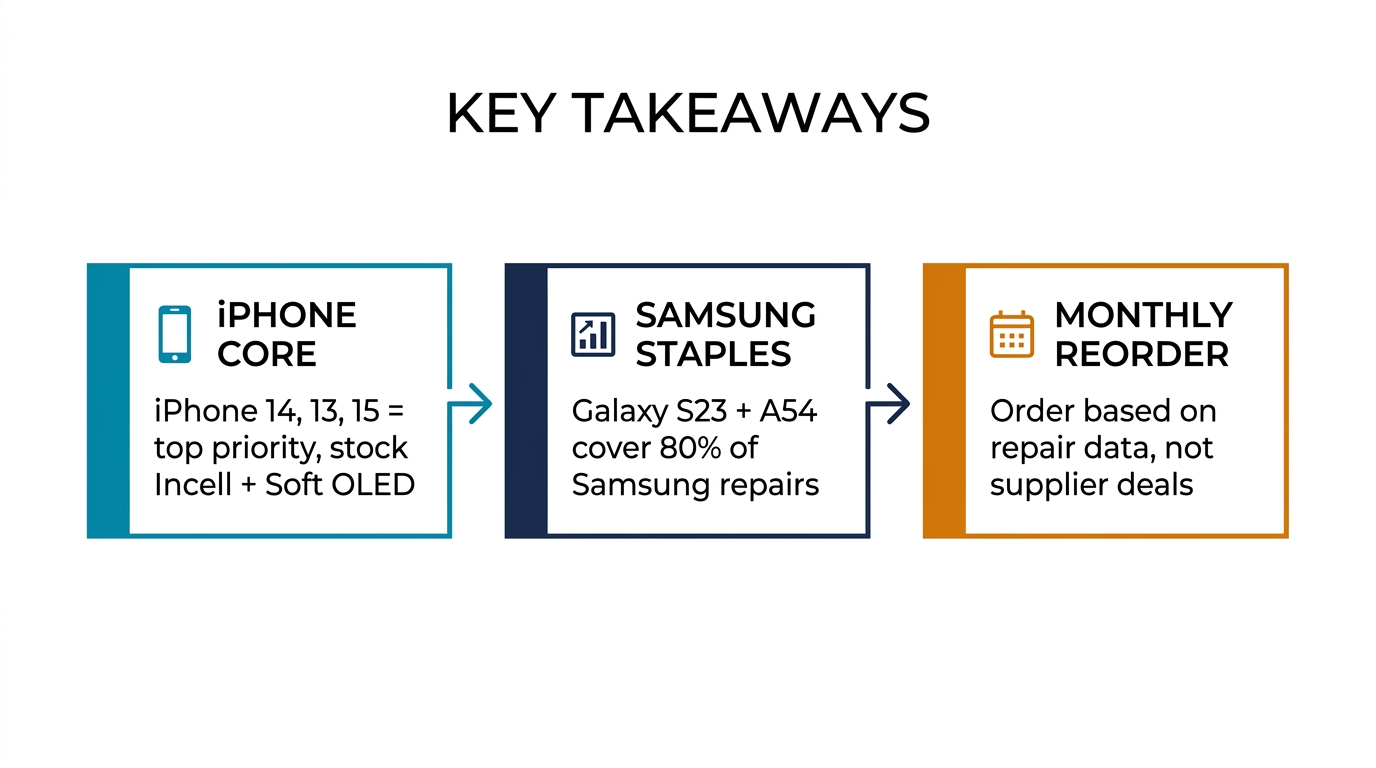
The best inventory strategy isn't about stocking everything — it's about stocking the right models at the right quantities in the right grades. In 2026, that means iPhone 14, 13, 15 as your core, Samsung S23 and A54 as your Samsung staples, and a disciplined monthly reorder cycle based on actual repair data.
Your repair records are your most valuable inventory planning tool. Use them.
Need help building your 2026 screen inventory? Send us your top repair models and we'll put together a custom stock list with pricing for each grade, MOQ options, and a suggested reorder schedule.