
iPhone 13 Screen Replacement Cost in 2026: Is It Still Worth Repairing?

The iPhone 13 launched in 2021. Five years later, it's one of the most common phones walking into repair shops — and one of the most common questions technicians hear is whether it's still worth fixing. The answer depends on numbers that most cost guides ignore: the phone's current resale value, the wholesale cost of the replacement screen, and what margin the repair actually leaves.
The iPhone 13 screen replacement cost ranges from $22 for a budget Incell LCD to $279 at Apple's out-of-warranty rate. Between those extremes sits a range of screen grades that determine whether this repair makes money — or barely breaks even. This guide breaks down the real economics of iPhone 13 screen replacement in 2026 for repair shops, technicians, and anyone deciding whether the repair is worth it.
Sourcing Replacement Screens in Bulk?
Incell / Hard OLED / Soft OLED grades — wholesale pricing, grade comparison on request.
Get Wholesale QuoteiPhone 13 Screen Replacement Cost: Every Option Compared
The price you'll pay depends entirely on who does the repair and what screen goes in. Here's the current landscape as of March 2026.
| Repair Channel | Cost Range | Screen Type Used | Warranty |
|---|---|---|---|
| Apple (Out-of-Warranty) | $279 / £389 | OEM Original | 90 days |
| Apple (AppleCare+) | $29 / £25 | OEM Original | AppleCare term |
| Third-Party Shop (Premium) | $165–$250 | Soft OLED / Hard OLED | 30–180 days |
| Third-Party Shop (Budget) | $80–$140 | Incell LCD | 30–90 days |
| DIY (iFixit Kit) | $110 | Soft OLED | Lifetime (iFixit) |
| DIY (Amazon/AliExpress) | $22–$45 | Incell LCD / Hard OLED | Varies |
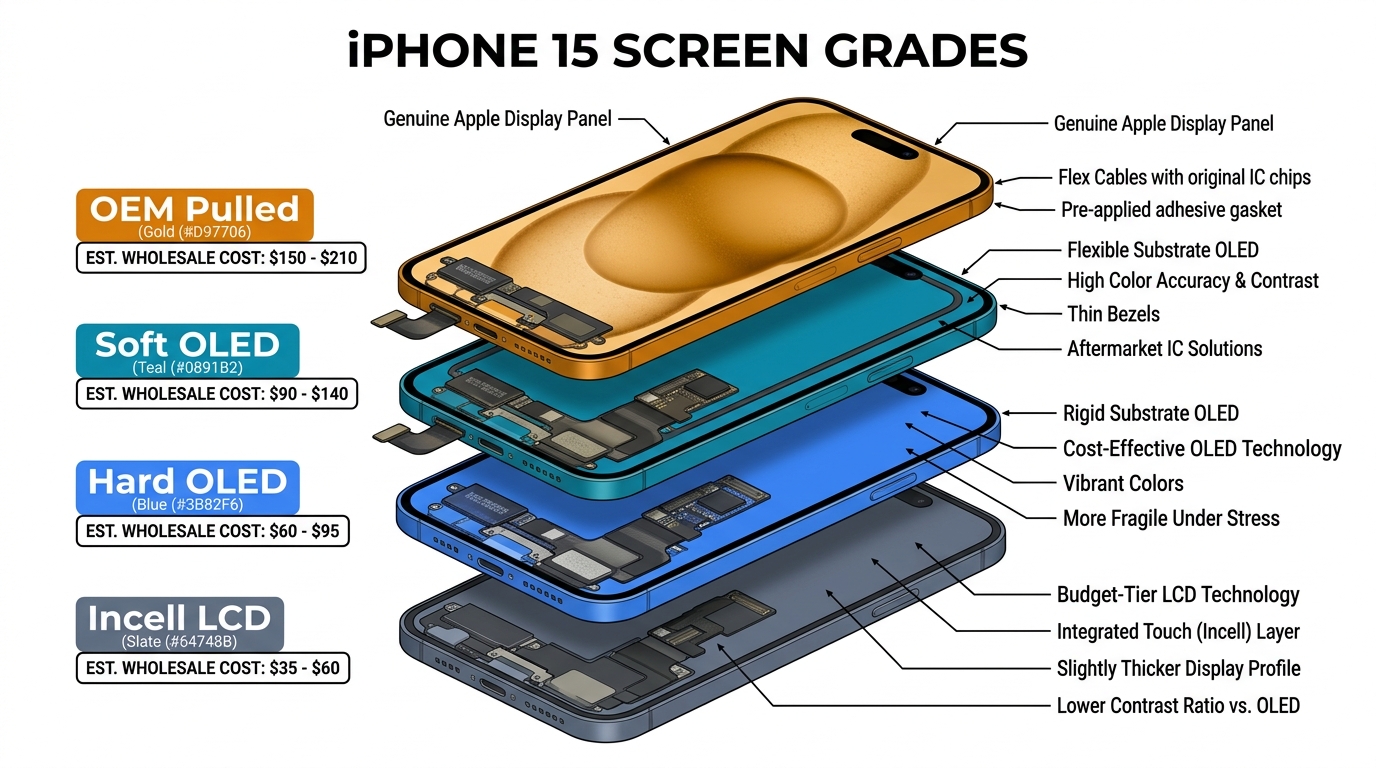
See the full four-grade comparison with live wholesale prices: iPhone Screen Grade Guide
Apple charges $279 in the US and £389 in the UK for an out-of-warranty iPhone 13 screen replacement. That price includes an OEM display with full True Tone calibration and Face ID support. For most repair shops, though, Apple's pricing is a ceiling that creates the margin opportunity.
Third-party shops — where most iPhone 13 screen replacements actually happen — charge $80–$250 depending on location and screen grade. The biggest variable is the replacement screen itself.
iPhone 13 Screen Grades: What Actually Goes Into the Phone
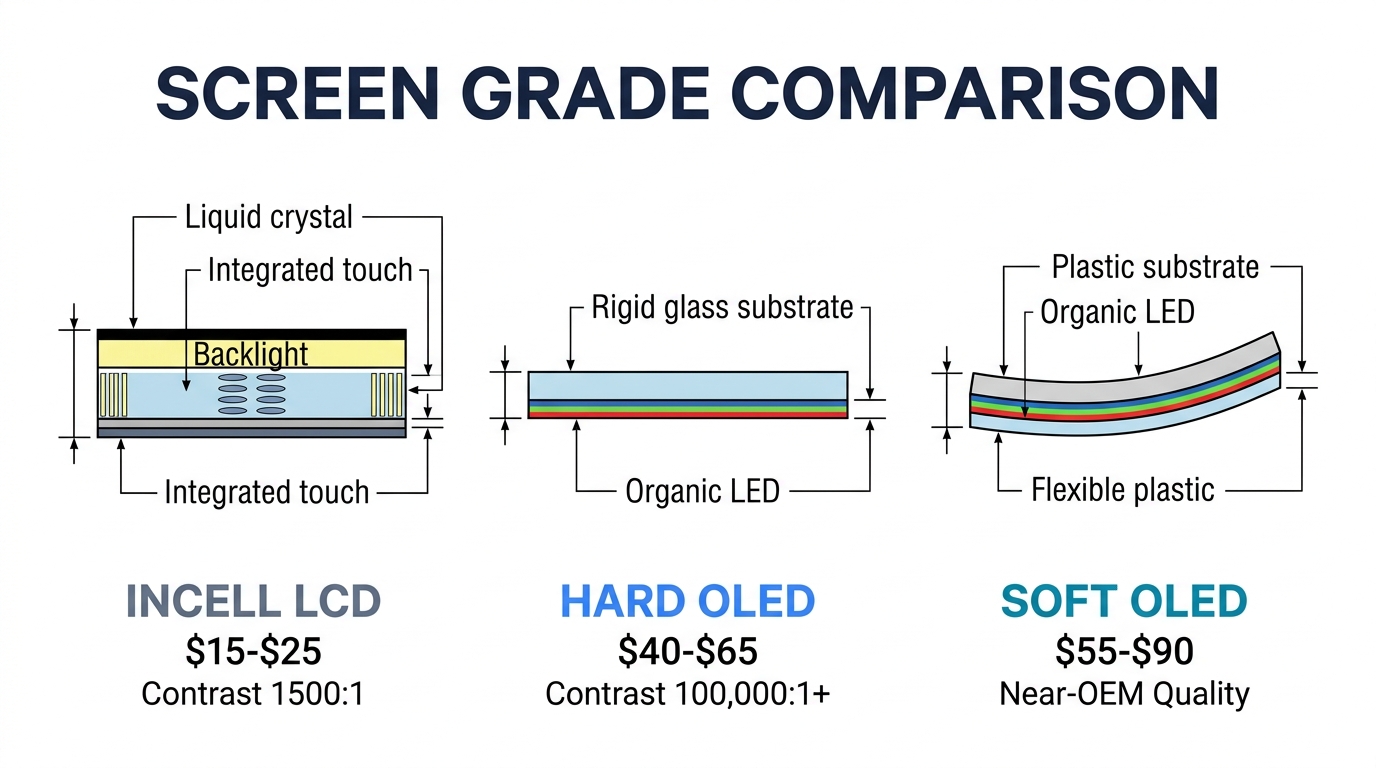
The iPhone 13 uses a 6.1-inch Super Retina XDR OLED display at 2532 × 1170 resolution with 800 nits typical brightness. When that screen cracks, the replacement doesn't have to match those exact specs — and most don't. Here's what's available on the market.
Incell LCD
Incell screens are the cheapest option. Wholesale cost runs $15–$25 per unit in bulk. The technology is fundamentally different from the original OLED — it uses a backlit LCD panel with the touch layer integrated into the liquid crystal cell.
What this means in practice: lower contrast ratio, no true blacks, slightly thicker profile, and colour temperature that's noticeably cooler than the original. The display works, touch works, but a side-by-side comparison with an original screen is obvious.
Best for: Budget-conscious end customers who just need a functional screen. Repair shops that compete on price.
Hard OLED
Hard OLED screens use an organic light-emitting diode panel on a rigid glass substrate instead of the flexible plastic used in original Apple displays. Wholesale cost is $40–$65 per unit.
Display quality is significantly better than Incell: true blacks, strong contrast, accurate colours. The main trade-off is fragility — the rigid substrate is more prone to cracking on drop impact than the original flexible OLED. Some Hard OLED panels also run slightly dimmer than the original at peak brightness.
Best for: Mid-tier repairs where the customer expects good display quality but doesn't need OEM-level specs. The sweet spot for most repair shops in terms of margin versus quality.
Soft OLED
Soft OLED screens use a flexible plastic substrate, matching the construction method of Apple's original display. Wholesale cost is $55–$90 per unit — the most expensive aftermarket option.
Display quality is near-identical to OEM: same contrast, similar brightness, accurate colour reproduction. The flexible substrate also means better drop resistance. For most customers, a quality Soft OLED replacement is indistinguishable from the original screen.
Best for: Premium repairs where the shop charges top rates and wants minimal callbacks. Also the right choice for customers who plan to keep or resell the phone.
| Screen Grade | Wholesale Cost (Bulk) | Contrast Ratio | True Blacks | Colour Accuracy | Drop Resistance |
|---|---|---|---|---|---|
| Incell LCD | $15–$25 | 1500:1 | No | Fair | Good |
| Hard OLED | $40–$65 | 100,000:1+ | Yes | Good | Lower |
| Soft OLED | $55–$90 | 100,000:1+ | Yes | Excellent | High |
| OEM Original | $150–$200 | 2,000,000:1 | Yes | Perfect | High |
For a deeper comparison of these screen technologies and how they affect wholesale pricing, see our full guide on Soft OLED vs Hard OLED vs Incell for bulk buyers.
Is the iPhone 13 Still Worth Repairing? The Numbers
This is the question that separates a smart repair from a bad one. The answer comes down to comparing three numbers: repair cost, phone residual value, and replacement cost.
iPhone 13 Residual Value in 2026
As of early 2026, a used iPhone 13 (128GB, good condition) sells for approximately:
- Trade-in to Apple: $250
- Resale (Swappa/eBay): $200–$300
- Trade-in (carrier programs): $150–$250
- Cracked screen condition: $80–$120
A working iPhone 13 is still worth $200–$300. A cracked one drops to $80–$120. That $100–$200 gap is exactly what makes screen replacement worth it — the repair restores value that significantly exceeds the repair cost.
The Repair vs. Replace Calculation
For an end user, the decision is straightforward:
| Scenario | Cost | Outcome |
|---|---|---|
| Replace with iPhone 15 | $699–$799 (after trade-in of cracked phone) | New phone |
| Repair at Apple | $279 | Same phone, OEM screen |
| Repair at third-party (Soft OLED) | $120–$180 | Same phone, near-OEM screen |
| Repair at third-party (Incell) | $80–$120 | Same phone, downgraded screen |
| Sell cracked + buy used iPhone 14 | $300–$400 net | Newer phone |
At a third-party repair price of $120–$180, screen replacement makes clear financial sense. The phone is worth $200–$300 after repair, and it extends the phone's usable life by 1–2 years. Even at Apple's $279, the math works for users who prefer OEM quality.
The break-even point: iPhone 13 screen replacement stops making financial sense when the total repair cost exceeds about 60% of the phone's post-repair value. With current pricing, that threshold is around $180 — well above most third-party repair costs.
iPhone 13 Screen Replacement Cost for Repair Shops: Margin Analysis
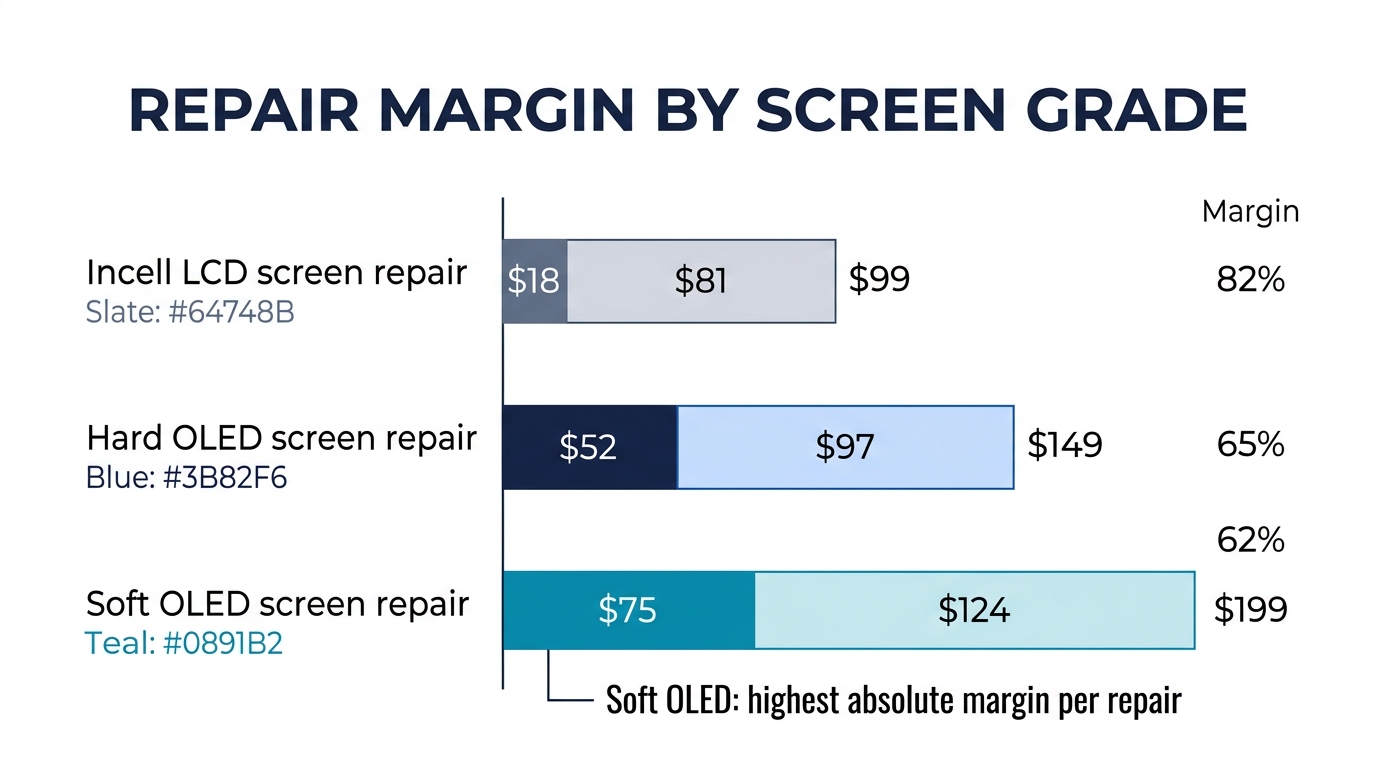
For repair shop owners, the real question isn't "is it worth repairing" — it's "how much margin does this job produce?"
Here's the margin breakdown by screen grade, based on typical UK and US shop pricing.
US Market Margins
| Screen Grade | Wholesale Cost | Typical Charge | Gross Margin | Margin % |
|---|---|---|---|---|
| Incell LCD | $18 | $99 | $81 | 82% |
| Hard OLED | $52 | $149 | $97 | 65% |
| Soft OLED | $75 | $199 | $124 | 62% |
UK Market Margins
| Screen Grade | Wholesale Cost | Typical Charge | Gross Margin | Margin % |
|---|---|---|---|---|
| Incell LCD | £15 | £79 | £64 | 81% |
| Hard OLED | £42 | £129 | £87 | 67% |
| Soft OLED | £62 | £169 | £107 | 63% |
The counter-intuitive finding: Incell delivers the highest percentage margin, but Soft OLED delivers the highest absolute margin per repair. If your shop does 10 iPhone 13 screen replacements per week, choosing Soft OLED over Incell earns an extra $430/week — even though the margin percentage is lower.
For more on optimising your screen repair pricing by grade and model, see our repair pricing strategy guide.
Stocking iPhone 13 screens in bulk? We supply Incell, Hard OLED, and Soft OLED screens for the full iPhone 13 series with tested quality and wholesale pricing. Request a quote to compare grades and MOQ options.
What About Face ID and True Tone?
Two features cause the most customer questions after an iPhone 13 screen replacement: Face ID and True Tone.
Face ID
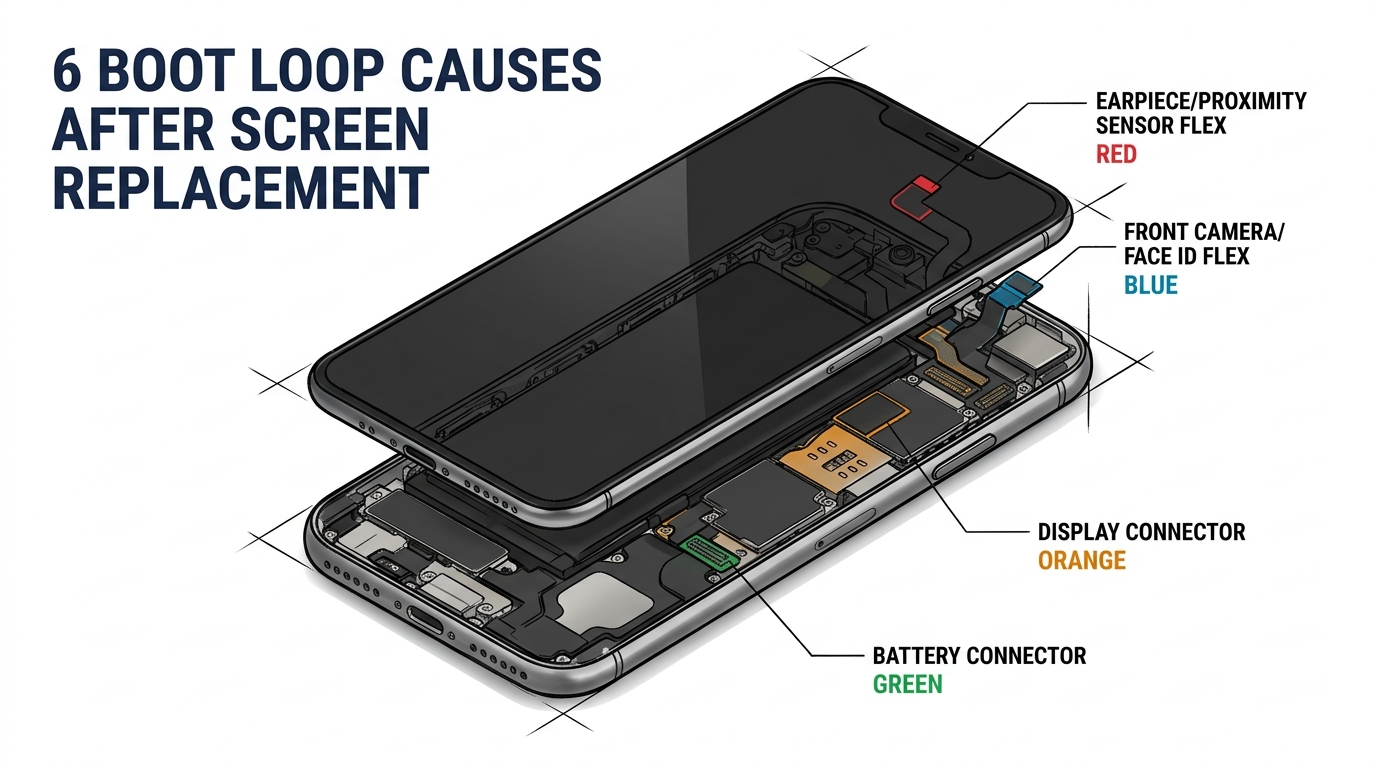
The iPhone 13 has a notorious Face ID issue with third-party screen replacements. Apple designed the Face ID module to be paired to the original screen's flex cable. If the earpiece speaker/proximity sensor flex isn't carefully transferred from the original screen to the replacement, Face ID can stop working entirely.
This was a major problem in 2021–2022. Since then, Apple has released software updates that improved third-party repair compatibility, and most quality replacement screens now include instructions for proper flex cable transfer. But it remains a risk with very cheap screens that lack proper flex cable routing.
For repair shops: Always transfer the original earpiece/proximity sensor flex assembly. Test Face ID before returning the phone to the customer. This is the single biggest source of callbacks on iPhone 13 screen jobs.
True Tone
True Tone requires the original display's colour calibration data, which is stored on a small IC chip on the screen's flex cable. Most aftermarket screens don't include this chip, so True Tone is disabled after replacement unless the shop uses a programmer tool to transfer the calibration data.
True Tone programmers cost $30–$100 and take about 2 minutes per screen. For shops doing volume iPhone repairs, this is a worthwhile investment — customers notice when True Tone disappears, and offering "True Tone preserved" as part of the repair builds trust.
Why iPhone 13 Screen Replacement Cost Varies So Much Between Shops
Walk down any high street or search online and you'll find iPhone 13 screen repair quoted at anywhere from £79 to £289. That spread isn't random — it maps directly to three variables.
Screen grade. As covered above, the wholesale cost difference between Incell ($18) and Soft OLED ($75) is over 4x. That cost difference flows through to the customer price. A shop quoting £79 is almost certainly using Incell. A shop quoting £169+ is likely using Hard OLED or Soft OLED.
Overhead and location. A shop in central London paying £4,000/month rent prices differently from a mobile repair tech working from home. Labour cost per repair varies from $10 to $40 depending on the shop's volume and staffing model.
Warranty and service level. Shops offering 6-month or lifetime warranties build that risk into the price. A shop with a 30-day warranty on a budget screen can afford to charge less, but they'll also see more callbacks.
For repair shop owners sourcing screens, understanding how your competitors price by grade helps you position your own offering. If every shop near you uses Incell, stocking Hard OLED or Soft OLED creates a quality differentiation that justifies higher pricing. See our OEM vs aftermarket phone screens guide for more on how grade differences affect customer perception.
Which iPhone 13 Model Is Most Profitable to Repair?
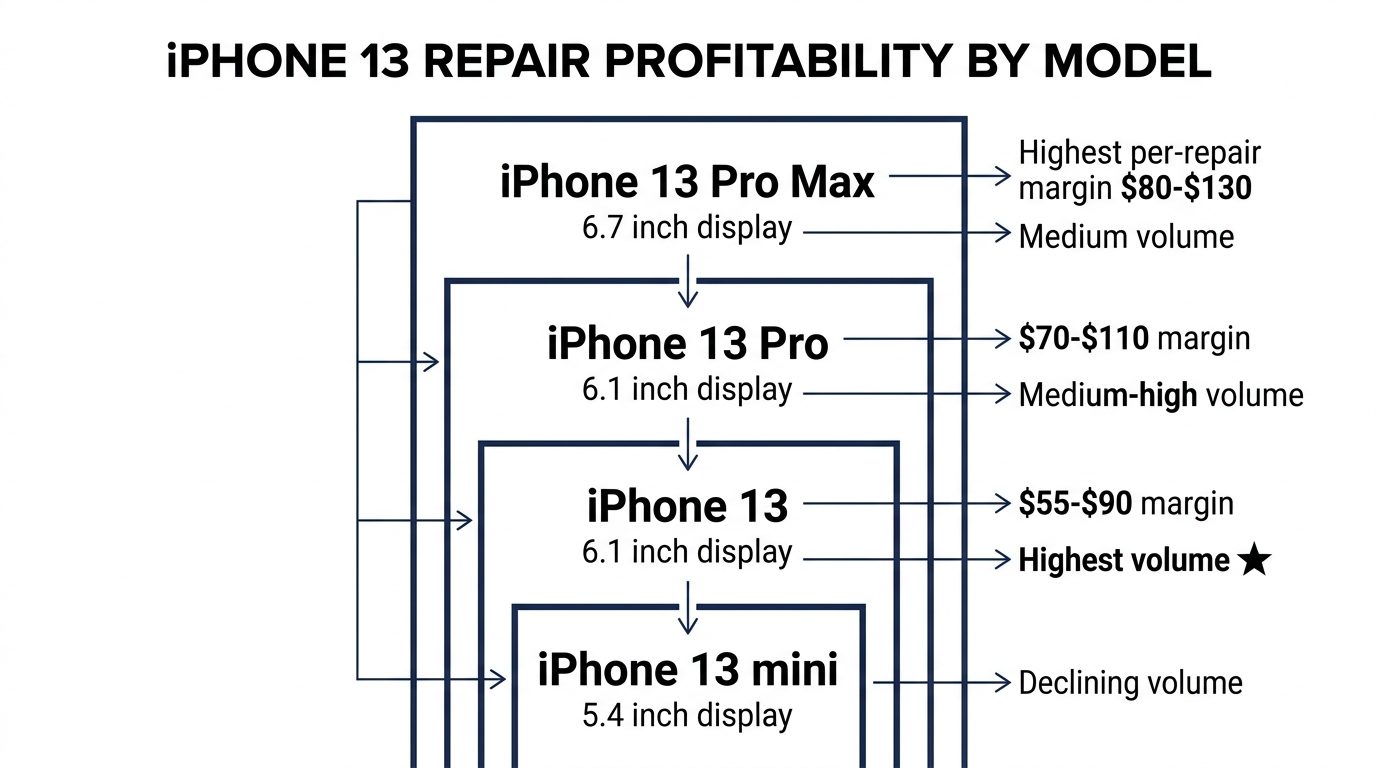
The iPhone 13 series has four models, each with different screen costs and repair economics.
| Model | Screen Size | Apple Price | Aftermarket Soft OLED | Repair Volume |
|---|---|---|---|---|
| iPhone 13 mini | 5.4" | $229 | $65–$85 | Low (declining) |
| iPhone 13 | 6.1" | $279 | $55–$90 | High |
| iPhone 13 Pro | 6.1" | $279 | $70–$110 | Medium-High |
| iPhone 13 Pro Max | 6.7" | $329 | $80–$130 | Medium |
The standard iPhone 13 is the highest-volume repair job — it sold the most units and has the best margin ratio (lowest screen cost relative to what shops can charge). The iPhone 13 Pro Max has the highest absolute margin per repair due to higher charge-out prices, but lower volume.
The iPhone 13 mini is becoming less common in repair shops as owners upgrade, and the smaller screen is more fiddly to work on. Unless you're in a market with high mini demand, it's not worth stocking mini screens separately.
iPhone 13 Screen Replacement Cost: DIY vs Professional
For end users weighing DIY against professional repair, here's what matters.
DIY makes sense when:
- You've done phone repairs before
- You have proper tools (pentalobe driver, suction cup, spudger, heat source)
- You're comfortable transferring the Face ID flex cable
- The cost savings of $60–$100 justify the time and risk
Professional repair makes sense when:
- You've never opened a phone before
- Face ID preservation matters to you
- You want a warranty on the repair
- Your time is worth more than the cost difference
A DIY iPhone 13 screen replacement using an iFixit Soft OLED kit costs about $110 and takes 45–90 minutes for a first-timer. A professional shop does the same job in 20–30 minutes for $150–$200. The real cost difference is smaller than it appears once you factor in time, risk of damaging other components, and the lack of warranty on DIY work.
Frequently Asked Questions
How much does it cost to replace an iPhone 13 screen in 2026?
The iPhone 13 screen replacement cost in 2026 ranges from $22 for a DIY Incell LCD to $279 at Apple. Most third-party repair shops charge $80–$200 depending on screen grade. Soft OLED (near-original quality) typically costs $150–$200 at a shop, while budget Incell LCD repairs run $80–$120.
Is it worth replacing the screen on an iPhone 13?
Yes, in most cases. A working iPhone 13 is worth $200–$300 in 2026, while a cracked-screen unit sells for $80–$120. Even at the highest third-party repair cost of $200, the repair adds more value than it costs. The phone also has at least 2–3 more years of iOS support remaining, making it viable as a daily driver through 2028.
Does replacing the iPhone 13 screen affect Face ID?
It can if the earpiece speaker and proximity sensor flex cable aren't properly transferred from the original screen. With a careful repair and quality replacement screen, Face ID continues to work normally. Always test Face ID before finalising the repair.
What's the best screen grade for iPhone 13 replacement?
For most users, Soft OLED offers the best balance of quality and cost — near-identical to the original display at 30–60% less than Apple's price. For budget repairs, Incell LCD works but with noticeably lower display quality. Hard OLED sits in between: good quality but slightly more fragile. Repair shops should stock at least two grades to offer customers a choice.
How long does an iPhone 13 screen replacement take?
Professional shops complete the repair in 20–30 minutes. DIY repairs take 45–90 minutes for someone with basic experience. The Face ID flex cable transfer adds 5–10 minutes to either timeline. Most shops offer same-day or walk-in service for iPhone 13 screen replacements.
The Bottom Line: iPhone 13 Screen Replacement Is Still Worth It in 2026
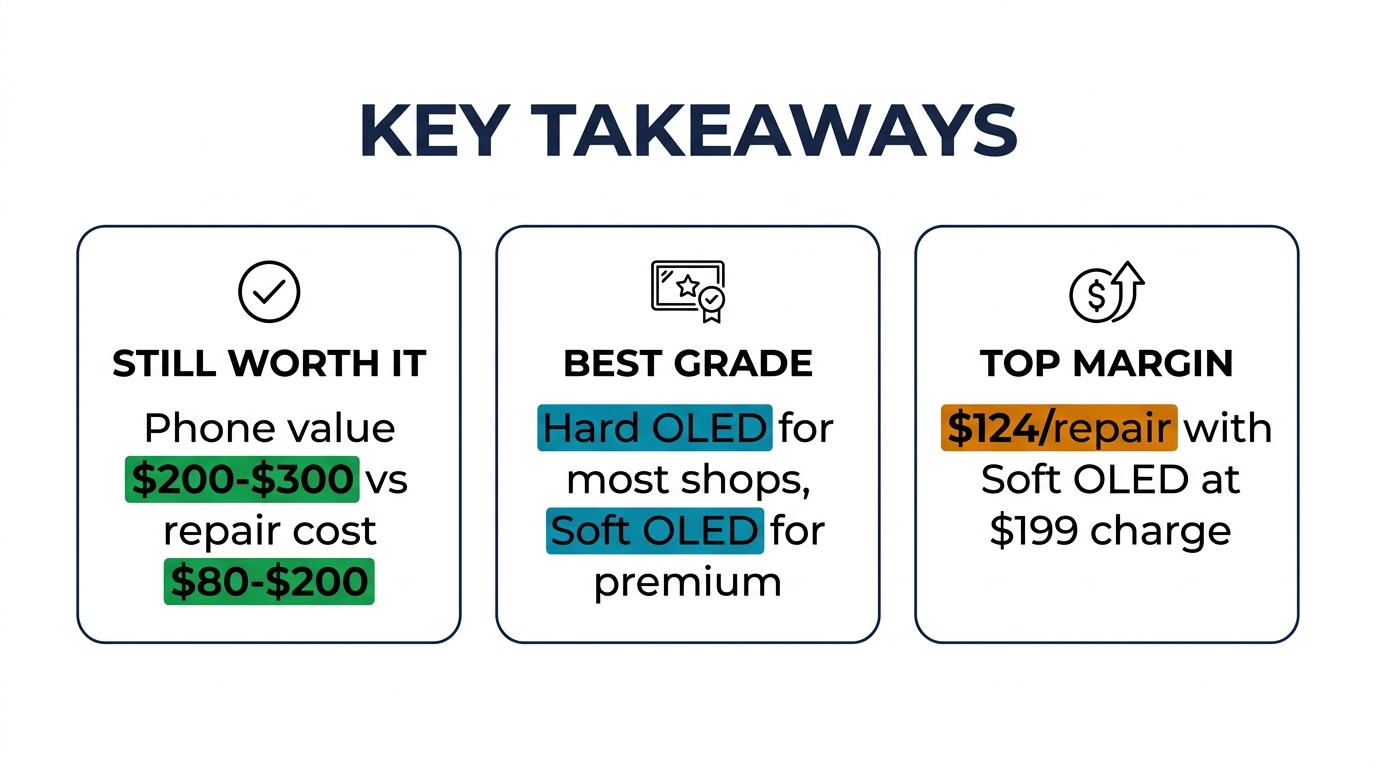
The iPhone 13 remains one of the most practical phones to repair in 2026. The screen replacement cost is well below the phone's residual value, parts supply is abundant across all grades, and repair shops can earn $80–$120+ gross margin per job. For end users, fixing the screen costs less than any upgrade path and extends the phone's life by years.
The key decision isn't whether to repair — it's which screen grade matches your situation. Budget customers get a functional phone back with Incell. Quality-focused customers get near-original display quality with Soft OLED. And repair shops that stock both grades can serve the full market while maintaining healthy margins.
For a complete breakdown of costs across all iPhone models, see our iPhone screen replacement cost guide.
Need wholesale iPhone 13 screens for your repair business? We supply tested Incell, Hard OLED, and Soft OLED screens for the iPhone 13 series at bulk pricing. Request a wholesale quote to get grade samples and volume pricing.