
How to Choose a Reliable Phone Parts Supplier: 10 Questions Every Buyer Should Ask
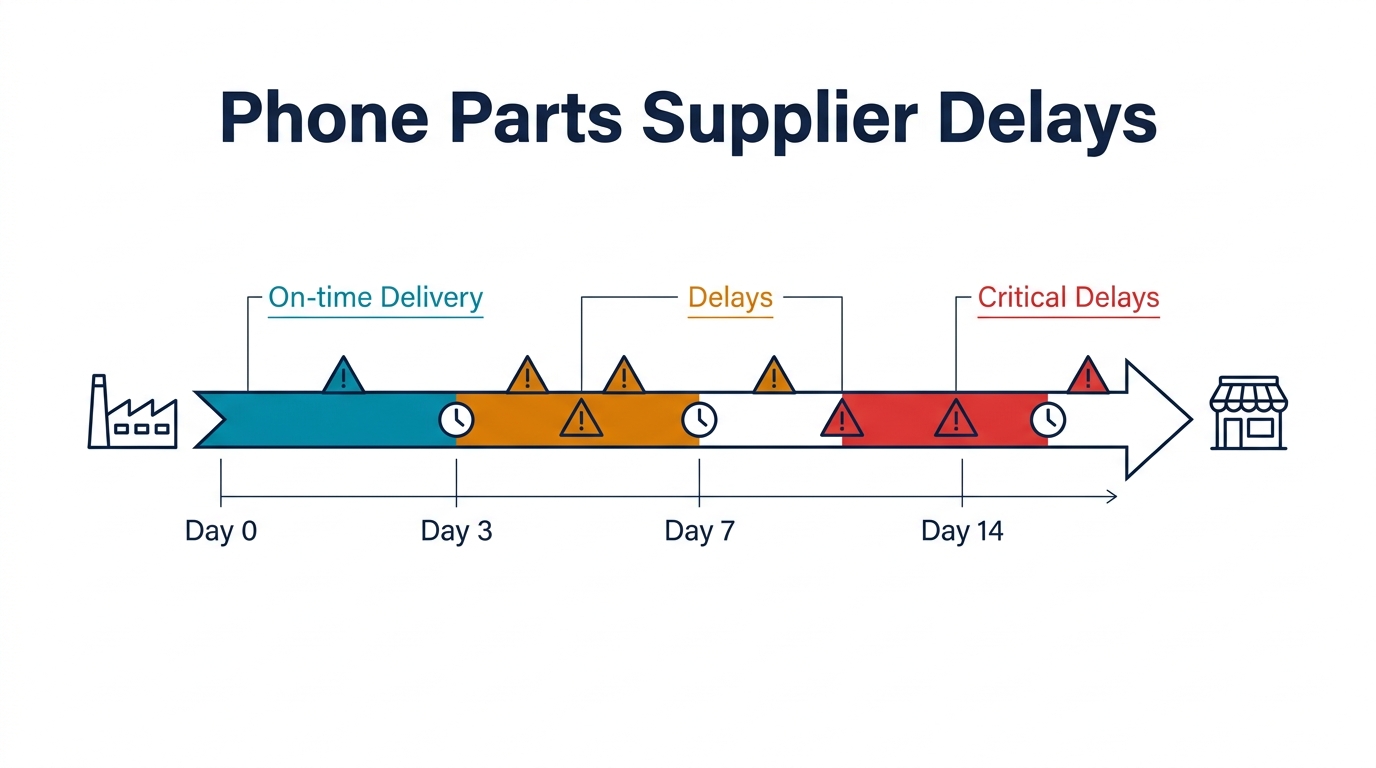
A bad phone parts supplier doesn't announce itself. The first order arrives on time, screens look fine, prices seem fair. The problems start on month two — defect rates creep up, response times stretch from hours to days, and that "Soft OLED" grade starts looking suspiciously like Hard OLED.
By then, you've already committed inventory budget, quoted prices to your customers, and built your repair workflow around parts that aren't performing. Switching suppliers mid-stream costs time, money, and reputation.
This article gives you 10 specific questions to ask any cell phone parts supplier before your first bulk order. Each question is designed to surface the information that actually predicts long-term reliability — not just first-order performance.
Looking for a Reliable Wholesale Parts Supplier?
Factory-direct from Shenzhen — transparent grades, invoices & 12-month warranty.
Get Wholesale QuoteWhy Choosing the Right Phone Parts Supplier Matters More Than Price
Most buyers start their supplier search by comparing prices. That's backwards.
A supplier quoting $2 less per screen but delivering 4% more defectives costs you more than the "expensive" option. Here's the math on a 200-unit order of iPhone 15 Incell screens:
| Supplier | Unit Price | Defect Rate | Defective Units | Replacement Cost (labor + part) | True Cost Per Good Unit |
|---|---|---|---|---|---|
| Supplier A | $12 | 2% | 4 | $60 | $12.30 |
| Supplier B | $10 | 6% | 12 | $180 | $10.92 |
Supplier B looks cheaper per unit, but after accounting for 8 extra defective screens and the rework time, the gap narrows to $1.38. Factor in customer complaints and review damage from those 8 failed repairs, and Supplier A wins.
Price matters — but only after you've verified quality, consistency, and support. The 10 questions below help you do exactly that.
The 10 Questions to Ask Any Phone Parts Supplier
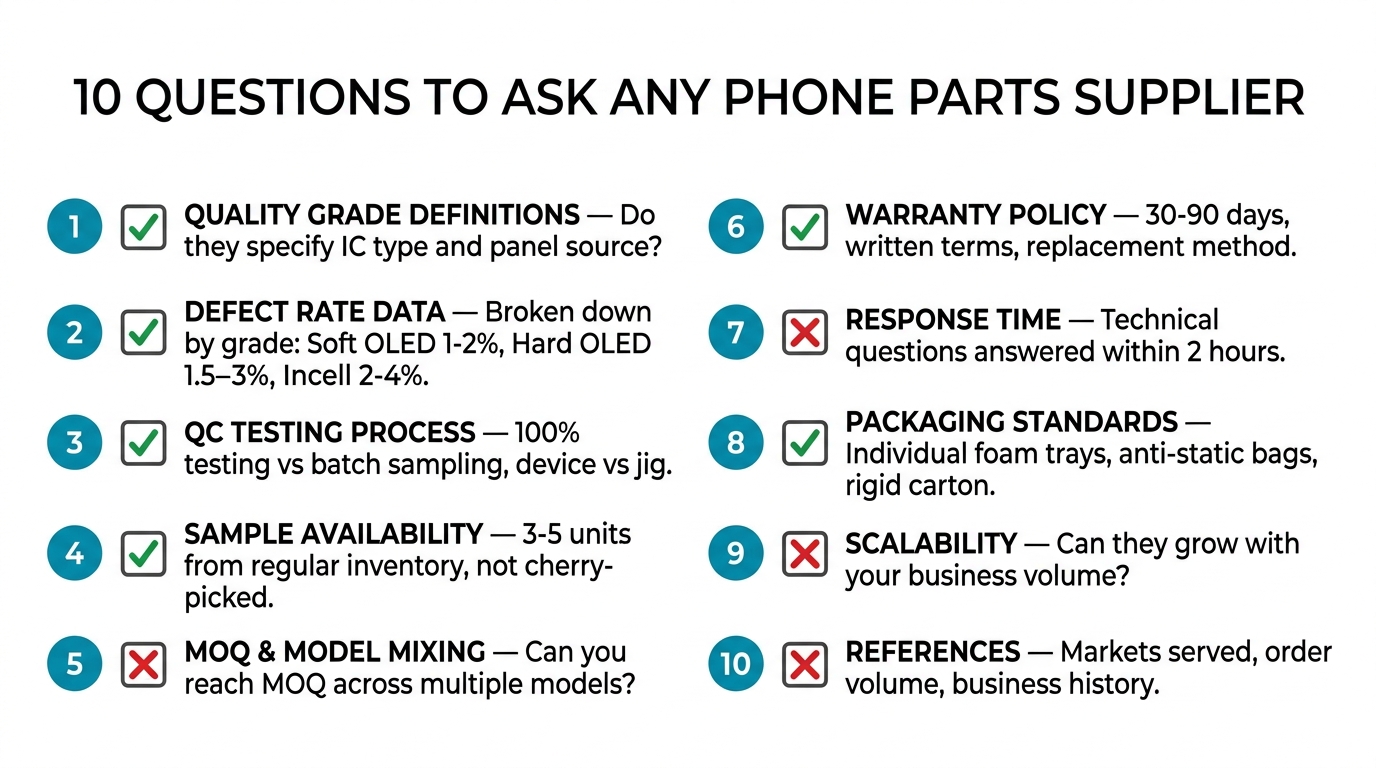
Question 1: How Do You Define Your Quality Grades?
This is your first filter. A reliable supplier will name specific grades (Incell, Hard OLED, Soft OLED, Original OEM) and explain exactly what each means — including the display technology, panel source, and IC chip used.
Red flag: "We have standard quality and premium quality." Vague grade names with no technical definition usually mean the supplier doesn't control their own sourcing or is buying from multiple factories without standardization.
What a good answer sounds like: "Our Hard OLED uses a rigid OLED panel from [manufacturer], with a BOE IC. Color accuracy is approximately 87% of original. We test each unit for dead pixels, touch responsiveness, and backlight uniformity."
Question 2: What Is Your Tested Defect Rate Per Grade?
Don't accept "very low" or "less than 1%." Ask for the actual number, broken down by grade and ideally by phone model.
Industry benchmarks to compare against:
| Grade | Acceptable Defect Rate | Concerning Rate |
|---|---|---|
| Original OEM | <0.5% | >1% |
| Soft OLED | 1–2% | >3% |
| Hard OLED | 1.5–3% | >4% |
| Incell LCD | 2–4% | >5% |
See the full four-grade comparison with live wholesale prices: iPhone Screen Grade Guide
If a supplier claims 0% defect rate across all grades, they're either not tracking or not being honest. Zero-defect claims on aftermarket screens are a bigger red flag than a supplier who openly says "our Incell runs about 3% — here's how we handle replacements."
Question 3: What Is Your QC and Testing Process?
The testing process tells you more about a supplier's reliability than anything else. Ask specifically:
- 100% testing or batch sampling? 100% testing (every single unit checked) costs more but means fewer surprises. Batch sampling (spot-checking 10–20% per shipment) is cheaper but increases your incoming defect rate.
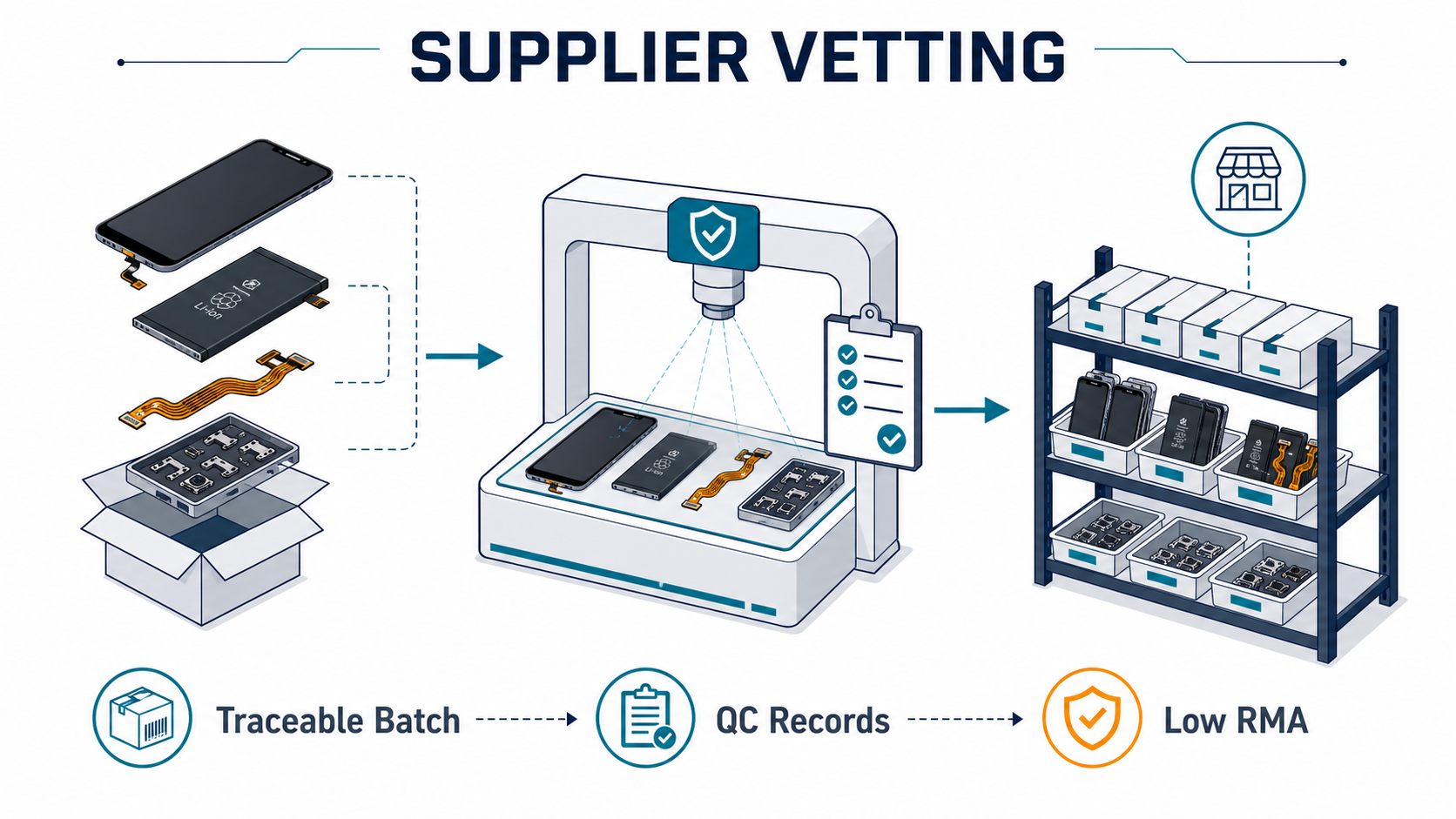
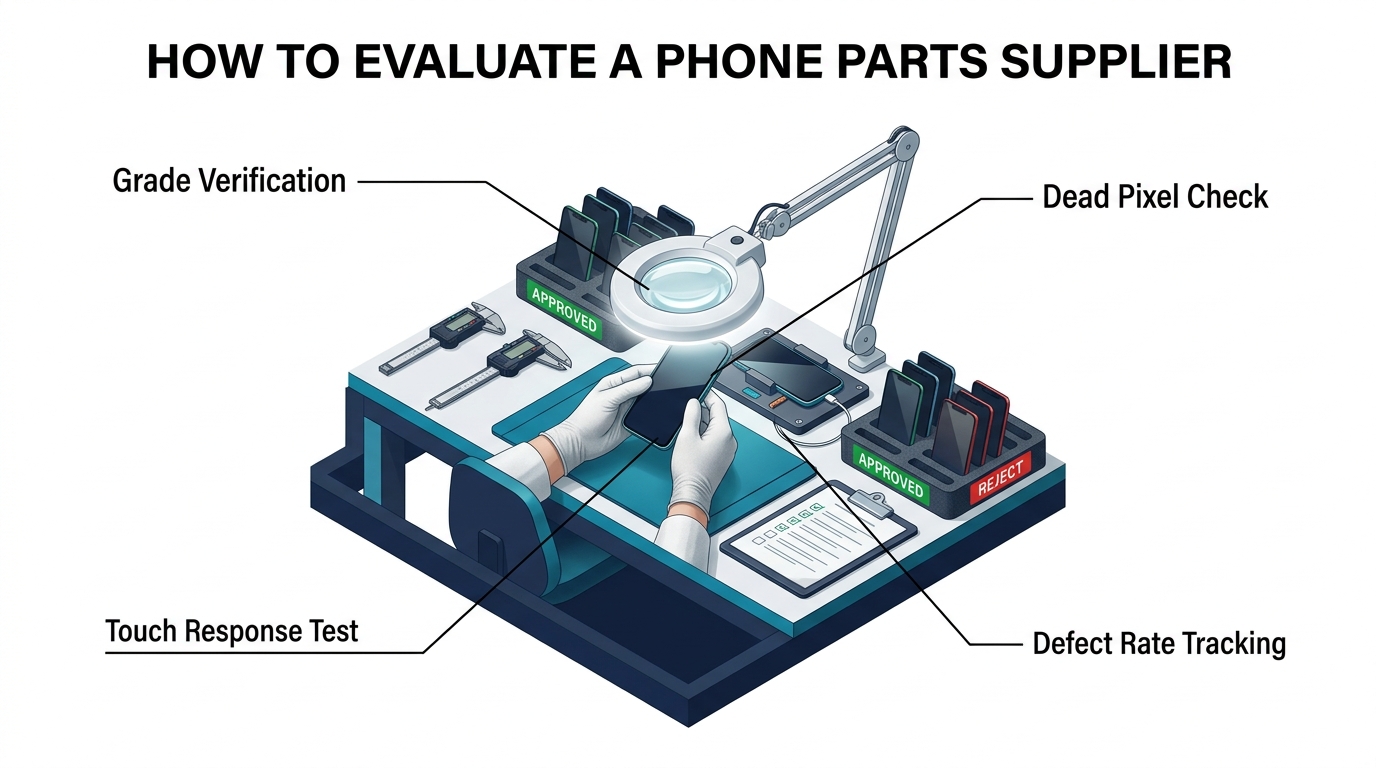
- What do they test for? At minimum: touch functionality across the full screen surface, dead pixel check, backlight bleed, color uniformity, and digitizer responsiveness.
- Device testing or jig-only? Screens tested on actual phones catch more issues than screens tested only on test jigs. Jig-only testing misses compatibility problems specific to certain iOS or Android versions.
- OLED burn-in test? For OLED grades, a 15–30 minute burn-in test catches panels that will develop issues within the first week of use.
Question 4: Can I Order Samples Before Committing to Bulk?
This question reveals more about the supplier than the answer itself. Any supplier confident in their product will send 3–5 sample units for you to test.
What to watch for:
- Do they charge a reasonable sample price, or is it inflated to discourage testing?
- Are samples pulled from regular inventory, or specially selected? Ask directly: "Are these from the same batch you'd ship in a bulk order?"
- How quickly do they ship samples? Slow sample fulfillment often predicts slow bulk fulfillment.
Your test protocol for samples: Install them in actual customer devices. Use them for 5–7 days. Check for color drift, touch dead zones, and brightness consistency. Compare side-by-side against the original screen and against screens from your current supplier.
Question 5: What Is Your MOQ and Can I Mix Models?
Minimum Order Quantity (MOQ) determines whether you can work with a supplier at your current scale.
Typical ranges:
| Supplier Type | Usual MOQ | Model Mixing |
|---|---|---|
| Factory direct | 100–500/model | Rarely allowed |
| Trading company / exporter | 50–100/model | Usually allowed |
| Regional distributor | 10–50/model | Almost always |
The real question isn't just "what's your MOQ" but "can I reach it by mixing models?" A 100-unit MOQ that allows 20 iPhone 15 + 30 iPhone 14 + 50 iPhone 13 is far more practical than 100 units of one model.
Also ask: Does MOQ decrease after repeat orders? Most suppliers will lower MOQ for established buyers with consistent ordering patterns.
Evaluating suppliers right now? We offer sample kits across multiple screen grades so you can test before committing. Request a sample kit.
Question 6: What Is Your Warranty and Replacement Policy?
Get this in writing before your first order. Verbal promises mean nothing when you're holding 15 dead screens from a 500-unit shipment.
Key details to confirm:
- Warranty period: Industry standard is 30–90 days from delivery. Anything less than 30 days is a warning sign.
- What's covered: Dead on arrival (DOA) should always be covered. Post-installation failures within the warranty window should also be covered if not caused by installation error.
- Replacement method: Credit on next order? Free replacement units shipped separately? Refund? Most suppliers do next-order credit — it's operationally simplest and keeps the relationship going.
- Documentation required: What evidence do you need to submit? Photos? Video? Test reports? Know this upfront so you can document issues as they happen.
Benchmark: A supplier handling 1–3% claims smoothly and without argument is normal. A supplier who fights every claim or adds conditions not in the original agreement is one you should leave.
Question 7: How Fast Do You Respond to Technical Issues?
Response time during a quality crisis separates good suppliers from bad ones. When a batch of screens starts failing after installation and your repair queue is backing up, you need answers within hours.
How to test this before ordering: Send a moderately technical question via their primary communication channel. Something like: "What IC chip do you use on your iPhone 15 Pro Max Hard OLED, and what's the expected color temperature difference versus original?" Time the response and evaluate the answer quality.
| Response Profile | What It Tells You |
|---|---|
| Reply within 2 hours, technically accurate | Dedicated support team, product knowledge |
| Reply within 24 hours, generic answer | Sales-focused, may struggle with technical issues |
| Reply after 48+ hours | Understaffed or deprioritizing your inquiry |
Also ask: What communication channels do you support? WhatsApp/WeChat for quick exchanges plus email for formal records is the standard combination for international suppliers.
Question 8: How Do You Package and Ship Screens?
A $12 screen that arrives cracked because of bad packaging is a $12 loss. Multiply by a shipment of 200, and sloppy packaging becomes a serious cost center.
What proper packaging looks like:
- Each screen in an individual foam-cushioned tray or box
- Anti-static bag around each unit
- Rigid outer carton (not a thin shipping envelope)
- Foam or air-pillow fill between units and carton walls
- "Fragile" labeling and handling instructions
Ask for photos of their standard packaging before ordering. Some suppliers offer basic packaging at standard price and upgraded packaging for $0.20–$0.50 more per unit. The upgrade almost always pays for itself.
Shipping options to discuss:
- Air express (DHL/FedEx/UPS): 5–7 days, $3–$6 per unit for screens
- Air freight (to airport): 7–10 days, $2–$4 per unit
- Sea freight: 25–35 days, $0.50–$1.50 per unit (only for large orders 500+)
Question 9: Can Your Phone Parts Supply Scale With My Business?
This question matters if you're growing. A supplier that works perfectly at 100 units/month may fall apart at 1,000.
What to ask:
- What's your maximum monthly capacity for my top 3 models?
- If I double my order next quarter, can you maintain the same lead time?
- Do you stock inventory, or do you order from factories per my order? (Stocked inventory = faster fulfillment; made-to-order = longer lead times but sometimes fresher stock)
- Can you add new models or part categories (batteries, flex cables, back glass) without going through a new onboarding process?
Why this matters: Switching suppliers is expensive. If your current supplier can grow with you, that saves months of re-evaluation, sample testing, and relationship building.
Question 10: Can You Provide References or Order History?
A confident supplier won't hesitate to share:
- How many repair shops or distributors they currently supply
- Which markets they ship to regularly (US, UK, Europe, Latin America)
- General order volume ranges (without revealing specific customer details)
You're not asking for a customer list. You're asking for evidence that they operate at scale and serve businesses similar to yours.
Bonus questions to close the evaluation:
- How long have you been in the phone parts business?
- Do you have your own QC team, or do you rely on factory QC?
- Can I visit your warehouse or QC facility (in person or via video call)?
Phone Parts Supplier Red Flags: When to Walk Away

Not every bad supplier is obviously bad. Watch for these patterns:
- Grade inflation: They call everything "original quality" or "OEM grade" but prices are 60% below actual OEM. If it sounds too good to be true on grade claims, it is.
- No written warranty: "We'll take care of it" is not a policy. No documentation = no accountability.
- Pressure to skip samples: "Just place a bulk order and we'll make it right if there's a problem" is a setup for disappointment.
- Inconsistent specs: They describe the same product differently across conversations or their website doesn't match their direct quotes. This usually means they're reselling from multiple sources without standardization.
- Only price talk, no quality talk: A supplier who only wants to discuss how cheap their prices are, without voluntarily raising quality details, is optimizing for the wrong thing.
Phone Parts Supplier Evaluation Scorecard
Use this when comparing 2–3 shortlisted suppliers side by side:
| Criteria | Weight | Supplier A | Supplier B | Supplier C |
|---|---|---|---|---|
| Grade definitions (clear, specific) | 15% | /10 | /10 | /10 |
| Defect rate data (transparent, reasonable) | 15% | /10 | /10 | /10 |
| QC process (100% testing, device-tested) | 15% | /10 | /10 | /10 |
| Sample availability | 10% | /10 | /10 | /10 |
| MOQ flexibility | 10% | /10 | /10 | /10 |
| Warranty policy (written, clear) | 10% | /10 | /10 | /10 |
| Response time (<24 hours, accurate) | 10% | /10 | /10 | /10 |
| Packaging quality | 5% | /10 | /10 | /10 |
| Scalability | 5% | /10 | /10 | /10 |
| References / track record | 5% | /10 | /10 | /10 |
Score each supplier out of 10 per criteria, multiply by weight, and compare totals. This takes the decision out of gut feeling and into data.

Frequently Asked Questions
How many suppliers should I evaluate before committing?
Shortlist 3–5 suppliers, request samples from your top 3, and test side by side. Two rounds of sample testing (initial test + one reorder to check consistency) is enough to make a confident decision. The entire evaluation process typically takes 3–4 weeks.
Should I work with a China-based supplier or a local distributor?
Both have a place. China-direct suppliers offer 30–50% lower unit prices but require larger MOQ and longer lead times (7–15 days). Local distributors charge more but ship in 1–3 days with easier returns. Many businesses use a China supplier for regular bulk orders and a local distributor for emergency restocks.
What's a reasonable warranty period for wholesale phone parts?
Industry standard is 30–90 days. For OLED screens, 60–90 days is preferred because some panel defects (color shift, burn-in) only appear after 2–4 weeks of use. Any supplier offering less than 30 days warranty likely lacks confidence in their product quality.
How do I verify a phone parts supplier is legitimate?
Check their business registration, ask for export licenses, and request a video call to see their warehouse or QC facility. Order samples before bulk. For China-based suppliers, verify they have their own inventory and QC team — many "suppliers" are actually middlemen buying from markets with no quality control.
Choose a Phone Parts Supplier Based on Evidence, Not Promises
Every supplier says they offer "high quality" and "great service." The 10 questions above let you test those claims before your money is on the line. Grade definitions, defect data, testing process, sample willingness, warranty terms — these are facts you can verify, not promises you hope will hold.
Take 2–3 weeks to evaluate properly. The time you invest now saves you months of dealing with returns, rework, and unreliable stock later.
Looking for a supplier who can answer all 10 questions? We source and QC every part from Shenzhen, with clear grade specs, written warranty, and sample kits available for testing.
Request a Wholesale Quote — include your top models and we'll send grade options with pricing.
Related reading: