
iPhone 14 Screen Replacement: Which Screen Grade Should Repair Shops Use?

iPhone 14 screen replacement is one of the most common jobs in any repair shop right now — and one where getting the screen grade wrong costs real money. Every shop stocking iPhone 14 screens faces the same decision: Incell LCD at $18, Hard OLED at $50, or Soft OLED at $80? The answer isn't the same for every shop — and it's definitely not the same for the standard iPhone 14 and the Pro models. Get the grade wrong and you're either leaving margin on the table or dealing with callbacks from unhappy customers.
The iPhone 14 series introduced a split that makes grade selection more complicated than previous generations. The standard iPhone 14 and 14 Plus use 60Hz OLED panels similar to the iPhone 13. The iPhone 14 Pro and Pro Max jumped to 120Hz ProMotion LTPO displays with Dynamic Island. That hardware difference changes which screen grades work — and which ones create problems.
This guide covers the practical differences between screen grades for each iPhone 14 model, with real wholesale costs and margin analysis so you can decide what to stock.
Sourcing Replacement Screens in Bulk?
Incell / Hard OLED / Soft OLED grades — wholesale pricing, grade comparison on request.
Get Wholesale QuoteWhy iPhone 14 Screen Grade Selection Is Different From iPhone 13
With the iPhone 13, grade selection was relatively simple. Every model used a 60Hz OLED panel. Incell, Hard OLED, and Soft OLED all worked acceptably — the difference was display quality, not functionality.
The iPhone 14 changed that equation in two ways.
The Pro models use 120Hz ProMotion. This means any aftermarket screen that can't match 120Hz refresh rate immediately creates a noticeable downgrade. An Incell LCD running at 60Hz on a phone that originally ran at 120Hz feels sluggish to the customer. Scrolling is visibly less smooth, animations lose their fluidity, and anyone who's used the phone for more than a week will notice.
Dynamic Island requires precise sensor integration. The iPhone 14 Pro and Pro Max replaced the notch with Dynamic Island — a cutout that interacts with the proximity sensor and front camera array. Cheap screens with poorly aligned cutouts can cause display artefacts around the Dynamic Island area or interfere with gesture-based interactions.
For the standard iPhone 14 and 14 Plus, grade selection works much like the iPhone 13. For the Pro and Pro Max, the stakes are higher.
iPhone 14 Screen Grades: Full Comparison by Model

iPhone 14 / iPhone 14 Plus (60Hz OLED)
The standard iPhone 14 uses a 6.1-inch Super Retina XDR OLED at 2532 × 1170 resolution with 60Hz refresh rate. The iPhone 14 Plus uses the same panel technology at 6.7 inches. Both are straightforward to source aftermarket screens for.
| Screen Grade | Wholesale Cost | Display Quality | Key Trade-offs |
|---|---|---|---|
| Incell LCD | $15–$22 | Functional | No true blacks, lower contrast, thicker. Noticeable downgrade |
| Hard OLED | $40–$58 | Good | True blacks, accurate colours. More fragile on drop |
| Soft OLED | $60–$85 | Near-OEM | Matches original quality closely. Best drop resistance |
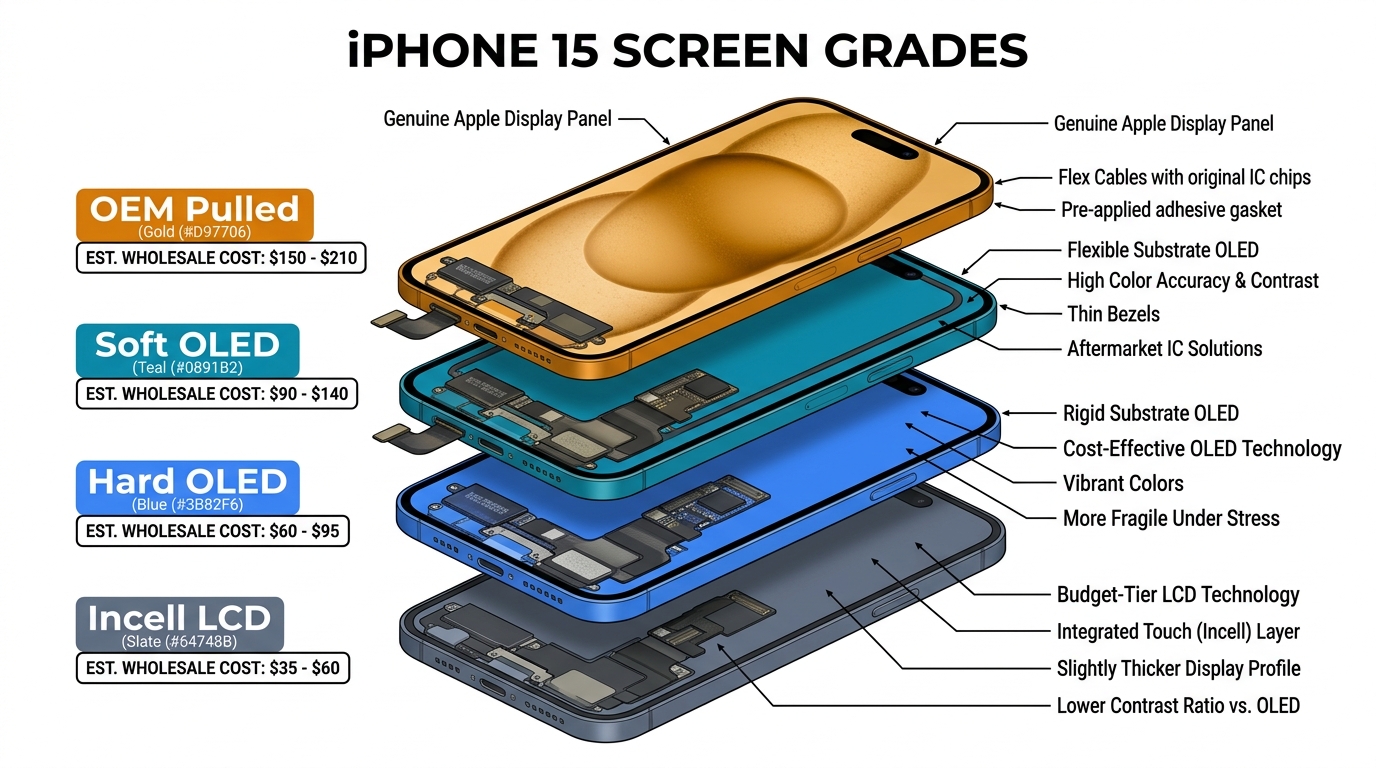
See the full four-grade comparison with live wholesale prices: iPhone Screen Grade Guide
Recommended grade for most shops: Hard OLED. It offers the best balance of cost and quality for a 60Hz phone. Customers get true OLED blacks and accurate colours at a price that leaves healthy margins. Incell works for budget-tier repairs, but expect some customers to notice the quality difference.
iPhone 14 Pro / iPhone 14 Pro Max (120Hz ProMotion + Dynamic Island)
The iPhone 14 Pro uses a 6.1-inch Super Retina XDR ProMotion OLED at 2556 × 1179 resolution with 1–120Hz adaptive refresh rate. The Pro Max is the same technology at 6.7 inches. These are significantly harder to match with aftermarket screens.
| Screen Grade | Wholesale Cost | Refresh Rate | Dynamic Island | Key Trade-offs |
|---|---|---|---|---|
| Incell LCD | $25–$35 | 60Hz only | Basic cutout | Major downgrade: no 120Hz, no true blacks, visible quality drop |
| Hard OLED | $55–$80 | 60Hz–120Hz varies | Proper cutout | Quality varies by supplier. Some support ProMotion, some don't |
| Soft OLED | $85–$130 | 120Hz supported | Full integration | Closest to OEM. Supports ProMotion and proper Dynamic Island interaction |
Recommended grade for most shops: Soft OLED for Pro models. The 120Hz difference is too noticeable to ignore. A customer who's been using ProMotion for a year will immediately feel a 60Hz downgrade, and that leads to complaints, negative reviews, and callbacks.
If you must offer a budget option for Pro models, use a Hard OLED from a reputable supplier that supports 120Hz. But verify the refresh rate spec before ordering — not all Hard OLED screens labelled "for iPhone 14 Pro" actually support ProMotion.
iPhone 14 Screen Replacement Cost: What Shops Should Charge
Apple charges $279 for the standard iPhone 14 and $329 for the Pro/Pro Max. Third-party shops price below Apple but above their cost. Here's how the margins work.
Standard iPhone 14 Margins
| Screen Grade | Wholesale | Charge to Customer | Gross Margin | Margin % |
|---|---|---|---|---|
| Incell LCD | $18 | $99 | $81 | 82% |
| Hard OLED | $48 | $149 | $101 | 68% |
| Soft OLED | $72 | $199 | $127 | 64% |
iPhone 14 Pro / Pro Max Margins
| Screen Grade | Wholesale | Charge to Customer | Gross Margin | Margin % |
|---|---|---|---|---|
| Incell LCD | $30 | $119 | $89 | 75% |
| Hard OLED (120Hz) | $68 | $189 | $121 | 64% |
| Soft OLED | $110 | $249 | $139 | 56% |
The pattern is the same as with iPhone 13: Soft OLED produces the highest absolute margin per repair even though percentage margins are lower. For iPhone 14 Pro repairs, the difference is even more pronounced. A shop doing 8 Pro/Pro Max screen replacements per week earns $1,112 gross with Soft OLED versus $712 with Incell — a $400/week difference.
For a complete breakdown of how to set repair prices by screen grade, see our phone screen repair pricing strategy guide.
Looking for tested iPhone 14 screens at wholesale pricing? We supply Incell, Hard OLED, and Soft OLED for the full iPhone 14 series — including 120Hz-verified screens for Pro models. Request a quote to compare grades and volume pricing.
The iPhone 14 Pro Screen Replacement Trap: What Catches Shops Out
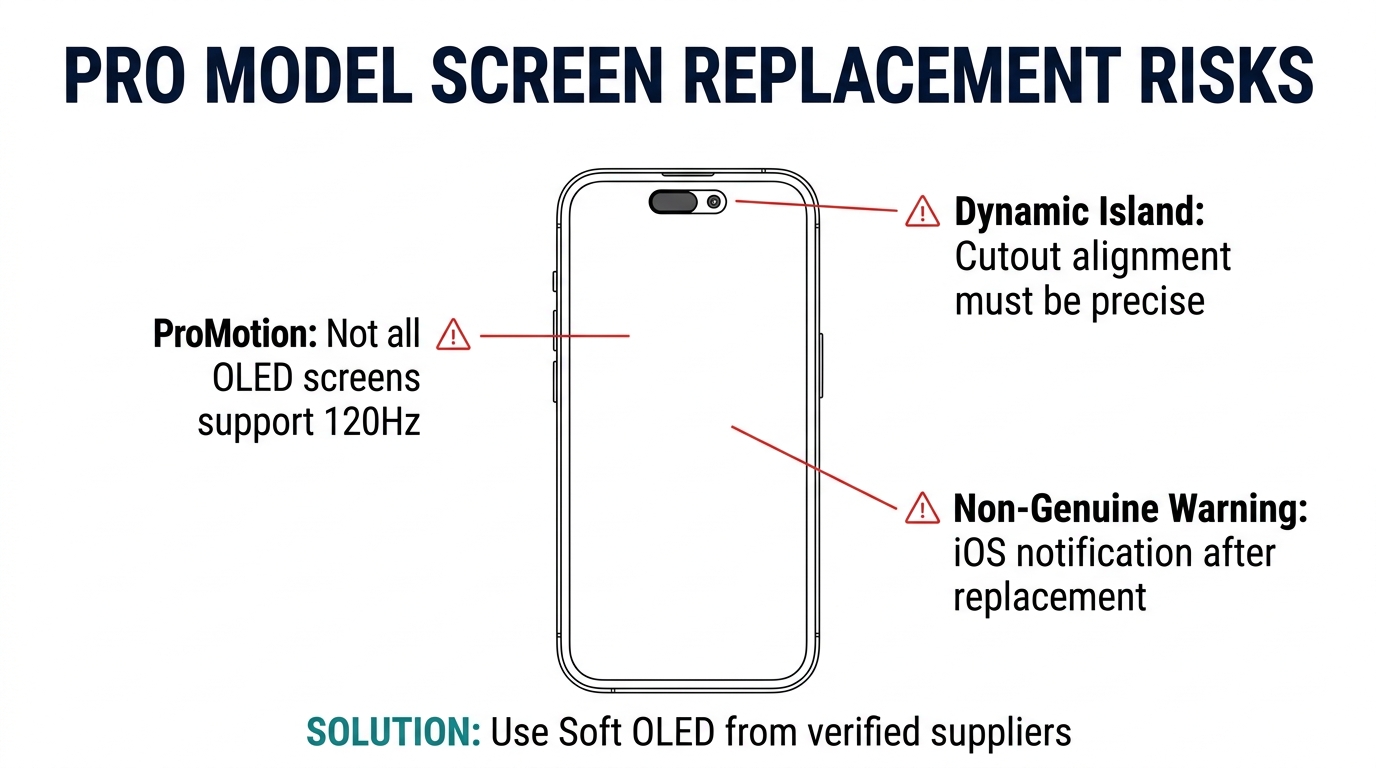
The iPhone 14 Pro and Pro Max screen replacement has a few technical complications that the standard model doesn't. Shops that don't account for these end up with callbacks and frustrated customers.
ProMotion Verification
Not every aftermarket "OLED" screen for the iPhone 14 Pro actually supports 120Hz. Some suppliers label screens as "OLED" but ship 60Hz-locked panels. The only way to verify is to install the screen and check Settings > Display & Brightness for the ProMotion toggle, or to use a screen testing app that reports actual refresh rate.
Prevention: Buy from suppliers who explicitly guarantee ProMotion compatibility, and test the first batch before committing to volume orders. At PRSPARES, we test every iPhone 14 Pro screen batch for 120Hz support before shipping.
Face ID and Dynamic Island
Like the iPhone 13, the iPhone 14 Pro requires careful transfer of the earpiece speaker and sensor flex cable to preserve Face ID. But the Dynamic Island adds another variable: the proximity sensor and front camera placement must align precisely with the screen cutout. Misalignment causes visual gaps, uneven bezels around the island, or proximity sensor issues during calls.
Prevention: Use screens with pre-aligned Dynamic Island cutouts from quality suppliers. Avoid the cheapest options where cutout precision is often poor.
Non-Genuine Parts Warning
iOS displays a "non-genuine part" warning after any third-party screen replacement on iPhone 14 series. This appears in Settings > General > About and is a one-time notification. It doesn't affect functionality, but it concerns some customers.
How shops should handle this: Inform customers before the repair that this warning will appear. Explain that it's Apple's standard notification for any non-Apple screen, regardless of quality. Shops that explain this upfront get zero complaints. Shops that don't explain it get panicked calls.
How to Stock iPhone 14 Screens: A Practical Framework
Stocking every grade for every iPhone 14 model ties up cash unnecessarily. Here's a practical approach based on typical repair shop volume.
Small Shop (Under 20 iPhone Repairs/Week)
Stock two grades:
- Hard OLED for iPhone 14 / 14 Plus — covers mid-range demand
- Soft OLED for iPhone 14 Pro / Pro Max — avoid 60Hz downgrade on Pro models
Skip Incell unless you specifically serve a budget market. The margin difference per unit doesn't justify the callback risk.
Medium Shop (20–50 iPhone Repairs/Week)
Stock three grades:
- Incell LCD for iPhone 14 / 14 Plus — budget option for price-sensitive customers
- Hard OLED for iPhone 14 / 14 Plus — standard offering
- Soft OLED for all models — premium option and default for Pro models
High-Volume Operation (50+ Repairs/Week)
Stock all grades for all models. At this volume, you can negotiate wholesale pricing tiers that make even Incell profitable with minimal risk. Consider keeping a small stock of OEM refurbished screens for customers who insist on original parts.
Grade Verification Before Ordering
Whatever your shop size, always verify screen quality before committing to bulk orders. Request 2–3 sample units of each grade and test them in actual repairs. Check for:
- Colour temperature — hold the replacement next to an original screen under the same lighting. Cheap Incell panels often have a blue-ish or green-ish tint.
- Touch responsiveness — test multi-touch, edge swipes, and keyboard typing speed. Poor digitiser calibration causes missed key presses.
- Brightness uniformity — display a pure white image and check for dark spots or uneven backlight bleed (Incell) or colour banding (OLED).
- 120Hz verification (Pro models only) — go to Settings > Display & Brightness and confirm the ProMotion toggle is present and functional.
Suppliers who refuse to send samples or who don't specify refresh rate for Pro screens are a red flag. For guidance on evaluating supplier quality, see our how to choose a phone parts supplier guide.
For more detail on which models and grades to prioritise in your inventory, see our guide on which phone screen models to stock in bulk.
iPhone 14 vs iPhone 13 Screen Replacement: Which Is More Profitable?

Both are common repair jobs, but they have different margin profiles.
| Factor | iPhone 13 | iPhone 14 |
|---|---|---|
| Repair volume (2026) | High — still very common | High — growing as warranties expire |
| Wholesale screen cost | $15–$90 | $15–$130 |
| Typical customer charge | $99–$199 | $99–$249 |
| Best margin grade | Soft OLED ($124 margin) | Soft OLED ($127–$139 margin) |
| Complexity | Standard | Standard (14/14 Plus) / Higher (Pro models) |
| ProMotion risk | None | Yes (Pro/Pro Max only) |
The iPhone 14 Pro and Pro Max generate higher per-repair margins than any iPhone 13 model, but they also carry more risk if you use the wrong screen grade. The standard iPhone 14 is essentially identical to the iPhone 13 in terms of repair economics and complexity.
The bottom line for inventory planning: Both iPhone 13 and 14 screens deserve shelf space. If you have to choose, prioritise the models your local market brings in most — and always stock Soft OLED for any Pro model.
For a complete comparison of OLED screen technologies and how they affect bulk buying decisions, see our Soft OLED vs Hard OLED vs Incell guide for wholesale buyers.
Frequently Asked Questions
What screen does the iPhone 14 use — LCD or OLED?
All iPhone 14 models use OLED displays. The standard iPhone 14 and 14 Plus use a 60Hz Super Retina XDR OLED. The iPhone 14 Pro and Pro Max use a 120Hz ProMotion LTPO OLED with Always-On Display support. When replacing with aftermarket screens, Incell LCD options exist but represent a downgrade from the original OLED technology.
How much does iPhone 14 screen replacement cost at a repair shop?
Third-party repair shops typically charge $99–$249 for an iPhone 14 screen replacement, depending on model and screen grade. The standard iPhone 14 ranges from $99 (Incell) to $199 (Soft OLED). The iPhone 14 Pro and Pro Max range from $119 (Incell) to $249 (Soft OLED). Apple charges $279–$379 for out-of-warranty repairs, or $29 with AppleCare+.
Should repair shops use Incell screens for iPhone 14 Pro?
Using Incell for iPhone 14 Pro models is risky. The original display runs at 120Hz with ProMotion — Incell drops that to 60Hz, which customers notice immediately. It also downgrades contrast and colour accuracy. For Pro models, Soft OLED is the recommended minimum grade. If budget is a concern, Hard OLED screens that support 120Hz are an acceptable alternative.
Does replacing the iPhone 14 screen affect Face ID?
Face ID can be preserved with a proper screen replacement if the original earpiece speaker and proximity sensor flex cable are carefully transferred. The process is similar to iPhone 13 but slightly more complex on Pro models due to Dynamic Island sensor alignment. Quality aftermarket screens include clear instructions for the flex cable transfer.
What's the most profitable iPhone 14 model to repair?
The iPhone 14 Pro Max generates the highest absolute margin per repair — typically $139 with Soft OLED (charging $249 against a $110 wholesale cost). The standard iPhone 14 has the highest volume but lower per-unit margin. For most repair shops, the optimal strategy is stocking both standard and Pro models with appropriate grades for each.
Choosing the Right iPhone 14 Screen Grade: Summary

The iPhone 14 series split into two tiers, and your screen grade strategy should follow that split. For the standard iPhone 14 and 14 Plus, grade selection works exactly like the iPhone 13 — Hard OLED is the sweet spot for most shops, with Incell as a budget option. For the Pro and Pro Max, Soft OLED is the safe default because of the 120Hz ProMotion display.
The worst mistake a repair shop can make is putting a 60Hz Incell screen into a phone that originally ran at 120Hz. The customer notices, the callback happens, and the cost of redoing the job wipes out whatever margin the cheap screen saved.
Stock the right grade for each model. Communicate the grade difference to customers. And build your pricing around margin per repair, not margin percentage.
Tip for iPhone 14 Pro Max jobs: Many customers combine screen repair with back glass damage — our iphone 14 pro max back glass replacement guide covers the $80–$199 cost range and three repair methods so your team can quote confidently.
Ready to stock iPhone 14 screens for your shop? We offer grade-verified Incell, Hard OLED, and Soft OLED screens for all iPhone 14 models, with 120Hz testing on Pro screens. Browse the wholesale iPhone screen catalog, or get wholesale pricing.