
iPhone charging port repair is consistently one of the most profitable service categories for independent phone repair shops, ranking right behind screen replacements and battery swaps in daily bench volume. As iPhones age beyond their initial warranty coverage, charging port issues become a primary reason customers seek professional repair.
However, unlike screen repairs where physical damage is immediately visible, charging complaints are notoriously prone to misdiagnosis. A customer reporting that their iPhone won't charge might have a pocket-lint obstruction, damaged connector pins, a torn flex ribbon, or a failing charging IC on the logic board. Replacing the port assembly when a simple clean-out or a board-level repair is needed wastes technician bench time and inventory.
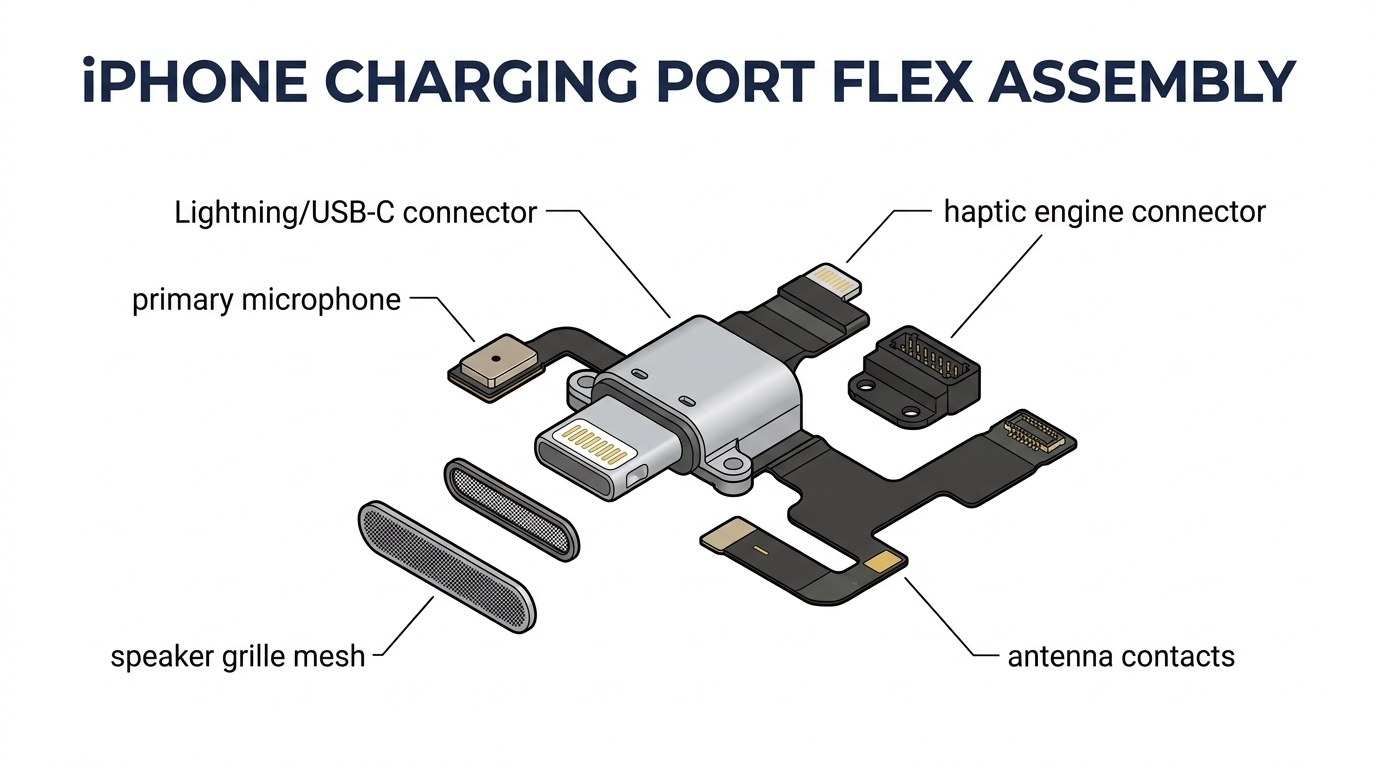
Furthermore, an iPhone charging port is rarely just a charging port. On modern iPhones, the dock assembly is a complex multi-layer flexible printed circuit (FPC) that integrates the primary voice microphone, cellular antenna contacts, Taptic Engine spring connectors, and loudspeaker grounding points. Sourcing low-grade charging assemblies or botching the installation doesn't just impact charging speed—it can kill cellular reception, cause muffled call audio, or trigger erratic vibrations.
This guide provides a comprehensive technical manual for repair shops: from diagnostic triage and parts anatomy to wholesale quality evaluation and bulk stocking strategies.
The 4 Most Common iPhone Charging Faults (and Which Ones Need a Port Replacement)
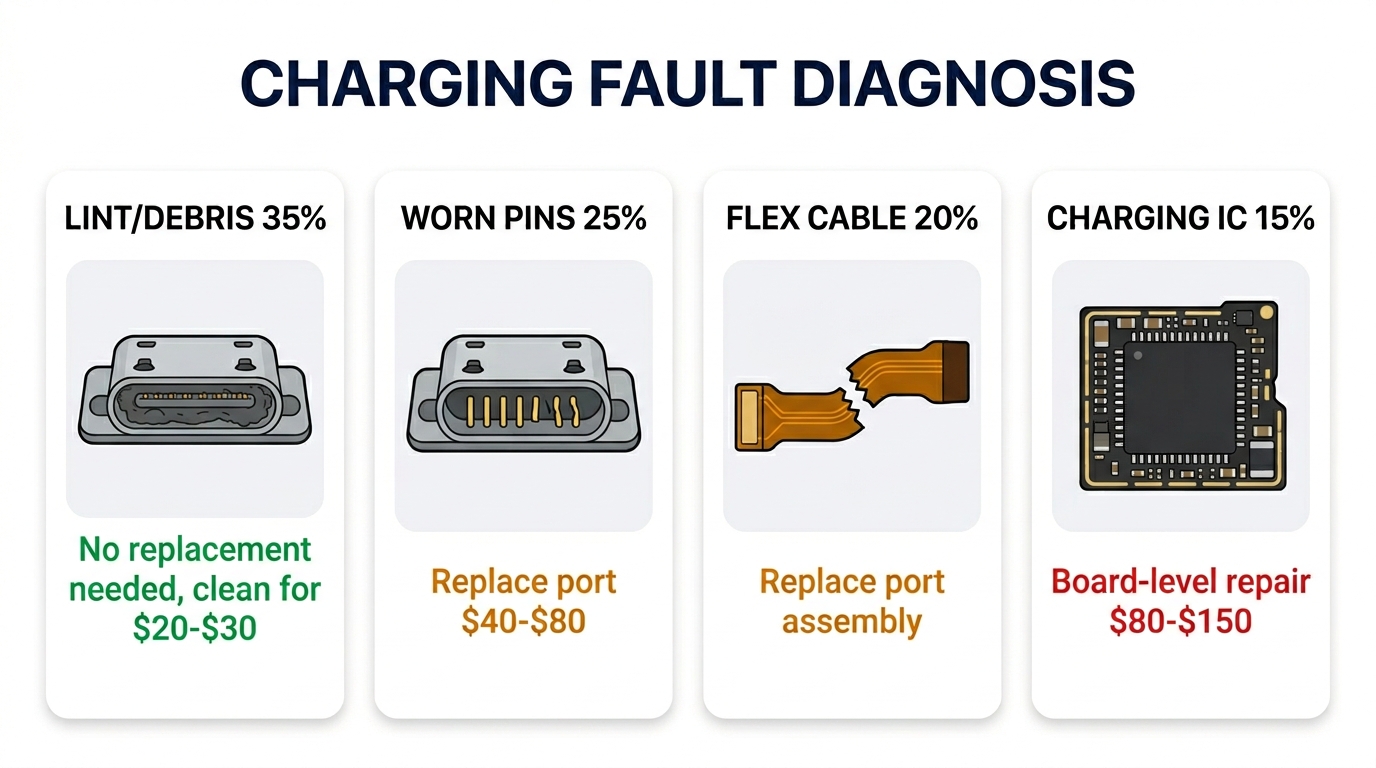
Before unscrewing a customer's device, technicians should run through a standardized diagnostic sequence to isolate the root cause:
1. Lint, Dust, and Debris Compacted in the Port Cavity
By far the most frequent cause of charging failure is compacted pocket lint. Every time a user inserts a charging cable into a pocket-carried phone, debris is driven deeper into the connector cavity. Over months, this forms a dense, non-conductive felt pad at the bottom of the port that prevents the cable from seating fully.
- Symptoms: The charging cable feels spongy upon insertion, does not click into place, wiggles excessively, or only connects when held at an upward angle.
- Shop Action: Inspect the port under a stereo microscope or bright bench light. Use an ultra-fine anti-static probe or titanium tweezers to gently scrape out the compacted lint. Do not use metal needles aggressively, which can bend or short the delicate gold-plated contact pins. Clean-outs resolve a substantial portion of walk-in charging issues and build immense customer trust when handled transparently as an express service.
2. Worn, Corroded, or Physically Bent Connector Pins
If the port cavity is clean but charging remains intermittent, inspect the internal terminal pins for mechanical wear or liquid exposure.
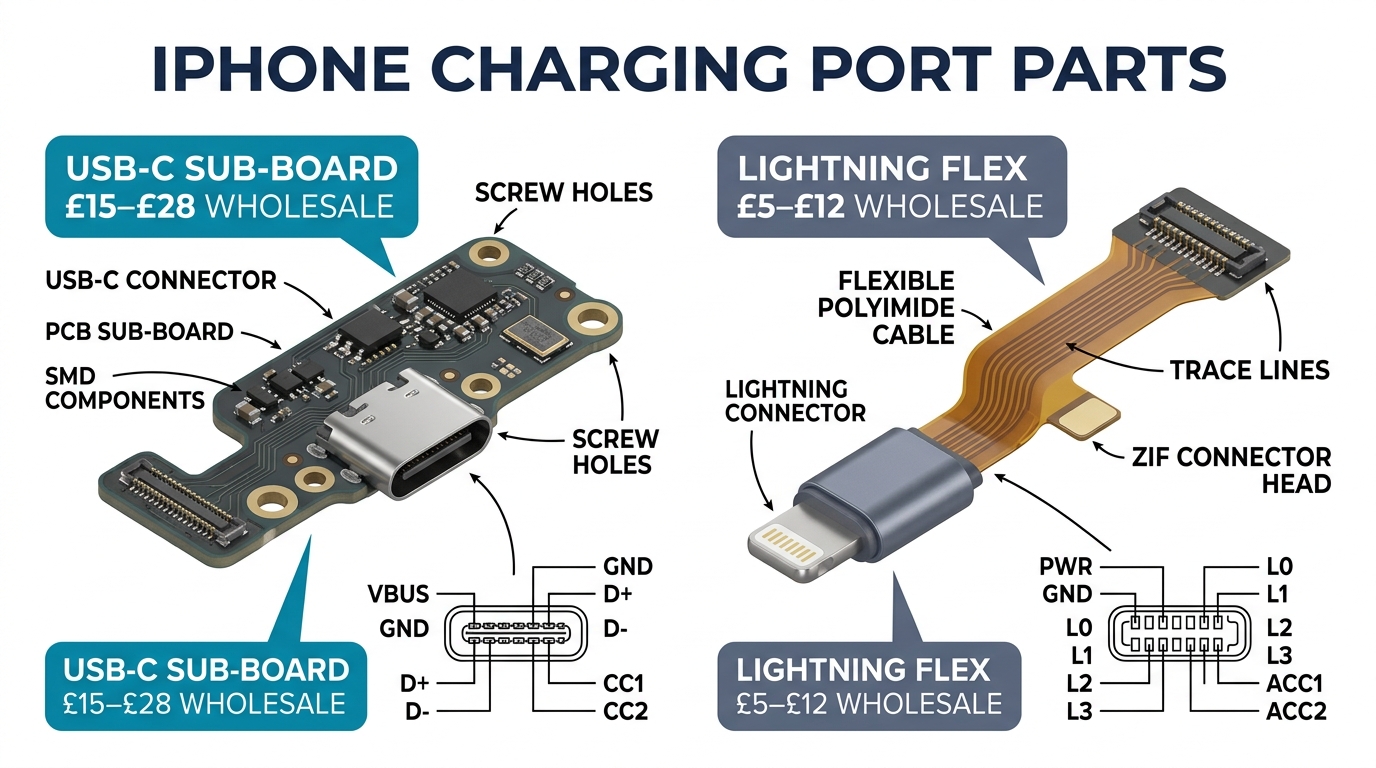
- Lightning Connectors: Rely on spring-loaded pins inside the dock that mate with the external gold pads on the Lightning plug. Exposure to moisture, counterfeit charging cables, or repetitive stress causes pitting, arcing burns (frequently on Pin 4/5 for power delivery), or flattened springs that lose retention force.
- USB-C Connectors (iPhone 15 Series and Newer): Feature a central tongue carrying 24 miniature pins. While mechanically more robust for high-wattage power delivery, bent pins on the central wafer or liquid corrosion can cause immediate short circuits or trigger iOS liquid detection warnings.
- Shop Action: Inspect pins under magnification. Corroded or bent pins cannot be reliably repaired; this fault requires a complete charging port flex replacement.
3. Internal Flex Cable Failure and Environmental Fatigue
The charging port assembly curves around the bottom chassis, hugging the loudspeaker and Taptic Engine before routing upward toward the motherboard connector.
- Causes: Severe chassis drops can cause micro-fractures in the copper traces running through the flex ribbon. Additionally, liquid ingress through bottom speaker grilles or charging ports can corrode surface-mount components, filtering chokes, or microphone acoustic membranes.
- Symptoms: Device fails to charge, fails to establish USB data transfer to a computer, exhibits a dead primary microphone (no audio in Voice Memos or phone calls), or fails to activate the Taptic Engine.
- Shop Action: Requires full replacement of the charging port flex assembly.
4. Logic Board Charging IC and Power Management Failure
When a device refuses to charge even with a known-good battery and charging assembly, the fault lies on the logic board's power management circuitry (such as the Tristar/Hydra IC on older models, or modern USB-PD power management controllers).
- Symptoms: The device displays the charging lightning bolt icon but battery percentage stays flat or drains (fake charging), draws 0.00A on an inline USB power meter, or overheats rapidly around the upper motherboard shield.
- Shop Action: This is a micro-soldering job requiring board preheating, chip removal, and reballing. Installing a new charging port flex will not resolve a board-level power management IC failure.
Diagnostic Triage Summary
| Diagnostic Test | Observation | Probable Cause | Correct Bench Action |
|---|---|---|---|
| Visual / Mechanical Probe | Cable cannot seat fully; spongy feel | Compacted pocket lint / debris | Precision clean-out under microscope |
| Microscope Pin Inspection | Burned, corroded, or bent pins | Pin fatigue or liquid arcing | Full charging port flex replacement |
| USB Power Meter Test | Draws normal 1.0A–2.4A+ steady current | Working port and charging system | Battery or software issue |
| Inline Meter: 0.00A Draw | Clean port, good cable, no current | Broken flex trace or dead PMIC | Test replacement flex before board diagnosis |
| Fake Charging | Icon shows charging; battery drops | Faulty power management IC | Board-level micro-soldering repair |
Need Charging Port Flex in Bulk?
Wholesale charging port assemblies for iPhone & Samsung — tested, factory-direct.
Get Wholesale QuoteWhat's Actually Inside a Charging Port Flex Cable Assembly?
Many repair technicians mistakenly view the charging port as a simple pass-through socket. In reality, the bottom flex assembly is one of the most component-dense sub-assemblies inside an iPhone.
Understanding its internal architecture explains why sourcing quality parts is so essential:
- Connector Block (Lightning or USB-C): The primary mechanical interface, built with high-retention stainless steel shielding, grounding tabs, and gold-plated terminal contacts.
- Primary Voice Microphone: Located at the bottom corner, this MEMS microphone captures the user's voice during standard phone calls and Voice Memos. It relies on a fine acoustic mesh and an airtight rubber acoustic gasket to block chassis resonance and isolate voice frequencies.
- Cellular Antenna Contact Springs: Gold-plated beryllium copper spring tabs that ground to the bottom frame and route RF signals to the primary cellular antenna bands. Low-grade aftermarket flex cables often feature weak spring tension, resulting in dropped cellular bars or poor signal reception.
- Taptic Engine & Loudspeaker Contact Pads: Precision solder pads or spring contacts that bridge power and audio signals to the vibration motor and bottom speaker. Misaligned pads cause crackling speaker output or dead haptic feedback.
- Barometric Pressure Vent Mesh: Microscopic venting pathways that allow internal air pressure to equalize with atmospheric pressure without letting liquid penetrate the chassis.
When you purchase a replacement dock assembly, you are purchasing an integrated sub-system. Substandard materials in any of these five areas will trigger customer callbacks.
Parts Quality: What Matters in Charging Port Assemblies
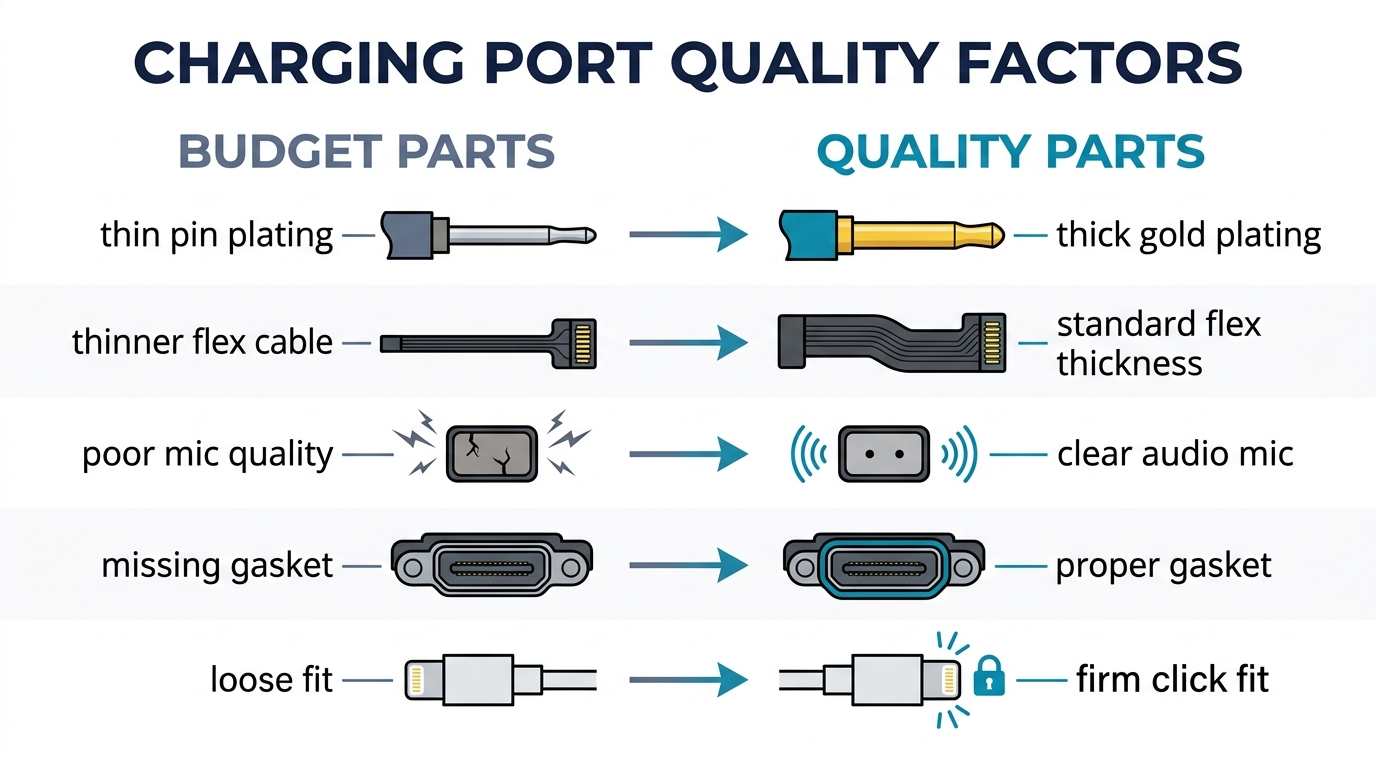
Wholesale charging port flex assemblies vary dramatically in manufacturing quality. When evaluating parts from Shenzhen suppliers, inspect these five critical parameters:
1. Connector Retention Force and Insertion Feel
A quality replacement port should provide a distinct, satisfying tactile click when a genuine cable is inserted. Substandard ports use cheap stamped alloy retaining springs that lose elasticity after a few dozen insertions. If the cable feels loose or slips out with minimal tugging, the connector will fail within weeks of customer use.
2. Microphone Acoustic Clarity and Sound Isolation
Substandard charging flex assemblies are notorious for poor microphone performance. Budget manufacturers cut costs by installing generic, low-sensitivity MEMS microphones or omitting the internal acoustic sealing gasket.
The result? Customers return complaining: "People can't hear me unless I put the phone on speakerphone." (Speakerphone uses the secondary microphone near the rear camera, masking a defective primary dock mic). Always record a 10-second test memo on the bench to verify audio volume and clarity before completing assembly.
3. Port Bezel Color Matching
The visible exterior bezel of the charging port must match the original chassis finish of the device (such as Midnight, Starlight, Silver, Space Black, or Natural Titanium). Low-tier suppliers stock generic silver or black ports and ship them indiscriminately, leaving the phone with an unsightly mismatched port. Professional wholesale suppliers categorize charging ports by exact chassis color code.
4. Flex Ribbon Trace Thickness and Durability
Quality assemblies utilize multi-layer flexible copper traces laminated between heat-resistant polyimide films. Budget flexes use paper-thin copper foil that fractures when folded along the tight contours of the iPhone speaker housing. A single micro-tear in an antenna ground trace will destroy cellular reception.
5. Screw Bracket and Grounding Hole Alignment
The charging port assembly contains multiple precision screw brackets and ground eyelets that secure to the chassis floor. If the screw holes are misaligned by even 0.3mm, tightening screws will warp the connector, distort the microphone gasket, or strip chassis threads. High-grade assemblies feature laser-aligned stamping brackets that drop into the chassis without forced bending.
Lightning vs. USB-C: Sourcing Strategy Across Generations
The transition from Apple's proprietary Lightning interface to universal USB-C across the iPhone 15 series and newer fundamentally changed charging repair dynamics:
Lightning Models (iPhone 8 through iPhone 14 Series)
- Repair Volume: Represents the overwhelming majority of current charging port repairs. As devices reach 3 to 6 years of age, physical pin fatigue and debris accumulation reach peak levels.
- Technical Considerations: Lightning assemblies feature asymmetric contacts that allow reversible insertion. Power delivery is typically capped at 20W to 27W, placing moderate thermal stress on power traces.
- Stocking Priority: High volume. Keep ample inventory for iPhone 11, iPhone 12, iPhone 13, and iPhone 14 series.
USB-C Models (iPhone 15 Series and Newer)
- Repair Volume: Still early in their lifecycle, but growing steadily as ports suffer liquid exposure or physical impact damage.
- Technical Considerations: USB-C ports manage substantially higher power delivery (up to 27W–30W+ fast charging) and high-speed data transmission. The interior tongue carries 24 miniature pins packed into a tight footprint. Solder connections and heat dissipation require higher thermal tolerances.
- Stocking Priority: Moderate to light stocking. Maintain 2 to 5 units per model in core colors for immediate walk-in readiness.
The Most Expensive Charging Port Mistake
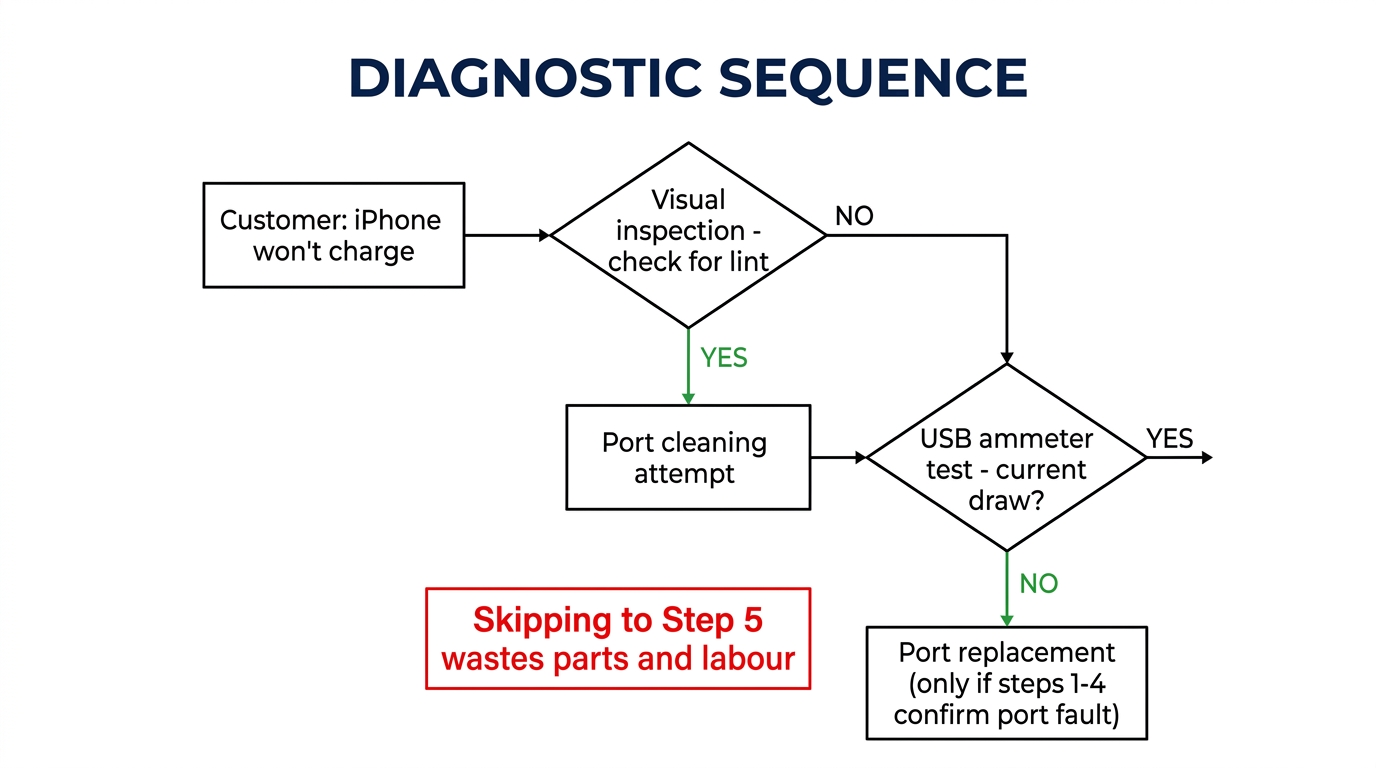
Charging port replacement is technically more involved than a simple screen or battery swap because it requires nearly complete disassembly of the lower half of the phone. Technicians must remove the display, disconnect the battery, unseat the loudspeaker, extract the Taptic Engine, and carefully release the glued flex assembly from the chassis frame.
The most expensive mistake repair shops make during this procedure is skipping pre-installation bench testing:
Imagine this all-too-common scenario:
- A technician spends 35 minutes carefully disassembling an iPhone 13, peeling out the old damaged flex, seating the new replacement, screwing in all twelve bottom brackets, re-installing the Taptic Engine and speaker, and sealing the display with water-resistant adhesive.
- The phone boots up. The phone charges perfectly.
- The customer leaves the shop happy.
- Two hours later, the customer returns furious: "Nobody can hear me on phone calls, and my cellular reception keeps dropping to one bar!"
- The shop must now reopen the freshly glued phone, waste another adhesive gasket, dismantle the entire lower assembly, and swap the defective flex cable—costing an additional 45 minutes of unpaid bench labor.
The 3-Minute Dry Bench Test Rule
To completely prevent this mistake, enforce the 3-minute dry bench test rule on every charging port repair:
- Open the phone and disconnect the battery.
- Without removing the old charging flex from the chassis, temporarily connect the new replacement flex cable directly to the logic board socket.
- Reconnect the battery and power on the device.
- Plug in a charging cable: Verify current draw on an inline USB power meter.
- Open the Voice Memos app: Record a brief voice clip to confirm primary microphone input.
- Check cellular reception: Verify that antenna bars register normally.
- Only after passing all three checks should the technician proceed with full lower-chassis teardown and permanent installation.
Model-by-Model Stocking Priorities for Repair Workshops
Because charging port assemblies are model-specific and color-matched, stocking every possible permutation is an inefficient use of capital. Prioritize your inventory based on actual bench repair velocity:
| Priority Tier | iPhone Models | Recommended Shop Stock | Color Strategy |
|---|---|---|---|
| Tier 1: Core High-Velocity | iPhone 11, 12, 12 Pro, 13, 13 Pro | 5–10 units per model | Stock primary colors: Black / Midnight, Silver / White, Blue |
| Tier 2: Steady Maintenance | iPhone 14, 14 Pro, XR, SE (2020/2022) | 3–5 units per model | Stock dominant colors: Midnight, Starlight, Black |
| Tier 3: Low-Velocity / Newer | iPhone 15, 15 Pro, iPhone X / XS, 8 | 1–3 units per model | Black / Natural Titanium; reorder on demand |
Sourcing Mistakes Repair Shops Must Avoid
- Mistake 1: Ordering Bare Connector Jacks Instead of Full Assemblies: Some suppliers sell raw replacement connector sockets for a few cents, requiring micro-soldering to splice into the existing flex. Splicing takes 30 minutes of delicate bench work and rarely matches factory durability. Always order complete, pre-assembled flex harnesses.
- Mistake 2: Ignoring Bezel Colors: Installing a silver charging port bezel into a Midnight iPhone looks amateurish. Keep your stock organized by chassis color code.
- Mistake 3: Over-Ordering Legacy Models: Carrying stacks of iPhone 7 or 8 charging ports ties up cash in declining repair categories. Focus your capital on models released between iPhone 11 and iPhone 14.
Sourcing Wholesale Charging Ports: Commercial & RMA Terms
When sourcing charging port assemblies and small parts in bulk from Shenzhen, look for established B2B supply partners with transparent commercial policies:
Transparent B2B Payment and Dispatch
- Payment via Bank Wire (T/T): Established wholesale suppliers operate strictly via Bank Wire (T/T). Consumer payment platforms carry 3% to 5% processing surcharges that inflate component prices. Bank wire ensures clean commercial invoicing, direct foreign exchange settlements, and transparent tier pricing.
- Next-Business-Day Dispatch: Look for suppliers who maintain physical inventory, conduct incoming QC verification on every batch, and dispatch packaged shipments the next business day after payment confirmation via air express couriers (DHL, FedEx, UPS) with 3 to 7 business day transit.
MOQ and Tiered Pricing
At PRSPARES, our minimum order requirements are structured to support independent repair shops:
- Mixed Orders Containing Screens: A mixed order that includes screens qualifies at just 10 pieces total across all models and categories, unlocking published 10+ wholesale tier rates across every line.
- Standalone Small Parts Orders: Sourcing charging ports and small parts without screens requires a minimum of 20 pieces total.
- Tiered Volume Brackets: Transparent wholesale pricing operates on standardized 10+, 50+, and 200+ quantity brackets.
Dependable 12-Month Small Parts Warranty
Small parts should never be treated as disposable items:
- 12-Month Coverage: All PRSPARES charging port assemblies and small parts carry a comprehensive 12-month warranty starting from delivery.
- Straightforward Proof: If a defect is identified during pre-installation bench testing, record a short video showing the failure alongside the supplier QC stamp.
- Next-Order Credit or Replacement: Once verified, the part value is credited toward your next order, refunded, or shipped as a free replacement in your subsequent consignment.
Frequently Asked Questions
What components are included in an iPhone charging port flex assembly?
An iPhone charging port flex assembly is an integrated multi-layer circuit that includes the Lightning or USB-C connector port, the primary voice microphone, cellular antenna contact springs, Taptic Engine connection pads, loudspeaker contact springs, and barometric pressure vent mesh.
How do I know if an iPhone needs a charging port replacement or just cleaning?
Inspect the port cavity under magnification with bright light. If pocket lint is compacted inside and preventing the cable from seating fully, clean it out gently with an anti-static probe. If the cavity is completely clean but terminal pins are bent, corroded, or burned, or if the primary microphone has failed, a full charging port flex replacement is required.
What is the minimum order quantity for wholesale iPhone charging ports?
At PRSPARES, standalone small parts orders have a minimum order quantity of 20 pieces across models and categories. If charging ports are ordered as part of a mixed order containing screens, the minimum is just 10 pieces total across all items, unlocking published 10+ wholesale tier pricing.
Why do some aftermarket charging ports cause poor microphone audio?
Substandard aftermarket charging flex assemblies often use low-grade generic MEMS microphones or omit the airtight acoustic isolation gasket, resulting in muffled call audio, background echo, or failure to capture voice input during regular phone calls. High-grade assemblies include factory-spec acoustic membranes and precision-molded rubber gaskets.
Does replacing an iPhone charging port affect water resistance?
Any repair that requires opening the iPhone chassis breaks the original factory adhesive seal. To restore dust and splash resistance, technicians should completely clean away old adhesive residue and install a model-specific pre-cut perimeter adhesive gasket before resealing the display assembly.
How long does wholesale shipping take for small parts orders?
Orders are bench-tested, packed, and dispatched the next business day after payment confirmation. Shipments sent via international air express couriers (DHL, FedEx, UPS) typically take 3 to 7 business days door-to-door, including customs processing.
Repair Profitably with Quality Small Parts
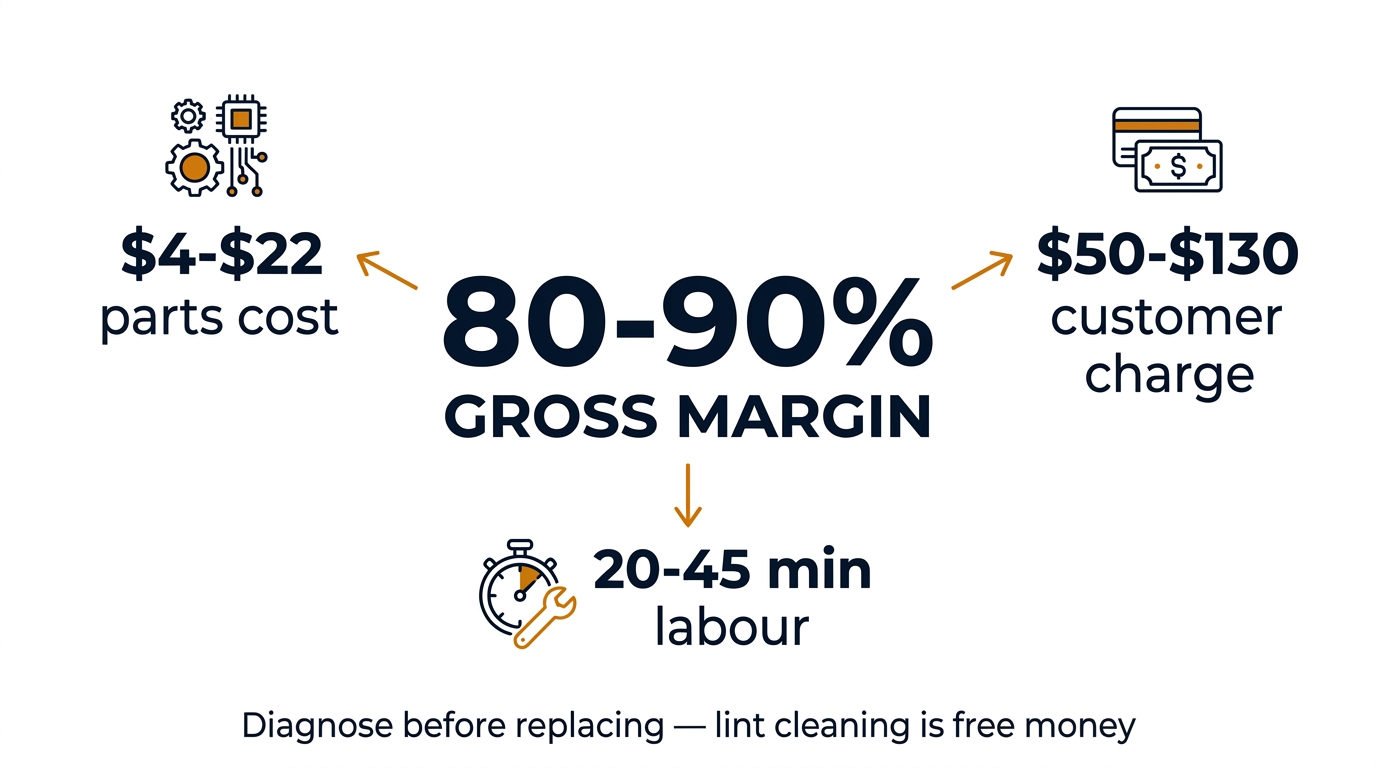
Charging port replacements provide some of the strongest labor margins on your repair menu. By mastering accurate diagnostic triage, testing assemblies before completing installation, and sourcing high-grade assemblies with verified microphone and connector quality, your shop can turn charging repairs into a consistent driver of customer satisfaction and profitability.
Explore our small parts inventory and wholesale components:
- Wholesale iPhone Charging Ports & Small Parts
- Wholesale iPhone & Smartphone Screens
- Wholesale Replacement Batteries
- Warranty and RMA Policy Details
- How to Choose a Reliable Phone Parts Supplier
Ready to stock high-grade charging port assemblies for your repair bench? Submit a wholesale inquiry or request pricing to test sample assemblies with next-business-day dispatch.