
iPhone 12 Screen Replacement Cost in 2026: Is It Still Worth Repairing?
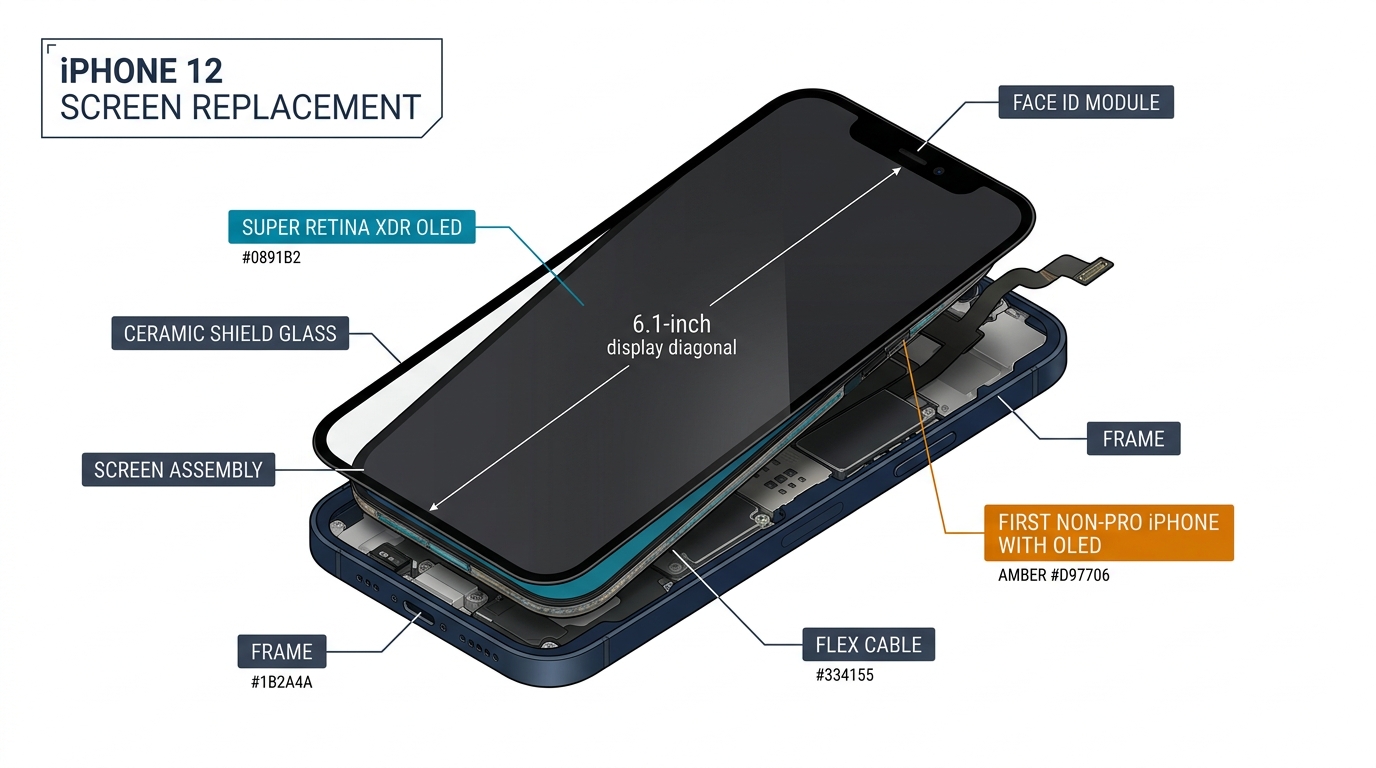
The iPhone 12 sits in an interesting middle ground in 2026. The iPhone 12 screen replacement cost ranges from $18 for a budget DIY Incell to $279 at Apple — but at six years old, whether any of those options makes sense depends on numbers that most guides ignore. With 5G, MagSafe, and Ceramic Shield glass, the iPhone 12 is more capable than the iPhone 11 — but it's firmly in the "aging" category where repair cost needs careful weighing against the phone's declining value. It's also the phone that changed the screen replacement equation: the first standard iPhone to ship with an OLED display.
That OLED detail matters for repair decisions. Unlike the iPhone 11 (which used LCD, so a cheap Incell replacement matched the original), the iPhone 12's original Super Retina XDR OLED display means that an Incell LCD replacement is a visible downgrade. Customers who don't know this end up disappointed. Shops that don't explain it end up with callbacks.
This guide covers the real iPhone 12 screen replacement cost in 2026, which screen grade actually makes sense, the phone's current residual value, and where the repair margins sit for shops still servicing this model.
Sourcing Replacement Screens in Bulk?
Incell / Hard OLED / Soft OLED grades — wholesale pricing, grade comparison on request.
Get Wholesale QuoteHow Much Does iPhone 12 Screen Replacement Cost in 2026?
The iPhone 12 screen replacement cost varies significantly depending on the repair channel and the screen grade used.
| Repair Channel | Cost Range | Screen Type Used | Warranty |
|---|---|---|---|
| Apple (Out-of-Warranty) | $279 / £229 | OEM Original OLED | 90 days |
| Apple (AppleCare+) | $29 / £25 | OEM Original OLED | AppleCare term |
| Third-Party Shop (Premium) | $130–$200 | Soft OLED | 30–180 days |
| Third-Party Shop (Mid-Tier) | $90–$150 | Hard OLED | 30–180 days |
| Third-Party Shop (Budget) | $60–$100 | Incell LCD | 30–90 days |
| DIY (iFixit Kit) | $53–$120 | Soft OLED | Lifetime (iFixit) |
| DIY (Amazon/AliExpress) | $18–$40 | Incell LCD / Hard OLED | Varies |
See the full four-grade comparison with live wholesale prices: iPhone Screen Grade Guide
Apple charges $279 in the US for an out-of-warranty iPhone 12 screen replacement — the same price as the iPhone 13, because both phones use OLED displays. This is $80 more than Apple charges for the iPhone 11 ($199), which reflects the jump from LCD to OLED technology.
Third-party shops typically charge $60–$200 depending on screen grade. The wide range exists because the quality gap between an Incell LCD ($60–$100) and a Soft OLED ($130–$200) is much larger on the iPhone 12 than on the iPhone 11, where Incell matched the original display technology.
For a complete cost comparison across all iPhone models, see our iPhone screen replacement cost guide.
iPhone 12 Screen Grades: Why Incell Is a Downgrade
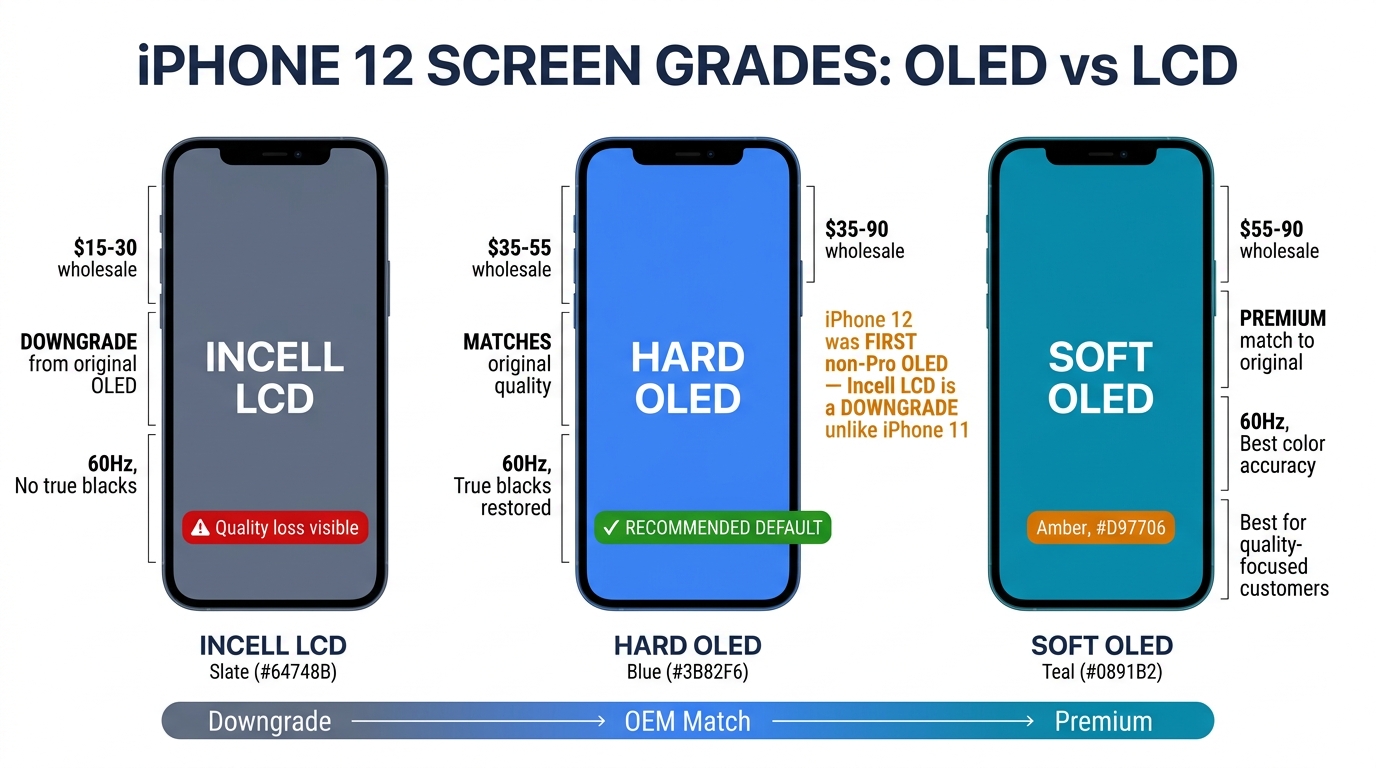
This is the most important thing to understand about iPhone 12 screen replacement — and the point where this model differs fundamentally from the iPhone 11.
The iPhone 12 shipped with a Super Retina XDR OLED display. It was the first non-Pro iPhone to use OLED. That means Incell LCD is no longer a "match" for the original — it's a downgrade. Any customer who's used to the iPhone 12's original screen will notice the difference with Incell.
Incell LCD — Budget Option (Downgrade from Original)
Incell LCD screens for the iPhone 12 cost $12–$20 wholesale in bulk. They use backlit LCD technology with the touch layer integrated into the liquid crystal cell — fundamentally different from the original OLED.
What the customer sees: no true blacks (the backlight is always on), lower contrast ratio, slightly washed-out colours, and a cooler colour temperature. In a dark room, the difference is obvious — OLED shows pure black, while Incell shows a dark grey glow.
This matters because many iPhone 12 owners have used OLED for six years. They know what their screen looked like. Putting an Incell in an iPhone 12 feels like a downgrade in a way that Incell in an iPhone 11 doesn't, because the iPhone 11's original was also LCD.
Best for: Customers on a tight budget who understand it's a downgrade. Backup phones and secondary devices. Customers who plan to upgrade within a few months and just need the phone functional.
Hard OLED — The Practical Choice
Hard OLED screens use an organic light-emitting diode panel on a rigid glass substrate. Wholesale cost is $30–$50 per unit. Display quality is significantly better than Incell: true blacks, strong contrast, and colour accuracy that's close to the original.
The main trade-off is the rigid substrate — it's slightly more fragile on impact than Apple's original flexible OLED. Some Hard OLED panels also run marginally dimmer at peak brightness. But in everyday use, most customers can't distinguish a Hard OLED from the original screen.
For the iPhone 12, Hard OLED is the sweet spot. It restores the OLED experience the customer expects without the premium price of Soft OLED. This is the grade most shops should recommend as their standard offering.
Best for: Standard iPhone 12 repairs. The default recommendation for most customers. Any repair where the customer expects the phone to look like it did before.
Soft OLED — Premium Restoration
Soft OLED uses a flexible plastic substrate, matching Apple's original display construction. Wholesale cost is $50–$80 per unit — the most expensive aftermarket option, but still far less than Apple's replacement.
Display quality is near-identical to the original: same deep blacks, same contrast ratio, similar brightness and colour accuracy. The flexible substrate also provides better drop resistance than Hard OLED. For a customer who wants the phone back to exactly how it was, Soft OLED is the answer.
Best for: Premium repairs on well-maintained iPhone 12s. Customers who plan to keep or resell the phone. Shops charging top-tier prices and positioning themselves as quality-first.
Grade Comparison Table
| Screen Grade | Wholesale Cost | vs Original Display | True Blacks | Best For |
|---|---|---|---|---|
| Incell LCD | $12–$20 | Downgrade | No | Budget repairs, temporary fixes |
| Hard OLED | $30–$50 | Close to original | Yes | Standard repairs, best value |
| Soft OLED | $50–$80 | Near-identical | Yes | Premium repairs, resale prep |
| OEM Original | $120–$180 | Identical | Yes | OEM-spec restoration |
For a detailed comparison of these screen technologies, see our Soft OLED vs Hard OLED vs Incell guide.
Is the iPhone 12 Still Worth Repairing? The Real Numbers
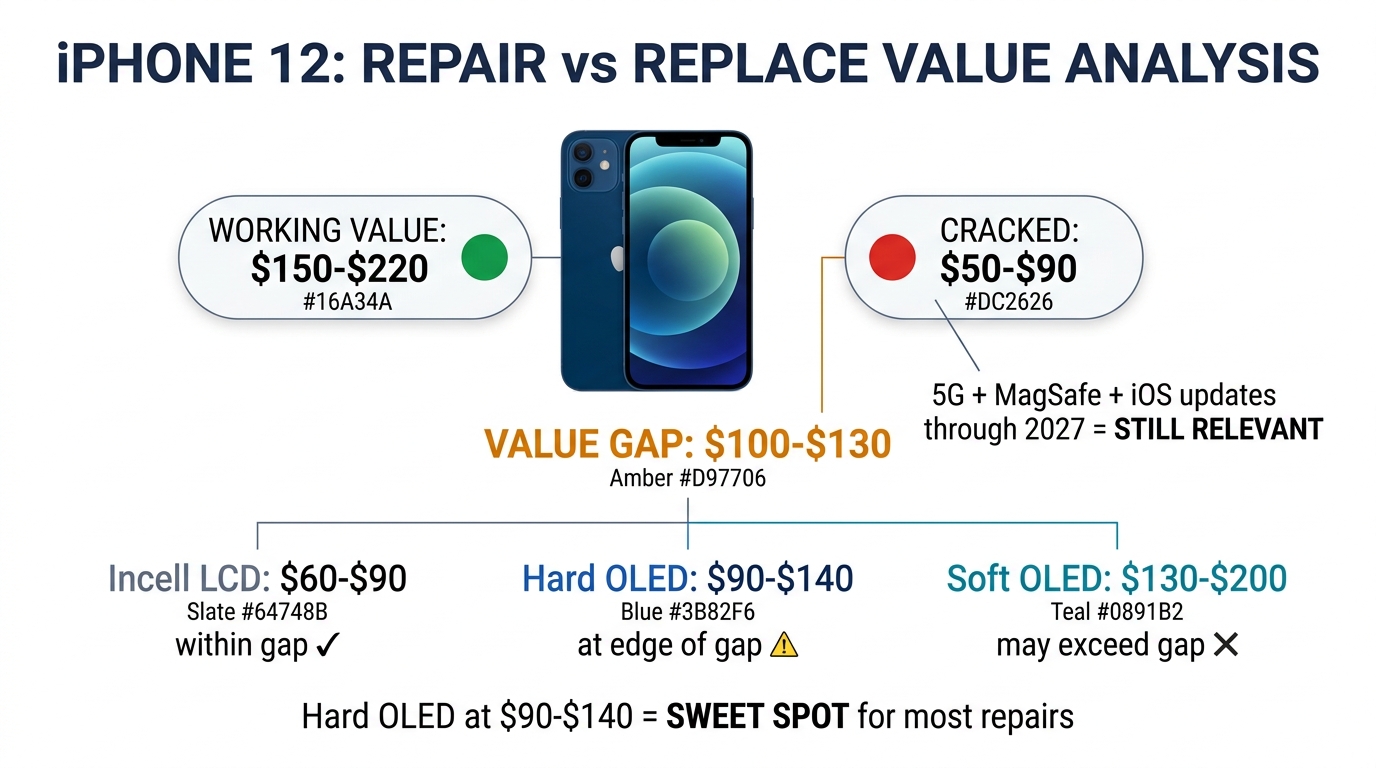
The iPhone 12 is in better shape than the iPhone 11 for repair economics, thanks to two factors: higher residual value and features (5G, MagSafe) that keep it relevant longer. But it's still a 6-year-old phone, so the numbers need to work.
iPhone 12 Residual Value in 2026
As of early 2026, a used iPhone 12 (64GB, good condition) sells for approximately:
- Trade-in to Apple: $150
- Resale (Swappa/eBay): $150–$220
- Trade-in (carrier programs): $100–$170
- Cracked screen condition: $60–$100
A working iPhone 12 is worth $150–$220. A cracked one drops to $60–$100. That $90–$120 gap is what makes screen replacement worth it — the repair cost needs to fall well below that gap.
The Repair vs. Replace Calculation
| Scenario | Cost | Outcome |
|---|---|---|
| Repair at Apple | $279 | Same phone, OEM screen — exceeds phone value, doesn't make sense |
| Repair at shop (Hard OLED) | $90–$150 | Same phone, OLED-quality screen — makes clear sense |
| Repair at shop (Incell LCD) | $60–$100 | Same phone, downgraded screen — makes sense if budget is tight |
| DIY (Hard OLED kit) | $35–$55 | Same phone, OLED screen — cheapest quality option |
| Sell cracked + buy used iPhone 14 | $250–$350 net | Newer phone, same 5G + better camera |
Apple's $279 repair doesn't make financial sense for iPhone 12 in 2026. The repair cost exceeds what the phone is worth. Third-party Hard OLED repairs at $90–$150 are the sweet spot — restoring the OLED experience at a fraction of the phone's post-repair value.
The break-even point: iPhone 12 screen replacement stops making financial sense when total repair cost exceeds about $150. Below that, repair wins. Above that, the customer should consider putting money toward a newer model — particularly if other components (battery, charging port) also need attention.
When It Still Makes Sense to Repair
The iPhone 12 has several advantages over the iPhone 11 that extend its repair viability:
- 5G support. The iPhone 12 was the first iPhone with 5G. In 2026, that's still the current network standard. The iPhone 11 doesn't have 5G, which limits its future usefulness.
- MagSafe compatibility. The iPhone 12 works with the entire MagSafe accessory ecosystem — chargers, wallets, mounts. This adds practical value that the iPhone 11 lacks.
- Ceramic Shield glass. The front glass is more durable than the iPhone 11's, which means the phone is better protected after repair.
- iOS 18 support. The iPhone 12 runs iOS 18 and should receive security updates through at least 2027.
- The phone works perfectly otherwise. Battery health above 80%, no other issues — a $100–$130 Hard OLED screen repair extends the phone's life another 1–2 years.
When Replacement Makes More Sense
- Battery health is below 75%. Screen repair plus battery replacement pushes cost to $120–$180, approaching the phone's residual value.
- Multiple issues exist. Charging port problems, back glass damage, or camera defects stack up quickly. Two or more repairs on a 6-year-old phone rarely make economic sense.
- The customer wants a noticeable upgrade. The iPhone 14 offers the same OLED display, better cameras, crash detection, and satellite SOS — and used iPhone 14s are increasingly affordable.
iPhone 12 Screen Replacement Margins for Repair Shops
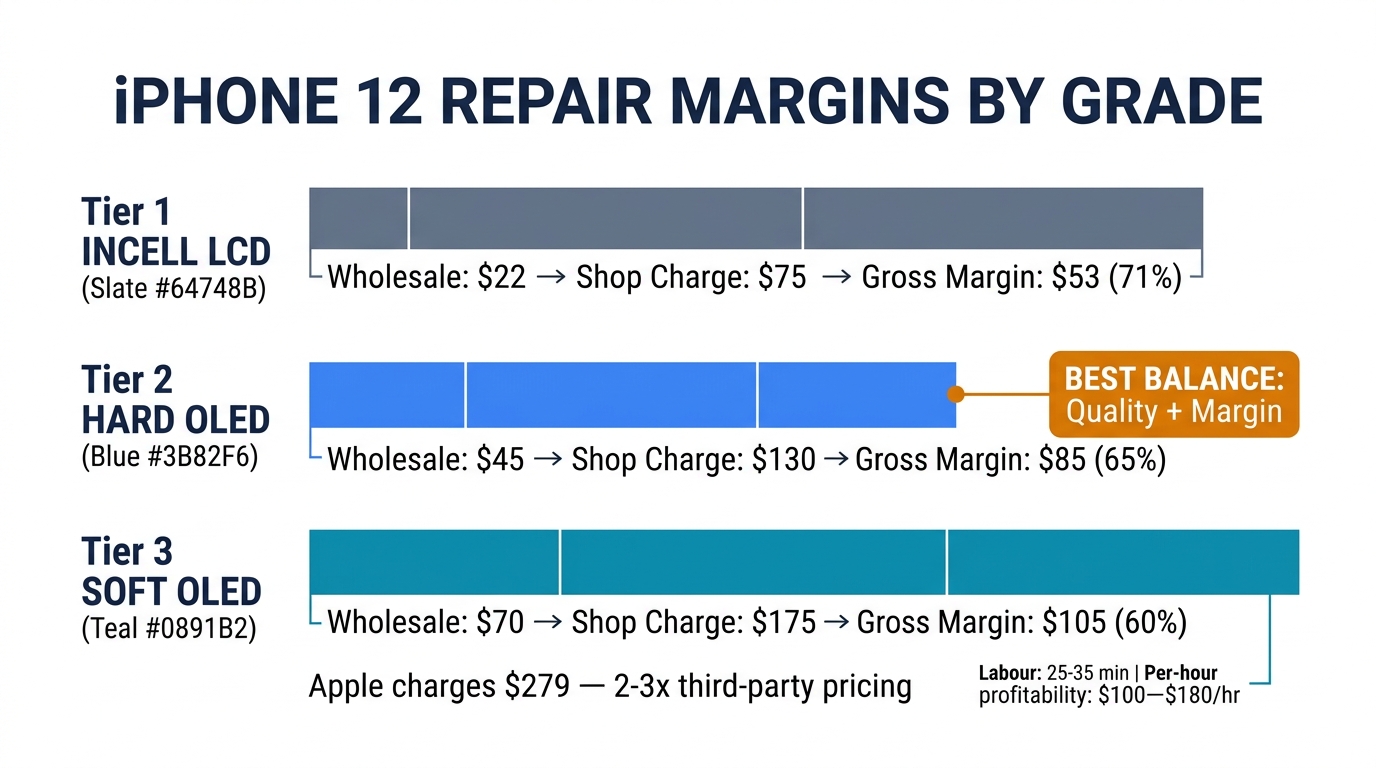
For repair shops, iPhone 12 screen repairs generate strong margins — better per-unit than iPhone 13 for Incell and Hard OLED due to similar charge-out rates but slightly lower wholesale costs on some grades.
US Market Margins
| Screen Grade | Wholesale Cost | Typical Charge | Gross Margin | Margin % |
|---|---|---|---|---|
| Incell LCD | $15 | $79 | $64 | 81% |
| Hard OLED | $40 | $129 | $89 | 69% |
| Soft OLED | $65 | $179 | $114 | 64% |
UK Market Margins
| Screen Grade | Wholesale Cost | Typical Charge (UK) | Gross Margin | Margin % |
|---|---|---|---|---|
| Incell LCD | £12 | £59 | £47 | 80% |
| Hard OLED | £32 | £99 | £67 | 68% |
| Soft OLED | £52 | £139 | £87 | 63% |
Hard OLED is the margin sweet spot for iPhone 12. It delivers the best combination of absolute margin ($89 per repair) and customer satisfaction (restores the OLED experience the customer expects). Incell has higher percentage margins but generates more "it doesn't look like my old screen" complaints.
Soft OLED produces the highest absolute margin at $114 per repair, but the higher wholesale cost means more cash tied up in inventory. For shops doing moderate iPhone 12 volume (5–10 per week), Hard OLED is the most capital-efficient grade to stock.
Stocking iPhone 12 screens? We supply Incell LCD, Hard OLED, and Soft OLED screens for the iPhone 12 at wholesale pricing. Hard OLED is our most popular grade for this model — it matches the OLED experience customers expect at the best margin ratio. Request a quote to see bulk pricing and sample options.
For more on structuring repair prices by screen grade, see our phone screen repair pricing strategy guide.
The iPhone 12 Repair Lifecycle: Where We Are in 2026
Understanding where the iPhone 12 sits in its lifecycle helps shops plan inventory and set customer expectations.
Peak repair volume (2022–2024): The iPhone 12 was among the top 3 most-repaired models in most shops. AppleCare+ coverage had expired, and the phone was still a primary daily driver for millions.
High-volume phase (2024–2025): Repair volume remained strong as phones entered their 4th and 5th years. Battery replacements became common alongside screen repairs. 5G support kept the phone relevant while competitors without 5G (iPhone 11) started losing owners.
Declining but significant phase (2026): Volume is dropping as owners upgrade to iPhone 14 and iPhone 15, but demand remains meaningful. The phone's 5G support and MagSafe compatibility give it more staying power than the iPhone 11, which is declining faster.
For inventory planning: Keep 2–4 Hard OLED units on hand for walk-in demand. Don't overstock Incell — customers who know their phone had OLED tend to reject the LCD downgrade when they see it in person. Stock Soft OLED only if you have consistent premium iPhone 12 repair volume. For a broader inventory strategy, see our small repair shop stock guide.
Common iPhone 12 Screen Replacement Mistakes
Defaulting to Incell LCD Without Explaining the Downgrade
This is the single biggest mistake shops make on iPhone 12 repairs. Technicians who are used to iPhone 11 (where Incell matches the original LCD) sometimes default to Incell for iPhone 12 without telling the customer it's a downgrade from their original OLED display.
The customer picks up the phone, opens it in a dim room, and immediately sees grey instead of black. They come back the next day thinking the screen is defective. It's not defective — it's LCD technology doing exactly what LCD does. But the shop didn't set expectations.
Always explain: "Your iPhone 12 came with an OLED screen. The budget option is LCD, which works fine but has lower contrast — you'll notice the difference. For the same visual quality as your original, I'd recommend our OLED option."
Ignoring Battery Health During Screen Repair
An iPhone 12 coming in for a screen repair in 2026 is 5–6 years old. Battery health is almost certainly degraded. Check it before quoting the repair and offer a combo price. A $5–$8 battery adds $30–$50 in revenue while the phone is already open. For battery quality guidance, see our iPhone battery quality guide.
Pricing Against Apple's $279 Instead of the Phone's Value
Apple's $279 is irrelevant for iPhone 12 repair pricing in 2026. The phone is worth $150–$220 — no rational customer will pay $279 to fix it. Price your repair against the phone's actual residual value, not Apple's rate. A $99–$149 Hard OLED repair feels right for a 6-year-old phone. A $250 repair feels wrong regardless of quality.
Not Mentioning the Face ID Flex Transfer
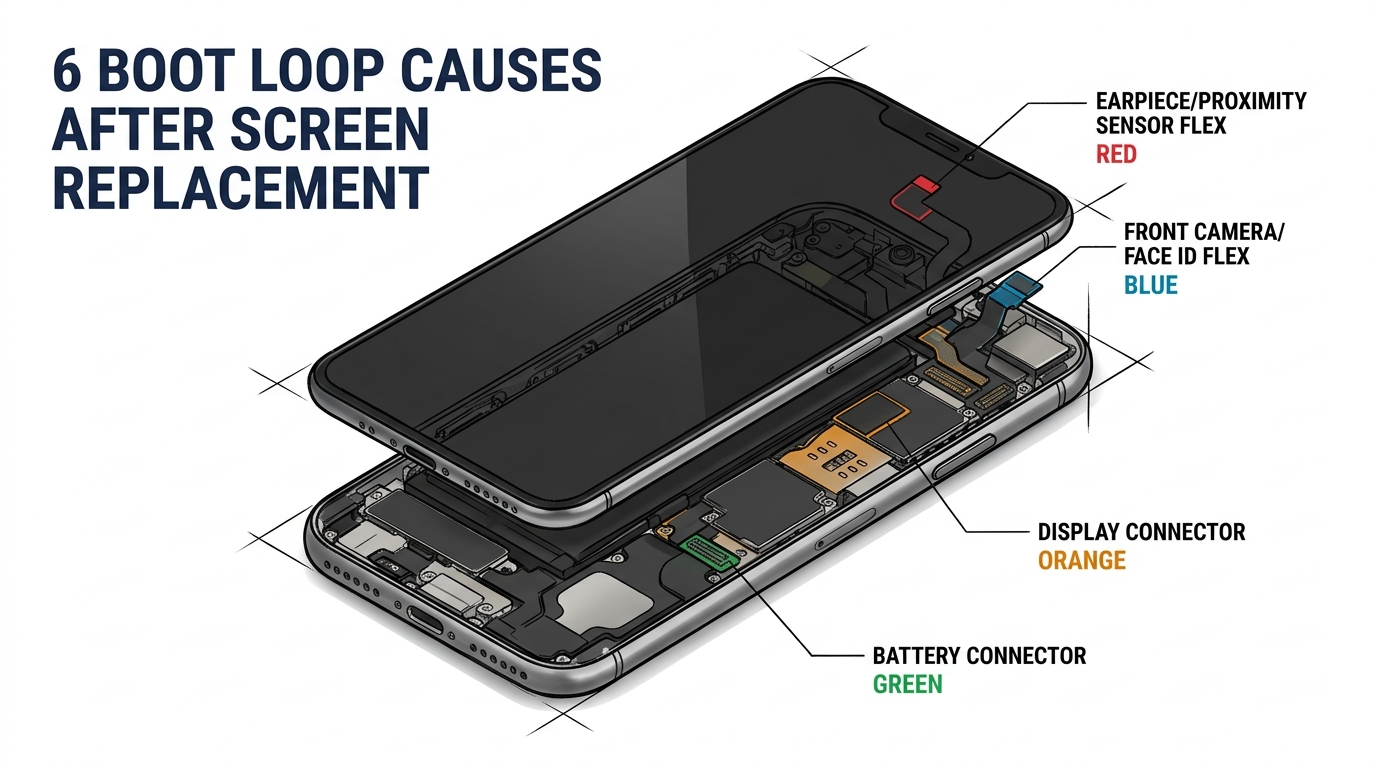
Like the iPhone 13, the iPhone 12 requires careful transfer of the earpiece speaker and proximity sensor flex cable from the original screen to the replacement. If this isn't done properly, Face ID can stop working. Always test Face ID before returning the phone.
Frequently Asked Questions
How much does it cost to replace an iPhone 12 screen in 2026?
Apple charges $279 for iPhone 12 screen replacement, but most third-party shops charge $60–$200 depending on screen grade. Budget Incell LCD repairs cost $60–$100 at a shop or $18–$40 for DIY. Hard OLED repairs (which restore the original OLED experience) cost $90–$150 at a shop. Soft OLED (near-identical to original) costs $130–$200 at a shop. For most iPhone 12 owners, a $90–$150 Hard OLED repair is the best value.
Is it worth replacing the screen on an iPhone 12 in 2026?
At a third-party shop with Hard OLED, yes — if the phone is otherwise in good condition. A working iPhone 12 is worth $150–$220, and Hard OLED screen repairs cost $90–$150. The math works clearly. Apple's $279 repair doesn't make sense because it exceeds the phone's value. The iPhone 12's 5G support and MagSafe compatibility make it more worth repairing than the iPhone 11, which lacks both features.
Should I get Incell LCD or OLED for iPhone 12 screen replacement?
OLED (Hard OLED or Soft OLED) is strongly recommended for iPhone 12. Unlike the iPhone 11, the iPhone 12 originally shipped with an OLED display. Incell LCD is a noticeable downgrade — lower contrast, no true blacks, and washed-out colours compared to the original. Hard OLED at $30–$50 wholesale restores the OLED experience and is the best value choice. Only choose Incell if budget is the absolute priority and the customer understands the trade-off.
Does replacing the iPhone 12 screen affect Face ID?
It can, if the earpiece speaker and proximity sensor flex cable aren't properly transferred from the original screen. With careful handling and a quality replacement screen, Face ID continues working normally. Shops should always test Face ID before returning the phone to the customer. This is the most common source of callbacks on iPhone 12 screen repairs.
How does iPhone 12 screen replacement compare to iPhone 11 and iPhone 13?
The iPhone 12 sits between the two in both cost and complexity. Apple charges $199 for iPhone 11 (LCD), $279 for iPhone 12 and 13 (both OLED). The key difference: iPhone 11 Incell LCD matches the original, while iPhone 12 and 13 Incell is a downgrade from the original OLED. iPhone 12 wholesale screen costs are slightly lower than iPhone 13 across all grades. For detailed comparisons, see our iPhone 11 and iPhone 13 screen replacement guides.
Still Worth Repairing — With the Right Grade
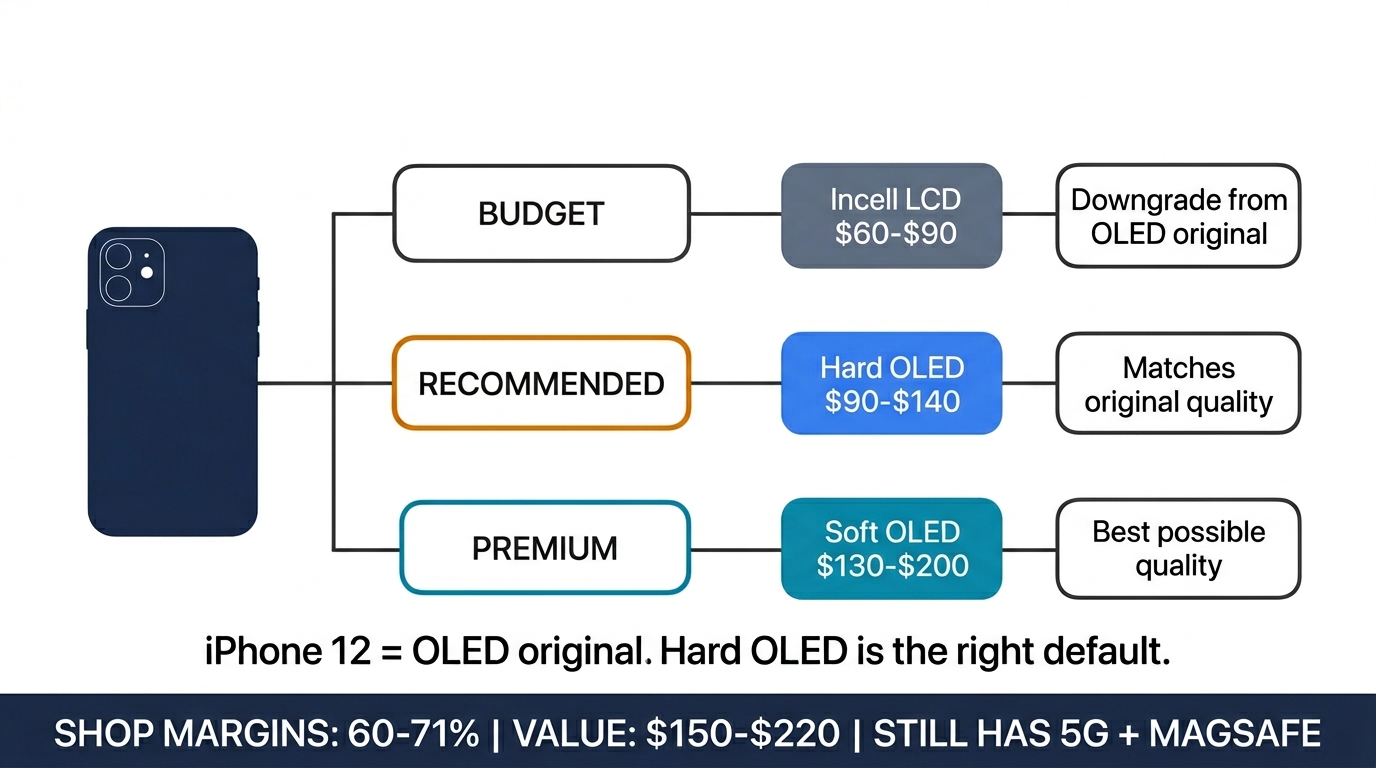
The iPhone 12 screen replacement is still worth it in 2026, but the grade selection matters more than on any previous model. Because the iPhone 12 was the first non-Pro iPhone with OLED, using Incell LCD creates a visible downgrade that most customers won't accept — or won't understand until they see it. Hard OLED is the right default for this phone.
At $90–$150 for a Hard OLED repair, the numbers work. The phone is worth $150–$220, it has 5G, MagSafe, and iOS 18 support, and a screen repair extends its useful life by 1–2 years. For repair shops, Hard OLED delivers $89 gross margin per repair at 69% — the best balance of profit and customer satisfaction on this model.
Stock Hard OLED as your default iPhone 12 grade, offer Soft OLED as the premium tier, and always check the battery while the phone is open. That's the iPhone 12 playbook for 2026.
Need wholesale iPhone 12 screens? We supply tested Incell LCD, Hard OLED, and Soft OLED screens for the iPhone 12 series at bulk pricing. Request a wholesale quote to get grade samples and volume pricing for your shop.