
Phone Screen Repair Pricing Strategy: How to Set Prices That Maximize Profit Per Repair

Most repair shop owners set their phone screen repair pricing by checking what the shop down the street charges and matching it — maybe undercutting by $10. This is how you end up in a race to the bottom where everyone's busy but nobody's profitable.
The repair shops that consistently earn $60-80 profit per screen repair (instead of $25-35) aren't charging wildly more. They're pricing smarter: offering multiple tiers, matching screen grade to customer willingness to pay, and understanding their true per-repair cost — not just the screen price.
This guide gives you a pricing framework built around actual wholesale screen costs and real-world repair margins. No theory — specific numbers you can adapt to your market.
Sourcing Replacement Screens in Bulk?
Incell / Hard OLED / Soft OLED grades — wholesale pricing, grade comparison on request.
Get Wholesale QuoteWhy Most Phone Screen Repair Pricing Is Wrong
The typical repair shop makes one of three pricing mistakes:
Mistake 1: Single-price model. You charge $129 for an iPhone 14 screen repair, regardless of whether you're installing a $12 Incell or a $45 Soft OLED. Your profit swings from $72 to $39 based on which screen you use — but the customer doesn't know or choose. You're leaving money on the table.
Mistake 2: Cost-plus without knowing your true costs. You buy a screen for $25, add $60 labor, and charge $85. But you forgot the $4 in adhesive and tools, the $8 in rent per repair hour, and the 2% redo rate. Your real margin is $48, not $60.
Mistake 3: Competing on price alone. Undercutting competitors by $20 attracts price-sensitive customers who leave 1-star reviews when anything isn't perfect and never come back for repeat business. Meanwhile, you're working harder for less.
The True Cost of a Screen Repair
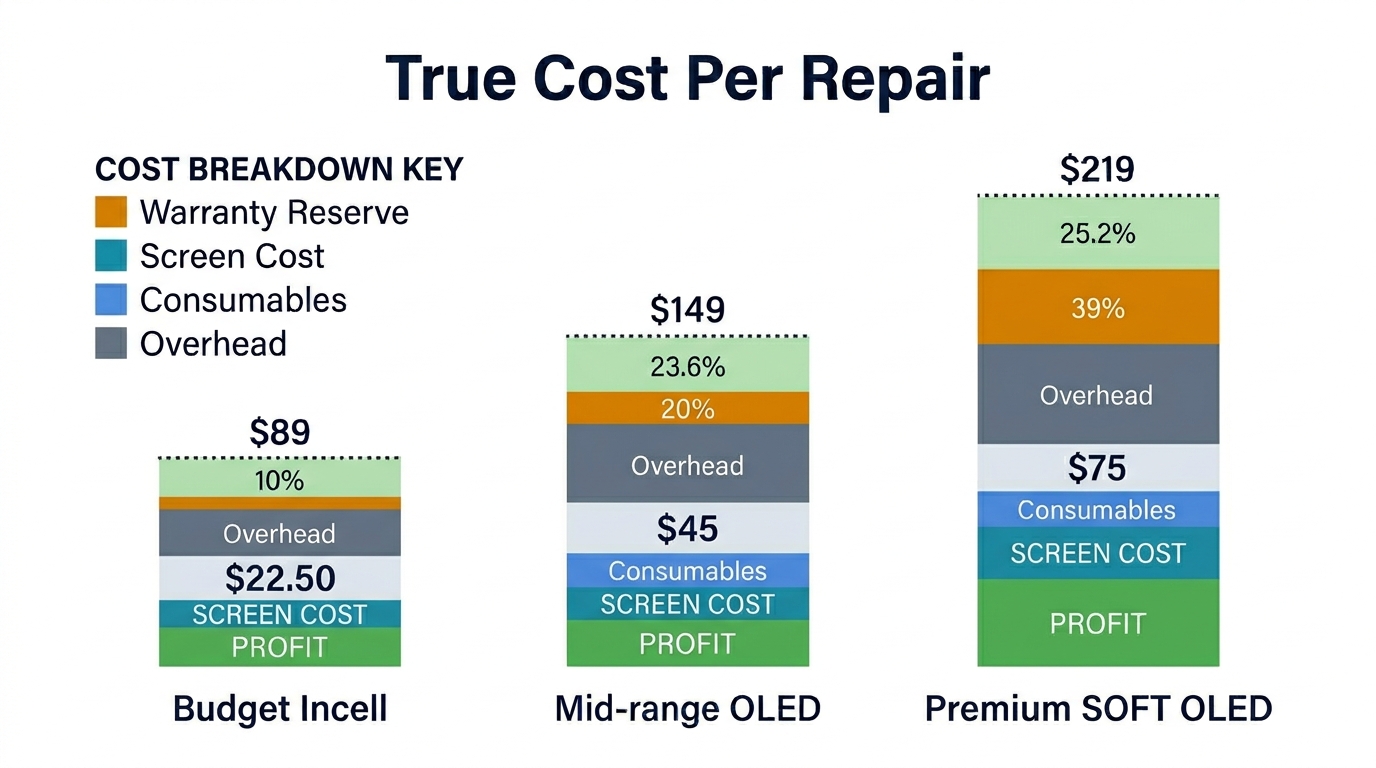
Before setting prices, you need to know what each repair actually costs you. Most shops only track screen cost — but that's typically just 40-55% of your true per-repair expense.
Fixed Costs Per Repair Hour
Calculate your monthly overhead and divide by your productive repair hours:
| Cost Category | Typical Monthly Cost | Per Hour (at 160 repair hours/month) |
|---|---|---|
| Rent | $1,500-3,000 | $9.40-18.75 |
| Utilities + internet | $200-400 | $1.25-2.50 |
| Insurance | $150-300 | $0.94-1.88 |
| POS/software | $50-150 | $0.31-0.94 |
| Marketing/advertising | $300-800 | $1.88-5.00 |
| Total overhead per hour | $13.78-29.07 |
A screen repair takes 20-40 minutes depending on the model. At 30 minutes average, your overhead allocation per repair is roughly $7-15.
Variable Costs Per Repair
| Item | Cost |
|---|---|
| Screen (wholesale) | $12-55 depending on grade |
| Adhesive, seals, screws | $1-3 |
| Tools wear/replacement | $0.50-1.00 |
| Warranty reserve (2-3% redo rate) | $2-4 |
| Total variable cost | $15.50-63.00 |
Your Real Cost Per Repair
Total cost = Overhead allocation + Variable costs
- Budget Incell repair: $7 + $15.50 = $22.50
- Mid-range Hard OLED repair: $10 + $35 = $45
- Premium Soft OLED repair: $12 + $63 = $75
Any price above these numbers is your actual profit. Below these numbers, you're losing money — even if it feels like you're making $50 per screen.
The Tiered Pricing Model: Good, Better, Best
The single most effective pricing change a repair shop can make is offering customers a choice of screen grades at different price points. This is standard practice in auto repair, dentistry, and dozens of other service industries — yet most phone repair shops still offer one option.
How Tiered Pricing Works
For each phone model, offer 2-3 repair options:
Example: iPhone 14 Pro Max Screen Repair
| Tier | Screen Grade | Your Cost | Your Price | Profit | Margin |
|---|---|---|---|---|---|
| Standard | Incell LCD | $22.50 | $89 | $66.50 | 75% |
| Premium | Hard OLED | $45 | $149 | $104 | 70% |
| Original Quality | Soft OLED | $75 | $219 | $144 | 66% |
See the full four-grade comparison with live wholesale prices: iPhone Screen Grade Guide
Example: Samsung Galaxy S24 Ultra Screen Repair
| Tier | Screen Grade | Your Cost | Your Price | Profit | Margin |
|---|---|---|---|---|---|
| Standard | Aftermarket AMOLED | $85 | $189 | $104 | 55% |
| Premium | Refurbished Original | $135 | $269 | $134 | 50% |
| Original Quality | Service Pack | $210 | $349 | $139 | 40% |
Why Tiered Pricing Works
- Customers self-select: Budget customers choose Standard and are happy. Premium customers choose Original Quality and are happy. Nobody feels overcharged.
- Your average profit increases: In practice, about 20% choose Standard, 50% choose Premium, and 30% choose Original Quality. That middle tier generates the most volume AND the highest absolute profit.
- Fewer complaints: When a customer specifically chose the budget option, they're less likely to complain about minor quality differences. They made an informed choice.
- Upsell is natural: "For $60 more, you get an OLED screen with deeper blacks and better color accuracy" is an easy conversation. You're educating, not selling.
Need wholesale screens across multiple grades for tiered pricing? We supply all tiers — from Incell to Soft OLED — with consistent quality at each level. Get grade-specific pricing.
How to Price by Phone Model
Not every phone model should use the same markup formula. Newer, more expensive phones support higher repair prices because the customer's alternative (buying a new phone) costs more.
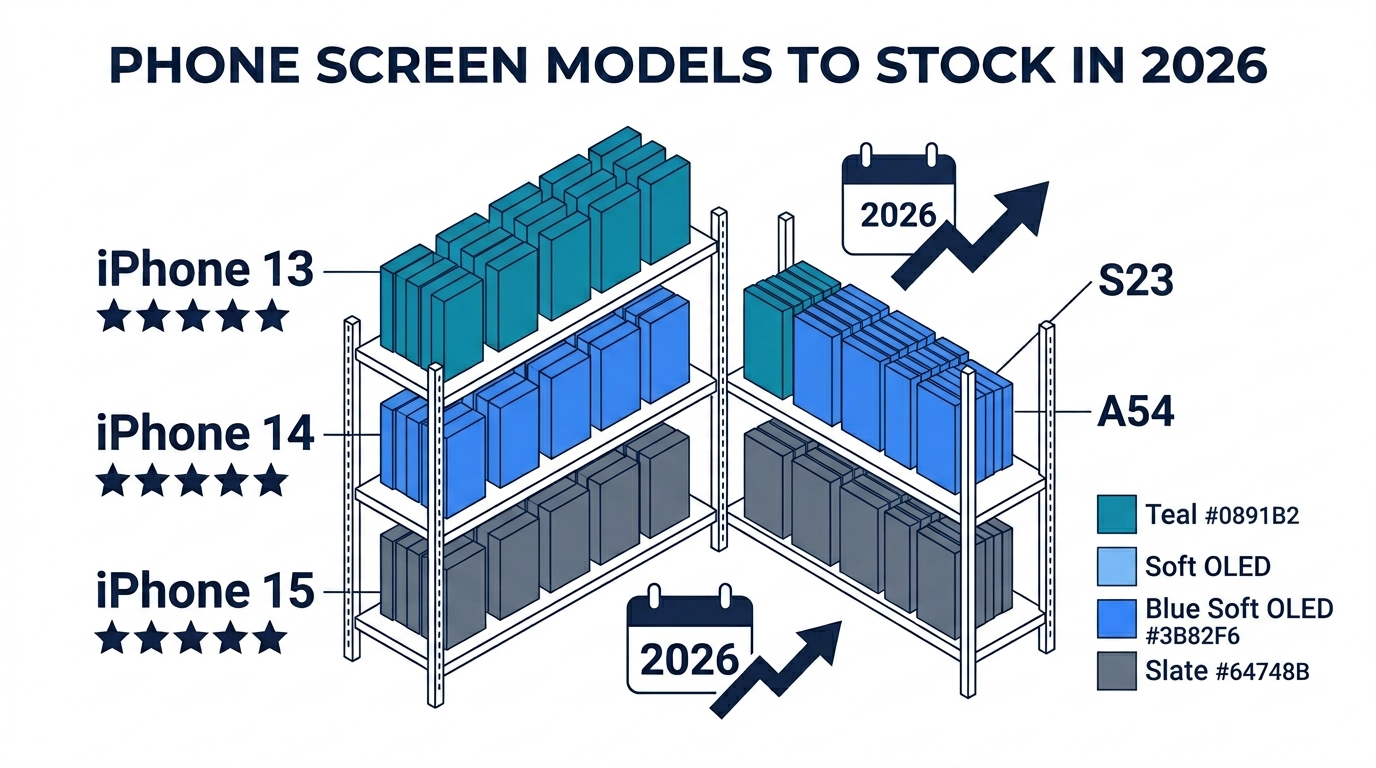
iPhone Pricing Guidelines
| Model | Standard (Incell) | Premium (Hard OLED) | Original (Soft OLED) |
|---|---|---|---|
| iPhone 15 Pro Max | $99-119 | $169-199 | $249-289 |
| iPhone 15/15 Pro | $89-109 | $149-179 | $219-259 |
| iPhone 14 Pro Max | $89-99 | $149-169 | $219-249 |
| iPhone 14/14 Pro | $79-89 | $129-149 | $189-219 |
| iPhone 13 series | $69-79 | $109-129 | $169-189 |
| iPhone 12 series | $59-69 | $89-109 | $149-169 |
| iPhone 11 and older | $49-59 | — | — |
Samsung Pricing Guidelines
| Model | Standard (Aftermarket) | Premium (Refurbished) | Original (Service Pack) |
|---|---|---|---|
| Galaxy S24 Ultra | $179-209 | $259-289 | $329-379 |
| Galaxy S24/S24+ | $149-179 | $219-249 | $289-329 |
| Galaxy S23 Ultra | $159-189 | $229-259 | $299-349 |
| Galaxy A55/A54 | $69-89 | $99-119 | — |
For wholesale screen costs behind these prices, see our guides on wholesale iPhone screen pricing and wholesale Samsung screens.
5 Pricing Tactics That Increase Revenue Without Raising Prices
1. Bundle Screen Repair with Protection
Offer a tempered glass screen protector installation for $15-20 with every screen repair. Your cost: $1-3 for the protector. This adds pure profit and reduces warranty claims because the protector absorbs future impact.
2. Charge a Premium for Same-Day or While-You-Wait
Most shops offer walk-in repair as standard. Flip it: make 24-hour turnaround your standard price and charge $20-30 extra for "Express" 1-hour service. Many customers will pay for speed, and you can batch standard repairs more efficiently.
3. Offer a Warranty Upgrade
Your standard repair includes a 30-day warranty. Offer a 90-day or 6-month extended warranty for $15-25. Very few screens fail between 30 and 180 days, so the actual cost to you is minimal — but the perceived value to the customer is high.
4. Price Samsung Higher Than iPhone (You Should)
Samsung flagship repairs are harder (curved edges, adhesive removal, fingerprint recalibration) and screens cost more wholesale. Yet many shops charge the same as iPhone repairs. A Galaxy S24 Ultra screen repair should be $30-60 more than an equivalent iPhone repair. Customers expect it — Samsung parts are expensive.
5. Use Anchor Pricing on Your Menu
List the Original Quality tier first on your price board, even though most customers will choose Premium. Seeing the highest price first makes the middle tier feel like good value. This is basic anchoring psychology, and it works.
Competitive Pricing: When and How to Check the Market
Know your market, but don't let competitors dictate your pricing.
How to research local pricing:
- Call or visit 3-5 competing repair shops and ask their prices for 3 common models (iPhone 14, iPhone 15 Pro, Galaxy S24)
- Check their Google Business listings for price mentions in reviews
- Review their websites if they publish pricing
What to do with the data:
- If you're within 10-15% of competitors, your pricing is fine — compete on quality, speed, and warranty instead
- If you're significantly cheaper than everyone, you're underpricing. Raise gradually (5-10% per quarter)
- If you're 20%+ higher, make sure your marketing clearly communicates WHY (better screen quality, longer warranty, premium experience)
When to NOT match competitors:
- A competitor using cheap TFT copies while you use quality AMOLED for Samsung — you're not selling the same product
- A competitor with no warranty while you offer 90 days — your service is objectively better
- A competitor operating from a kiosk with no rent vs. your storefront — different cost structures
Tracking and Optimizing Your Pricing
Set prices once, then improve continuously. Track these metrics monthly:
| Metric | What It Tells You | Target |
|---|---|---|
| Average profit per repair | Overall pricing health | $60-80 for screen repairs |
| Tier selection rate | Whether your pricing ladder works | 20/50/30 split (Standard/Premium/Original) |
| Close rate on quotes | Whether you're pricing yourself out | >70% of quotes convert to repairs |
| Warranty claim rate | Screen quality vs. price level | <3% within warranty period |
| Revenue per repair hour | Efficiency of your pricing + workflow | $120-180 |
If your Premium tier is chosen less than 40% of the time, the price gap between Standard and Premium may be too large — close it by $10-15. If Original Quality is chosen more than 40% of the time, you're underpricing it — raise by $20-30.
Frequently Asked Questions
How much profit should a phone screen repair make?
Target $50-80 net profit per screen repair after accounting for screen cost, consumables, overhead allocation, and warranty reserve. Budget repairs (Incell/TFT) typically net $40-65. Premium OLED repairs net $80-140. If your average is below $40, you're likely underpricing or over-paying for screens. Review your wholesale costs and consider switching to a more competitive supplier.
Should I publish my repair prices on my website?
Yes — with tiered options. Hiding prices makes customers assume you're expensive and discourages inquiries. Publishing tiered pricing (Standard / Premium / Original Quality) lets customers self-qualify before they walk in. You'll get fewer price-shoppers and more customers who've already decided to buy.
How often should I adjust my repair prices?
Review pricing quarterly. Wholesale screen costs fluctuate — especially after new iPhone/Samsung launches when older model screens drop in price. If your wholesale cost decreases by $5+ per unit, keep your repair price the same and pocket the extra margin. Only raise customer-facing prices when your costs increase or when you've confirmed competitors have raised theirs.
Is it better to charge per model or use flat pricing?
Per-model pricing always outperforms flat pricing. An iPhone 11 screen costs $8-12 wholesale while an iPhone 15 Pro Max costs $40-55. Charging both the same price means you're either overcharging on old models (losing customers) or undercharging on new models (losing profit). The extra menu complexity is worth it.
How do I handle price-matching requests from customers?
Don't match blindly. Ask what screen grade the competitor is using — if they're quoting $79 for a Galaxy S24, they're using a TFT copy, not AMOLED. Explain the difference: "Their price likely uses an LCD copy. We use genuine AMOLED for $189, which preserves your fingerprint sensor and display quality." Most customers understand you get what you pay for.
Price for Profit, Not for Volume
The most profitable repair shops aren't the busiest — they're the ones extracting the most value from every repair. Phone screen repair pricing should reflect your actual costs, the quality you deliver, and what each customer segment is willing to pay.
Start with tiered pricing this week. Calculate your true per-repair costs. And stop matching the cheapest competitor — they're probably not making money either.
Need better wholesale screen prices to improve your margins? Contact our team for volume pricing across all grades and models.