
How to Buy Wholesale iPhone Screens Without Overstocking Slow Models
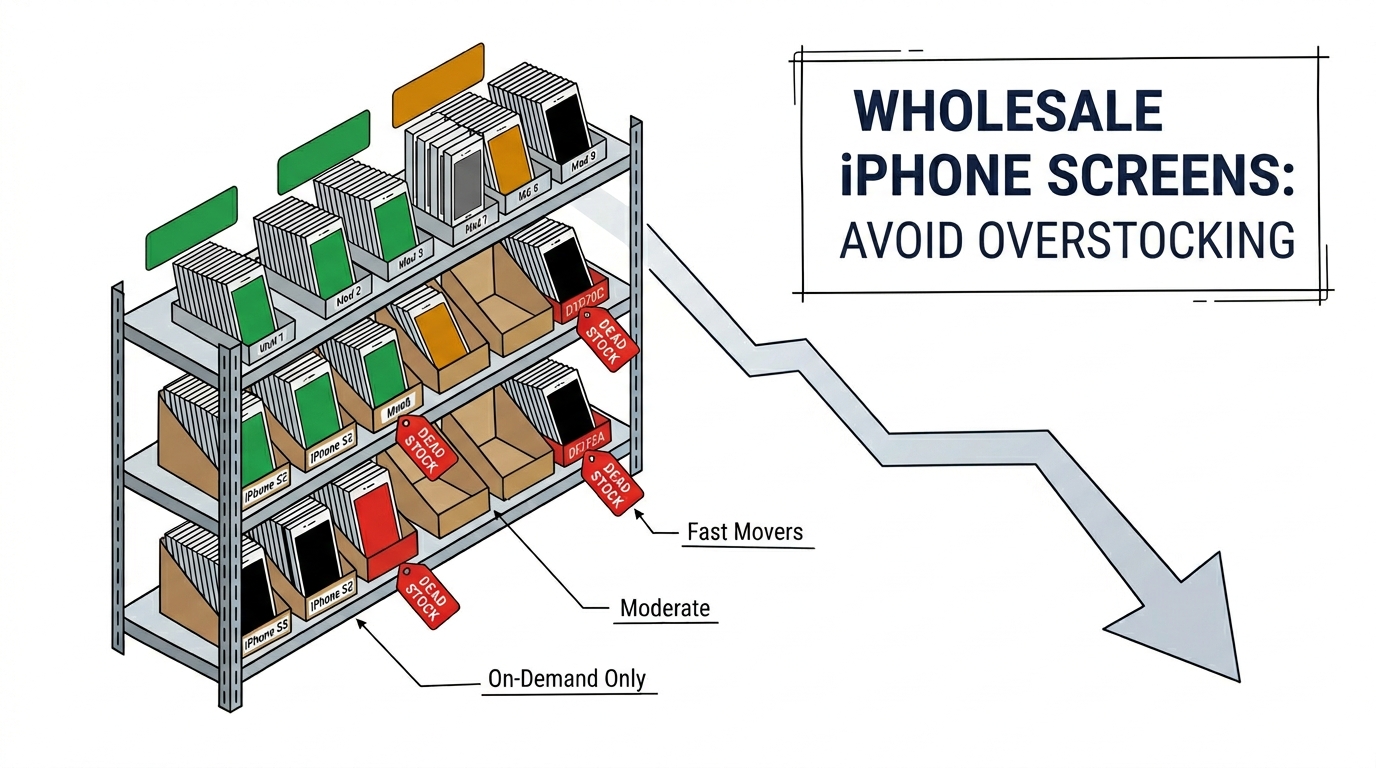
Every repair shop has a drawer of screens that stopped moving. iPhone 11 Incell screens ordered six months ago. iPhone 12 Pro Max Soft OLED that made sense when Pro Max repairs were $180 — now customers just upgrade instead. That drawer represents $500–$2,000 in dead capital.
The problem isn't buying wholesale iPhone screens — it's buying the wrong quantities of the wrong models at the wrong time. Bulk pricing tempts you to over-order, and by the time you realize a model is slowing down, you've already committed the budget.
This guide gives you the formulas, timelines, and warning signals to keep your iPhone screen inventory lean — buying enough to never run out of fast movers, without sinking cash into slow models that depreciate on your shelf.
Sourcing Replacement Screens in Bulk?
Incell / Hard OLED / Soft OLED grades — wholesale pricing, grade comparison on request.
Get Wholesale QuoteWhy iPhone Screens Depreciate Faster Than You Think
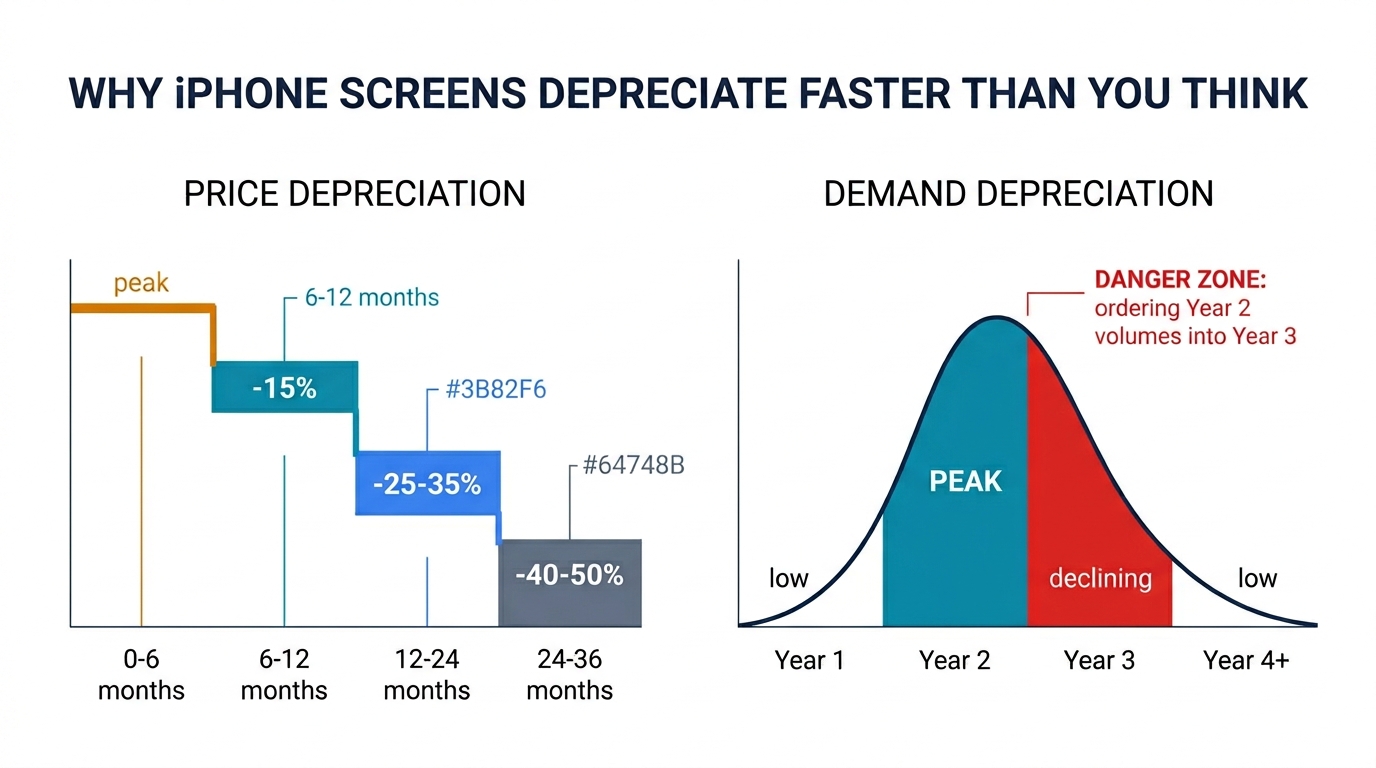
Phone screens aren't like cases or cables that sit on a shelf indefinitely. iPhone screens lose value in two predictable ways, and understanding both determines how much to stock.
Price Depreciation
The wholesale price of an iPhone screen drops as the model ages. This is predictable and consistent:
| Model Age | Typical Price Drop (from peak) | Example: iPhone 14 Hard OLED |
|---|---|---|
| 0–6 months (new model) | Peak pricing | $38–$45 |
| 6–12 months | -15% | $32–$38 |
| 12–24 months | -25% to -35% | $24–$30 |
| 24–36 months | -40% to -50% | $20–$24 |
| 36+ months | -50% or more | $18–$22 |
What this means for inventory: Every month a screen sits in your drawer, it's worth less. An iPhone 14 Hard OLED you bought at $30 six months ago can now be replaced for $24. You haven't lost cash in your bank account, but you've lost $6 per unit in inventory value. On 50 screens, that's $300 gone.
Demand Depreciation
As a model ages, fewer people own it, and those who do are more likely to upgrade rather than repair. The demand curve follows a bell shape:
- Year 1 (0–12 months after launch): Low repair volume. Phones are new, fewer breakages, most are under warranty.
- Year 2 (12–24 months): Peak repair volume. Warranties expire, phones are in heavy use, enough damage accumulates.
- Year 3 (24–36 months): Declining volume. Trade-in programs pull users to new models. Budget-conscious owners still repair.
- Year 4+ (36+ months): Low volume. Repairs only make economic sense at budget pricing. Most owners have upgraded.
The danger zone: Ordering aggressively during Year 2 and not reducing by Year 3. Your last bulk order at Year 2 volumes arrives just as demand drops — and now you're holding 8 weeks of stock that takes 16 weeks to sell.
The Reorder Formula: How Much to Buy for Wholesale iPhone Screens
Stop guessing. Use this formula to calculate your reorder quantity for each model:
The 4-Week Rolling Formula
Reorder Quantity = (Average Weekly Usage × 4) + Safety Buffer − Current Stock
Here's how to calculate each part:
Average Weekly Usage: Track how many screens of each model you install per week over the past 4 weeks. Not how many you sell — how many you install. Sales and installation should match, but if you're quoting repairs you can't fulfill due to stockouts, your actual demand is higher than your installation count.
The 4-Week Factor: This covers the time between ordering and receiving your next shipment:
- 1–2 weeks for the supplier to ship
- 1 week buffer for customs or shipping delays
- 1 week of safety stock
Safety Buffer: Add 20% to your weekly usage figure. This covers unexpected demand spikes (a phone drops well at a nearby concert, a corporate client brings in 15 devices at once).
Current Stock: What's physically on your shelf right now.
Real Example
Your shop installs 12 iPhone 15 Hard OLED screens per week (average over 4 weeks).
- Average weekly usage: 12
- 4-week requirement: 12 × 4 = 48
- Safety buffer (20%): 48 × 1.2 = 58
- Current stock: 22
Reorder quantity: 58 − 22 = 36 screens
That's it. Not 50 because it's a rounder number. Not 100 because the per-unit price drops by $0.50. Exactly 36 — unless the price break at 50 units saves you more than the depreciation risk on the extra 14 screens.
When Price Breaks Are Worth the Overstock Risk
Sometimes ordering more than your formula suggests makes sense:
Worth it: Price drops from $28 to $24 at 50 units (saving $200 total). Your formula says 36 units. The extra 14 units cost $336 but save $144 on the entire order, and you'll use them within 5 weeks based on your usage rate. Net benefit: $144 savings minus minimal depreciation risk.
Not worth it: Price drops from $28 to $26 at 100 units (saving $200 total). Your formula says 36 units. The extra 64 units cost $1,664 and take 5+ extra weeks to sell. During that time, the per-unit price could drop $2–3 as the model ages. Net risk: $128–$192 in depreciation, plus $1,664 in tied-up capital for 5+ weeks.
Rule of thumb: Accept a price break only if you'll use the extra stock within 6 weeks. Beyond that, depreciation and capital cost eat the savings.
Need help calculating order quantities for your model mix? Send us your weekly repair volume by model — we'll build a reorder schedule that keeps you stocked without overcommitting. Get a custom order plan.
The 5 Warning Signs a Model Is Becoming Dead Stock
Catching a slowing model early is the difference between adjusting your next order and getting stuck with 40 screens nobody needs. Watch for these signals:
Signal 1: Weekly Usage Drops 2 Weeks in a Row
One slow week is normal. Two consecutive weeks of declining installations for the same model means demand is trending down — not just fluctuating. When you see this, reduce your next reorder by 25–30%.
Signal 2: Repair Quote-to-Completion Ratio Drops
You're quoting iPhone 12 repairs, but customers are choosing not to proceed. When your quote-to-repair conversion drops below 50% for a specific model, it usually means the repair cost is approaching the phone's resale value. Customers are doing the math and choosing to upgrade instead.
Action: Lower your repair price by switching to a cheaper grade (Incell instead of Hard OLED), or stop stocking that model and order on-demand only.
Signal 3: New iPhone Launch Is 3 Months Away
Apple launches new iPhones every September. Starting June, reduce your stock of the current flagship. When the iPhone 17 launches, iPhone 15 screen demand won't drop overnight — but iPhone 14 and older will accelerate their decline as trade-in programs push owners to upgrade.
Action: By July, reduce 3+ year old models to 2-week stock levels. By August, consider moving to on-demand ordering for those models.
Signal 4: Your Supplier Starts Discounting That Model
When your regular supplier drops the price on a specific model without you asking, it means they're seeing reduced demand across their customer base and need to move inventory. Take the lower price on your current order, but don't increase your volume — they're discounting because the model is slowing.
Signal 5: Pro Max Versions Stall First
Pro Max models are always the first to become dead stock. They're the most expensive to repair, so the repair-vs-upgrade breakeven hits sooner. If your iPhone 14 Pro Max installations drop 30% while iPhone 14 standard holds steady, it's a leading indicator — the standard model will follow in 2–3 months.
Model-by-Model Stocking Guide: How Much Is Too Much?
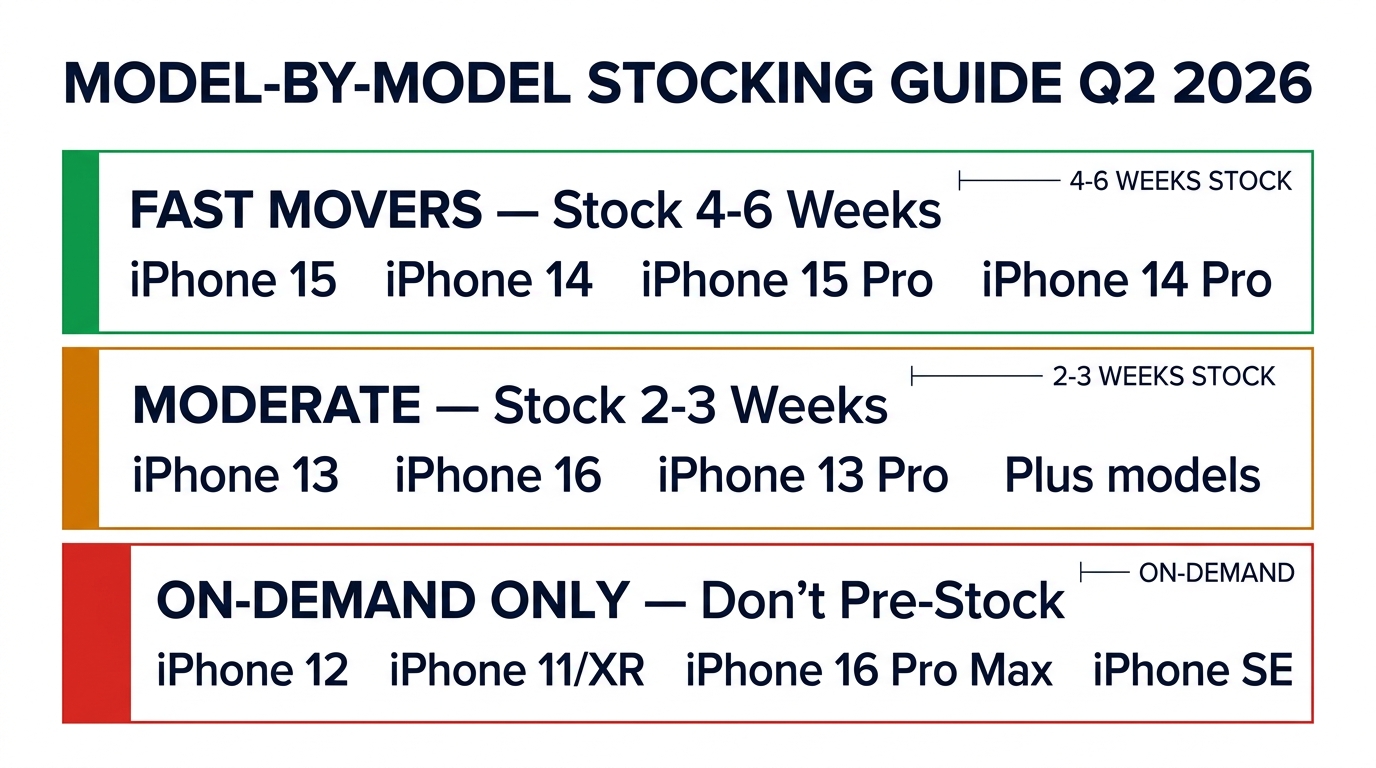
Based on current demand patterns and the depreciation curve, here's a maximum stock recommendation for each iPhone generation in Q2 2026:
Fast Movers — Stock 4–6 Weeks
| Model | Max Stock (per grade) | Why |
|---|---|---|
| iPhone 15 | 4–6 weeks of usage | Peak repair demand. Warranties expiring. Stable pricing. |
| iPhone 14 | 4–6 weeks | Still the single most-repaired model in most shops. |
| iPhone 15 Pro | 4–5 weeks | Strong demand, but slightly lower volume than standard. |
| iPhone 14 Pro | 4–5 weeks | Maturing but consistent. Watch for decline starting Q3. |
Moderate Movers — Stock 2–3 Weeks
| Model | Max Stock (per grade) | Why |
|---|---|---|
| iPhone 13 | 2–3 weeks | Declining but still steady. Budget repair segment. |
| iPhone 16 | 2–3 weeks | Growing demand but still new. Prices haven't normalized. |
| iPhone 13 Pro | 2–3 weeks | Lower volume than iPhone 13 standard. |
| iPhone 14 Plus / 15 Plus | 2 weeks | Plus models consistently under-perform standard in repair volume. |
On-Demand Only — Don't Pre-Stock
| Model | Why |
|---|---|
| iPhone 12 / 12 mini | Repair volume declining. Budget customers may choose upgrade. |
| iPhone 11 / XR | Very low margin. Only stock if you have consistent demand data. |
| iPhone 16 Pro / Pro Max | Too new — pricing premium is high, supply is tight, demand hasn't ramped. |
| iPhone SE (any gen) | Low repair volume. Cheap phones = customers replace rather than repair. |
For detailed model-by-model demand analysis, see our guide on which phone screen models to stock in 2026.
What to Do When You're Already Overstocked
If you're reading this with a shelf full of slow-moving screens, here's how to recover your capital.
Strategy 1: Bundle Slow Models with Fast Ones
Offer customers a deal: "iPhone 12 screen repair, $59 this month." Use your overstock as a discount driver. You're not making your target margin, but you're converting dead inventory into cash and foot traffic. Some of those customers will buy accessories, refer friends, or come back for a newer phone repair later.
Strategy 2: Sell to Other Repair Shops
Post your excess stock in repair community forums (Reddit r/mobilerepair, Facebook repair groups, local WhatsApp networks). Price it 10–15% below your cost. Yes, you'll take a loss — but 85% of your money back now is better than 100% of your money locked in screens that depreciate another 10% each quarter.
Strategy 3: Grade Swap with Your Supplier
Some suppliers will accept slow-moving stock as partial credit toward your next order — especially if you're a regular buyer. Ask: "Can I return 30 units of iPhone 12 Incell and apply the credit toward iPhone 15 Hard OLED?" Not every supplier offers this, but it costs nothing to ask.
Strategy 4: Adjust Your Repair Pricing
If you're sitting on 50 iPhone 13 Soft OLED screens, lower your Soft OLED repair price for that model to match Hard OLED pricing. You move the inventory faster, customers get a premium screen at mid-tier prices, and you generate goodwill that drives repeat business.
Building a Lean Ordering System for Wholesale iPhone Screens
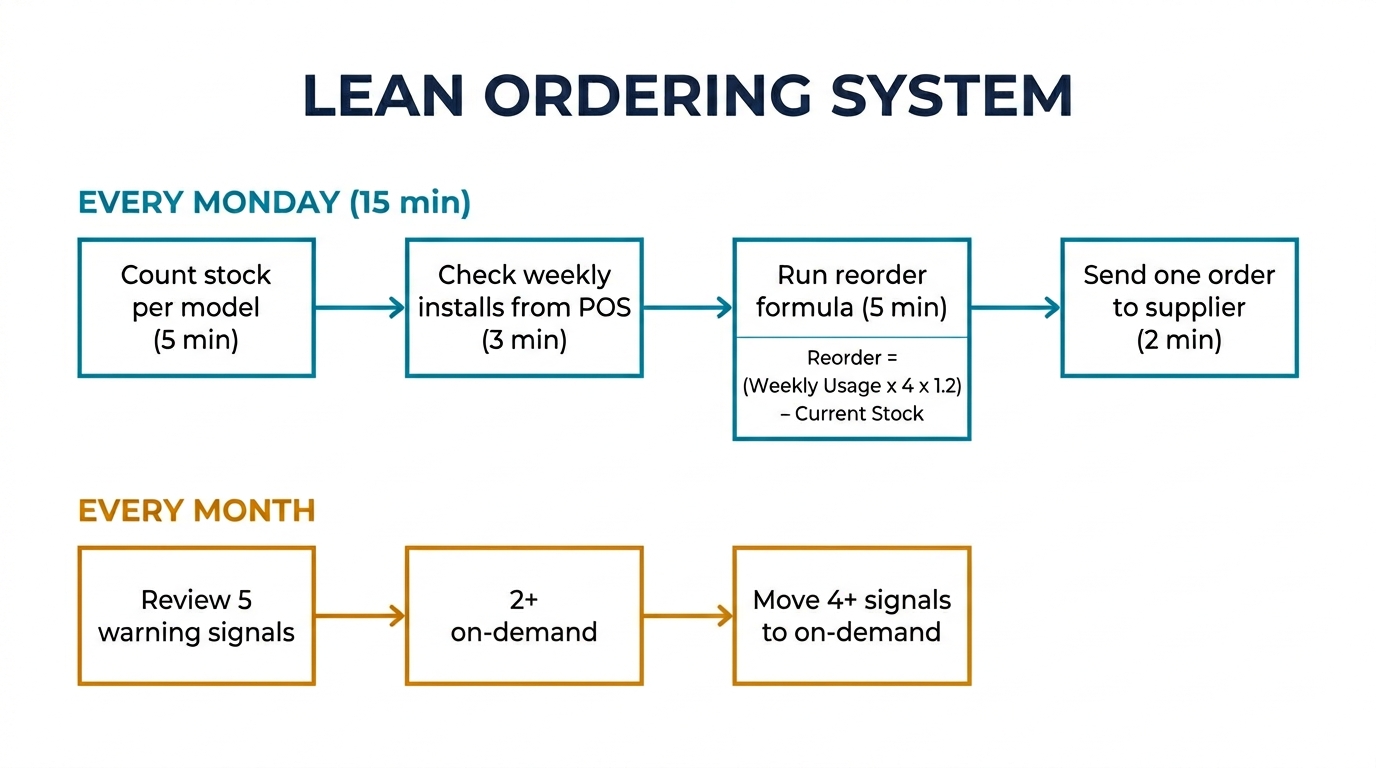
The shops that never overstock aren't lucky — they have a system. Here's a simple weekly routine that takes 15 minutes:
Every Monday morning:
- Count current stock for each model/grade (5 minutes)
- Check weekly installations from the past week in your POS system (3 minutes)
- Run the reorder formula for any model below safety stock (5 minutes)
- Send one consolidated reorder to your supplier (2 minutes)
Every month:
- Review the 5 warning signals for each model
- Move any model showing 2+ signals to the "reduced stock" tier
- Move any model showing 4+ signals to "on-demand only"
This system prevents two problems simultaneously: running out of fast movers (because you reorder weekly) and overstocking slow models (because you check warning signals monthly).
For MOQ negotiation tactics that support smaller, more frequent orders, see our wholesale iPhone screens MOQ guide. For lead time planning that makes weekly ordering feasible, see our guide on MOQ, sample orders, and lead time.
Frequently Asked Questions
How many weeks of iPhone screen stock should I keep?
Four weeks for fast-moving models (iPhone 14, 15), two to three weeks for moderate movers (iPhone 13, 16), and zero pre-stock for slow models (iPhone 11, 12, SE). The 4-week buffer accounts for shipping time from China plus a safety margin. Anything beyond 6 weeks for any model creates depreciation risk that typically outweighs bulk pricing benefits.
Is it better to order small quantities more often or large quantities less often?
For most repair shops, smaller orders every 2–3 weeks beat large orders every 6–8 weeks. Smaller orders reduce depreciation risk, let you adjust quantities as demand shifts, and keep less capital tied up. The per-unit price difference between a 50-unit and 200-unit order is typically 3–5% — not enough to justify the overstocking risk on models that might slow down.
What should I do with iPhone screens I can't sell?
Try four approaches in order: (1) discount repairs to move the stock, (2) sell to other repair shops at 10–15% below your cost, (3) ask your supplier for a stock-swap credit toward faster-moving models, (4) bundle them as a "budget option" for price-sensitive customers. Dead stock doesn't become more valuable with time — cut your losses early rather than hoping demand returns.
How do I predict which iPhone model will slow down next?
Follow the 3-year cycle. Models entering their third year (36+ months since launch) will see the sharpest demand decline. In 2026, that means iPhone 12 and 13 are entering or in the decline phase. Also watch for Apple's September announcement — the trade-in push around new iPhone launches accelerates older model decline by 2–3 months. Pro Max models always slow down before standard models because their higher repair cost hits the upgrade-vs-repair threshold sooner.
Should I stock iPhone 16 screens now?
Stock conservatively — 2 weeks maximum for standard models, and avoid pre-stocking iPhone 16 Pro/Pro Max unless you have confirmed demand. iPhone 16 screen pricing is still in the normalization phase (15–20% above stable pricing), supply from tier-1 manufacturers is tight for Pro Max Soft OLED, and repair volume won't ramp significantly until mid-2026 as warranties expire. Order on-demand until pricing stabilizes.
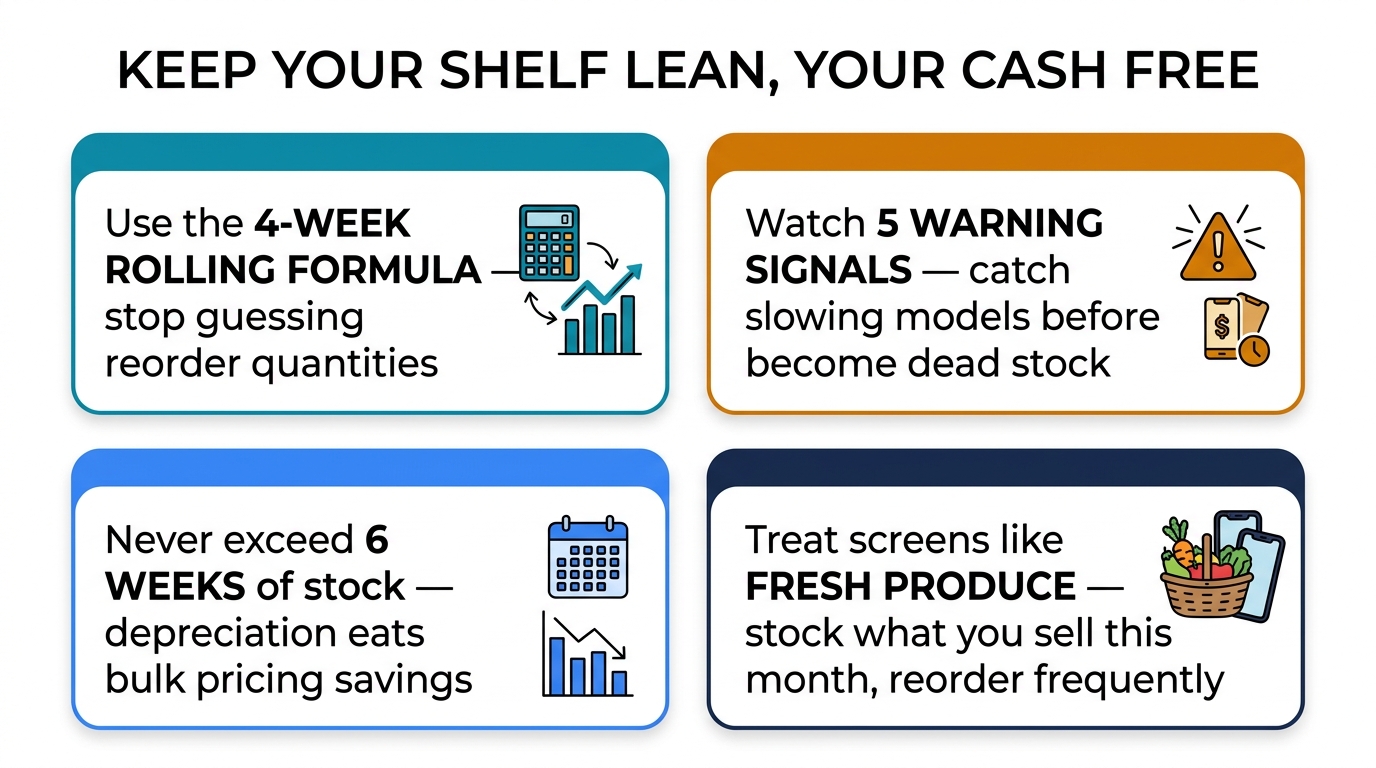
Keep Your Shelf Lean, Your Cash Free
The goal isn't to have the most screens — it's to have the right screens. Use the 4-week rolling formula for fast movers, watch the 5 warning signals for models entering decline, and never let a price break tempt you into 8+ weeks of stock on any single model.
Wholesale iPhone screens are a depreciating asset. The best inventory strategy treats them like fresh produce: stock what you'll sell this month, reorder frequently, and move slow stock before it loses more value.
Need a reorder schedule tailored to your shop's repair volume? Tell us your top models, weekly installation counts, and current stock levels. We'll build a lean ordering plan with grade recommendations and pricing.
Request a Custom Order Plan — include your model mix and weekly volume for a tailored recommendation within 24 hours.
Related reading: