
Wholesale iPhone Screens: Pricing Logic, Grade Differences, and What to Check Before Ordering

iPhone screens account for 60–70% of most repair parts businesses' revenue. They're also where the biggest pricing confusion lives. An iPhone 15 Pro Max screen can cost anywhere from $14 to $85 at wholesale — same phone model, wildly different prices. If you don't understand why, you're either overpaying or buying screens that will generate returns.
This guide covers everything wholesale buyers need to know about wholesale iPhone screens: how pricing works by model and grade, what to verify before placing a bulk order, and how to structure your first iPhone screen purchase for maximum margin with minimum risk.
Sourcing Replacement Screens in Bulk?
Incell / Hard OLED / Soft OLED grades — wholesale pricing, grade comparison on request.
Get Wholesale QuoteHow Wholesale iPhone Screen Pricing Actually Works

Price isn't random. Every wholesale iPhone screen price is a function of four variables: model generation, screen grade, IC chip source, and testing depth. Understanding these variables lets you decode any price quote instantly.
Variable 1: Model Generation
Newer iPhone models cost more because the screens are more complex. The jump from LCD (iPhone 11 and below) to OLED (iPhone 12 and up) roughly doubled screen costs. Within OLED models, Pro/Pro Max versions with ProMotion (120Hz) cost more than standard models.
| Model Group | Display Tech | Screen Complexity | Wholesale Price Range (Incell–Soft OLED) |
|---|---|---|---|
| iPhone SE / 8 / 7 | LCD | Low | $4–$8 |
| iPhone XR / 11 | LCD | Low-Medium | $6–$12 |
| iPhone X / XS / 11 Pro | OLED | Medium | $12–$35 |
| iPhone 12 / 12 Pro | OLED | Medium-High | $12–$40 |
| iPhone 13 / 13 Pro | OLED | High | $14–$45 |
| iPhone 14 / 14 Pro | OLED | High | $15–$50 |
| iPhone 15 / 15 Pro | OLED | Very High | $18–$65 |
| iPhone 16 / 16 Pro | OLED | Very High | $25–$85 |
See the full four-grade comparison with live wholesale prices: iPhone Screen Grade Guide
Key pattern: Price drops roughly 15–25% per model generation as a phone ages 1–2 years. iPhone 13 Incell screens that cost $18 at launch now run $10–$12. Factor this into your inventory planning — stocking too much of a current-gen model means watching your inventory value drop each quarter.
Variable 2: Screen Grade
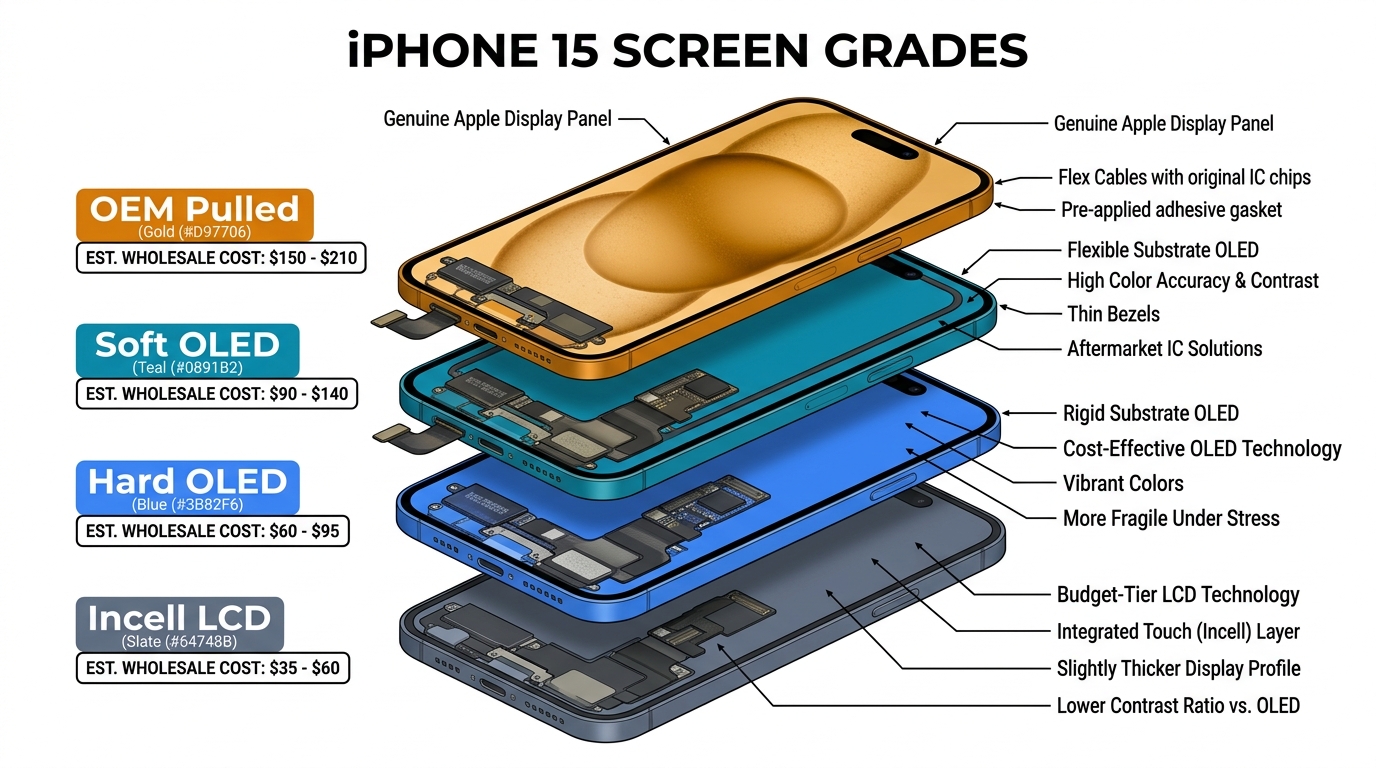
The grade determines the display technology and quality level. For iPhone OLED models (12 and up), you have four options:
| Grade | Technology | Color vs. Original | Defect Rate | Price Multiplier |
|---|---|---|---|---|
| Original OEM | Original OLED | 100% | <0.5% | 4–6x base |
| Soft OLED | Aftermarket flexible OLED | 90–95% | 1–2% | 2.5–3.5x base |
| Hard OLED | Aftermarket rigid OLED | 85–90% | 1.5–3% | 1.5–2x base |
| Incell LCD | LCD + integrated touch | 70–80% | 2–4% | 1x (base) |
For LCD models (iPhone 11 and below), the grade spread is simpler: OEM Refurbished, Aftermarket High-Copy, and Aftermarket Standard. Prices range from $4 to $15 depending on model and quality.
Variable 3: IC Chip Source
The IC (integrated circuit) chip controls touch sensitivity and display communication. This is the hidden variable most buyers overlook.
- BOE IC: Best aftermarket compatibility. Supports True Tone transfer on most models. Costs $1–$3 more per unit.
- Tianma IC: Good compatibility, slightly lower color accuracy. Standard choice for mid-tier screens.
- Generic IC: Cheapest option. Higher risk of touch issues, especially on newer iOS versions. Apple software updates occasionally break compatibility with generic ICs.
Practical tip: After major iOS updates, generic IC screens sometimes develop touch lag or display glitches. BOE IC screens are more resistant to compatibility breaks because they more closely replicate OEM signal protocols.
Variable 4: Testing Depth
Same grade, same IC, different testing level = different price and different incoming defect rate.
| Testing Level | Cost Adder | Expected Defect Rate |
|---|---|---|
| Factory QC only | $0 | 4–6% |
| Batch sampling (20%) | +$0.30/unit | 3–4% |
| 100% jig-tested | +$0.50–$0.80/unit | 1.5–2.5% |
| 100% device-tested | +$1.00–$1.50/unit | <1.5% |
On a 200-unit order, the difference between factory-QC-only ($0 extra) and 100% device-tested ($1.50 extra) is $300. But the defect reduction from 5% to 1.5% saves you 7 defective screens × $15 rework cost = $105, plus the customer satisfaction value. For Soft OLED and Hard OLED, always insist on 100% tested.
Wholesale iPhone Screen Compatibility: What to Verify Before Ordering
This is where many first-time buyers of wholesale iPhone screens get burned. Not every screen that "fits" a model actually works correctly. iPhone screens have specific compatibility requirements that aftermarket manufacturers don't always get right.
True Tone Transfer
True Tone adjusts screen color temperature based on ambient lighting. On iPhone 8 and newer, True Tone data is stored on a small chip on the screen's flex cable. When you replace the screen, True Tone stops working unless:
- The new screen supports IC transfer (you move the original True Tone chip to the new screen), or
- The new screen comes with a pre-programmed True Tone chip
What to ask your supplier: "Does this screen support True Tone transfer via IC swap?" Most quality Incell and OLED aftermarket screens now support this, but cheaper options may not. Losing True Tone isn't a deal-breaker for budget repairs, but premium customers notice.
Face ID Compatibility
On iPhone X and newer, the earpiece/proximity sensor flex cable is linked to Face ID. If a replacement screen doesn't support transferring the original earpiece flex, Face ID breaks after installation.
Rule: Always buy screens that support original earpiece flex transfer. Some ultra-cheap screens have integrated (non-removable) earpiece assemblies that disable Face ID permanently. This generates refunds, not just complaints.
Battery Health Display (iPhone 15+)
Starting with iPhone 15, Apple shows a battery health warning if the screen isn't paired with the device. Aftermarket screens trigger a "Unable to verify this iPhone has a genuine Apple display" notification. This is cosmetic (the screen works fine), but it bothers some customers.
What this means for your business: Set customer expectations before the repair. The notification doesn't affect screen function, but if a customer sees it and panics, you're handling a support call.
Need help picking the right grade and IC for your top iPhone models? Tell us your model mix and we'll recommend the most cost-effective screen specs. Get a custom quote.
iOS Version Compatibility
Apple's iOS updates occasionally break aftermarket screen compatibility. This typically affects:
- Touch responsiveness (lag or dead zones after update)
- Auto-brightness function
- Haptic touch / 3D Touch behavior
How to protect yourself: Ask your supplier if they track iOS compatibility and issue firmware updates for their IC chips. Tier-1 aftermarket manufacturers release IC firmware updates within 2–4 weeks of major iOS releases. Generic IC manufacturers rarely do.
iPhone Screen Wholesale Price Guide by Model (2026)
Here's a reference pricing table based on current Shenzhen wholesale market rates. Prices fluctuate with supply and component costs, but this gives you a baseline for evaluating quotes.
iPhone 16 Series
| Model | Incell | Hard OLED | Soft OLED | OEM Refurb |
|---|---|---|---|---|
| iPhone 16 | $22–$28 | $35–$45 | $50–$60 | $70–$85 |
| iPhone 16 Plus | $24–$30 | $38–$48 | $52–$65 | $75–$90 |
| iPhone 16 Pro | $28–$35 | $42–$55 | $58–$72 | $80–$100 |
| iPhone 16 Pro Max | $30–$38 | $48–$60 | $65–$80 | $90–$110 |
iPhone 15 Series
| Model | Incell | Hard OLED | Soft OLED | OEM Refurb |
|---|---|---|---|---|
| iPhone 15 | $16–$22 | $28–$36 | $38–$48 | $55–$70 |
| iPhone 15 Plus | $18–$24 | $30–$38 | $40–$50 | $58–$72 |
| iPhone 15 Pro | $20–$26 | $34–$44 | $45–$58 | $65–$80 |
| iPhone 15 Pro Max | $22–$28 | $38–$48 | $50–$65 | $70–$90 |
iPhone 14 Series
| Model | Incell | Hard OLED | Soft OLED | OEM Refurb |
|---|---|---|---|---|
| iPhone 14 | $12–$16 | $22–$30 | $32–$40 | $45–$58 |
| iPhone 14 Plus | $14–$18 | $24–$32 | $34–$42 | $48–$60 |
| iPhone 14 Pro | $16–$22 | $28–$38 | $38–$50 | $55–$70 |
| iPhone 14 Pro Max | $18–$24 | $32–$42 | $42–$55 | $60–$78 |
iPhone 13 Series
| Model | Incell | Hard OLED | Soft OLED | OEM Refurb |
|---|---|---|---|---|
| iPhone 13 | $10–$14 | $18–$26 | $28–$35 | $40–$50 |
| iPhone 13 Pro | $12–$16 | $22–$30 | $32–$42 | $45–$58 |
| iPhone 13 Pro Max | $14–$18 | $26–$34 | $36–$48 | $50–$65 |
Note: These are FOB Shenzhen prices (before shipping). Add $2–$5/unit for air express shipping to US/UK. Prices valid as of March 2026 — request current quotes for exact pricing.
How to Structure Your First Wholesale iPhone Screen Order

If you're ordering wholesale iPhone screens for the first time, minimize risk with this approach.
Step 1: Identify Your Top 5 iPhone Models
Pull your repair data. For most shops in 2026, the highest-volume iPhone repairs are:
- iPhone 14 (still the most-repaired model in most US/UK markets)
- iPhone 13
- iPhone 15
- iPhone 12
- iPhone 15 Pro / 14 Pro
Step 2: Choose 2 Grades Maximum for Your First Order
Don't stock all four grades immediately. Pick two that match your business:
- Budget-focused shop: Incell + Hard OLED
- Mid-range shop: Hard OLED + Soft OLED
- Premium shop: Soft OLED + OEM Refurbished
Step 3: Order Samples of Each Grade for Your Top 2 Models
5 units per grade × 2 grades × 2 models = 20 screens. Install them in customer devices. Track quality for 7 days. This costs $300–$600 but prevents a $3,000+ mistake on your first bulk order.
Step 4: Place a 4-Week Inventory Order
Based on your repair volume, order 4 weeks of stock. Example for a shop doing 8 iPhone repairs per day:
| Model | Grade | Daily Usage | 4-Week Order |
|---|---|---|---|
| iPhone 14 | Hard OLED | 3/day | 60 units |
| iPhone 13 | Incell | 2/day | 40 units |
| iPhone 15 | Hard OLED | 2/day | 40 units |
| iPhone 12 | Incell | 1/day | 20 units |
Total: 160 units. At an average of $18/unit (mixed grades), that's roughly $2,880 for your first order — a manageable risk level that gives you real data to optimize your second order.
Step 5: Reorder Before You Run Out
Track your inventory weekly. Reorder when you hit 1.5 weeks of remaining stock. This buffer accounts for shipping time (7–15 days from China) without overstocking.
Common Wholesale iPhone Screen Pitfalls
Buying Last-Gen Stock at Current-Gen Prices
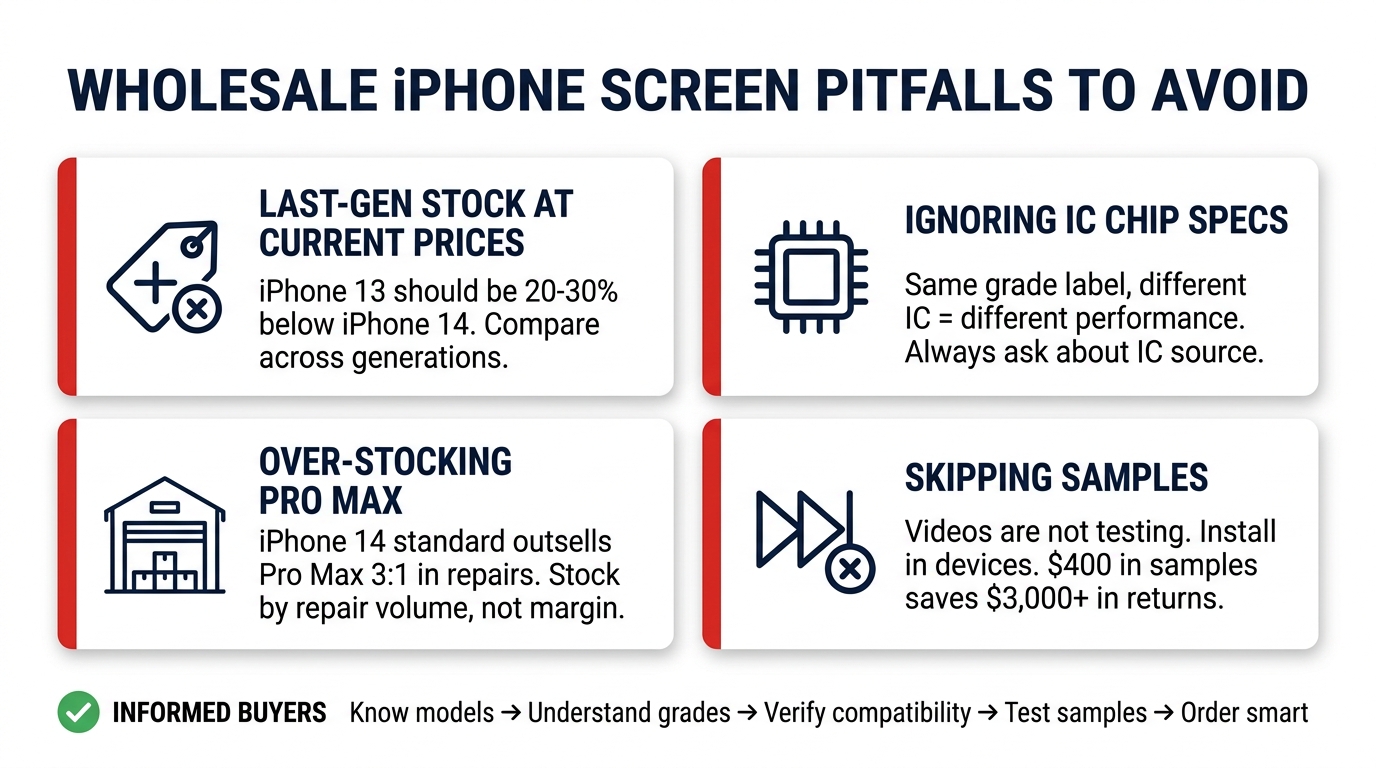
iPhone 13 screen prices should be 20–30% below iPhone 14 prices. If a supplier quotes similar prices for both, they're either overcharging on the 13 or quoting outdated pricing. Always compare across model generations.
Ignoring the IC Chip Specification
Two "Hard OLED iPhone 15" screens at different prices likely have different IC chips. The $22 version with a generic IC and the $28 version with a BOE IC will perform very differently after an iOS update. Ask about the IC on every quote.
Over-Stocking Pro Max Models
Pro Max screens are the most expensive but not the most-repaired. iPhone 14 standard outsells iPhone 14 Pro Max in repair volume by roughly 3:1. Don't let high per-unit margins trick you into over-stocking slow-moving Pro Max inventory.
Skipping the Sample Phase
"The supplier showed me a video and it looked great" is not testing. Install screens in actual devices. The $400 you spend on samples saves thousands in returns on a failed bulk order.
How to Compare Wholesale iPhone Screen Quotes
When you receive quotes from multiple suppliers, prices alone tell you almost nothing. Two "Hard OLED iPhone 15" quotes at different prices usually mean different products. Here's how to make an apples-to-apples comparison.
The 5-Point Quote Comparison Framework
For every quote, extract these five data points before comparing price:
| Data Point | What to Ask | Why It Matters |
|---|---|---|
| IC Chip | BOE, Tianma, or generic? | BOE adds $2–3/unit but resists iOS update breakage |
| Testing Level | Factory QC, batch sampling, or 100% device-tested? | 100% tested adds $0.50–$1.50 but cuts defects by 60% |
| True Tone | Supports IC transfer? Pre-programmed chip included? | Losing True Tone generates customer complaints on premium repairs |
| Warranty | 3 months? 6 months? What's covered? | Short warranty = supplier doesn't trust their own product |
| Defect Tolerance | What percentage does the supplier accept as normal? | "3–5% is normal" vs "under 2%" tells you their quality floor |
The Hidden Costs Behind a "Cheap" Quote
A screen that costs $5 less per unit but has a 5% defect rate instead of 2% costs you more in the end. Here's how to calculate the real price:
Real Unit Cost = Quote Price + (Defect Rate × Quote Price) + Callback Labor
Example with iPhone 14 Hard OLED:
- Supplier A: $24/unit, 4% defects, generic IC → Real cost: $24 + ($24 × 0.04) + $5 labor = $29.96
- Supplier B: $28/unit, 1.5% defects, BOE IC → Real cost: $28 + ($28 × 0.015) + $2 labor = $30.42
The $4 price gap shrinks to $0.46 — and Supplier B's screens have better iOS compatibility, fewer customer complaints, and a longer warranty. At scale, Supplier B wins.
Pro tip: Create a simple spreadsheet with these five columns for every quote you receive. After 3–4 suppliers, the real cost differences become obvious — and the "cheapest" quote often falls to second or third place.
Best iPhone Screen Replacement Options by Business Type
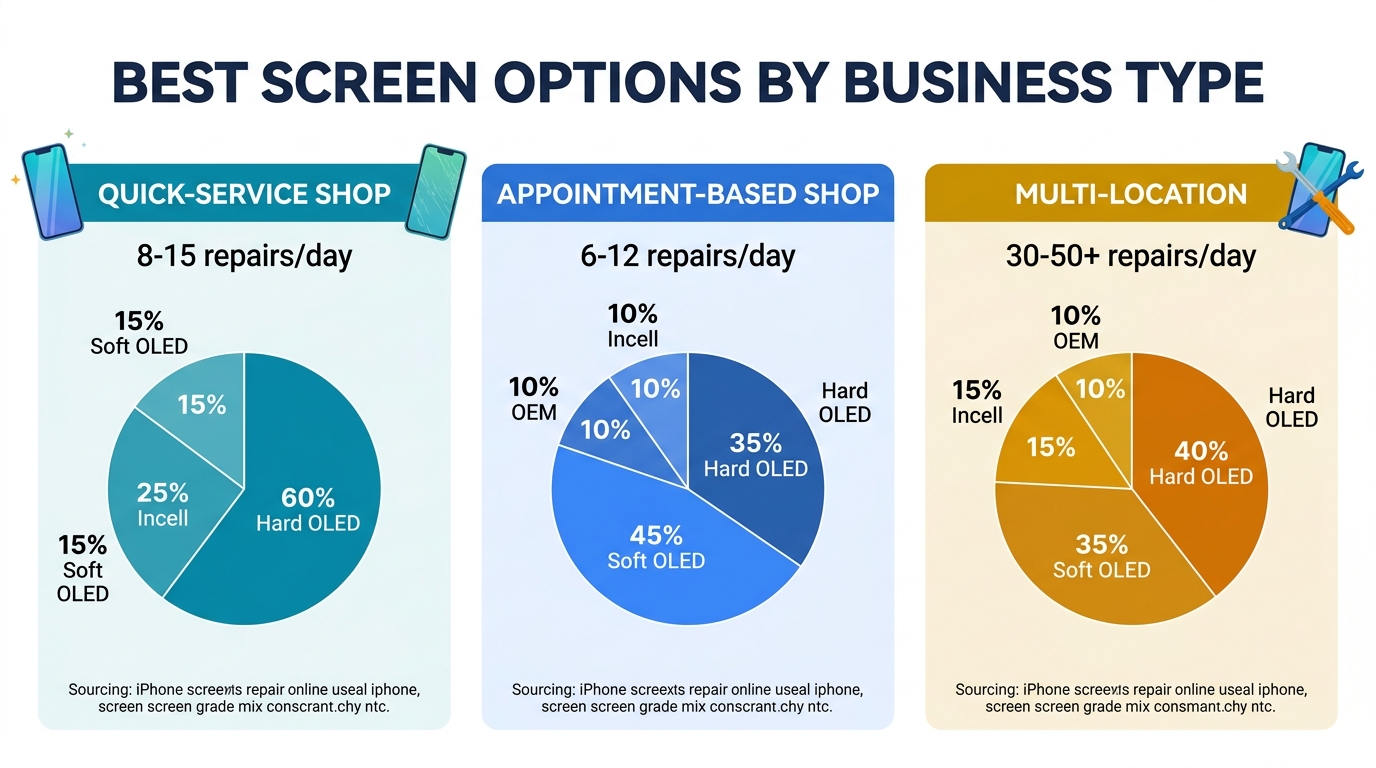
Your business model determines which wholesale options make sense. Here are specific recommendations for the three most common repair business types.
Type 1: Quick-Service Shop (Mall Kiosk, Walk-In Counter)
Profile: High foot traffic, price-conscious customers, 15–30 minute repair promise, 8–15 repairs per day.
| Model | Primary Grade | Secondary Grade | Why |
|---|---|---|---|
| iPhone 15 | Hard OLED | Incell (budget option) | Highest volume model. Hard OLED satisfies 80% of customers. |
| iPhone 14 | Hard OLED | Incell | Still strong demand. Same two-tier approach. |
| iPhone 13 | Incell only | — | Budget model. Customers choosing to repair a 3-year phone are price-sensitive. |
| iPhone 15 Pro | Soft OLED | Hard OLED | Pro customers expect quality. Soft OLED prevents complaints. |
| iPhone 14 Pro | Soft OLED | Hard OLED | Same logic as iPhone 15 Pro. |
Grade split recommendation: 60% Hard OLED, 25% Incell, 15% Soft OLED. Use a domestic distributor as primary (next-day restocking matters when you can't afford stockouts) and China direct for planned monthly bulk orders on your top 3 models.
Type 2: Appointment-Based Repair Shop (Standalone Location)
Profile: Scheduled repairs, relationship-driven customers, 45–90 minute service window, 6–12 repairs per day, higher average ticket.
| Model | Primary Grade | Premium Upsell | Why |
|---|---|---|---|
| iPhone 15 | Soft OLED | OEM Refurbished | Your customers value quality over speed. Lead with Soft OLED, upsell OEM. |
| iPhone 14 | Hard OLED | Soft OLED | Mid-tier default with premium option. |
| iPhone 15 Pro / Pro Max | Soft OLED | OEM Refurbished | Pro owners spending $1,000+ on a phone expect the best repair. |
| iPhone 13 | Hard OLED | — | Budget repairs still come in. Hard OLED keeps quality acceptable. |
Grade split recommendation: 45% Soft OLED, 35% Hard OLED, 10% OEM Refurbished, 10% Incell. China direct for ~70% of volume (your appointment model gives you planning time for international lead times), domestic distributor for emergency restocks.
Type 3: Multi-Location / High-Volume Operation
Profile: 3+ locations, centralized purchasing, 30–50+ total daily repairs, technician teams, established brand.
At this scale, your wholesale strategy needs three levels:
- Core inventory (China direct, 70% of budget): Top 5 models × 2 grades each = 10 SKUs. Monthly orders of 300–500+ screens. At 300+ units/month, China direct pricing saves $3,000–$6,000/month versus domestic-only sourcing.
- Fast restock (domestic distributor, 20% of budget): Same top 5 models, one grade each. Weekly orders to cover gaps between monthly China shipments.
- Premium tier (OEM specialist, 10% of budget): iPhone 15 and 15 Pro OEM Refurbished only. Low volume, high margin — the $180–$220 repairs that boost average ticket across all locations.
Grade split recommendation: 40% Hard OLED, 35% Soft OLED, 15% Incell, 10% OEM Refurbished. Centralize purchasing: one person negotiates and orders; each location submits weekly reorder requests based on its own usage data.
Frequently Asked Questions
How much do wholesale iPhone screens cost?
Prices depend on model and grade. iPhone 14 Incell screens run $12–$16 per unit, Hard OLED $22–$30, Soft OLED $32–$40, and OEM Refurbished $45–$58. Newer models (iPhone 15/16) cost 20–40% more. Pro and Pro Max variants add another 15–25%. These are Shenzhen FOB prices — add $2–$5/unit for air shipping.
What's the best iPhone screen grade for a repair shop?
For most mid-range shops, Hard OLED offers the best balance of quality and margin. Customers rarely complain about the visual difference vs. original, and your cost is 50–60% below OEM. Stock Soft OLED for customers who want premium quality and Incell for budget-conscious requests.
Do aftermarket iPhone screens support True Tone?
Most quality aftermarket screens (Incell and OLED grades with BOE or Tianma IC) support True Tone transfer — you move the original True Tone chip from the broken screen to the new one. Cheap screens with generic ICs may not support this. Always confirm with your supplier before ordering.
How many iPhone screens should I order for my first wholesale purchase?
Start with 4 weeks of inventory based on your daily repair volume, focused on your top 3–5 models and 2 grades. For a shop doing 8 iPhone repairs per day, that's roughly 150–200 screens totaling $2,500–$4,000. Order samples first (20 units to test), then scale up once you've validated quality.
Order Wholesale iPhone Screens With Confidence
The iPhone screen market rewards informed buyers. Know your model priorities, understand the grade and IC differences, verify compatibility features before ordering, and always test samples. The $400 sample investment and the time spent understanding pricing logic will save you thousands on every bulk order.
Ready to get pricing on wholesale iPhone screens for your top models? We supply all grades from Shenzhen with full QC, True Tone support confirmation, and clear grade specs per model. Browse the wholesale iPhone & Samsung screen catalog to see SKUs and grades.
Request a Wholesale Quote — list your models, quantities, and preferred grades for pricing within 24 hours.
Related reading: