
MOQ, Sample Orders, and Lead Time: What to Confirm Before Your First Wholesale Phone Parts Order

You've found a supplier, compared screen grades, and settled on a price range. Now comes the part where money actually changes hands — and where first-time buyers make the most expensive mistakes.
Understanding the wholesale phone parts MOQ, sample order process, and lead time is what separates a smooth first purchase from a costly one. There's no "Add to Cart" button that handles everything.
You need to confirm the minimum order quantity, figure out whether you can test samples first, and understand exactly how long it takes for screens to arrive at your door. Skip any of these steps and you risk overpaying, understocking, or receiving parts you can't use.
This guide covers the real numbers behind MOQ, sample orders, and lead time for wholesale phone screens and parts — based on how suppliers in Shenzhen actually operate, not textbook definitions.
Sourcing Replacement Screens in Bulk?
Incell / Hard OLED / Soft OLED grades — wholesale pricing, grade comparison on request.
Get Wholesale QuoteWhy MOQ, Samples, and Lead Time Matter More Than Price
Most buyers fixate on per-unit price. That's understandable — a $2 difference per screen across 200 units is $400. But MOQ, sample terms, and lead time affect your total cost more than the unit price ever will.
Here's a scenario: you find a supplier offering iPhone 15 Incell screens at $18.50 each. Great price. But their MOQ is 100 pieces per model, they don't offer samples, and lead time is 25 days by sea. Meanwhile, another supplier charges $20.00 per screen, allows a 10-piece sample order, has a 50-piece MOQ, and ships in 7 days by air.
If you're a repair shop doing 30-40 screen replacements per month, that second supplier saves you from tying up $1,850 in inventory you won't use for three months. The "expensive" supplier is actually cheaper when you factor in cash flow and risk.
The takeaway: price per unit is one number. Total cost of acquisition — including MOQ commitment, testing cost, shipping time, and cash lockup — is the number that matters.
Typical Wholesale Phone Parts MOQ by Category and Grade
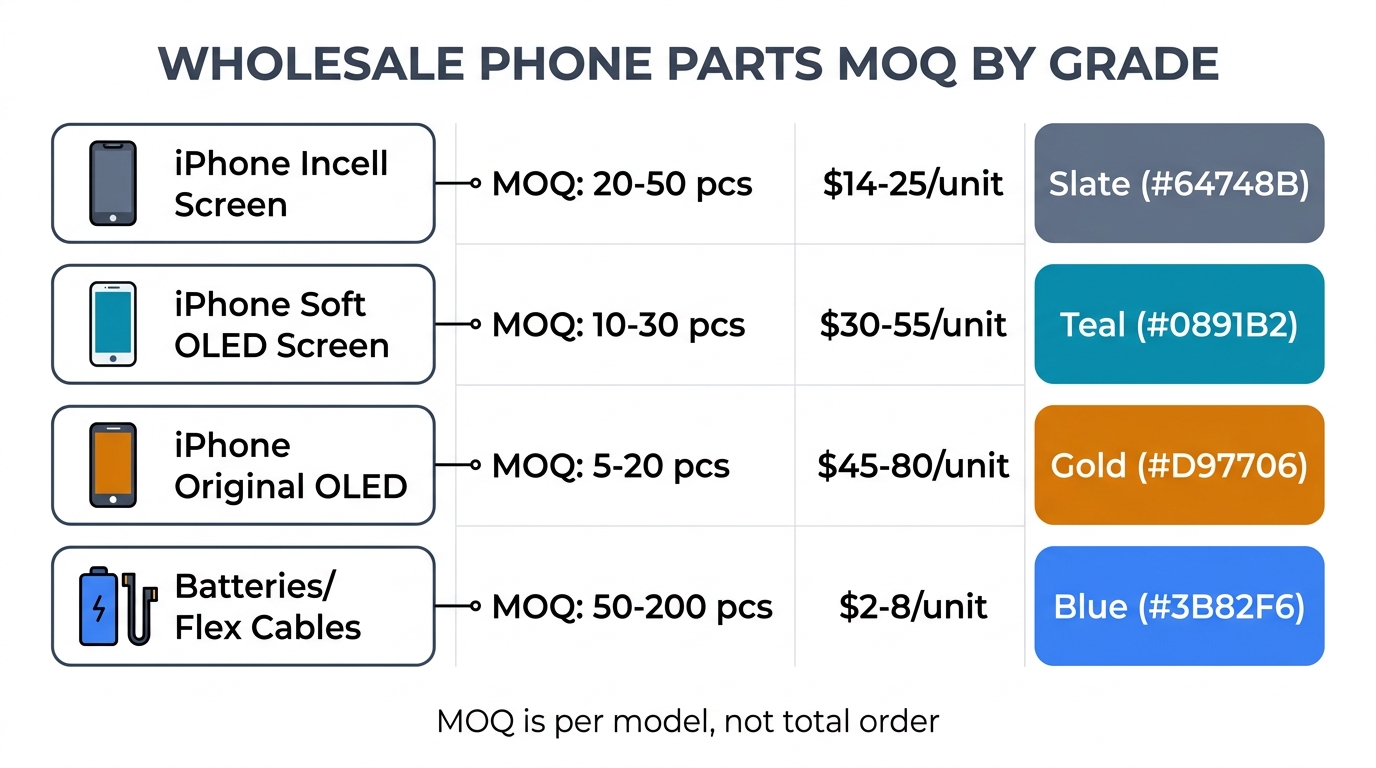
MOQ varies dramatically depending on what you're ordering, which quality grade, and whether the supplier is a factory, trading company, or distributor. Here are the ranges we see most often in the Shenzhen market:
| Part Category | Quality Grade | Typical MOQ (Per Model) | Notes |
|---|---|---|---|
| iPhone LCD/Incell Screen | Standard Aftermarket | 20–50 pcs | Most common entry point |
| iPhone Soft OLED Screen | Premium Aftermarket | 10–30 pcs | Higher unit price = lower MOQ |
| iPhone Hard OLED Screen | Mid-tier Aftermarket | 20–50 pcs | Similar to Incell |
| iPhone Original OLED (Refurbished) | OEM-grade | 5–20 pcs | Limited supply, flexible MOQ |
| Samsung OLED Screen | Aftermarket | 10–30 pcs | Varies by model popularity |
| Phone Batteries | Aftermarket | 50–100 pcs | Low unit price, higher MOQ |
| Charging Ports / Flex Cables | Aftermarket | 50–200 pcs | Very low unit price |
| Back Glass / Housing | Aftermarket | 30–50 pcs | Model-specific |
See the full four-grade comparison with live wholesale prices: iPhone Screen Grade Guide
A few things to note about these numbers:
At most suppliers, MOQ is per model — not per order. A 50-piece MOQ on iPhone screens usually means 50 units of the same model, not 50 screens split across five different iPhones. This catches most first-time buyers off guard: if you need screens for iPhone 13, 14 and 15 from a supplier with a 50-piece minimum, you are looking at 150 screens before they will quote you.
We are the exception, and it is the single most useful thing to know on this page. PRSPARES applies no single-model MOQ. A mixed order that includes screens qualifies once it reaches 10 pieces in total, models and categories mixed freely, and the published 10+ tier price applies to every line on it. Ordered on their own, screens start at 10 pieces, batteries and small parts at 20, repair tools at 5. Three iPhone 11 screens, four batteries and three charging port flex cables is a valid order. This is not a promotional exception — it is how our tier pricing is structured, and you can verify it against the published per-model tier prices before you contact anyone.
Trading companies have lower MOQs than factories. A factory producing Incell screens might require 500+ pieces per run. Trading companies and distributors buy from multiple factories and break bulk, so they can offer 20–50 piece minimums. The trade-off is a slightly higher per-unit cost — typically 5–15% more than going direct to factory.
Popular models have lower MOQs. iPhone 13 and 14 series screens move fast, so suppliers keep them in stock and accept smaller orders. Screens for older models like iPhone 11 or niche Android phones may require larger orders because suppliers don't stock them regularly.
For a deeper breakdown of screen quality grades and how they affect pricing, see our guide on OEM vs aftermarket phone screens and wholesale iPhone screen pricing.
What a 10-Piece First Order Actually Costs
The most common reason a new buyer never places a first China order is the belief that it requires committing $500–800 to one model. With no single-model minimum, it does not. Here is a real starter order built entirely from our published 10+ tier prices, priced on 2026-07-29:
| Line | Qty | Unit (10+ tier) | Line total |
|---|---|---|---|
| iPhone 11 HD Incell screen assembly | 2 | $9.02 | $18.04 |
| iPhone 13 HD Incell screen assembly | 1 | $11.38 | $11.38 |
| iPhone 11 battery (3110mAh) | 2 | $5.88 | $11.76 |
| iPhone 13 battery (3227mAh) | 2 | $6.07 | $12.14 |
| iPhone 11 charging port flex cable | 2 | $2.31 | $4.62 |
| iPhone 14 charging port flex cable | 1 | $2.71 | $2.71 |
| Total | 10 pcs | — | $60.65 |
Sixty dollars of goods, across three part categories and three device generations, at tier pricing. Freight and any duty sit on top and are the real fixed cost of a small first order — which is why a 10-piece order is a qualification exercise, not an economical restock. You are buying information: grade accuracy, packing quality, response time, and whether the parts test clean.
In our experience the shops that scale fastest treat this first order as a supplier test rather than inventory, then place a properly sized second order once the parts pass. That sequence is covered in how to use a small test order to evaluate a supplier and structuring the first real order after a test order.
How to Place a Sample Order — and What to Test
Never commit to a bulk order without testing samples first. This is non-negotiable, even if you've worked with the supplier before on a different product line.
What a Sample Order Looks Like
Most reputable phone parts suppliers offer sample orders under these terms:
- Quantity: 1–5 pieces per model (some allow up to 10)
- Pricing: Full retail price or slightly above wholesale — expect to pay 20–40% more per unit than bulk pricing. This is standard and not a red flag.
- Shipping: You pay shipping. Samples are usually sent by express courier (DHL, FedEx, UPS) so you can evaluate them quickly.
- Lead time: 2–5 days for in-stock items to ship, plus 3–7 days transit via express
Some suppliers will credit sample costs toward your first bulk order. Ask about this before ordering — it's a common arrangement but not always advertised.
What to Test During Your Sample Evaluation
Don't just power on the screen and call it good. Run through this checklist:
- Display quality: Check for dead pixels, color accuracy, brightness uniformity. Compare side-by-side with an original screen if possible
- Touch responsiveness: Test edge-to-edge sensitivity, multi-touch, and swipe gestures. Pay special attention to corners — aftermarket screens often have weak touch zones near the edges
- Fit and alignment: Install the screen in the device. Check that screw holes align, flex cables seat properly, and the frame sits flush
- Face ID / True Tone: For iPhone screens, verify whether Face ID works after installation and whether True Tone can be transferred (this depends on the screen type and whether an IC chip is included)
- Durability signals: Flex the cable gently — cheap screens use thin, brittle flex cables that fail within weeks. Check the adhesive quality on pre-applied frames
Need help comparing screen grades before ordering samples? We can send you a mixed-grade sample pack so you can test Incell, Hard OLED, and Soft OLED side by side. Request a sample quote here.
When a Supplier Refuses Samples — What It Means
If a supplier flatly refuses any sample order, treat it as a warning sign. Legitimate suppliers understand that buyers need to verify quality. Common reasons for refusal include:
- They don't have stock and would need to source it specially (ask when stock is expected)
- Their actual quality doesn't match their marketing claims
- They only deal in very high volume and aren't set up for small shipments
If you encounter this, consider looking at alternative suppliers. Our guide on how to choose a reliable phone parts supplier covers the evaluation process in detail.
Understanding Wholesale Phone Parts Lead Time: From Payment to Delivery
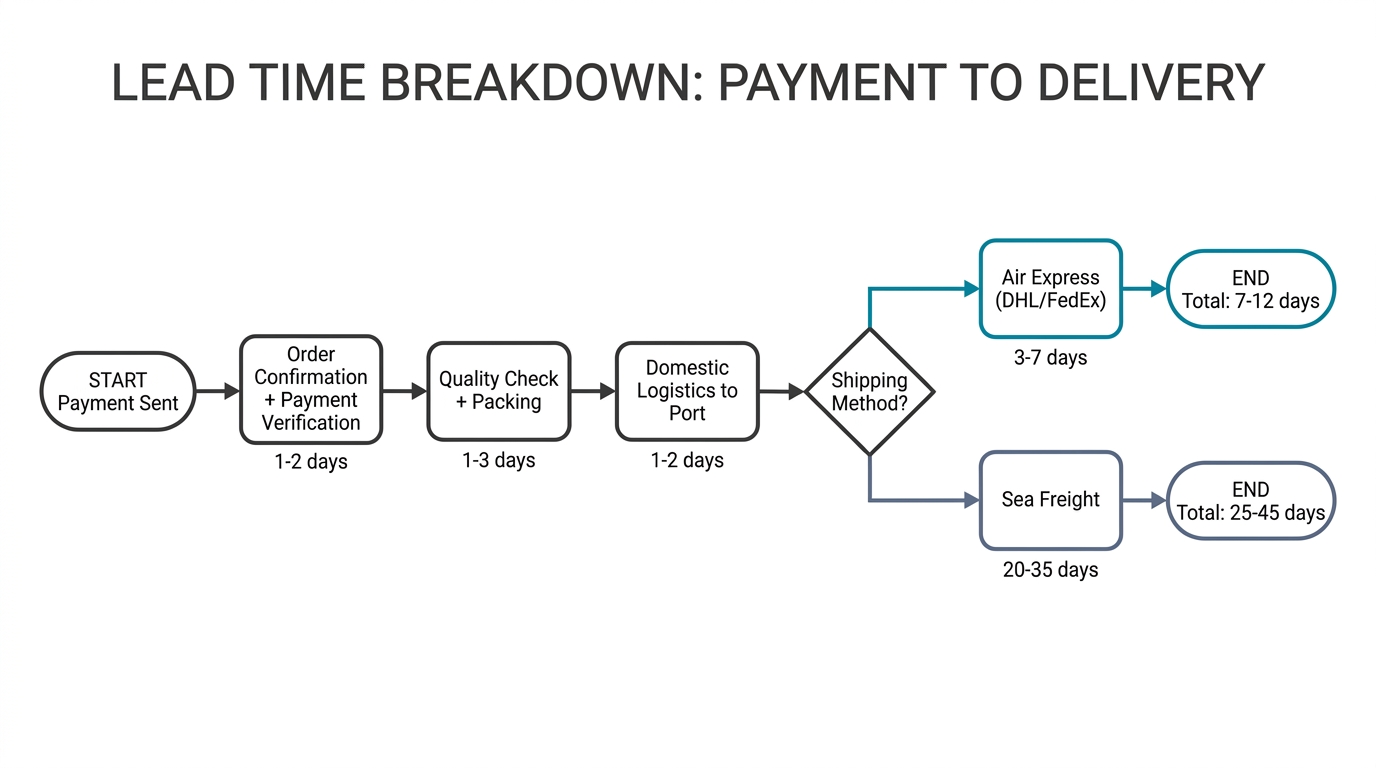
Lead time is the total number of days between paying your supplier and receiving the parts at your location. It's not just shipping time — there are several stages, and each one can add delays if you're not prepared.
The Lead Time Breakdown
| Stage | Typical Duration | What Happens |
|---|---|---|
| Order confirmation + payment verification | 1–2 days | Supplier confirms stock, verifies payment |
| Quality check + packing | 1–3 days | Supplier inspects, packs, and labels |
| Domestic logistics (to port/airport) | 1–2 days | Transfer to shipping agent |
| Air freight (China → US/UK) | 3–7 days | Door-to-door express or air cargo |
| Sea freight (China → US/UK) | 20–35 days | Port-to-port, plus customs clearance |
| Local customs clearance | 1–5 days | Varies by country and shipment size |
| Last-mile delivery | 1–3 days | From customs to your address |
Total realistic lead time:
- Express air (DHL/FedEx/UPS): 7–12 days from payment to delivery
- Standard air freight: 10–18 days
- Sea freight: 25–45 days
Which Shipping Method Makes Sense?
The choice between air and sea freight depends on your order size and urgency:
Air freight is the right choice when:
- Your order is under 100 kg (roughly 200–400 phone screens depending on packaging)
- You need parts within two weeks
- The per-unit value is high enough that shipping cost doesn't kill your margin (OLED screens: yes. Charging cables: probably not)
Sea freight is the right choice when:
- Your order exceeds 200 kg or fills multiple cartons
- You can plan 4–6 weeks ahead
- You're ordering low-value, high-volume parts like batteries, flex cables, or back covers
For most repair shops placing their first few orders, air freight is the practical choice. The extra $2–4 per screen in shipping costs is worth the faster cash cycle and ability to restock quickly based on actual demand.
Common Lead Time Surprises
A few things that catch first-time buyers off guard:
- Chinese holidays: Chinese New Year (late Jan–mid Feb) effectively shuts down the supply chain for 2–4 weeks. National Day (Oct 1–7) adds a week of delay. Plan your Q1 and Q4 orders well in advance.
- Payment method delays: T/T (bank wire) clears in 1–3 business days. PayPal is instant but many suppliers add a 3–5% surcharge. Western Union works for small amounts but offers zero buyer protection.
- Customs holds: First-time importers sometimes trigger additional inspection. Having proper commercial invoices and packing lists speeds up clearance.
- Stock availability: Just because a supplier lists a product doesn't mean they have it in stock right now. Always confirm stock before paying — especially for specific models like iPhone 15 Pro Max Soft OLED, which moves fast.
How to Negotiate MOQ with a New Wholesale Phone Parts Supplier
MOQ isn't always a hard number. Here's what actually works when negotiating:
Start with a mixed-model order. Instead of ordering 50 pieces of one iPhone model, ask if you can order 50 pieces total split across 3–4 models. Many suppliers accept this because the total order value stays the same. You get variety for your shop; they get the same revenue.
Offer to pay a slightly higher per-unit price. Suppliers set MOQs to protect their margin. If you're willing to pay $1–2 more per unit on a smaller order, many will accommodate. This is especially true for trading companies and distributors.
Commit to a reorder schedule. Telling a supplier "I'll order 50 pieces now and 50 more next month" is much more persuasive than a one-time 50-piece request. Suppliers invest time in new accounts and prefer buyers who signal ongoing business.
Use sample orders as a stepping stone. Place a 10-piece sample order, provide feedback, then negotiate a 30-piece first bulk order instead of their standard 50-piece MOQ. This proves you're a serious buyer, not a tire-kicker.
Know when MOQ is truly non-negotiable. Factory-direct orders where the supplier needs to run a production batch genuinely can't be split below a certain threshold. If a factory says their minimum run is 500 pieces, no amount of negotiation will get that to 50. In these cases, work with a trading company or distributor instead.
For a broader view of the wholesale buying process, our complete sourcing guide for cell phone parts walks through the full journey from supplier identification to ongoing ordering.
Red Flags in the Ordering Process
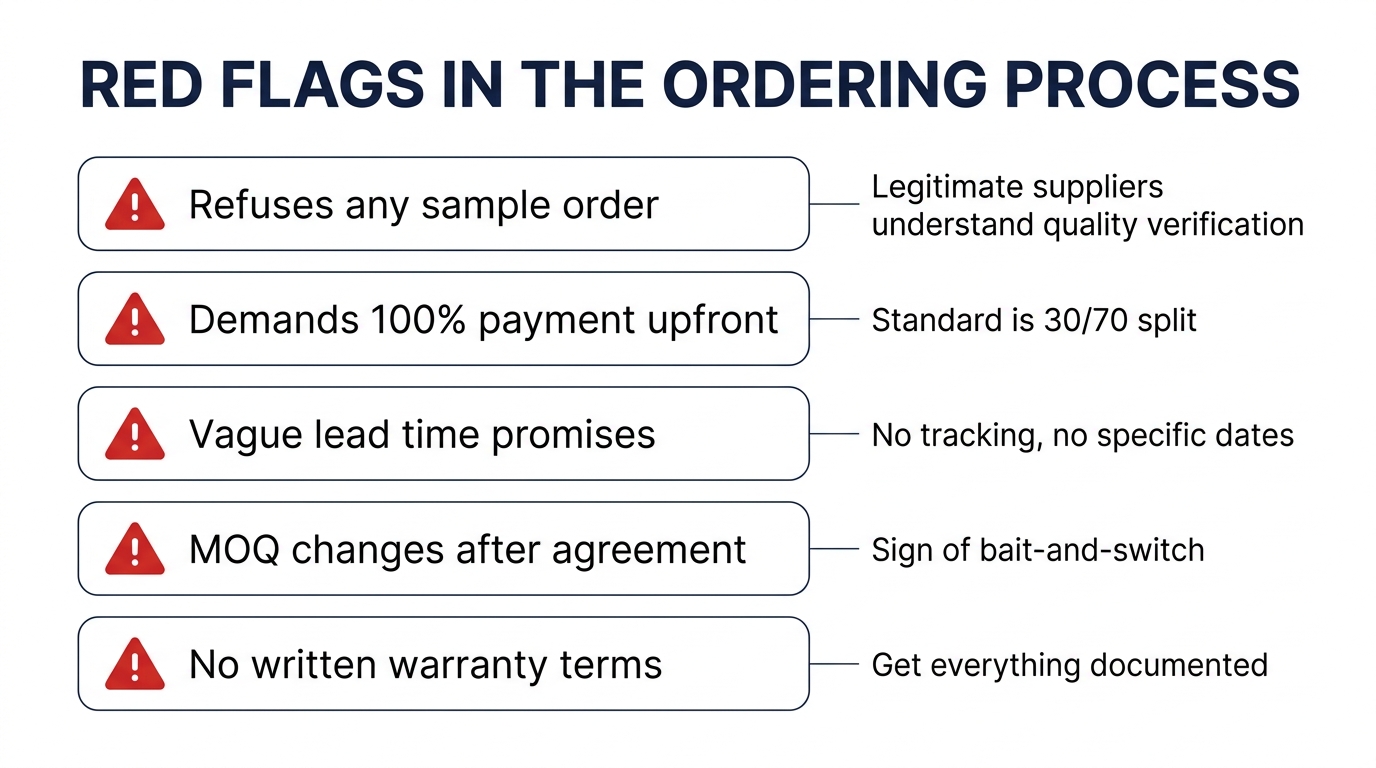
Watch for these warning signs during your first transaction:
- No proforma invoice: Any legitimate supplier should provide a detailed proforma invoice before payment, listing exact models, quantities, grades, unit prices, and total amount
- Pressure to pay via non-traceable methods: Suppliers insisting on Western Union, cryptocurrency, or personal bank accounts (rather than a company account) are higher risk
- Vague delivery timeline: "We'll ship soon" is not an answer. You should get a specific date or date range
- No photos of actual stock: If the supplier can't send photos of the actual products you're ordering (with your order number written on paper next to the products), they may be sourcing from another vendor after you pay
- MOQ that changes after payment: Some suppliers quote a low MOQ to get your order, then claim they can't fulfill it and ask you to increase the order or wait. Get MOQ confirmed in writing before sending money
These aren't rare scenarios. In our experience, first-time buyers who don't verify these basics encounter issues on roughly 1 in 5 orders from unfamiliar suppliers.
If you're comparing multiple suppliers and want help evaluating them, read our guide on how repair shops can buy screens in bulk for a practical supplier comparison framework.
Frequently Asked Questions
What is a typical MOQ for wholesale iPhone screens?
For aftermarket iPhone screens (Incell and Hard OLED), most distributors set MOQ at 20–50 pieces per model. Premium screens like Soft OLED or refurbished original OLED may have lower MOQs of 10–20 pieces because the unit price is higher. Factory-direct orders typically start at 200–500 pieces per model.
Can I order samples before committing to a bulk order?
Yes — and you should. Most suppliers offer sample orders of 1–5 units per model at a slightly higher per-unit price. Expect to pay retail-level pricing on samples plus express shipping. Some suppliers credit sample costs toward your first bulk order. If a supplier refuses all sample requests, consider it a red flag.
How long does shipping take from China to the US or UK?
Express courier (DHL, FedEx, UPS) takes 3–7 days transit time. Standard air freight takes 7–14 days. Sea freight takes 20–35 days port-to-port. Add 1–5 days for customs clearance and last-mile delivery. Total time from payment to delivery: 7–12 days by express, 25–45 days by sea.
What happens if my first order has defective screens?
This depends on the warranty and return terms you negotiate before ordering. Reputable suppliers offer 30–90 day warranties and will replace defective units in your next order or issue credit. Always document defects with photos and video within the warranty window. For high-value orders, consider third-party inspection before shipment — it costs $100–300 but can save thousands.
Should I use air freight or sea freight for phone screens?
For orders under 100 kg (roughly 200–400 screens), air freight makes more sense despite the higher per-unit cost. The faster turnaround preserves your cash flow and lets you restock based on actual demand. Sea freight becomes cost-effective for larger, planned orders — typically 500+ screens or mixed orders with batteries and accessories.
Do I have to order 50 pieces of one model?
Not with us. PRSPARES applies no single-model minimum order quantity — a mixed order that includes screens qualifies once it totals 10 pieces across models, grades and categories, and the published 10+ tier price applies to every line. Ordered on their own, screens start at 10 pieces, batteries and small parts at 20, repair tools at 5. Most Shenzhen suppliers do enforce a per-model MOQ of 20–50 pieces, so this is worth confirming explicitly with any supplier you approach.
What is the smallest realistic first order?
Ten pieces. Priced on our published 10+ tiers on 2026-07-29, a mixed starter order of 3 screens, 4 batteries and 3 charging port flex cables comes to $60.65 in goods, with freight and duty on top. At that size the order is a supplier qualification test rather than a cost-efficient restock — the freight per unit is high, but you learn whether the grades, packing and response times hold up before you commit real capital.
The Rest of the First-Order Sequence
This page covers what to confirm before you order. The steps around it:
- Deciding whether to go direct at all — local distributor vs China direct landed-cost comparison
- Building the order list — how to prepare a mixed order list before contacting a supplier
- Ready-made order shapes — first wholesale order templates by shop size
- Testing the supplier — using a small test order to evaluate a new supplier
- Scaling after the test — structuring the first real order
- Paying safely — payment methods and trade terms for China suppliers
- Stocking without overbuying — starter inventory without overstocking slow models and combining batteries, ports and small parts in one order
- Reordering — what to check before a repeat order
Place Your First Order with Confidence
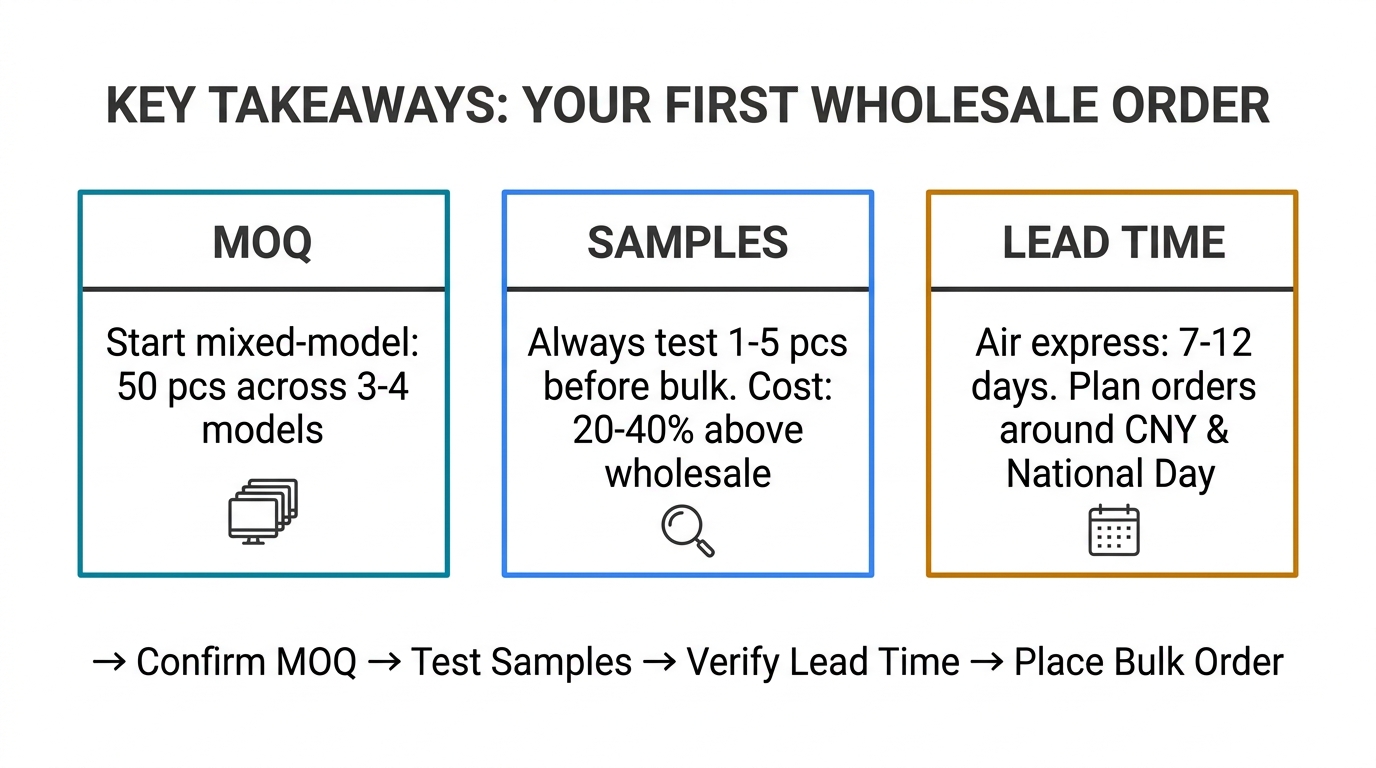
The difference between a smooth first order and a costly mistake comes down to preparation. Confirm MOQ in writing, test samples before scaling, understand the real lead time (not just shipping time), and negotiate terms that match your business volume.
Every supplier relationship starts small. A 20-piece sample order that goes well leads to a 100-piece reorder next month, which leads to a standing monthly order within a quarter. The goal isn't to get the biggest order at the lowest price — it's to build a reliable supply chain that keeps your repair bench stocked without draining your cash.
Ready to test our screen quality before committing to bulk? Request a sample order or wholesale quote — a mixed order that includes screens qualifies at 10 pieces in total at the published 10+ tier unit price (freight billed separately), and we dispatch within 48 hours.