
Samsung A-Series vs iPhone: Which Parts Small Buyers Should Stock First
If you're a small repair shop or a first-time wholesale buyer with a limited budget, you face a real decision: do you invest your first order in iPhone parts, Samsung A-Series parts, or both?
This isn't a brand loyalty question. It's a business question about Samsung vs iPhone repair parts — specifically, which investment gives you the best return based on your market, your customers, and your cash flow. The answer depends on where you operate, what walks through your door, and how much capital you can tie up in inventory.
This article breaks down the comparison on five factors that matter: unit cost, repair demand, margin per repair, inventory risk, and restocking complexity. By the end, you'll know which brand to prioritize for your first wholesale orders — and when it makes sense to stock both.
Looking for a Reliable Wholesale Parts Supplier?
Factory-direct from Shenzhen — transparent grades, invoices & 12-month warranty.
Get Wholesale QuoteUnit Cost Comparison: Samsung A-Series vs iPhone
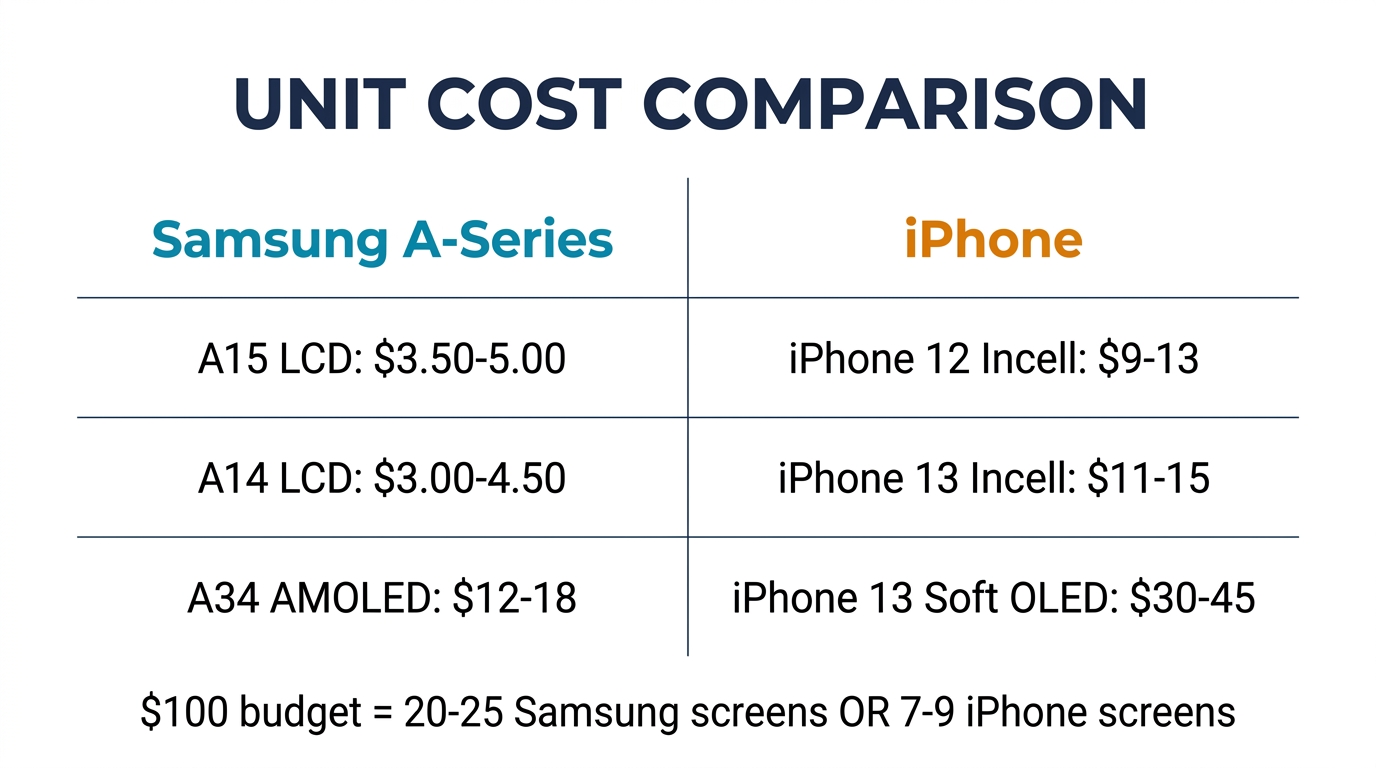
The price difference between Samsung A-Series and iPhone parts is significant, and it fundamentally changes your stocking math.
Screens
| Part | Wholesale Cost | Grade | Notes |
|---|---|---|---|
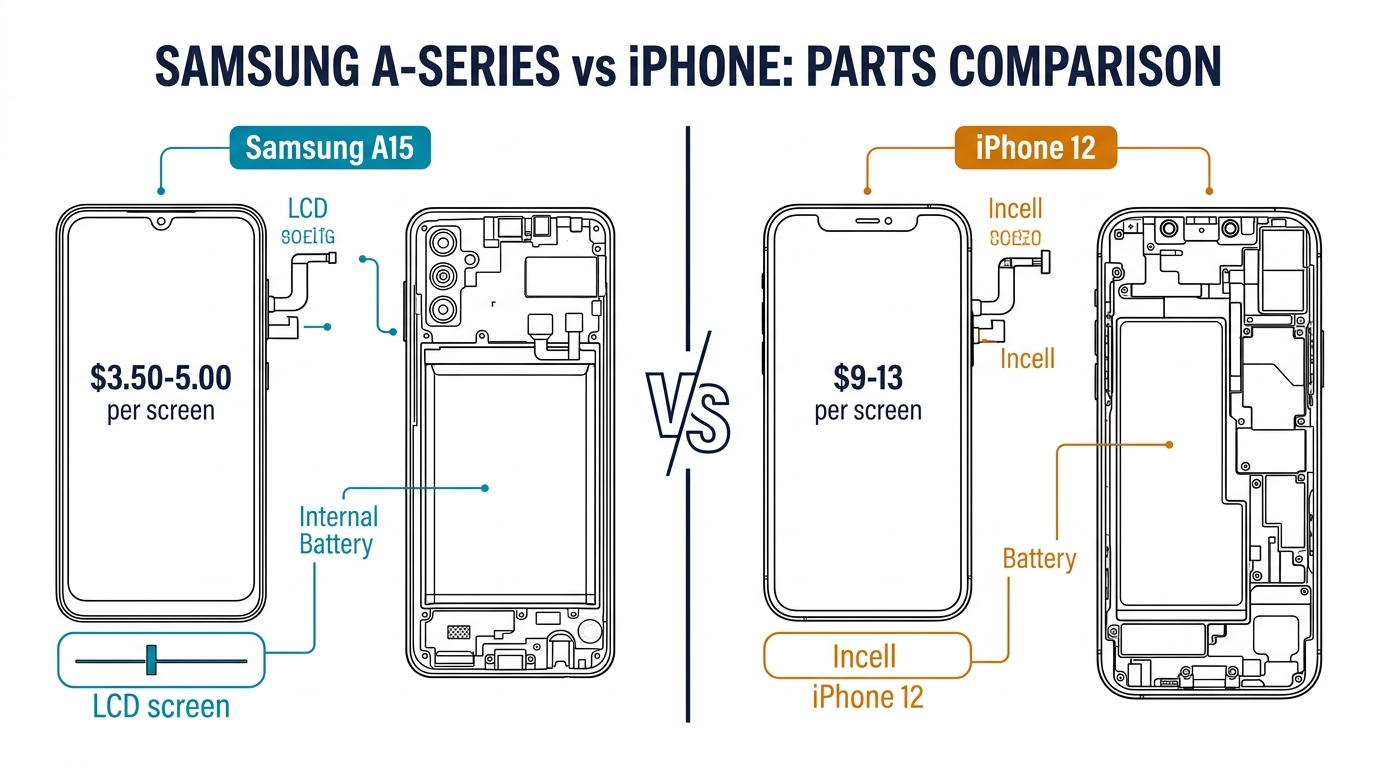
| Samsung A15 LCD | $3.50-5.00 | Standard | LCD panel, straightforward replacement |
| Samsung A14 LCD | $3.00-4.50 | Standard | High-volume budget model |
| Samsung A34 AMOLED | $12-18 | Standard | Mid-range, AMOLED adds cost |
| iPhone 12 Incell | $9-13 | A-grade | Most popular iPhone repair model |
| iPhone 13 Incell | $11-15 | A-grade | Growing demand as devices age |
| iPhone 13 Soft OLED | $30-45 | Premium | For high-end repair service |
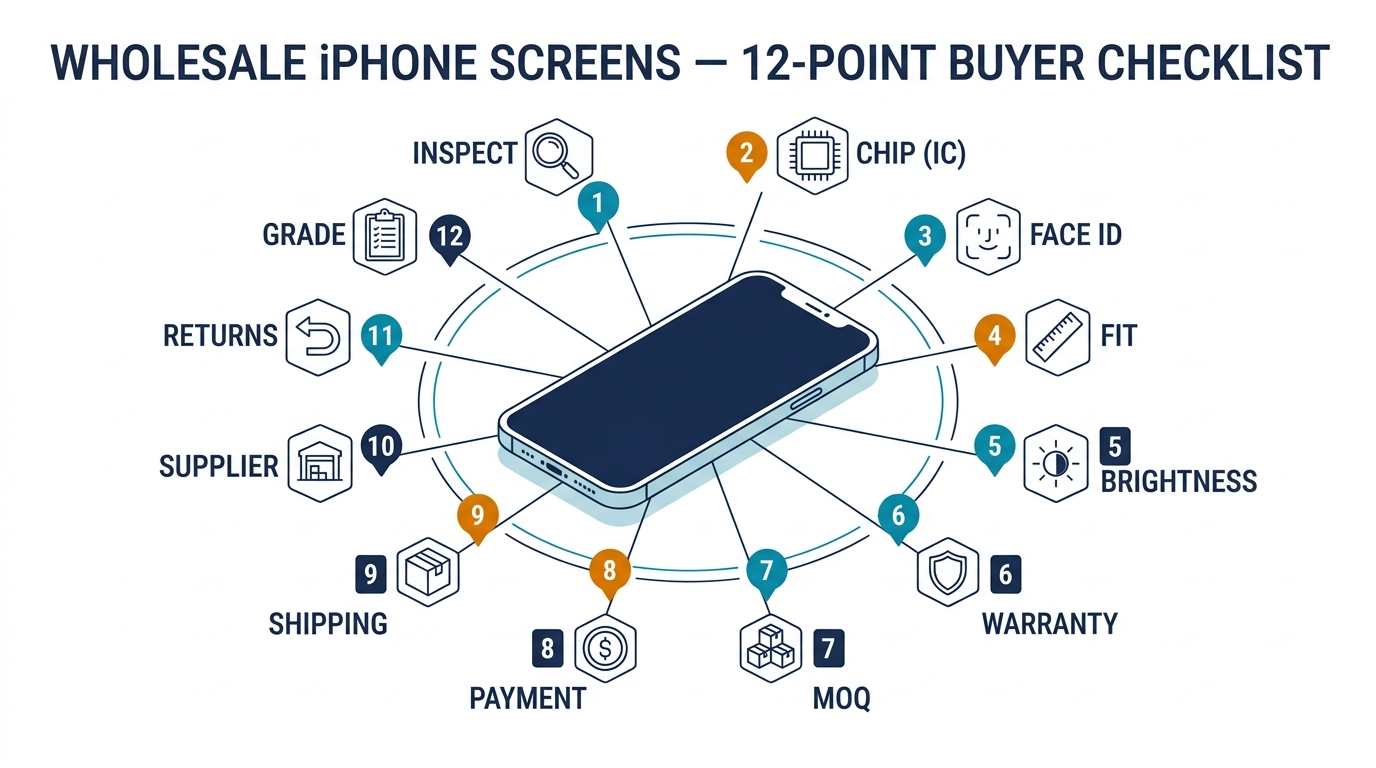
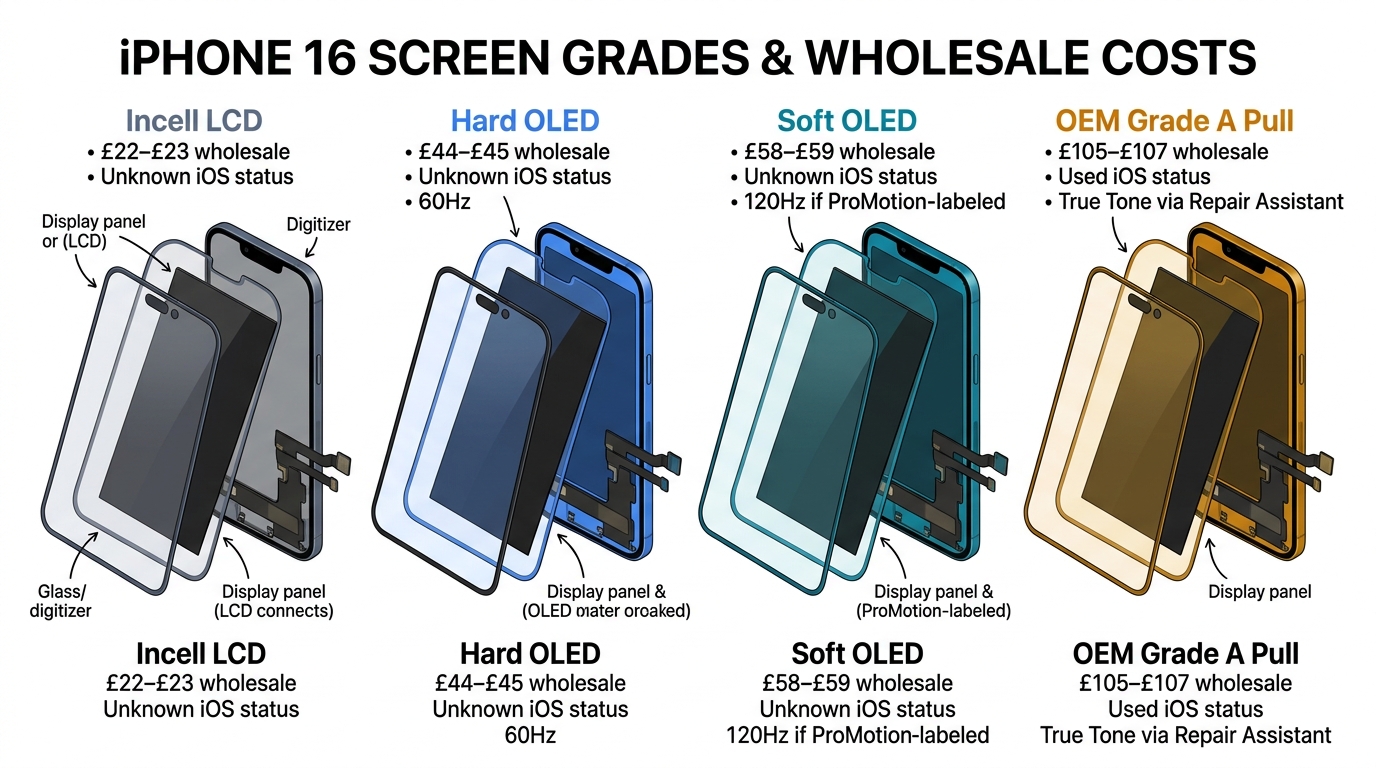
See the full four-grade comparison with live wholesale prices: iPhone Screen Grade Guide
Key insight: For the same $100 invested in screens, you can stock roughly 20-25 Samsung A-Series LCD screens or 7-9 iPhone Incell screens. Samsung gives you more units per dollar, which means more repairs covered per order.
Batteries
Battery costs are closer between brands:
| Part | Wholesale Cost | Notes |
|---|---|---|
| Samsung A15 battery | $2.00-3.00 | Standard capacity |
| Samsung A14 battery | $2.00-2.80 | Standard capacity |
| iPhone 12 battery | $3.00-4.00 | Standard grade |
| iPhone 13 battery | $3.50-4.50 | Standard grade |
The difference is smaller here — $1-2 per unit. Battery stocking decisions should be driven by demand volume rather than unit cost.
Demand Patterns: Where Each Brand Dominates
The most important factor in stocking decisions isn't which parts are cheaper — it's which parts your customers actually need.
iPhone-Dominant Markets
- UK and Western Europe: iPhone holds 50-55% market share. iPhone 11, 12, and 13 are the three highest-volume repair models.
- United States: iPhone share is 55-60%. Screen repairs skew heavily toward iPhone.
- Australia, Japan: Premium smartphone markets where iPhone dominates the repair queue.
If you're in these markets, iPhone parts should be your primary stocking investment. Samsung A-Series is secondary — stock it only if you see consistent demand.
Samsung A-Series Dominant Markets
- Africa: Samsung A-Series (A05, A06, A14, A15) dominates the budget smartphone segment. iPhone repairs exist but at much lower volume.
- Latin America: Similar pattern — Samsung and budget Xiaomi/Oppo dominate, with iPhone as a smaller premium segment.
- South and Southeast Asia: A mix, but Samsung A-Series and budget Chinese brands make up the majority of repairs.
- Middle East: Varies by country, but Samsung has strong market share across price tiers.
If you're in these markets, Samsung A-Series parts should be your primary investment. For specific stocking recommendations, see our guide on Samsung A-Series parts for small buyers.
Mixed Markets
Many repair shops — especially in Europe, the Middle East, and multi-ethnic urban areas — see both iPhone and Samsung in significant volumes. If your split is roughly 60/40 either direction, you need both. The question becomes how much of each.
Margin Comparison: Which Repairs Pay Better?
Revenue per repair matters as much as volume. Here's how the math works:
| Repair | Part Cost | Typical Charge | Gross Margin (Part) | Margin % |
|---|---|---|---|---|
| Samsung A15 screen | $4.00 | $20-30 | $16-26 | 80-87% |
| Samsung A14 screen | $3.50 | $18-25 | $14.50-21.50 | 81-86% |
| iPhone 12 Incell screen | $11.00 | $45-65 | $34-54 | 76-83% |
| iPhone 13 Incell screen | $13.00 | $50-70 | $37-57 | 74-81% |
| iPhone 13 Soft OLED screen | $38.00 | $80-120 | $42-82 | 53-68% |
Samsung A-Series has higher margin percentages but lower absolute margin per repair. You make $16-26 per Samsung A15 screen repair vs. $34-54 per iPhone 12 screen repair.
What this means for small buyers:
- If you need maximum revenue per repair job (higher ticket value), prioritize iPhone
- If you need maximum return on inventory investment (higher margin %), prioritize Samsung A-Series
- If cash flow is tight, Samsung A-Series lets you stock more repairs per dollar invested
Inventory Risk: What Happens If Parts Don't Sell
Every part sitting on your shelf is cash that isn't in your bank account. The risk profile differs between brands.
Samsung A-Series: Lower Unit Risk, Higher Model Risk
Samsung A-Series parts are cheap, so each unsold unit doesn't hurt much. A $4 screen that sits for 3 months is a minor loss. But Samsung releases new A-Series models frequently — A14 replaced A13, A15 is already available, and A16 will follow. If you overstock a model that's being phased out, you could end up with inventory that's hard to move.
Mitigation: Stock conservatively on Samsung A-Series (4-6 weeks of demand). Don't bulk-buy 50 Samsung A14 screens because they're cheap — buy what you'll use in 30-45 days.
iPhone: Higher Unit Risk, Lower Model Risk
iPhone parts cost more per unit, so overstocking hurts more. Five unsold iPhone 13 Soft OLED screens at $38 each = $190 tied up. But iPhone models stay relevant for repair much longer — iPhone 11 is still a top repair model in 2026, three years after most carriers stopped selling it. Once an iPhone part is in demand, it typically stays in demand for 3-4 years.
Mitigation: Focus your iPhone budget on proven high-demand models (iPhone 11, 12, 13 in 2026). Avoid stocking iPhone 15 or 16 heavily until aftermarket supply stabilizes and repair volume picks up.
How to Decide: A Framework for Small Buyers
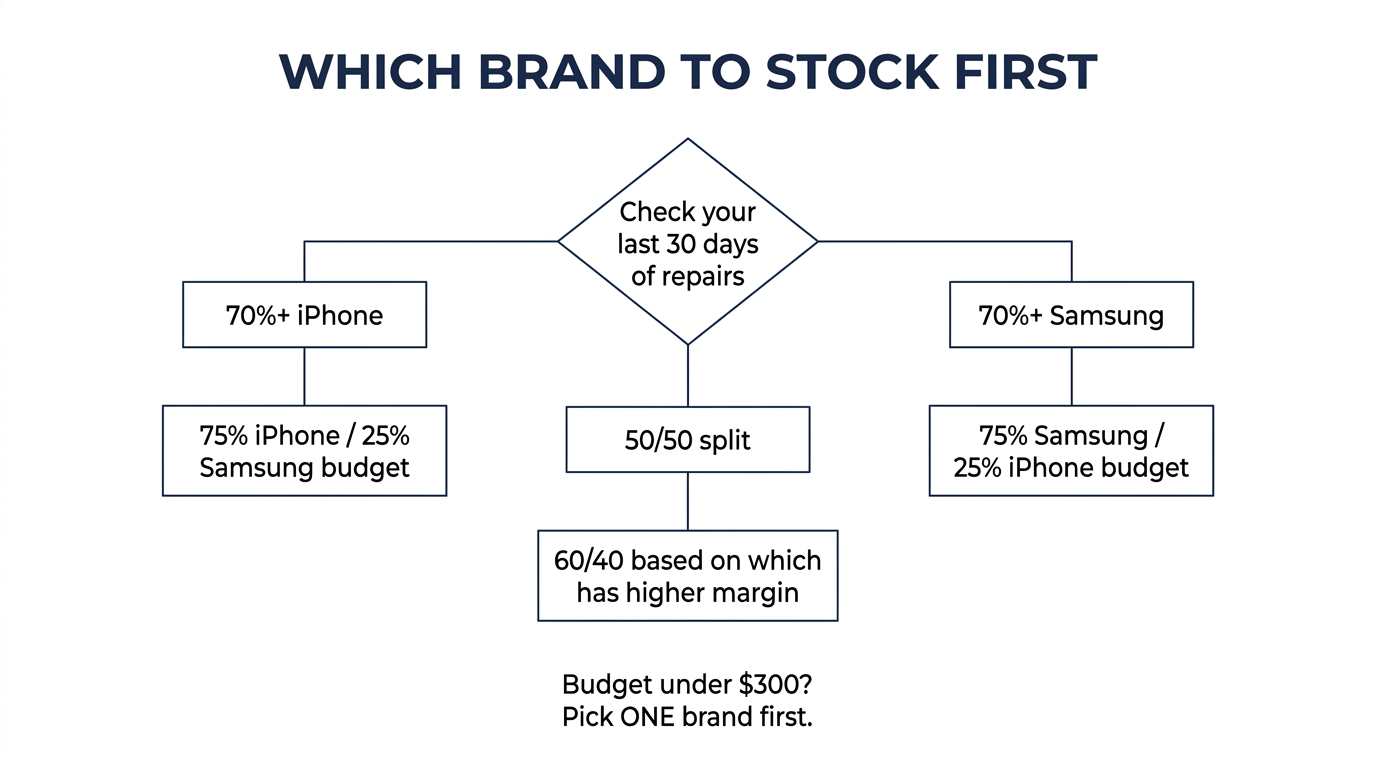
Step 1: Check Your Last 30 Days of Repairs
Count how many Samsung vs. iPhone repairs you did. If you don't track, start a tally now. Even 2 weeks of data is better than guessing.
Step 2: Calculate the Split
| iPhone Repairs (%) | Samsung Repairs (%) | Recommended Budget Allocation |
|---|---|---|
| 70%+ | 30% or less | 75% iPhone / 25% Samsung |
| 50-70% | 30-50% | 60% iPhone / 40% Samsung |
| 30-50% | 50-70% | 40% iPhone / 60% Samsung |
| 30% or less | 70%+ | 25% iPhone / 75% Samsung |
Step 3: Decide on Your First Order
If budget is very tight ($200-300), pick one brand for your first order. Stock it properly rather than splitting too thin across both. You can add the second brand in your next order once you have cash flow from the first batch of repairs.
If budget is moderate ($400-800), split across both brands following the ratio from Step 2. Use a mixed order approach to combine both brands plus batteries and small parts in one shipment.
Step 4: Evaluate After One Month
Did your iPhone parts sell faster than Samsung, or vice versa? Adjust the ratio for your next order. The first order is always partly a test — let real data guide your second order.
For a detailed look at planning your first order, see our wholesale order templates by shop size.
When to Stock Both Brands (and When to Focus)
Focus on one brand when:
- Your repair volume is clearly dominated by one brand (70%+)
- Your total monthly parts budget is under $300
- You're just starting and need to learn one supply chain before adding complexity
Stock both brands when:
- Your repair mix is 40/60 or closer
- You have a monthly parts budget of $400+
- You serve a diverse customer base (urban shops, multi-ethnic neighborhoods, tourist areas)
- You want to capture walk-in customers who might otherwise go to a competitor
The most common mistake small buyers make: splitting a small budget across too many models of both brands. It's better to stock 5 iPhone models and 3 Samsung models properly than to stock 10 models of each at 1-2 units each.
Frequently Asked Questions
Can I mix Samsung and iPhone parts in one wholesale order?
Yes — most wholesale suppliers, including PRSPARES, handle mixed-brand orders routinely. Combining Samsung A-Series screens, iPhone screens, batteries from both brands, and small parts in a single shipment is the most cost-effective approach because it consolidates shipping and helps you meet MOQ thresholds. See how to combine parts in one order.
Samsung screens seem much cheaper — why not just stock Samsung?
If your customers only bring Samsung devices, that's fine. But in most markets, ignoring iPhone means turning away your highest-ticket repairs. An iPhone 13 screen repair nets $37-57 in part margin vs. $16-26 for a Samsung A15. The question isn't which is cheaper to stock — it's which generates more total profit given your customer mix.
What about other Android brands like Xiaomi, Oppo, or Huawei?
Stock these only if they represent significant repair volume in your market. For most international shops, Samsung A-Series covers the budget Android segment well. Xiaomi and Oppo parts are worth adding once your Samsung and iPhone supply chain is stable — don't complicate your first few wholesale orders.
How do I handle Samsung's frequent model changes?
Order conservatively — 4-6 weeks of supply rather than 3 months. Samsung A-Series models turn over faster than iPhone, so you need to stay current with which models your customers actually bring in. Track repairs monthly and be willing to shift budget from an aging model (A13) to its successor (A14, A15) within one or two order cycles.
Match Your Stock to Your Market
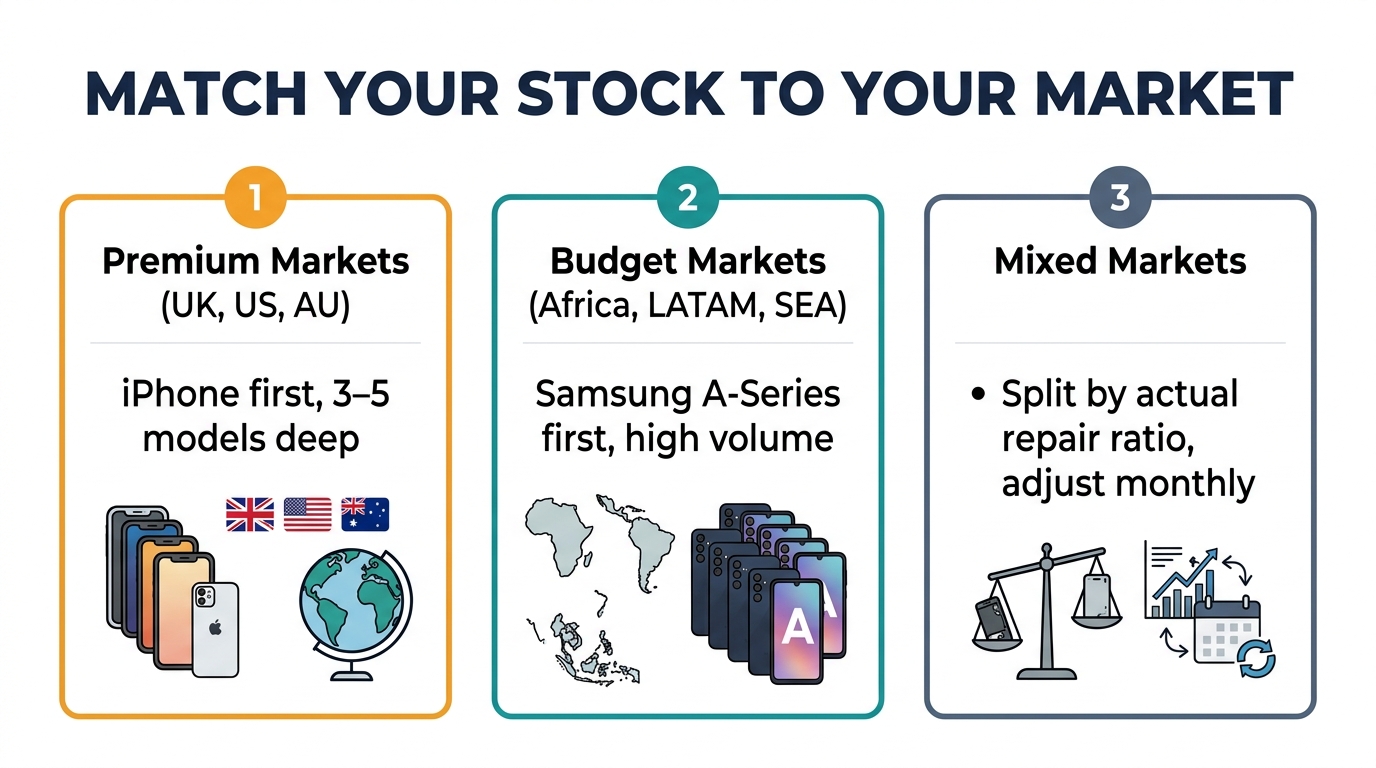
The Samsung vs. iPhone stocking decision isn't about which brand is "better" — it's about which brand matches your revenue reality. Check your repair data, allocate your budget accordingly, and adjust every month as demand shifts.
If you're planning your first wholesale order and need help sizing the Samsung-to-iPhone ratio, send us your model list and market. We stock both brands across all grades and can suggest a split that fits your shop's volume.
Related reading: