
Samsung A-Series Repair Parts: What Small Buyers Should Stock First
If you run a repair shop outside the US or Western Europe, Samsung A-series phones probably make up a big chunk of your daily work. In markets like Sub-Saharan Africa, Papua New Guinea, Southeast Asia, and Latin America, budget Samsung models — the A05, A06, A12, A14, and A15 — outsell iPhones by a wide margin. Yet most wholesale guides focus almost entirely on iPhone, leaving Samsung A series repair parts as a blindspot.
That creates a real problem for small buyers. You know you need these parts, but which models should you prioritize? Should you stock screens for every A-model from A05 to A55, or focus on three or four that actually move? And what about the LCD vs AMOLED split — does it matter for A-series, or is everything LCD anyway?
This guide gives you a practical stocking plan for Samsung A-series parts. We'll cover which models generate the most repair demand right now, what parts to prioritize for each, and how to build a first order that matches your market without overspending.
Sourcing Replacement Screens in Bulk?
Incell / Hard OLED / Soft OLED grades — wholesale pricing, grade comparison on request.
Get Wholesale QuoteWhy Samsung A-Series Matters for Repair Businesses
Samsung's A-series is the world's best-selling smartphone lineup by unit volume. The Galaxy A15 alone sold over 25 million units in its first year. In price-sensitive markets, the A12, A14, and A15 together account for more repair jobs than all Samsung flagship models combined.
Three things make A-series repair parts a strong business opportunity:
- High installed base, low repair cost. These phones retail for $100-200, and screen replacements cost customers $30-50. The math works for customers — unlike flagships where repair costs approach new phone prices.
- LCD-dominant lineup. Most A-series models use LCD panels, not AMOLED. LCD screens cost $4-12 wholesale, compared to $25-80 for Samsung AMOLED screens. Lower part costs mean better margins at lower customer price points.
- Consistent demand. Budget phones break more often (thinner build, less durable glass) and users hold onto them longer because upgrading is expensive. That means steady, repeating repair demand.
The challenge is that Samsung releases 8-12 new A-series models every year. You can't stock parts for all of them. The key is knowing which models actually generate repair volume in your market.
Model-by-Model Breakdown: Which A-Series Parts to Stock
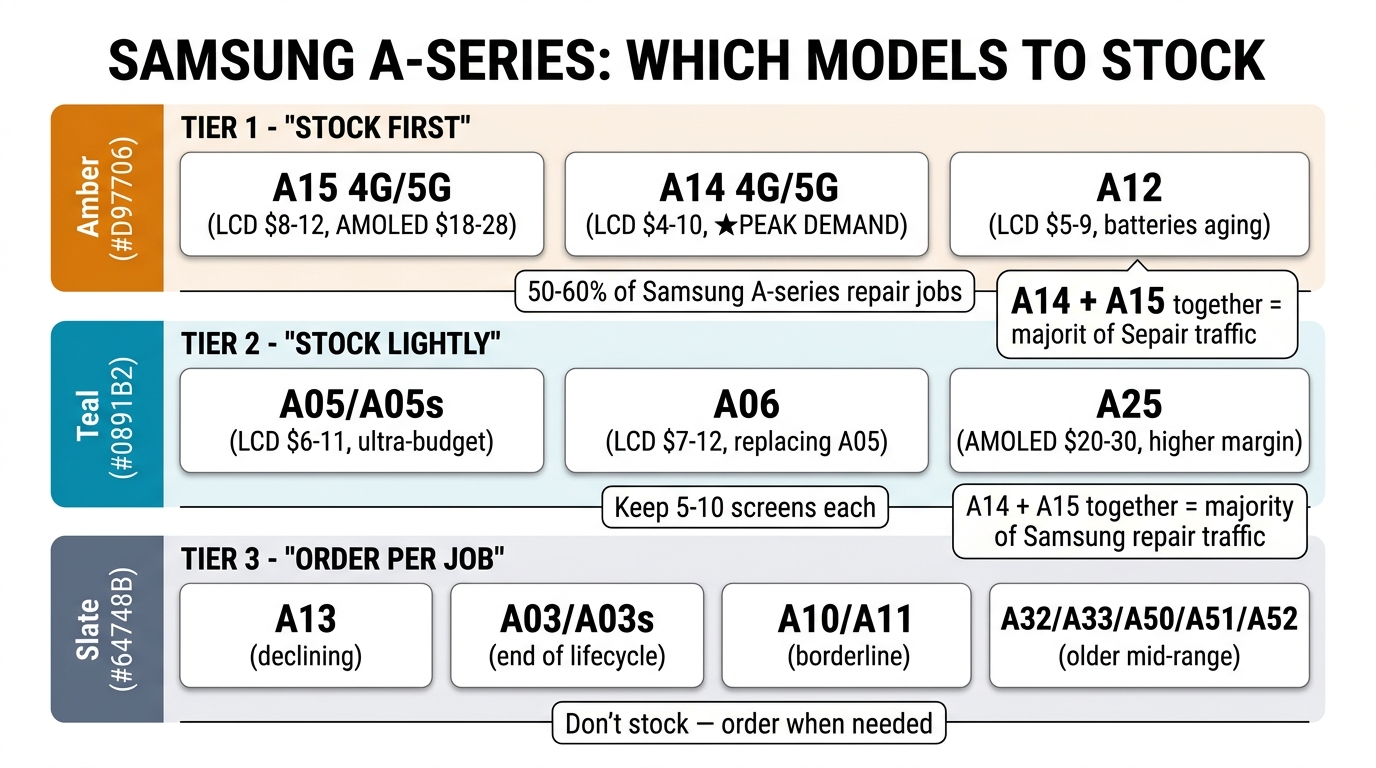
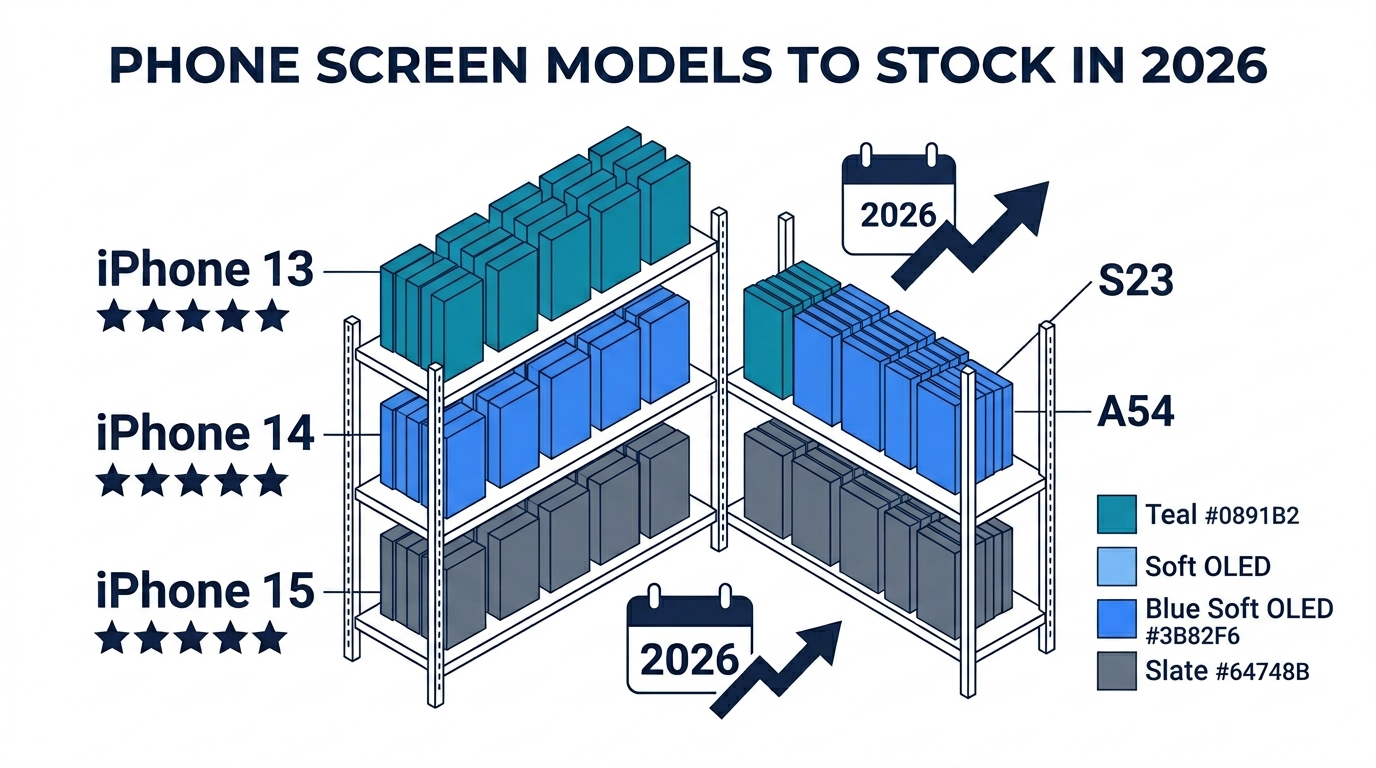
Based on repair demand patterns across Africa, Southeast Asia, Latin America, and the UK, here's how Samsung A-series models stack up in 2026:
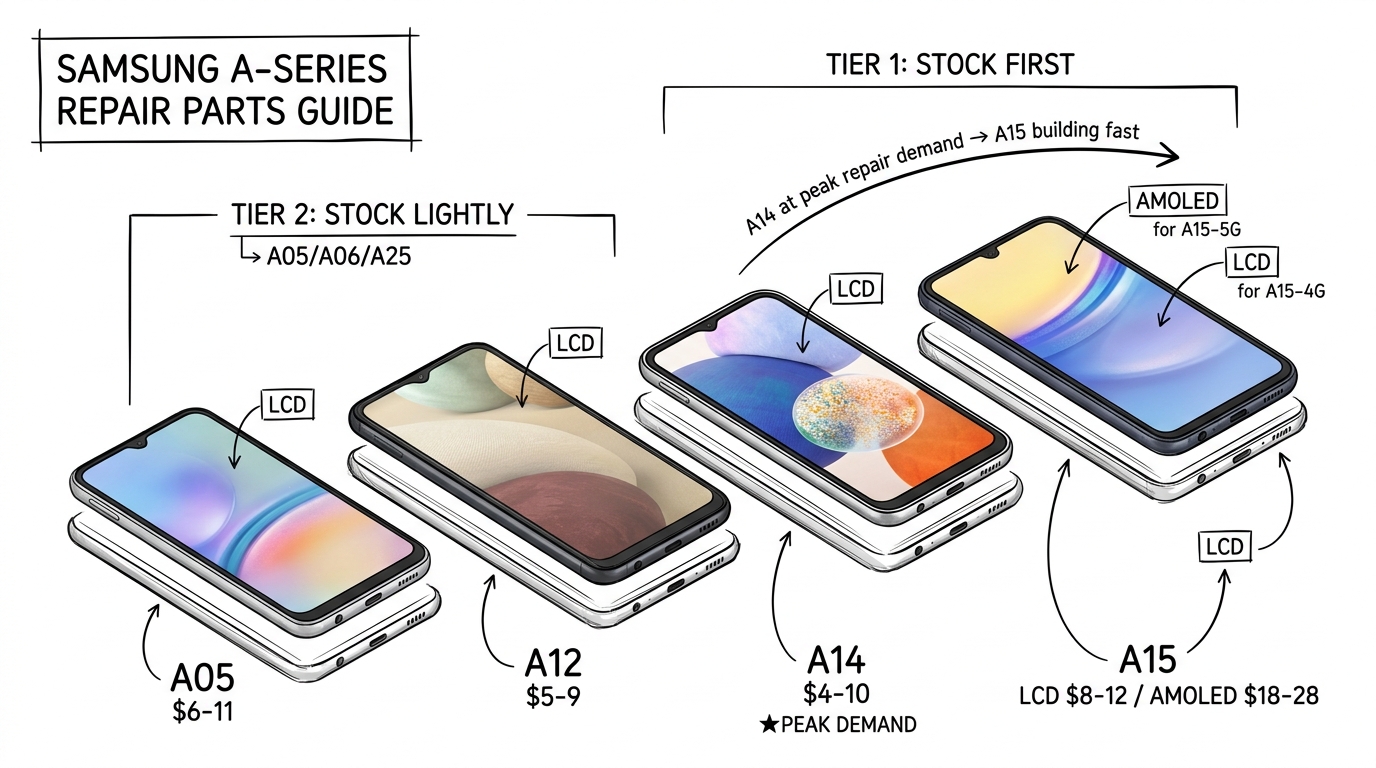
Tier 1: Stock These First (Highest Repair Volume)
| Model | Display Type | Screen Wholesale Price | Why High Demand |
|---|---|---|---|
| Galaxy A15 (4G/5G) | LCD (4G) / AMOLED (5G) | $8-12 (LCD) / $18-28 (AMOLED) | Current-gen best-seller, massive global distribution, screens crack easily |
| Galaxy A14 (4G/5G) | LCD | $4-10 | Previous-gen best-seller, huge installed base, peak repair demand now |
| Galaxy A12 | LCD | $5-9 | 2-3 years old, enormous installed base in emerging markets, batteries and screens both failing |
These three models will likely cover 50-60% of your Samsung A-series repair jobs. If you stock nothing else from Samsung, stock these.
The A14 is especially important right now. It hit the market in early 2023, which means by 2026 most units are past warranty, out of any carrier protection plans, and old enough for battery degradation and screen damage to accumulate. Repair demand for the A14 is at or near its peak.
The A15 is building fast. The 5G variant uses an AMOLED panel — a key distinction. If your market has significant A15 5G adoption, you'll need to stock the AMOLED version ($18-28), not just the LCD. The 4G variant uses LCD and is cheaper to source. Know which variant dominates your market before ordering.
Tier 2: Stock Lightly (Steady but Lower Volume)
| Model | Display Type | Screen Wholesale Price | Notes |
|---|---|---|---|
| Galaxy A05 / A05s | LCD | $6-11 | Ultra-budget entry, popular in Africa and South Asia, simple LCD repair |
| Galaxy A06 | LCD | $7-12 | Replacing A05 in retail channels, demand building |
| Galaxy A25 | AMOLED | $20-30 | Mid-range A-series, lower volume than A14/A15 but higher margin per repair |
For Tier 2 models, keep 5-10 screens on hand. These models generate consistent but lower repair traffic. The A05/A05s is worth stocking because it's the cheapest Samsung model on the market — in some African markets, it's the most common phone period.
The A25 is a different play. It uses AMOLED, which means higher part cost but also higher repair pricing. If you serve customers willing to pay $60-80 for a Samsung screen repair, the A25 is worth having in stock. If your customers are strictly price-sensitive, skip it and put that capital into more A14 and A15 screens.
Tier 3: Order Per Job (Low Volume or Declining)
| Model | Approach |
|---|---|
| Galaxy A13 | Demand declining as A14 replaces it. Keep 2-3 screens max or order per job |
| Galaxy A03 / A03s | End of lifecycle in most markets. Order only when a customer requests it |
| Galaxy A10 / A11 | Still circulating in some markets but repair economics are borderline. Order per job |
| Galaxy A32 / A33 | AMOLED models with limited repair demand. Don't stock — order when needed |
| Galaxy A50 / A51 / A52 | Older mid-range, declining. Order per job only |
Screens: LCD vs AMOLED in the A-Series
The biggest sourcing decision for Samsung A-series screens is understanding the LCD/AMOLED split. Unlike iPhones where the display technology is predictable by model, Samsung mixes LCD and AMOLED within the same A-series generation.
Here's what you need to know:
LCD models (A05, A06, A12, A14 4G, A15 4G):
- Wholesale cost: $4-12 per screen
- Quality grades are simpler — most are "standard" or "premium" LCD, no complex OLED tier system
- Easier to source, more consistent quality across suppliers
- Lower customer repair price ($25-40 typically)
- Higher margin as a percentage, but lower absolute dollar margin
AMOLED models (A15 5G, A25, A32, A33, A52, A53):
- Wholesale cost: $18-35 per screen
- Quality varies more — aftermarket AMOLED can have color and brightness issues
- Higher customer repair price ($50-80 typically)
- Higher absolute dollar margin, but more capital tied up per unit
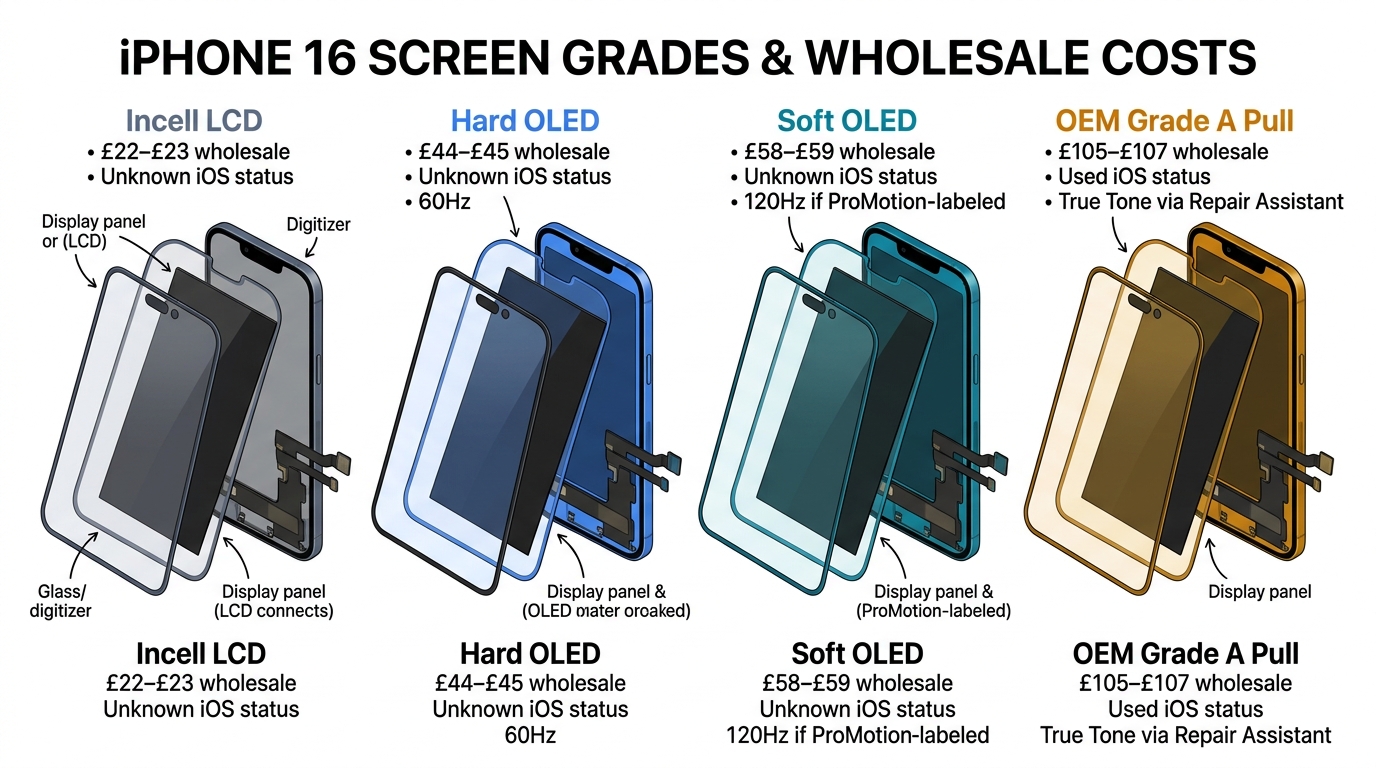
For a detailed comparison of LCD vs OLED technology and how it affects repair business decisions, see our LCD vs OLED vs Hard OLED vs Soft OLED guide.
Practical recommendation: If you're a small buyer just entering Samsung repair parts, start with LCD-only models (A14 4G, A15 4G, A12, A05). These are cheaper to stock, easier to quality-check, and serve the highest-volume repair demand. Add AMOLED models (A15 5G, A25) only after you've established steady LCD sales.
Beyond Screens: Batteries and Small Parts for A-Series
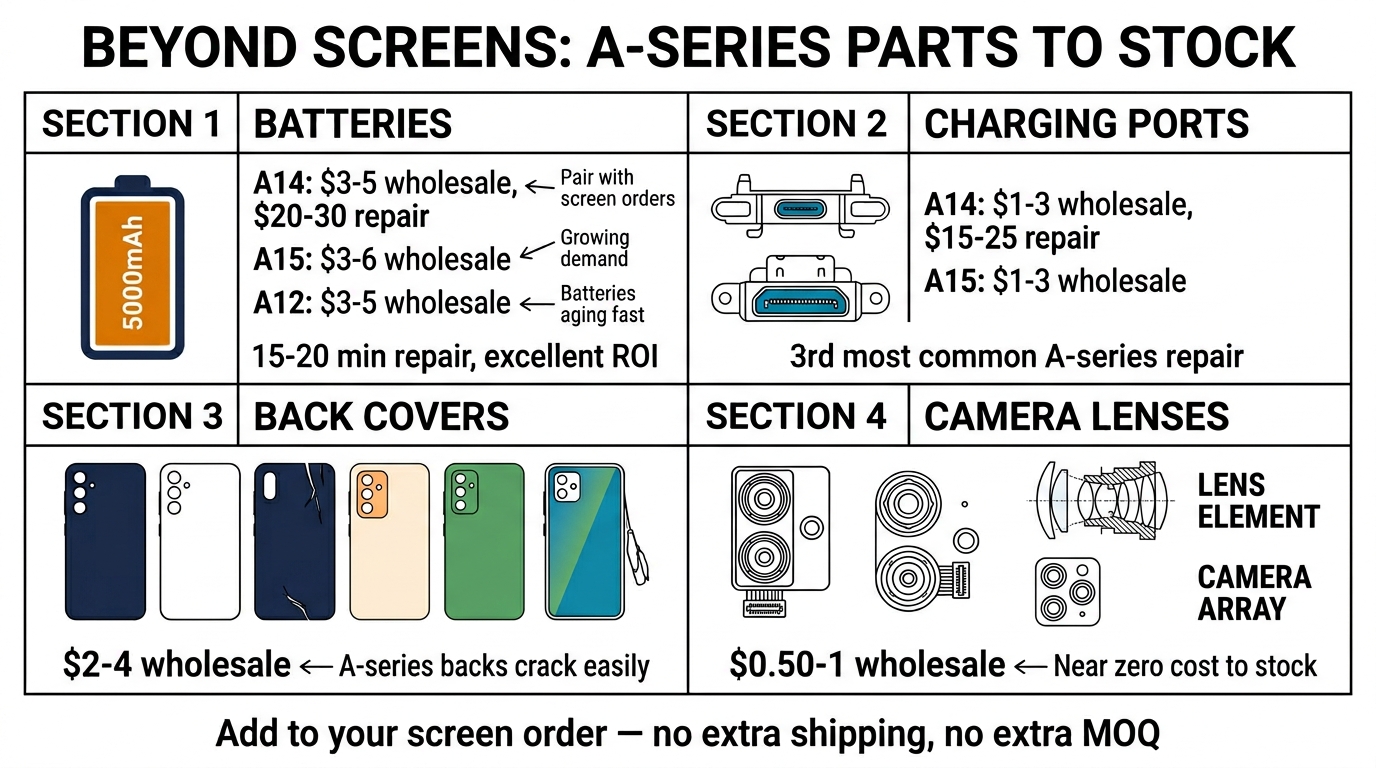
Screens get all the attention, but Samsung A-series batteries and small parts are worth stocking too — especially for Tier 1 models.
Batteries
Samsung A-series phones use large batteries (4,000-5,000mAh) that degrade noticeably after 18-24 months. Battery replacement demand for A12 and A14 is already strong and growing.
| Model | Battery Capacity | Wholesale Price | Stock? |
|---|---|---|---|
| A14 | 5,000mAh | $3-5 | Yes — pair with screen orders |
| A15 | 5,000mAh | $3-6 | Yes — growing demand |
| A12 | 5,000mAh | $3-5 | Yes — batteries are aging |
| A05 | 5,000mAh | $3-5 | Light stock only |
Battery replacements on A-series are straightforward repairs (15-20 minutes) with good margins. At $3-5 wholesale and $20-30 customer pricing, the ROI per repair is excellent. Include batteries in your screen orders to hit volume pricing thresholds.
Charging Ports
Charging port failures are the third most common A-series repair after screens and batteries. USB-C ports on budget phones are especially prone to:
- Lint and debris buildup (users often skip cases on budget phones)
- Connector wear from frequent charging cycles
- Flex cable fatigue
Stock charging port flex cables for A14 and A15 at minimum. Wholesale cost is $1-3 per unit, and repair pricing is $15-25 — strong margin for a quick repair.
Other Small Parts
For a small buyer, don't over-diversify into small parts initially. But if you're already ordering screens and batteries for A14/A15, consider adding:
- Back covers ($2-4) — A-series back panels crack easily
- Camera lens covers ($0.50-1) — cheap to stock, fast repair
- Earpiece and speakers ($1-2) — occasional demand
For a comprehensive overview of small parts categories and quality factors, see our guide on which cell phone repair parts a small shop should stock.
Building Your First Samsung A-Series Order
If you're adding Samsung A-series to your existing iPhone-focused inventory, or starting fresh, here's a practical first order for a small repair shop:
Starter Order: LCD Markets (Africa, South Asia, LATAM)
| Part | Model | Qty | Est. Cost (USD) |
|---|---|---|---|
| LCD Screen | A14 4G | 15 | $60-150 |
| LCD Screen | A15 4G | 12 | $96-144 |
| LCD Screen | A12 | 8 | $40-72 |
| LCD Screen | A05/A05s | 5 | $30-55 |
| Battery | A14 | 10 | $30-50 |
| Battery | A15 | 8 | $24-48 |
| Battery | A12 | 5 | $15-25 |
| Charging Port | A14 | 5 | $5-15 |
| Charging Port | A15 | 5 | $5-15 |
| Total | 73 parts | $305-574 |
Starter Order: Mixed Markets (UK, Southeast Asia)
| Part | Model | Qty | Est. Cost (USD) |
|---|---|---|---|
| LCD Screen | A14 4G/5G | 10 | $40-100 |
| LCD Screen | A15 4G | 8 | $64-96 |
| AMOLED Screen | A15 5G | 5 | $90-140 |
| LCD Screen | A12 | 5 | $25-45 |
| AMOLED Screen | A25 | 3 | $60-90 |
| Battery | A14 | 8 | $24-40 |
| Battery | A15 | 5 | $15-30 |
| Charging Port | A14 | 5 | $5-15 |
| Charging Port | A15 | 5 | $5-15 |
| Total | 54 parts | $328-571 |
Both orders stay under $600 and cover the models you'll actually need. Adjust quantities based on your local demand — track repairs by model for 2-4 weeks before your second order and shift budget toward whatever's moving fastest.
Quality Considerations Specific to Samsung A-Series
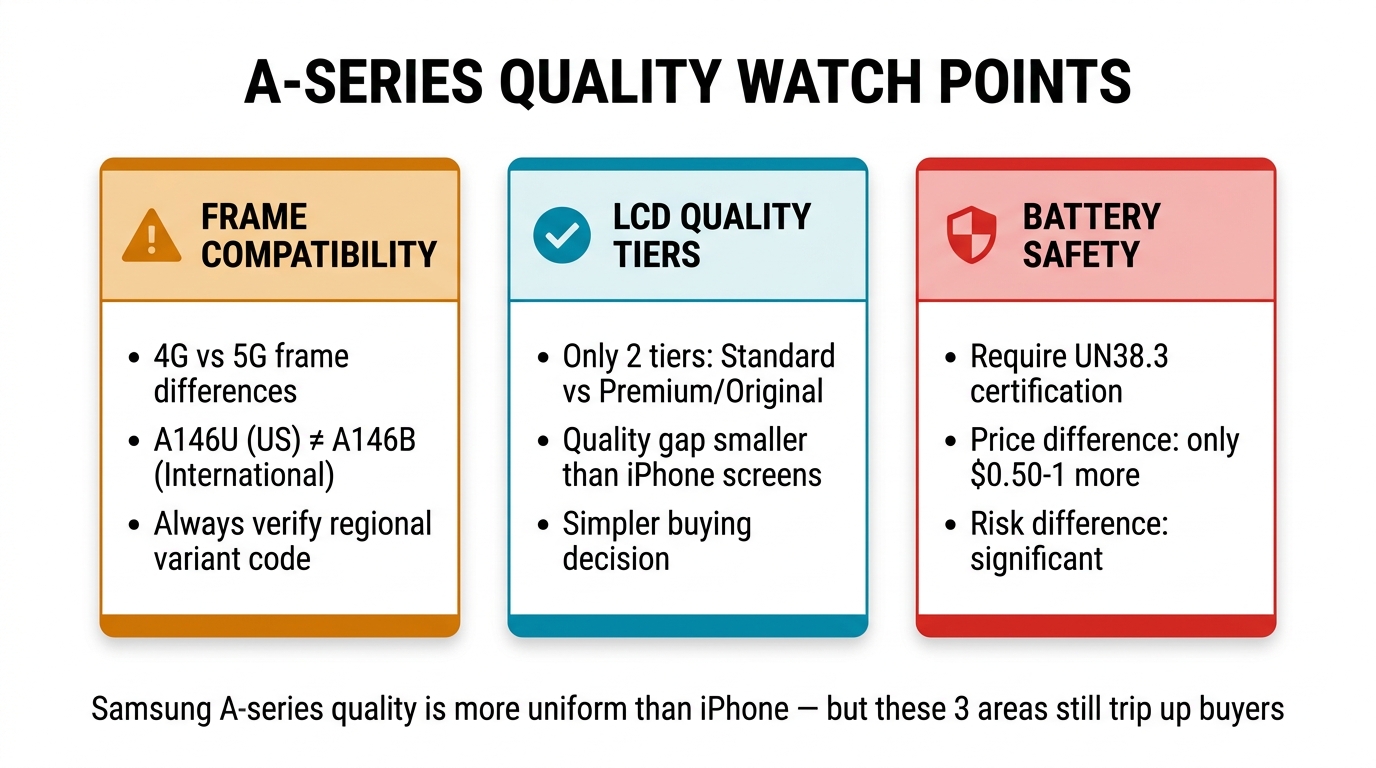
Samsung A-series parts have a few quality quirks that differ from iPhone parts:
Frame compatibility matters more. Many A-series LCD screens ship with a pre-attached frame. Make sure the frame matches your specific model variant (4G vs 5G, regional variant codes like A146U vs A146B). A screen for the A14 5G US version (A146U) may not fit the international version (A146B) due to frame differences.
LCD quality is more uniform than you'd expect. Unlike the iPhone screen market where there are 4-5 distinct quality grades, Samsung A-series LCD screens typically come in 2 tiers: standard aftermarket and premium/original-equivalent. The quality gap is smaller, which simplifies your buying decision.
Battery safety certification matters. Budget Samsung batteries from unknown suppliers occasionally have safety issues. Stick with suppliers who provide UN38.3 certification for their batteries. The price difference between certified and uncertified batteries is minimal ($0.50-1), but the risk difference is significant.
For more on Samsung screen grades and sourcing, see our wholesale Samsung screens guide. If you're comparing suppliers for your first Samsung order, our Samsung A15 screen replacement guide covers quality specifics for that model.

FAQ
Which Samsung A-series model has the highest repair demand in 2026?
The Galaxy A14 is at peak repair demand right now — it sold massively in 2023-2024, most units are out of warranty, and screens and batteries are failing at scale. The Galaxy A15 is close behind and growing. In most emerging markets, these two models together account for the majority of Samsung repair traffic.
Should I stock Samsung A-series AMOLED or LCD screens first?
Start with LCD. The highest-volume A-series models (A14 4G, A15 4G, A12, A05) all use LCD panels that cost $4-12 wholesale. AMOLED screens (A15 5G, A25) are 3-5x more expensive and serve lower-volume segments. Add AMOLED only after your LCD sales are consistent.
How do Samsung A-series screen prices compare to iPhone screens?
Samsung A-series LCD screens are significantly cheaper — $4-12 wholesale vs $8-25 for iPhone Incell screens and $30-60 for iPhone OLED screens. This makes Samsung A-series a good entry point for repair shops expanding beyond iPhone, with lower capital requirements and faster stock turnover.
Is it worth stocking parts for Samsung A-series phones older than 2 years?
For models 2-3 years old (A12, A14), yes — this is actually their peak repair demand period. For models 4+ years old (A10, A11, A03), the economics get marginal. The phones are worth less, customers are less willing to pay for repair, and parts can be harder to source. Order per job for anything older than A12.
Can I mix Samsung A-series parts with iPhone parts in one wholesale order?
Yes — most Shenzhen-based suppliers stock both Samsung and iPhone parts. Combining Samsung A-series screens and batteries with your iPhone order helps you hit volume pricing thresholds and reduces per-unit shipping costs. A mixed order of 50 iPhone screens + 30 Samsung screens will typically get better pricing than two separate 50-unit and 30-unit orders.
Start With What Sells, Scale From There
The biggest mistake with Samsung A-series stocking is trying to cover too many models at once. Samsung releases new A-models constantly, and it's tempting to stock a few of everything. Don't.
Start with A14 and A15 — screens and batteries for both. Add A12 if your market still has heavy A12 circulation. Track your repairs for a month, then adjust. That's the entire strategy.
If you're planning a Samsung A-series order or want to combine it with your existing iPhone parts order, contact our team for model-specific pricing and availability. We ship mixed Samsung + iPhone orders from Shenzhen with no single-model MOQ — in a mixed order that includes screens, individual models count toward the 10-piece total; battery-only or small-parts-only orders start at 20 pieces.