
How to Combine Batteries, Charging Ports, and Small Parts in One Repair Order
Most repair shop owners start wholesale buying with a single category — usually screens. But screens alone don't fill every job that walks through your door. Batteries die. Charging ports fail. Earpieces go silent. Flex cables crack. If you're ordering each category from a different supplier with a different shipment, you're bleeding money on shipping and missing the real advantage of wholesale: consolidation.
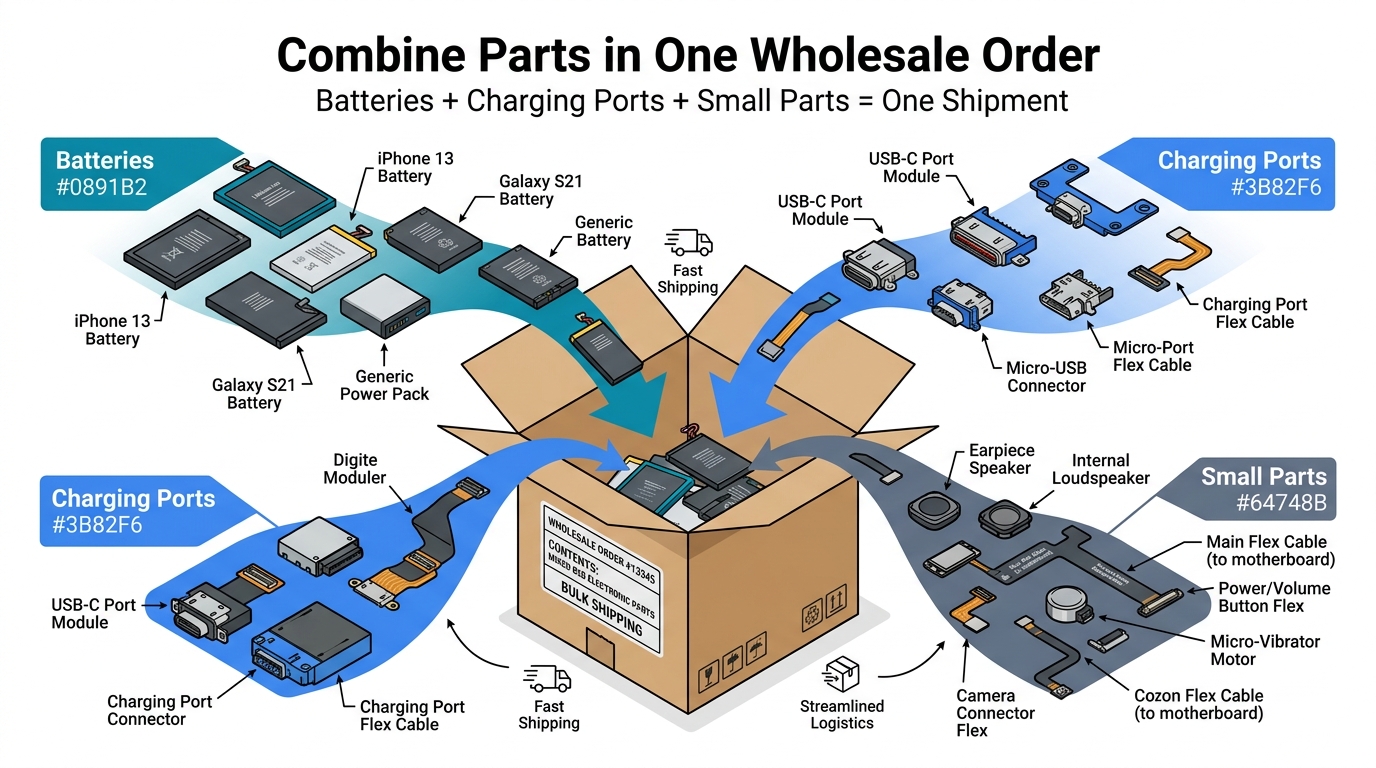
This guide shows you exactly how to build a mixed phone parts order that combines batteries, charging ports, and small parts into one shipment. You'll get sample configurations, quantity breakdowns, and the math behind why combining part categories in one order cuts your per-unit cost by 15–30%.
If you're new to mixed ordering, start with our overview: How Small Repair Shops Can Start Buying Phone Parts in Mixed Orders. This article goes deeper — it's the practical configuration guide.
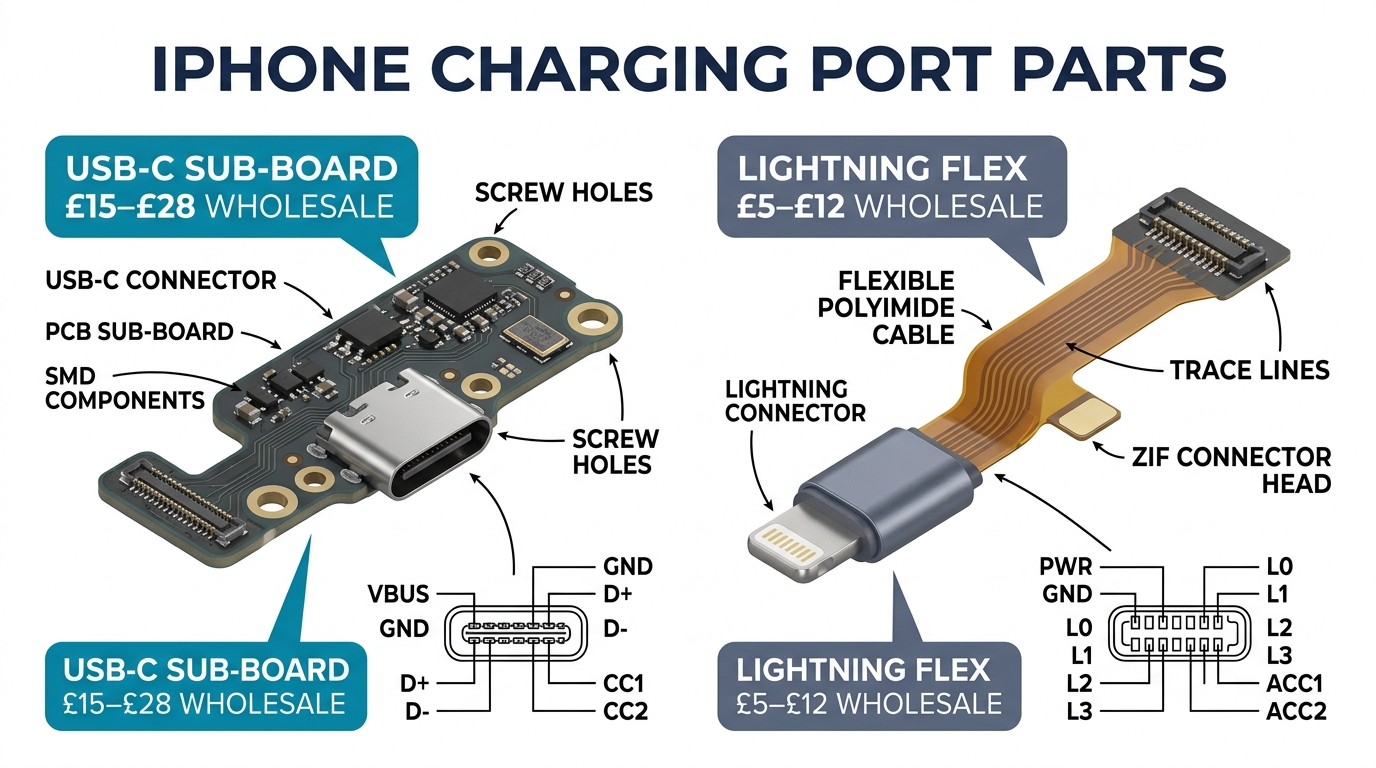
Need Charging Port Flex in Bulk?
Wholesale charging port assemblies for iPhone & Samsung — tested, factory-direct.
Get Wholesale QuoteWhy Combining Part Categories Saves You Real Money

The economics are straightforward. Let's look at a real comparison.
Scenario A: Separate orders
- Order 1: 50 iPhone batteries from Supplier A → $180 product + $45 shipping = $225
- Order 2: 30 charging ports from Supplier B → $55 product + $35 shipping = $90
- Order 3: 40 small parts (earpieces, speakers) from Supplier C → $30 product + $30 shipping = $60
- Total: $265 product + $110 shipping = $375
Scenario B: One combined order from one supplier
- 50 batteries + 30 charging ports + 40 small parts → $265 product + $55 shipping = $320
- Total: $320 (saved $55 on shipping alone)
That $55 savings is on a small order. At the $1,000–$1,500 level, consolidation saves $120–$200 per order. Over 12 months of monthly ordering, that's $1,440–$2,400 back in your pocket.
Beyond shipping, there are three other savings:
- MOQ efficiency. Many suppliers set a $200–$300 minimum. Combining categories lets you hit that threshold without over-ordering any single part. See our MOQ, Sample Orders, and Lead Time guide for more on navigating minimums.
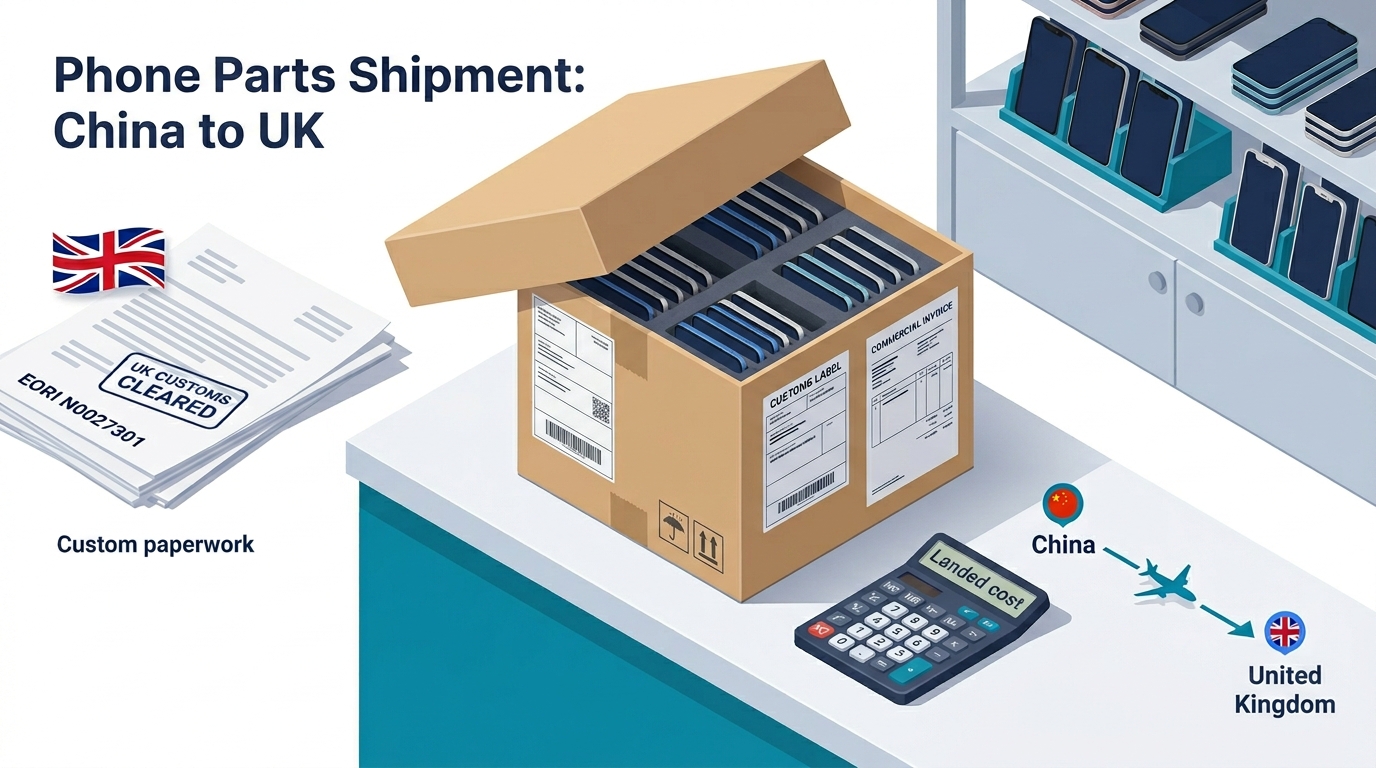
- Single customs clearance. One shipment = one customs declaration = one set of import fees.
- Time savings. One supplier relationship to manage, one tracking number to watch, one quality check on arrival.
Which Part Categories Pair Well Together
Not all combinations make equal sense. Here's how the main categories interact:
| Category A | Category B | Pairing Score | Why |
|---|---|---|---|
| Batteries | Charging ports | ★★★★★ | Both are high-demand consumables. Same customers need both. Similar weight profile. |
| Batteries | Small parts (earpieces, speakers, flex cables) | ★★★★☆ | Batteries are your anchor; small parts fill gaps cheaply. |
| Charging ports | Flex cables | ★★★★★ | Often replaced together. Technicians doing port work frequently find damaged flex cables. |
| Screens | Batteries | ★★★★☆ | Screens are high-value; batteries balance the order with volume. |
| Screens | Small parts | ★★★☆☆ | Works, but screen orders are already high-value — small parts add complexity without much savings. |
| Batteries | Back covers/housings | ★★★☆☆ | Different repair workflows, but both are fast-movers for popular models. |
The golden combination for most repair shops: Batteries + charging ports + 2–3 types of small parts (earpieces, loudspeakers, power flex cables). This covers 60–70% of non-screen repairs.
For guidance on which charging ports to prioritize, check How to Choose Charging Ports for Bulk Repair Orders.
Sample Order Configurations by Shop Size
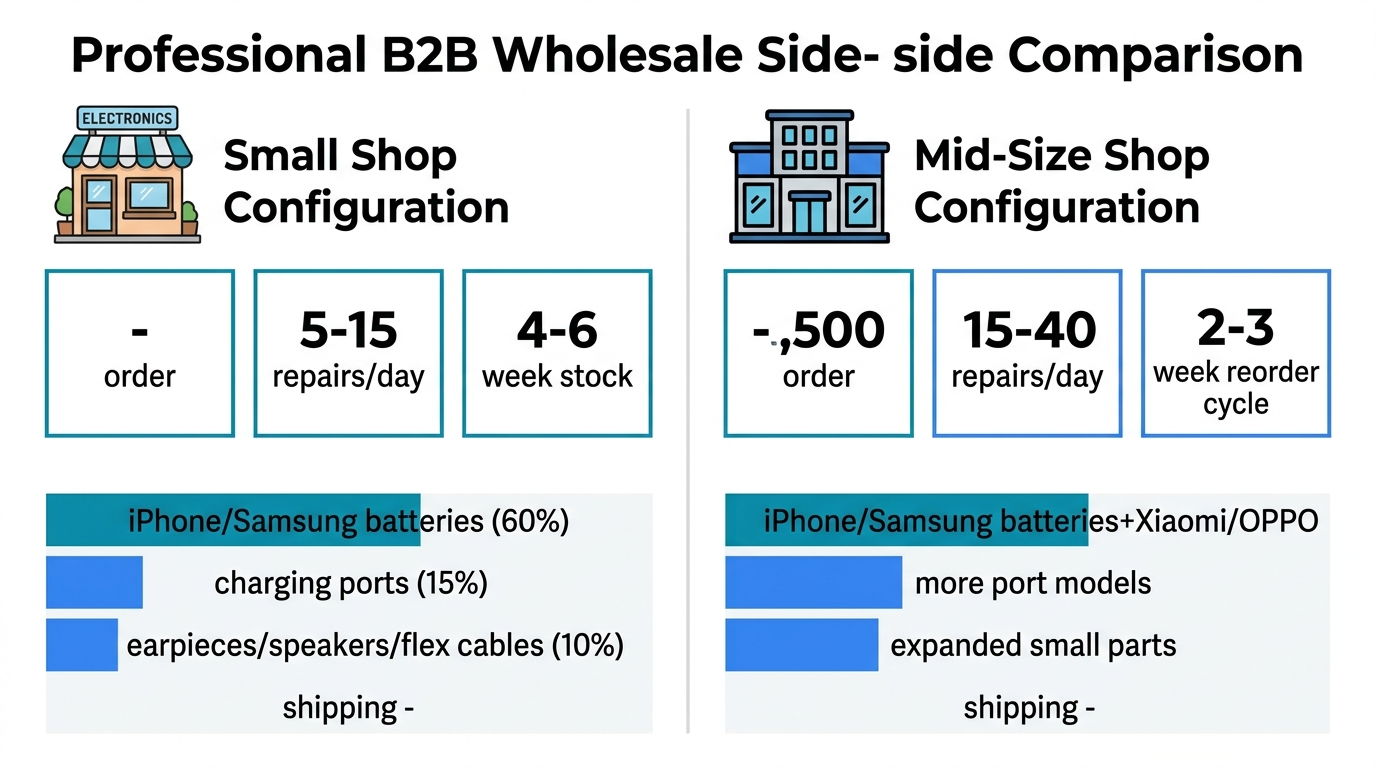
Configuration 1: Small Shop ($200–$500 order)
A shop doing 5–15 repairs per day. You need enough stock for 4–6 weeks.
| Part | Models | Qty per Model | Unit Price (est.) | Subtotal |
|---|---|---|---|---|
| iPhone batteries | iPhone 11, 12, 13, 14 | 10 each | $3.00–$4.50 | $140 |
| Samsung batteries | A12, A13, A52 | 5 each | $2.80–$3.50 | $50 |
| iPhone charging ports | iPhone 11, 12, 13 | 5 each | $1.20–$2.00 | $24 |
| Samsung charging ports | A12, A13, A52 | 5 each | $0.80–$1.50 | $17 |
| Earpieces | iPhone 11, 12, 13 | 5 each | $0.50–$0.80 | $10 |
| Loudspeakers | iPhone 12, 13, Samsung A52 | 5 each | $0.80–$1.20 | $15 |
| Power/volume flex cables | iPhone 12, 13 | 5 each | $0.60–$1.00 | $8 |
| Total | $264–$370 |
Shipping estimate (air freight to UK/Africa/SEA): $40–$65 for this weight class (approx. 3–5 kg).
This configuration works because batteries are your anchor product — they represent 50–60% of the order value and move fastest. Charging ports and small parts round out the order without adding much weight. For battery-specific buying tips, see What to Check Before Buying iPhone Batteries in Bulk.
Configuration 2: Mid-Size Shop ($500–$1,500 order)
A shop doing 15–40 repairs per day, or a small wholesaler supplying 3–5 technicians.
| Part | Models | Qty per Model | Unit Price (est.) | Subtotal |
|---|---|---|---|---|
| iPhone batteries | iPhone 11, 12, 13, 14, 15 | 20 each | $2.80–$4.20 | $350 |
| Samsung batteries | A13, A14, A52, A54, S21 | 10 each | $2.50–$3.20 | $143 |
| iPhone charging ports | iPhone 11, 12, 13, 14 | 10 each | $1.00–$1.80 | $56 |
| Samsung charging ports | A13, A14, A52, A54 | 10 each | $0.70–$1.30 | $40 |
| Xiaomi/OPPO charging ports | Redmi Note 12, OPPO A78 | 10 each | $0.50–$0.90 | $14 |
| Earpieces | iPhone 11–14, Samsung A13/A52 | 10 each | $0.40–$0.70 | $33 |
| Loudspeakers | iPhone 12–14, Samsung A52/A54 | 10 each | $0.70–$1.00 | $51 |
| Power flex cables | iPhone 12, 13, 14 | 10 each | $0.50–$0.90 | $21 |
| Home button/FPC | iPhone 7, 8 (still in demand) | 10 each | $0.80–$1.20 | $20 |
| Total | $728–$1,200 |
Shipping estimate: $70–$120 (approx. 6–12 kg). At this volume, sea freight becomes viable for non-urgent restocking at $35–$60, cutting shipping costs in half.
Notice the unit prices drop at higher quantities. At 20 units per model on batteries, you're typically getting 5–10% off compared to the 10-unit price. That adds up fast across 100+ batteries.
How to Calculate the Right Mix: Fast-Movers vs. Slow-Movers
The biggest mistake in building a mixed phone parts order is guessing quantities instead of calculating them. Here's the framework we recommend to every buyer.
Step 1: Track Your Repairs for 2 Weeks
Before placing your first combined order, log every repair you do for 14 days. Record:
- Part type (battery, port, earpiece, etc.)
- Phone model
- Quantity used
Step 2: Calculate Your Reorder Ratio
After two weeks, you'll see something like this (example for a small UK shop):
| Part Type | 2-Week Usage | Monthly Usage | 6-Week Stock Target |
|---|---|---|---|
| iPhone 12 battery | 8 | 16 | 24 |
| iPhone 13 battery | 12 | 24 | 36 |
| iPhone 12 charging port | 3 | 6 | 9 |
| Samsung A13 battery | 4 | 8 | 12 |
| iPhone 13 earpiece | 2 | 4 | 6 |
| iPhone 12 loudspeaker | 2 | 4 | 6 |
Step 3: Apply the 60/25/15 Rule
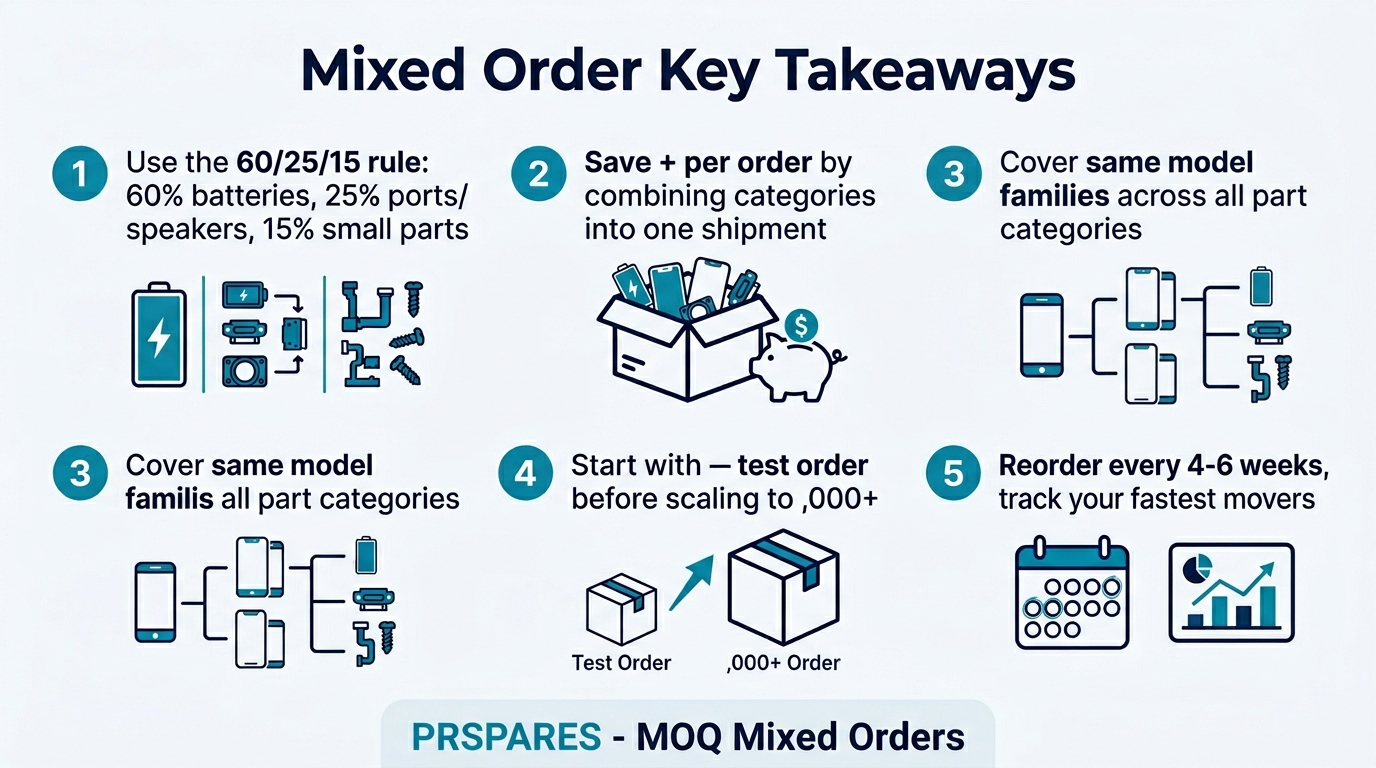
For a balanced mixed order:
- 60% of order value → fast-moving parts (batteries for top 3–5 models)
- 25% of order value → medium-movers (charging ports, loudspeakers for top models)
- 15% of order value → slow but necessary parts (earpieces, flex cables, niche model parts)
This ratio prevents the most common ordering mistake: spending too much on slow-moving parts just to add variety. Your capital should be weighted toward parts that sell within 2–3 weeks.
For a deeper look at which parts to prioritize, read Which Cell Phone Repair Parts Should a Small Shop Stock in 2026?.
Step-by-Step: How to Build Your First Mixed Order
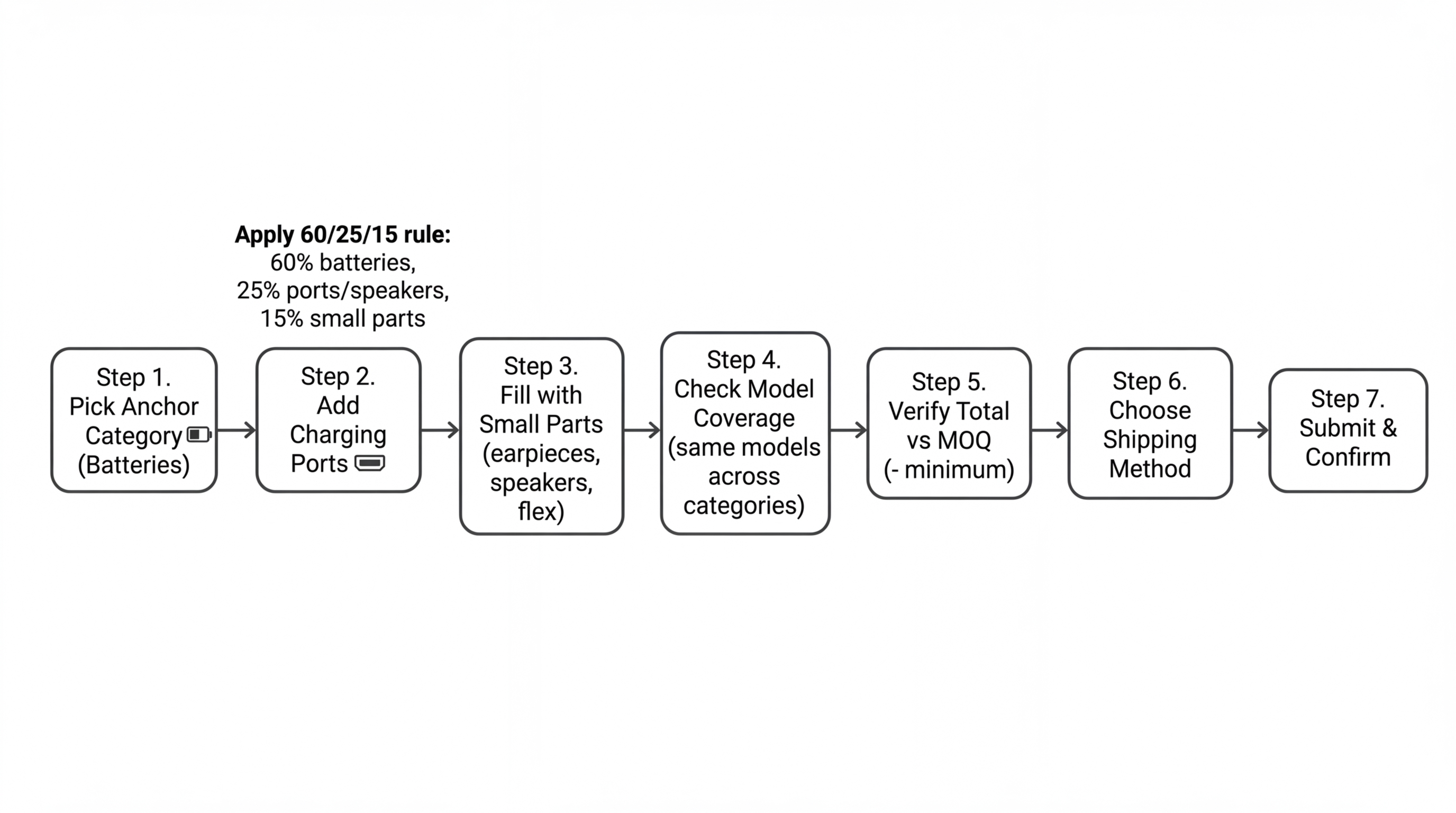
Step 1: Pick Your Anchor Category
For 90% of repair shops, this is batteries. They're the highest-demand consumable part after screens, they have healthy margins ($3–$4.50 cost, $15–$25 retail replacement fee), and they move fast.
Step 2: Add Your Secondary Category
Charging ports are the natural second pick. They pair with battery replacements (customers often need both), they're lightweight (won't spike your shipping), and unit costs are low ($0.50–$2.00).
Step 3: Fill with Small Parts
Add 2–4 types of small parts based on your repair logs:
- Earpieces and loudspeakers (common failure points)
- Power/volume flex cables (frequently damaged during screen repairs)
- Home buttons or FPC connectors (still relevant for iPhone 7/8 and budget Androids)
- Vibrator motors (small, cheap, easy to stock)
Step 4: Check Model Coverage
Make sure your order covers the same model families across categories. If you're ordering iPhone 13 batteries, also order iPhone 13 charging ports and iPhone 13 earpieces. This sounds obvious, but many buyers order batteries for one set of models and ports for a completely different set — creating inventory gaps.
Step 5: Verify the Total Against MOQ
Most Shenzhen suppliers set minimums at $100–$300 for mixed orders; PRSPARES counts pieces instead — 20 pieces for a battery and small-parts order, or 10 pieces if the order also includes screens. If your total is below the threshold, increase quantities on your fastest-moving battery models first — not by adding obscure small parts you won't sell for months.
Step 6: Choose Shipping Method
| Order Value | Weight (est.) | Best Shipping | Cost | Transit Time |
|---|---|---|---|---|
| $200–$400 | 2–5 kg | Air express (DHL/FedEx) | $40–$70 | 5–8 days |
| $400–$800 | 5–10 kg | Air freight | $60–$100 | 7–12 days |
| $800–$1,500 | 8–15 kg | Air freight or sea (if not urgent) | $80–$140 (air) / $40–$70 (sea) | 7–12 days (air) / 25–35 days (sea) |
Important note on batteries: Lithium batteries have shipping restrictions. They must be shipped at 30% charge state with proper UN38.3 certification. A supplier experienced in battery export (like PRSPARES) handles this as standard. Less experienced suppliers may delay your shipment or ship non-compliant, risking customs seizure.
Step 7: Submit and Confirm
Send your order list with exact model numbers and quantities. A good supplier will:
- Confirm stock availability within 24 hours
- Flag any models that are out of stock and suggest alternatives
- Provide a detailed invoice with per-item pricing
- Share shipping options with estimated delivery dates
For ready-made order templates you can customize, see Your First Wholesale Order: Sample Order Templates.
Common Mistakes to Avoid
Mistake 1: Over-Ordering Slow Parts to Hit MOQ
A $200 MOQ does not mean you need $50 worth of vibrator motors. If you only use 2 vibrator motors per month, ordering 50 units ties up capital for two years. Increase battery quantities instead.
Mistake 2: Ignoring Brand Compatibility
Ordering iPhone batteries but Samsung charging ports and Xiaomi earpieces might technically fill an order — but it doesn't match how your customers walk in. Stick to 2–3 brand families and cover them deeply rather than spreading across 6 brands thinly.
Mistake 3: Skipping Quality Tiers
Batteries come in standard and high-capacity grades. Charging ports come in original-equivalent and economy grades. Mixing quality tiers in one order without tracking which is which creates customer service problems. Label everything on arrival.
Mistake 4: Forgetting Seasonal Demand
Battery demand spikes 20–30% in cold months (October–February in the Northern Hemisphere) because cold weather accelerates battery degradation. Plan your Q4 order with extra battery stock. Charging port demand stays relatively flat year-round.
Mistake 5: Not Testing with a Small Order First
Before committing to a $1,000+ mixed order, place a $200–$300 test order to verify quality across all categories. A supplier might have great batteries but mediocre charging ports. Test before you scale.
Why PRSPARES for Mixed Part Orders
We ship mixed orders every day from our Shenzhen warehouse. Here's what makes the process smooth:
- No single-model MOQ: mix models and categories — once the order totals 10 pcs, the published 10+ tier applies to every line. No per-category minimums either — you can order 5 charging ports alongside 50 batteries.
- One invoice, one shipment: Batteries, ports, and small parts ship together with proper battery compliance documentation.
- Model flexibility: We stock parts for iPhone 7 through iPhone 16, Samsung A/S series, Xiaomi Redmi, OPPO, and Huawei — so you can cover your full repair menu in one order.
- Fast turnaround: Orders confirmed by 2 PM CST ship same day. Air express to most markets in 5–8 days.
Ready to build your first mixed order? Send us your part list for a wholesale quote →
We'll confirm availability, suggest optimizations if we spot gaps in your configuration, and get your mixed order shipped within 48 hours.
FAQ
Can I mix batteries and charging ports in one shipment without shipping issues?
Yes, but the supplier must handle battery shipping compliance (UN38.3 certification, proper packaging, 30% charge state). At PRSPARES, all mixed orders containing batteries are packed to meet IATA dangerous goods requirements. Charging ports and small parts have no shipping restrictions, so they simply share the same box.
What's the minimum order for a mixed parts order at PRSPARES?
PRSPARES sets minimums in pieces, not dollars, and there is no per-SKU minimum. A battery-only or small-parts-only order starts at 20 pieces in total, and a mixed order that includes screens qualifies at 10 pieces in total — so a 20-piece order could include 10 different part types across 3 categories without any MOQ issue.
How do I know which models to prioritize in my first order?
Check your repair logs from the past 30 days. If you don't track repairs yet, start with the top 5 models by market share in your region. For the UK: iPhone 12, 13, 14, Samsung A13, A14. For Africa: Samsung A12, A13, Xiaomi Redmi Note 12, OPPO A78, Tecno Spark 10. For Southeast Asia: Samsung A14, OPPO A78, Xiaomi Redmi 13C, iPhone 12, Vivo Y36. Then order batteries + ports + 1–2 small parts for each model.
Should I order the same quantity of every part type?
No. Follow the 60/25/15 value ratio: 60% batteries, 25% charging ports and speakers, 15% other small parts. In unit terms, you'll typically order 3–4x more batteries than charging ports, and 2x more charging ports than earpieces or flex cables — because batteries fail more frequently than any other component.
How often should I reorder a mixed parts order?
Most small shops reorder every 4–6 weeks. Mid-size shops or small wholesalers reorder every 2–3 weeks. The key metric is stock coverage: if your fastest-moving battery model drops below 1 week of stock, it's time to reorder. Build your next order while you still have 2 weeks of buffer stock — shipping takes 5–12 days depending on method.
PRSPARES is a Shenzhen-based B2B supplier of wholesale phone repair parts. We apply no single-model MOQ — battery-only or small-parts-only orders start at 20 pieces, a mixed order that includes screens qualifies at 10 pieces, and the published 10+ tier price applies to every line — for repair shops and small distributors worldwide. Get a wholesale quote →