
How Repair Shops Should Split Budget Between Screens, Batteries, and Small Parts
You have $500 to spend on parts this month. How much goes to screens? How much to batteries? Do you stock charging ports or skip them?
Most repair shops never think about this deliberately. They buy screens when they run out, add batteries when a customer asks, and ignore small parts until they lose a job because they didn't have a $1.50 earpiece in stock. The result: too much money tied up in screens you might not sell this month, not enough batteries to cover demand, and zero small parts inventory.
Setting a deliberate repair shop budget for phone parts changes this. By allocating your purchasing budget across categories based on actual repair volume and margin data, you spend less overall, stock out less often, and make more money per repair. This guide shows you how to set those allocations — with real numbers, not vague percentages.
Sourcing Replacement Screens in Bulk?
Incell / Hard OLED / Soft OLED grades — wholesale pricing, grade comparison on request.
Get Wholesale QuoteWhy Budget Allocation Matters More Than Total Spend
Two shops can spend the same $800 per month on parts and get completely different results.
Shop A spends 90% on screens because screens are the biggest ticket item. They stock 30 iPhone screens in various models. But they have no batteries and no small parts. Every battery replacement requires a rush order from a local distributor at 30% markup. Every charging port repair gets turned away.
Shop B spends the same $800 split across categories: 60% screens, 25% batteries, 15% small parts. They stock fewer screens (18-20 instead of 30) but never turn away a battery or charging port job. Their per-repair margin is higher because they're buying batteries and small parts at wholesale instead of retail emergency prices.
Shop B makes more money on the same budget. The difference isn't how much they spend — it's how they split it.
The Baseline Budget Split for Most Repair Shops
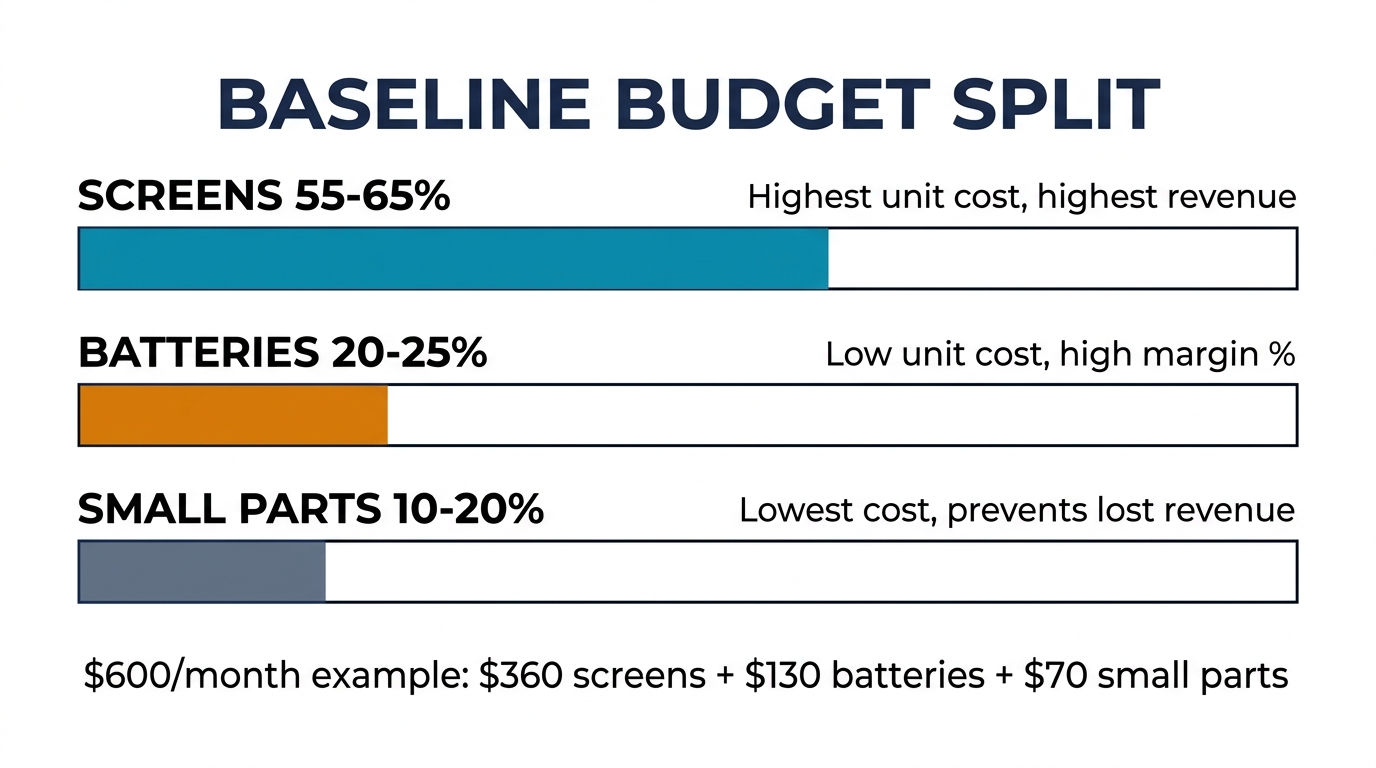
After working with hundreds of repair shops, here's the allocation that works for the majority:
| Category | % of Budget | Why This Ratio |
|---|---|---|
| Screens | 55-65% | Highest unit cost, highest revenue per repair, but also highest risk if overstocked |
| Batteries | 20-25% | Lower unit cost, very predictable demand, high margin percentage |
| Small Parts | 10-20% | Lowest unit cost, often overlooked, but prevents lost revenue from turned-away jobs |
This isn't a rigid formula. It's a starting point that you adjust based on your specific repair mix. A shop that does 80% screen repairs and almost no battery work will lean heavier on screens. A shop in a market where battery replacements are the main service will flip the ratio.
The important thing: have a ratio at all, rather than buying on impulse.
Screens: Your Biggest Spend, Your Biggest Risk
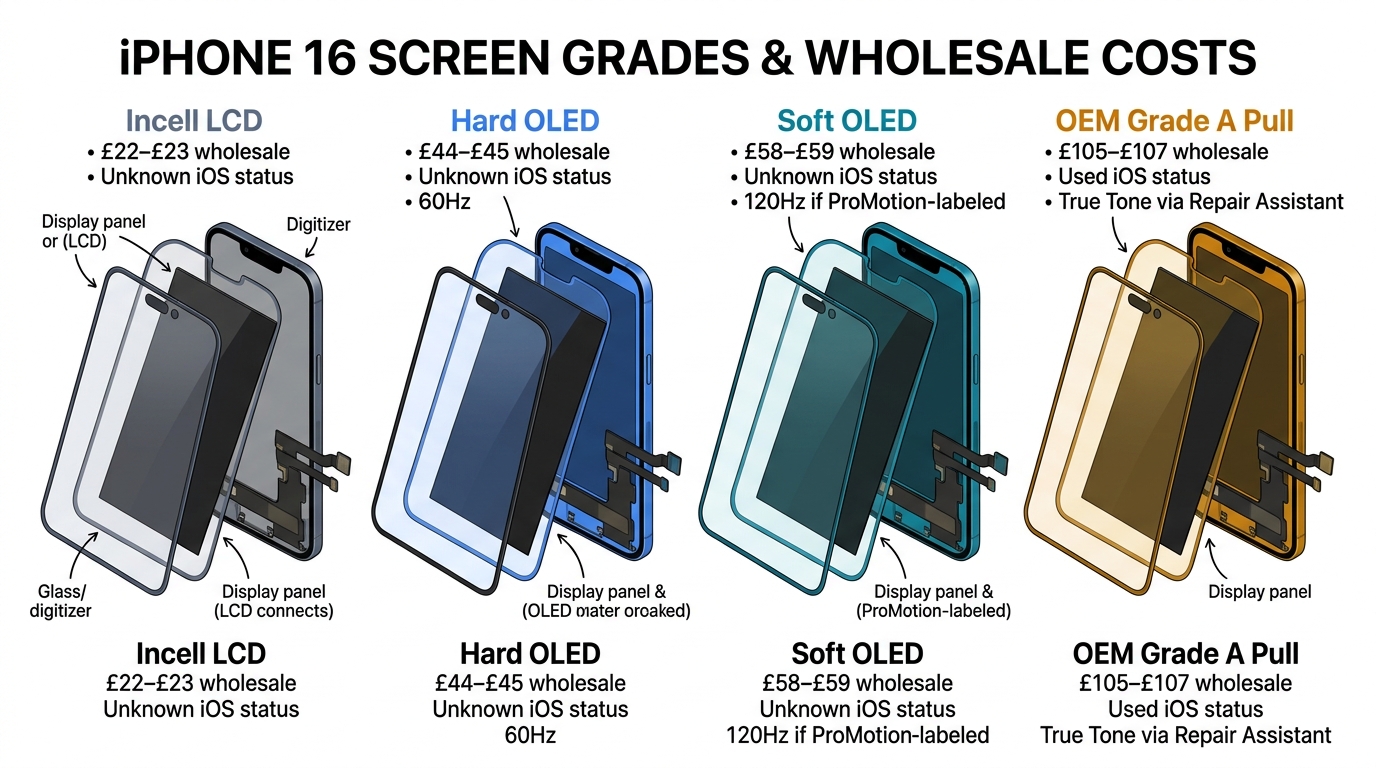
Screens take the largest share of your budget because they're the most expensive individual item. An Incell iPhone 13 screen costs $10-15 wholesale. A Soft OLED version costs $30-45. Even a small stock of 15-20 screens represents $150-400 in inventory.
How to Allocate Your Screen Budget
Prioritize Incell over Soft OLED for stock. Incell screens cover 70-80% of customer repairs at most shops. They're cheaper, so you can stock more models per dollar. Keep Soft OLED for order-on-demand premium repairs.
Stock your top 3-5 models, not every model. If 60% of your screen repairs are iPhone 11, 12, and 13, those three models should get 60% of your screen budget. Don't spread thin across 10 models — you'll end up with 1-2 units of each and run out of the ones you actually need.
Budget example for a $600/month total spend:
- Screen allocation: $360 (60%)
- Incell screens for iPhone 11, 12, 13, 14: ~25-30 units
- Soft OLED for 1-2 premium models: 2-3 units (order-on-demand for the rest)
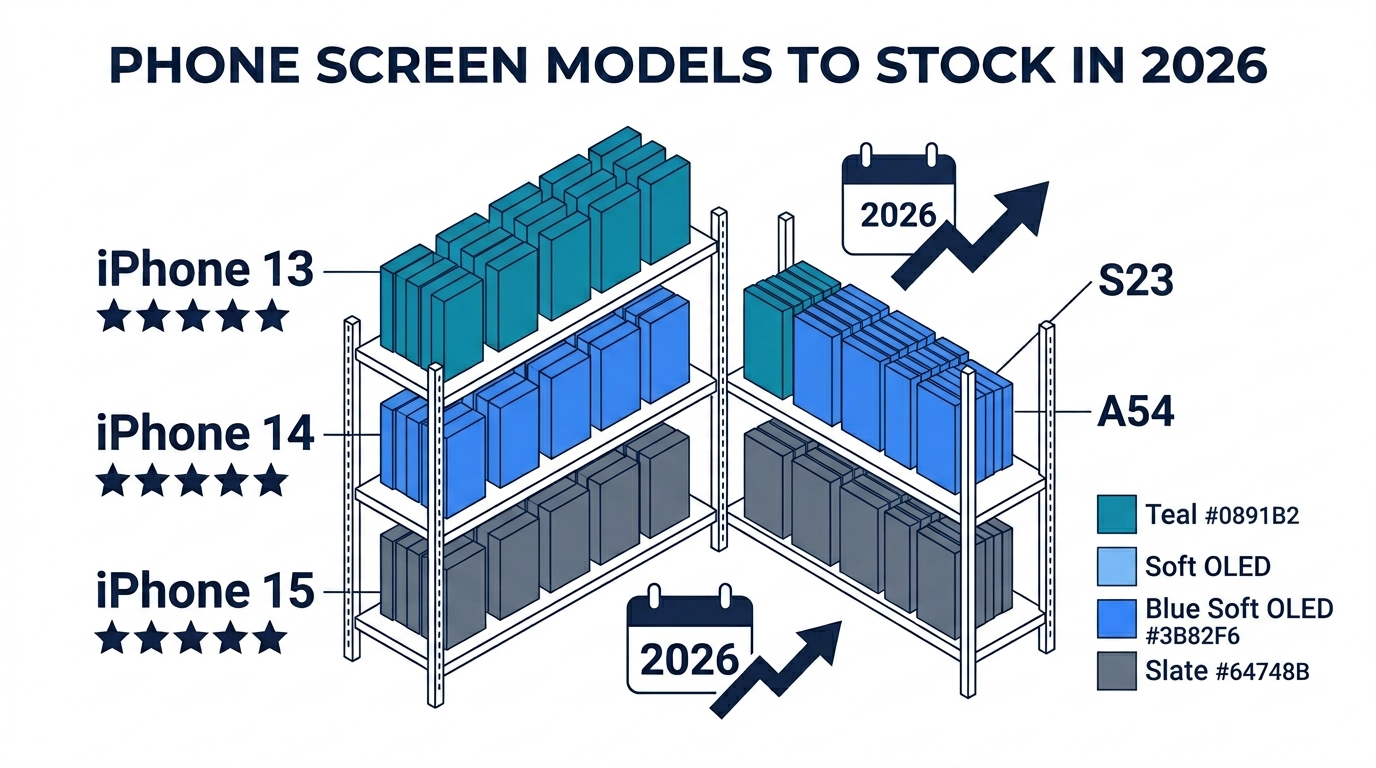
For specific model recommendations, see which phone screen models to stock in 2026.
The Overstocking Trap
The biggest budget mistake with screens: buying too many models at low quantities. If you stock 2 units each of 15 different models, you'll run out of your popular models in a week and sit on slow-moving stock for months. Concentrate your screen budget on the models that turn over fastest.
Batteries: High Margin, Low Risk
Batteries are the most budget-friendly category to stock. Unit costs are $2.50-5.00 wholesale, so even a modest budget allocation buys meaningful inventory. And battery replacements have the highest margin percentage of any common repair.
Why Batteries Deserve 20-25% of Your Budget
- Predictable demand. Battery health degrades on a predictable timeline. Every iPhone 11 and 12 in circulation will eventually need a battery replacement. This isn't speculative — it's guaranteed.
- High margin percentage. A battery that costs $3.50 wholesale gets installed for $30-50 customer-facing. That's 85-93% gross margin on the part. Screens have higher absolute margin but lower percentage margin.
- Low storage cost. 50 batteries fit in a drawer. 50 screens need a shelf with proper padding.
- Low obsolescence risk. A battery for iPhone 12 will still be needed in 2027 and 2028. Screen demand follows the same model lifecycle but batteries last even longer in the repair market because people keep older phones running.
Budget example:
- Battery allocation: $130 (22% of $600)
- iPhone 11, 12, 13 batteries: 10 each = 30 units at ~$3.50 = $105
- iPhone SE, Samsung A-series: 5 each = 10 units at ~$2.50 = $25
That $130 supports 40 battery replacements generating $1,200-2,000 in revenue. No other category delivers that return on inventory investment.
For more on battery quality tiers, see our guide on how repair shops choose iPhone battery grades for wholesale orders.
Small Parts: The Category Most Shops Under-Invest In
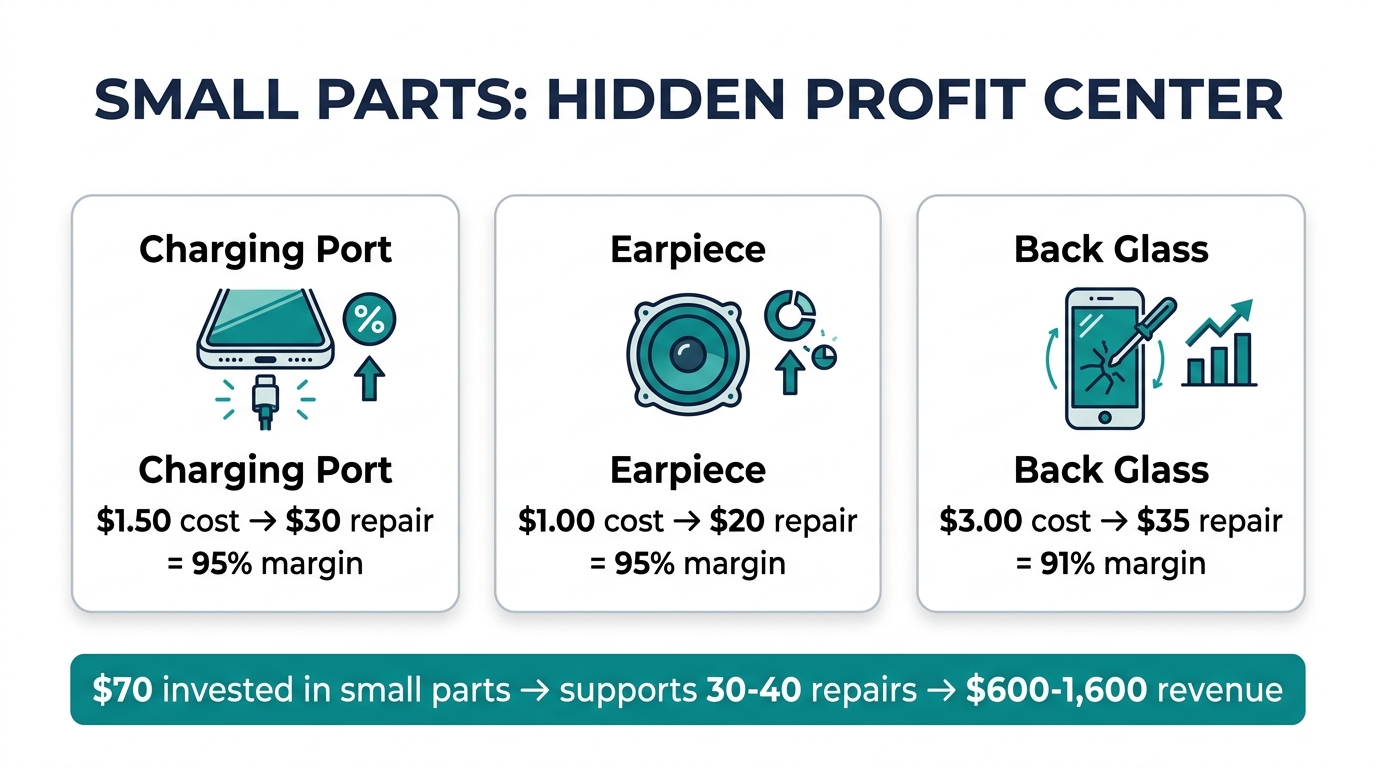
Small parts — charging ports, earpieces, speakers, camera lenses, flex cables — are where most shops leave money on the table. Not because the parts are expensive, but because having them in stock means you never turn away a repair.
The Math on Small Parts
A charging port flex cable costs $1.00-2.50 wholesale. The repair charges $25-40. That's a 90%+ margin on the part. But most shops don't stock charging ports because they don't think of it as a "regular" repair. So when a customer asks, they either turn the job away or order a single unit from a local supplier at $5-8.
If you stock 10 charging ports for your top iPhone models at $15 total cost, and 5 of them turn into repairs over the next month, that's $125-200 in revenue from a $15 investment.
What Small Parts to Stock
Not every small part is worth stocking. Focus on:
| Part | Stock For Models | Unit Cost | Why Stock |
|---|---|---|---|
| Charging port flex | iPhone 8, X, 11, 12, 13, 14 | $1.00-2.50 | Second most common repair after screens |
| Earpiece / speaker | iPhone 11, 12, 13 | $0.80-1.50 | Frequent complaint, fast repair, almost pure profit |
| Back glass | iPhone 12, 13, 14 | $2.00-4.00 | Growing demand, high perceived value by customers |
| Battery connector | iPhone 11-14 | $0.50-1.00 | Used during screen repairs when existing one is damaged |
Skip camera modules (too expensive to stock, low frequency), full housing assemblies (too many color/storage variants), and model-specific buttons (demand is too unpredictable).
Budget example:
- Small parts allocation: $70 (12% of $600)
- Charging ports (6 models × 3 each = 18): $30
- Earpieces (3 models × 5 each = 15): $15
- Back glass (3 models × 3 each = 9): $20
- Misc connectors: $5
That $70 supports roughly 30-40 small repairs at $20-40 each. Combined revenue potential: $600-1,600.
Adjusting the Split for Your Shop
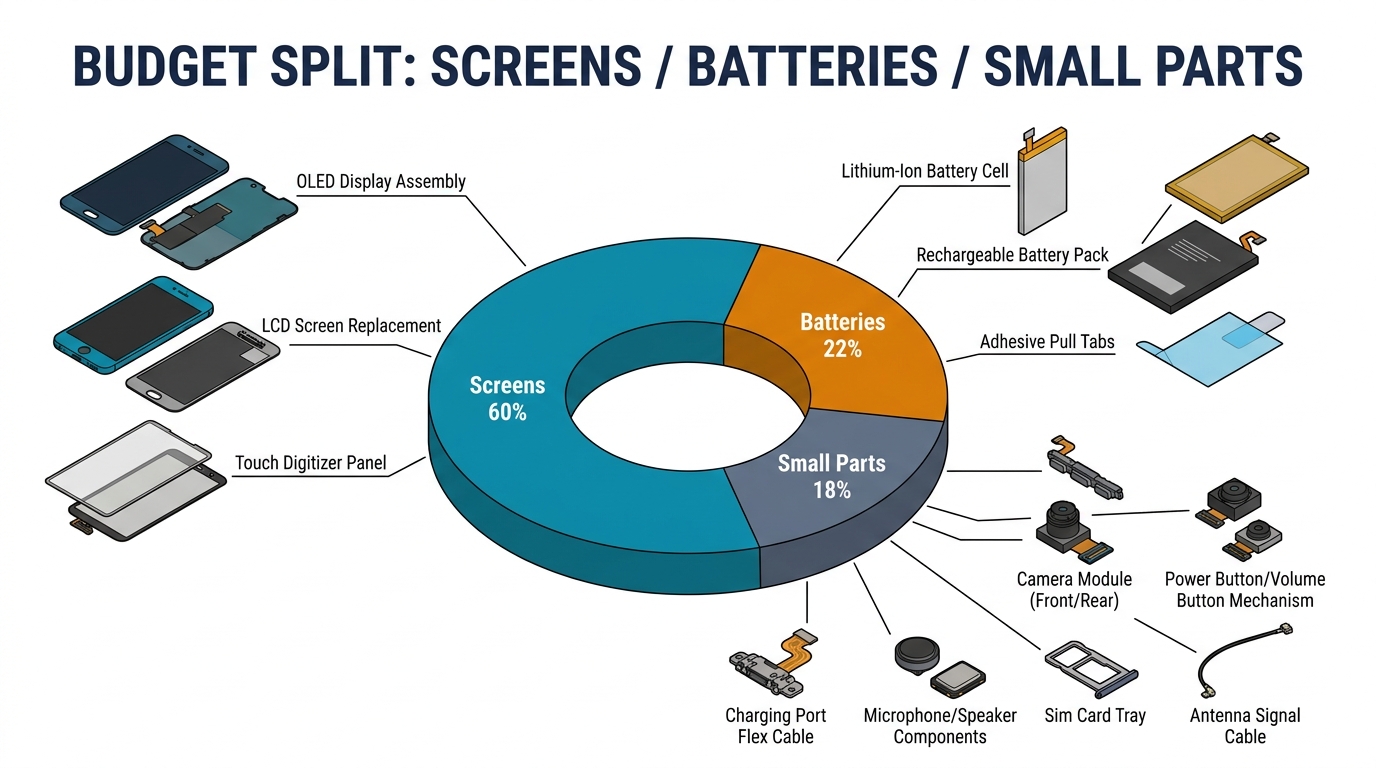
The 60/22/18 baseline works for a typical mixed-repair shop. But your shop might not be typical.
If You're Mostly Screen Repairs (80%+ of Jobs)
Shift to: 70% screens / 18% batteries / 12% small parts
You still need batteries and small parts, but screens dominate your workflow and deserve the majority of inventory investment. Make sure you're stocking the right grades — a shop focused on screens should invest more in understanding screen quality tiers.
If Battery Replacements Are Growing Fast
Shift to: 50% screens / 30% batteries / 20% small parts
This happens when your market has a large installed base of 2-3 year old phones with declining battery health. iPhone 11 and 12 are in this sweet spot right now. Stock heavier on batteries and pair them with charging port flex cables, since customers often ask about both.
If You're in a Budget Phone Market
Shift to: 50% screens / 20% batteries / 30% small parts
Budget phone markets (Samsung A-series, Xiaomi, Oppo) tend to have cheaper screens but higher demand for small parts and charging port repairs. The screen cost per unit is lower ($3-8 for LCD), freeing budget for a broader small parts inventory.
How to Review and Adjust Your Budget Each Quarter
Your initial budget split is a hypothesis. Real data tells you whether it's right.
Every 3 months, check:
- Stockout frequency: Which category ran out first? That category needs a larger share.
- Slow-moving inventory: Which parts are still sitting on the shelf after 60 days? Reduce that allocation.
- Turned-away repairs: Did you lose any jobs because you didn't have a part in stock? Track these — each one represents revenue you're leaving behind.
- Model mix shifts: Are new models increasing in repair volume? Reallocate within categories to match.
If you're placing monthly reorders, the quarterly review is the time to adjust both the allocation percentages and the specific models within each category.
Frequently Asked Questions
What if my total budget is under $300 per month?
Focus on fewer models but maintain the category split. Stock screens for your top 2-3 models only, batteries for the same models, and a handful of the most common small parts. The ratio stays roughly the same — you just stock fewer SKUs per category. Mixed wholesale orders work well at this budget level because they let you cover all three categories in a single shipment. See our guide on how small repair shops build mixed orders.
Should I count Soft OLED screens in my screen budget or separately?
Count them in your screen budget but treat them differently. Reserve 10-15% of your screen allocation for premium grades (Soft OLED, Hard OLED) and spend the rest on Incell. Most shops should not stock more than 2-3 Soft OLED screens at any time — the capital cost is too high for the demand frequency.
How do I decide between stocking more models vs. more units of fewer models?
More units of fewer models. Almost always. Running out of your top-selling model costs you more revenue than not having a rare model in stock. A customer with an iPhone 12 who finds you out of stock goes to a competitor. A customer with an iPhone SE 1st gen expects to wait for the part.
Start With a Ratio, Then Let Data Guide You

The difference between a profitable repair shop and one that's always short on cash often comes down to how inventory budget is allocated. You don't need a bigger budget — you need a smarter split.
Start with the 60/22/18 baseline. Track your repairs for a month. Adjust based on what you actually fix, not what you think you should stock. And consolidate your purchasing into monthly wholesale orders so every dollar stretches further.
Request a quote — tell us your monthly parts budget and repair volume, and we'll help you build an order that matches the right allocation for your shop.
Related reading: