
Phone Parts Dispute Resolution: How to Handle Quality Issues, Wrong Shipments, and Supplier Conflicts
Your shipment arrives. You open the first box, and the screens are the wrong model. Or the right model but the wrong grade. Or the grade looks right but half the batch has dead pixels. Now you've got $3,000 tied up in inventory you can't use, a supplier in another time zone, and customers waiting for repairs.
Every wholesale buyer in the phone parts industry hits this wall eventually. The difference between losing money and recovering it comes down to how you handle the phone parts dispute — specifically, how fast you act, how well you document, and whether your payment method gives you any negotiating power.
This guide walks through the most common dispute scenarios, the exact steps to resolve each one, and how to structure your ordering process so disputes become rare rather than routine.
Sourcing Replacement Screens in Bulk?
Incell / Hard OLED / Soft OLED grades — wholesale pricing, grade comparison on request.
Get Wholesale QuoteThe 5 Most Common Phone Parts Disputes
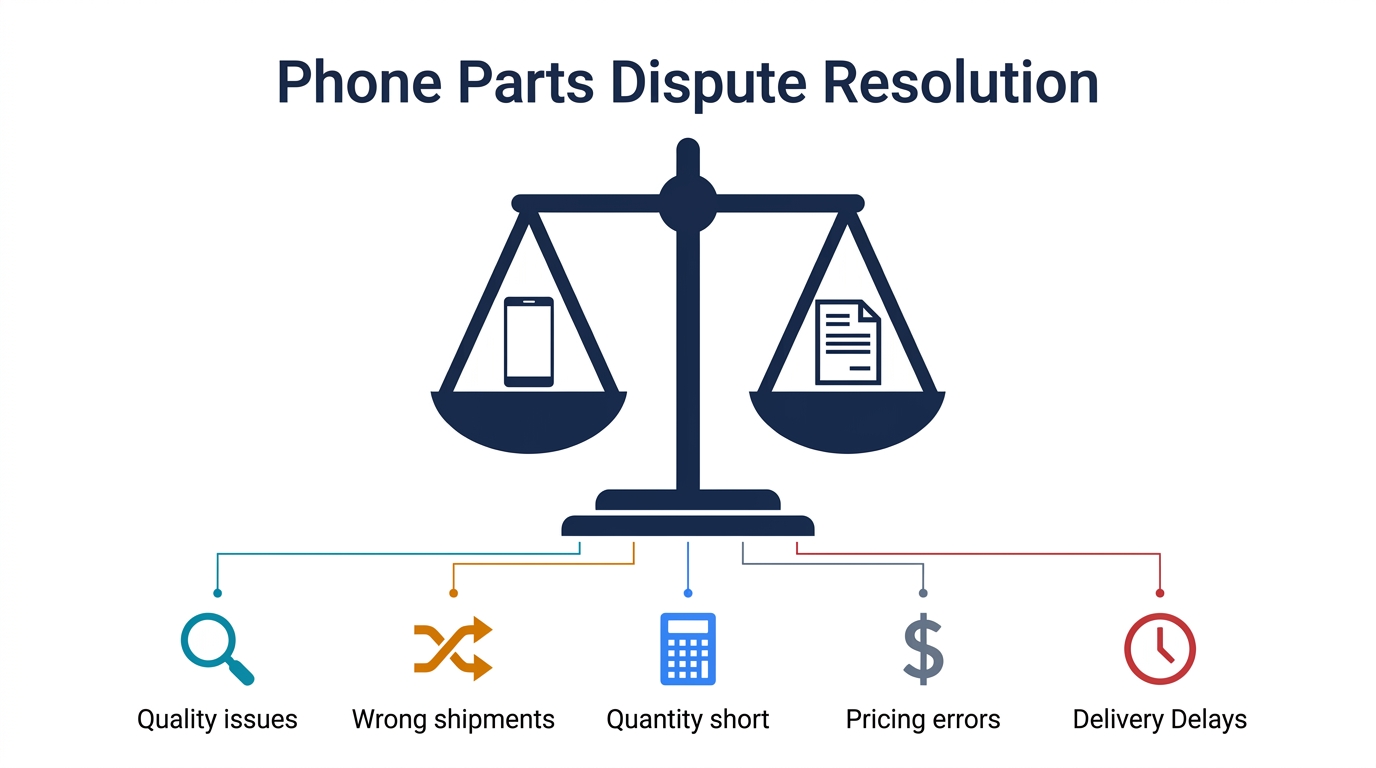
Before diving into resolution, it helps to categorize what went wrong. Each type requires a different approach.
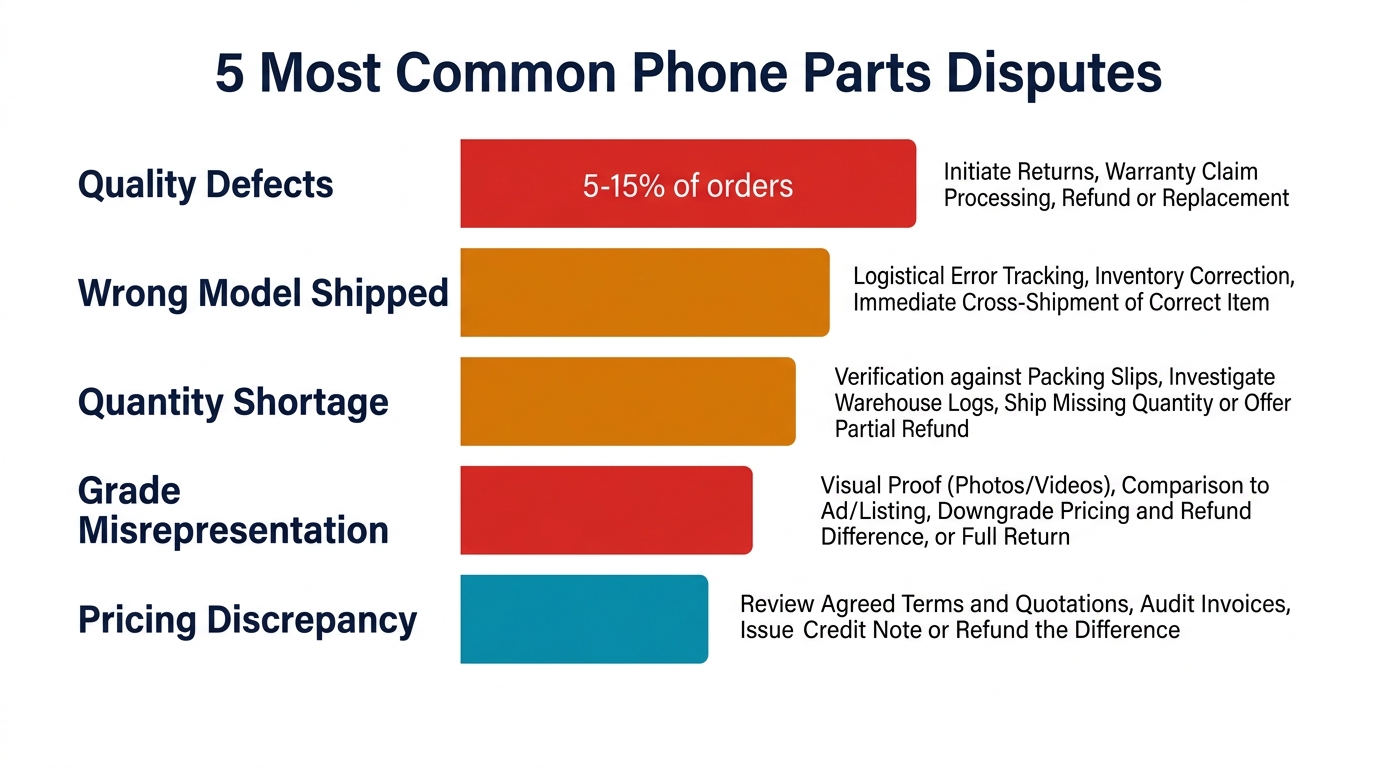
1. Wrong Product Shipped
You ordered iPhone 15 Pro Max screens and received iPhone 15 Plus screens. Or you ordered Soft OLED and received Hard OLED. The product doesn't match the purchase order.
Resolution difficulty: Low to medium. This is the easiest dispute to win because the evidence is black-and-white — the invoice says one thing, the product is another.
2. Quality Below Agreed Grade
The label says Grade A, but 15% of the batch has cosmetic defects that should classify as Grade B or C. The screens work, but they're not what you paid for.
Resolution difficulty: Medium. Grade classification is somewhat subjective, so you need clear documentation comparing the received quality against the supplier's own grade definitions.
3. High Defect Rate
The screens are the right model and grade, but an abnormal percentage fail during installation or within the first week of customer use. Normal defect rates for aftermarket screens run 1-3%. Anything above 5% signals a batch quality problem.
Resolution difficulty: Medium to high. You need to prove the defects existed before installation, not caused by your technicians.
4. Quantity Shortage
You paid for 500 units but only received 480. Or the boxes are padded with empty slots.
Resolution difficulty: Low. Weight verification and counting on arrival solves this — but only if you document before opening inner packaging.
5. Shipping Damage
Screens arrived cracked, water-damaged, or with crushed packaging. The product left the factory fine but didn't survive transit.
Resolution difficulty: Medium. The question becomes who's responsible — supplier, freight forwarder, or your local courier. Insurance and shipping terms (FOB, CIF, DDP) determine liability.
Step-by-Step: How to Resolve a Phone Parts Dispute
Regardless of dispute type, the resolution process follows the same framework. Speed and documentation are everything.
Step 1: Stop and Document (First 24 Hours)
The moment you suspect a problem, stop unpacking and start recording.
What to document:
- Unboxing video showing packaging condition before opening
- Photos of all shipping labels, batch codes, and invoice numbers
- Close-up photos of defective or wrong items with a ruler or reference object for scale
- Side-by-side comparison with correct/expected product if available
- Count of affected units vs. total shipment
Critical rule: Never install or sell disputed screens before the dispute is resolved. Once a screen is installed, you lose the ability to return it and weaken your claim significantly.
Step 2: Review Your Purchase Documentation
Before contacting the supplier, gather your paper trail:
- Purchase order: Does it explicitly state model, grade, quantity, and quality standards?
- Supplier's product listing or quote: Screenshots of the product description at time of purchase
- Payment method: PayPal, Trade Assurance, wire transfer, or letter of credit — each has different dispute mechanisms
- Warranty/return policy: What did the supplier agree to? Check your supplier's warranty and return terms
- Shipping terms: FOB, CIF, or DDP determines who bears shipping damage risk
If your purchase order was vague ("200 iPhone screens" without specifying grade), your negotiating position is weaker. This is why explicit specifications in writing matter — more on prevention later.
Step 3: Contact the Supplier with Evidence
Write a clear, professional message. Emotional complaints get ignored. Documented claims get resolved.
Template structure:
Subject: Quality Issue — Order #[number], [date]
We received order #XXX on [date]. Upon inspection, we found [specific issue]. Affected units: [count] out of [total].
Evidence attached: [list photos/videos]
We request [specific resolution: replacement, partial refund, credit on next order].
Please respond within 48 hours so we can resolve this promptly.
Key principles:
- State facts, not opinions. "15 screens show dead pixel clusters in the lower-left quadrant" beats "these screens are terrible quality."
- Request a specific resolution. Don't just complain — tell them what you want.
- Set a response deadline. 48-72 hours is reasonable for wholesale suppliers.
- Send via the same channel you placed the order (Alibaba messaging, WeChat, email) so there's a linked transaction record.
Step 4: Negotiate the Resolution
Most legitimate suppliers will respond with one of these options:
| Resolution Type | When It's Appropriate | Watch Out For |
|---|---|---|
| Full replacement | Wrong product shipped, major defects | Who pays return shipping? Get this in writing |
| Partial refund | Grade mismatch, minor quality issues | Should reflect actual price difference between grades |
| Credit on next order | Small defect counts, ongoing relationship | Only accept if you plan to reorder — otherwise it's worthless |
| Partial replacement | Mixed batch with some good and some bad units | Make sure replacement grade matches what you originally ordered |
| Return and full refund | Completely wrong product, relationship breakdown | Return shipping costs can be significant for international orders |
Struggling to reach a fair resolution with your current supplier? We offer transparent grading with pre-shipment inspection photos. Talk to our team about a trial order.
Negotiation tips:
- Start with your ideal resolution but be prepared to compromise. A partial refund plus credit is often the practical middle ground.
- Calculate the actual financial impact and present it. "The grade difference means we overpaid by $8 per unit × 50 affected units = $400" is harder to argue against than "we want a discount."
- If the supplier offers store credit, negotiate for a higher amount than cash refund — suppliers often agree to a 120-130% credit because it guarantees your next order.
Step 5: Escalate If Necessary
If the supplier refuses to respond or rejects your claim, escalate through the appropriate channel:
Alibaba/Trade Assurance:
- Open a formal dispute through the Alibaba platform within the required timeframe (usually 30 days of delivery)
- Upload all evidence to the platform dispute portal
- Alibaba assigns a mediator who reviews both sides
- Resolution typically takes 7-15 business days
PayPal:
- File a dispute within 180 days of payment
- Provide evidence of item not as described
- PayPal may require return shipping (at your cost) before issuing refund
Bank/Credit Card Chargeback:
- Available within 60-120 days depending on card issuer
- This is a nuclear option — it will likely end the supplier relationship
- Only use if the supplier is completely unresponsive or acting in bad faith
No payment protection (direct wire transfer):
- You have limited formal recourse
- Your main recourse is the threat of negative reviews, reduced future orders, or sourcing from competitors
- This is why we recommend payment methods with buyer protection for new supplier relationships
Prevention: How to Structure Orders That Minimize Disputes
The best dispute is one that never happens. These ordering practices dramatically reduce your exposure.
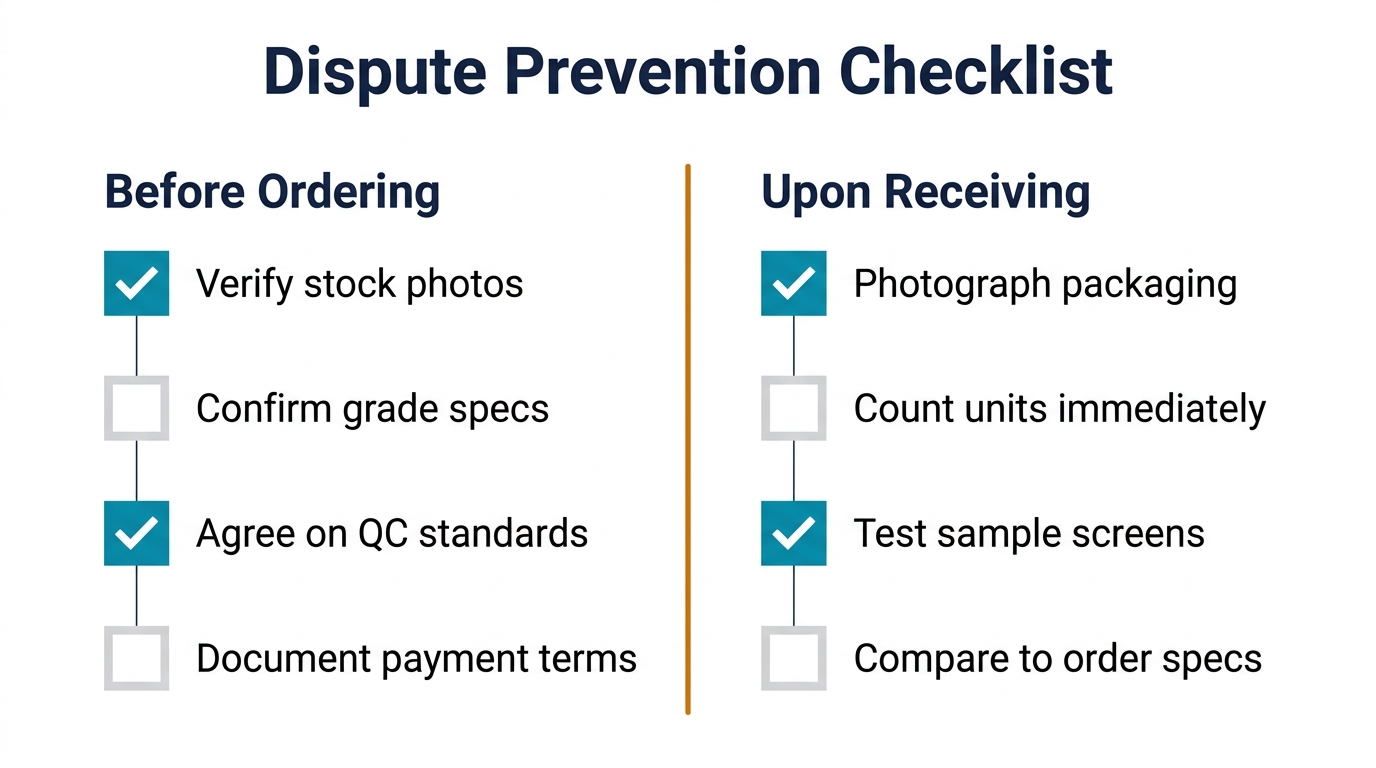
1. Write Detailed Purchase Orders
Every order should explicitly specify:
- Device model and variant (e.g., "iPhone 15 Pro Max — NOT iPhone 15 Plus")
- Screen grade using the supplier's own terminology (e.g., "Soft OLED Grade A" not just "good quality")
- Quantity with unit pricing
- Acceptable defect rate threshold (e.g., "maximum 2% DOA rate")
- What happens if specs aren't met (replacement, refund, credit)
A one-paragraph WhatsApp message is not a purchase order. Even informal suppliers will respect clear written specs because it protects them too.
2. Always Request Pre-Shipment Photos
Ask the supplier to photograph your actual packed order showing:
- Product labels and batch codes visible
- A count of boxes/units
- One screen powered on (if possible) to verify model and grade
Legitimate suppliers do this routinely. If a supplier refuses pre-shipment verification, that's a red flag worth noting before you send payment.
3. Inspect on Arrival — Every Time
Don't skip incoming quality inspection even for trusted suppliers. Check at least 10% of each shipment from random positions in the packaging. Keep a log of results by supplier and date. Over time, this data tells you which suppliers are consistent and which drift in quality.
4. Use Payment Methods with Buyer Protection
For the first 3-5 orders with any new supplier, use PayPal Business, Alibaba Trade Assurance, or a letter of credit. The transaction fees are worth the protection until trust is established. Only switch to direct wire transfer after multiple clean orders. See our full guide on paying China phone parts suppliers.
5. Negotiate Clear Return/Warranty Terms Upfront
Before placing your first order, ask:
- What's your defect warranty period? (30 days? 90 days?)
- Who pays return shipping for defective units?
- What's the process for reporting defects — is there a minimum batch size for claims?
- Do you offer replacement or refund for confirmed defective units?
Get answers in writing. A supplier who can't clearly state their warranty terms probably doesn't have a consistent policy — which means disputes will be harder to resolve.
6. Start Small, Scale Gradually
Your first order from a new supplier should be a test order — 50-100 units, not 500. Test every screen and track the defect rate. If the quality matches what was promised and communication is responsive, increase your order size gradually.
This approach costs slightly more per unit upfront but saves you from large-scale disputes with unknown suppliers. Our guide on MOQ and sample orders covers how to negotiate smaller initial quantities.
When to Walk Away from a Supplier
Not every dispute can or should be resolved. Here are clear signals to find a new supplier:
- Repeated grade misrepresentation: One instance might be a factory mix-up. Two or more is a pattern.
- Slow or no response to claims: A supplier who takes 2+ weeks to respond to a documented quality complaint doesn't prioritize your business.
- Blaming your technicians: If every defect claim is met with "your technician installed it wrong," the supplier isn't taking responsibility.
- Changing terms after disputes: A supplier who suddenly raises MOQ, changes payment terms, or restricts returns after you file a claim is penalizing you for holding them accountable.
- Defect rate above 5% on multiple orders: Consistent quality problems indicate systemic issues at the factory level that won't be fixed by complaining.
Finding a trustworthy supplier takes time, but sticking with a bad one costs more. Use our guide on choosing a reliable phone parts supplier to vet alternatives properly.
Frequently Asked Questions
How long do I have to file a dispute with my phone parts supplier?
It depends on your payment method. Alibaba Trade Assurance disputes must be filed within 30 days of confirmed delivery. PayPal allows 180 days from payment date. Credit card chargebacks typically have a 60-120 day window. For direct wire transfers, there's no formal timeframe — but contact the supplier within 48 hours of receiving the shipment for the strongest position.
What if my supplier says the defects were caused by my technician?
This is a common deflection. Counter it with evidence: photos of the defect before installation (dead pixels, backlight bleed, touch dead zones visible on a testing jig without full installation), documentation of your QC process, and defect rates compared to the same model from other suppliers. If 12% of one supplier's screens fail but only 2% from another, the issue isn't your technician.
Should I return defective screens or keep them as evidence?
Keep them until the dispute is fully resolved. Returning screens before receiving a refund or replacement removes your bargaining power. If the supplier requests returns, negotiate a simultaneous exchange — they ship replacements before or at the same time you return defective units. Never ship returns without a tracking number and written confirmation of what the supplier will provide in return.
Is it worth disputing a small number of defective units?
If the defect count is within the agreed tolerance (typically 1-3%), most buyers absorb the cost as normal business. But document it anyway — if the same supplier consistently hits 3% while others average 1%, that data supports renegotiating your unit price or switching suppliers. For defect counts above the agreed threshold, always file a claim regardless of the dollar amount, because not claiming signals to the supplier that they can let quality slip.
Can I get a refund if I already installed the defective screens?
Typically no — installed screens are considered used and most suppliers won't accept returns. However, if a screen fails within the warranty period (usually 30-90 days) during normal use, many suppliers offer replacement for confirmed manufacturing defects. The key is documenting the failure mode: a screen that develops ghost touches after 2 weeks is clearly a manufacturing issue, not installation damage. Track warranty claims separately from incoming QC defects.
Protect Your Business Before the Next Dispute
Phone parts disputes are a cost of doing business in wholesale — but they don't have to be expensive or stressful. The pattern is simple: document everything, communicate with specifics, and structure your orders to give yourself protection before problems arise.
The single most impactful change you can make is switching from verbal agreements to written purchase orders with explicit grade, model, and quality specifications. Most disputes become resolvable — or avoidable entirely — once both sides have clear, written expectations.
Looking for a supplier with transparent grading and a clear return policy? Request a sample order and test our process before committing to bulk.