
Build Long-Term Phone Parts Supplier Relationships (and Get Better Prices)
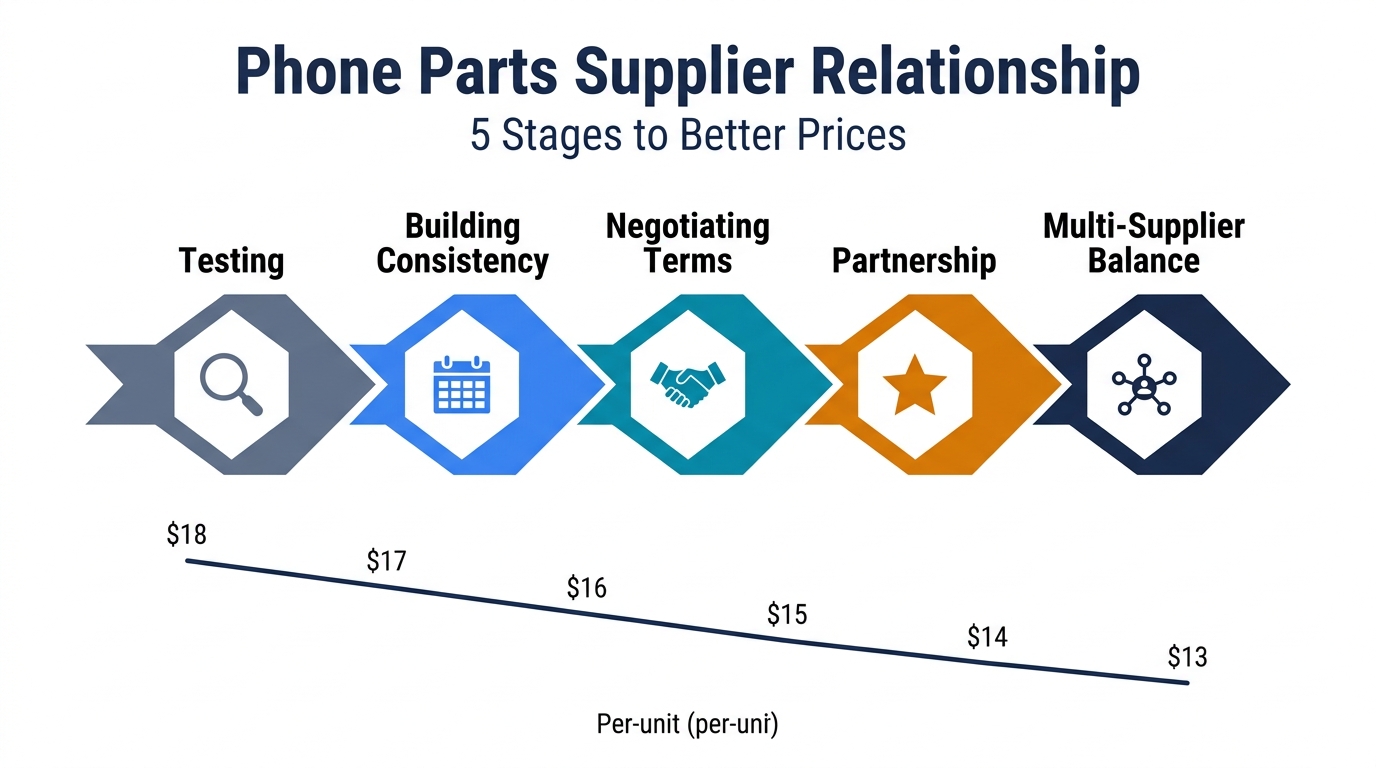
The repair shop paying $18 per Incell iPhone 15 screen and the one paying $13 for the same screen from the same supplier aren't getting different products. They have different relationships. The $13 buyer orders consistently, pays on time, communicates clearly, and has been buying for 8 months. The $18 buyer shops around, orders sporadically, and negotiates every invoice.
A strong phone parts supplier relationship isn't about being friends — it's about being a predictable, low-maintenance customer who's worth prioritizing. In return, you get better pricing, priority access to limited stock, faster shipping, and more flexible terms when problems arise.
This guide covers the practical steps to build that relationship, the specific negotiation tactics that work in the phone parts wholesale market, and the mistakes that quietly cost you money.
Looking for a Reliable Wholesale Parts Supplier?
Factory-direct from Shenzhen — transparent grades, invoices & 12-month warranty.
Get Wholesale QuoteWhat a Good Supplier Relationship Actually Gets You
Before investing time in relationship building, understand the tangible returns:
| Benefit | What It Looks Like | Estimated Value |
|---|---|---|
| Volume pricing | 10-20% lower per-unit cost at higher tier | $2-8 saved per screen |
| Priority stock allocation | New iPhone 16 screens reserved for you before general availability | Weeks of head start on competitors |
| Flexible payment terms | Net 15 or Net 30 instead of payment-before-shipment | Improved cash flow of $3,000-10,000/month |
| Faster dispute resolution | Quality issues resolved in 48 hours vs. 2 weeks | Less downtime, fewer unhappy customers |
| Custom orders | Specific model/grade combinations packed to your specs | Reduced sorting time on arrival |
| Market intelligence | Early warning on price increases, factory shutdowns, new grades available | Better purchasing decisions |
These benefits compound. A supplier who gives you 15% better pricing AND resolves disputes faster AND ships priority stock effectively increases your profit margin by 20-30% compared to a transactional relationship.
The 5 Stages of a Phone Parts Supplier Relationship
Stage 1: Testing (Orders 1-3)
Your goal: Verify quality, communication speed, and reliability. Don't commit yet.
What to do:
- Start with a small order (50-100 units) across 2-3 models and grades
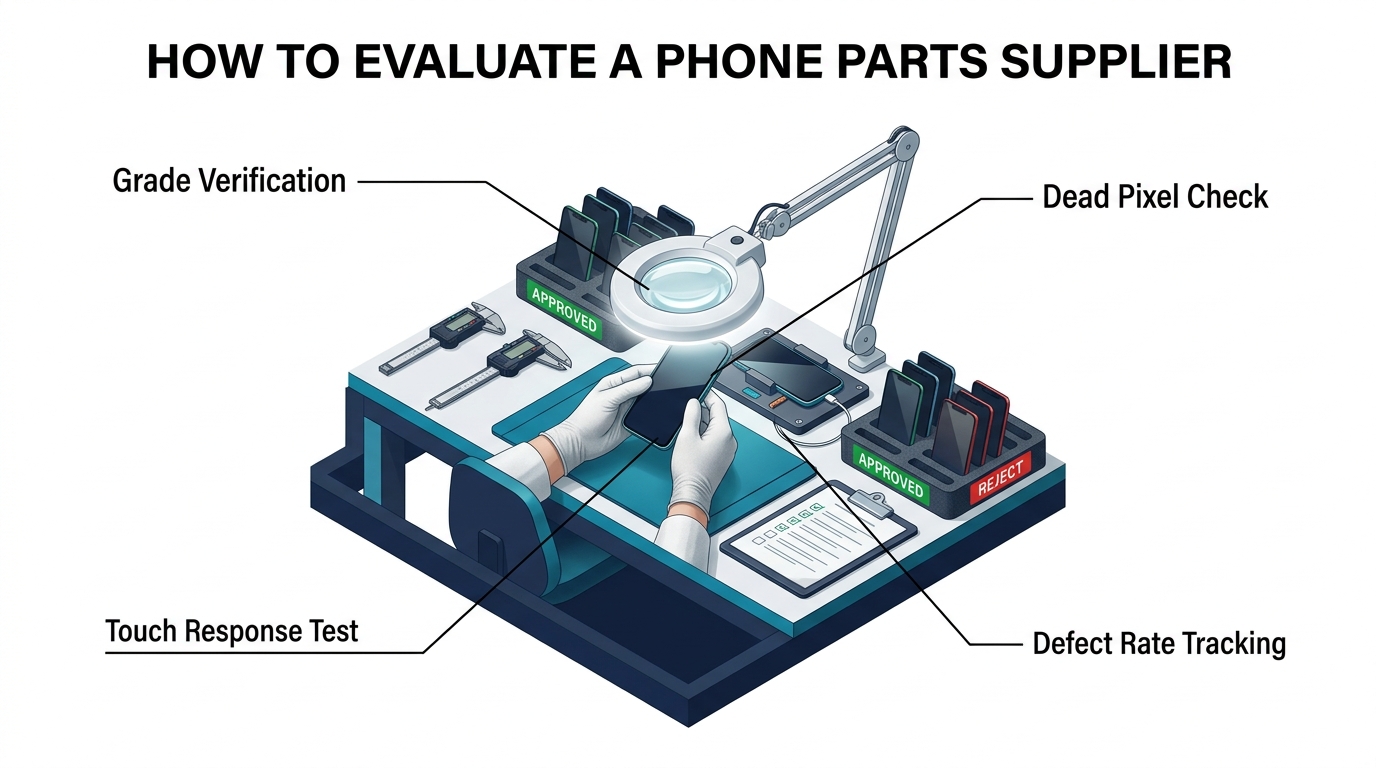
- Test every screen before using them in repairs — track defect rates meticulously
- Measure actual lead time vs. promised lead time
- Note how quickly they respond to questions (under 12 hours = good)
What NOT to do:
- Don't negotiate hard on pricing. You have no track record yet. Asking for "best price" on order #1 signals you're a price shopper, not a long-term buyer
- Don't order from 5 suppliers simultaneously and pit them against each other. Suppliers talk, and this reputation follows you
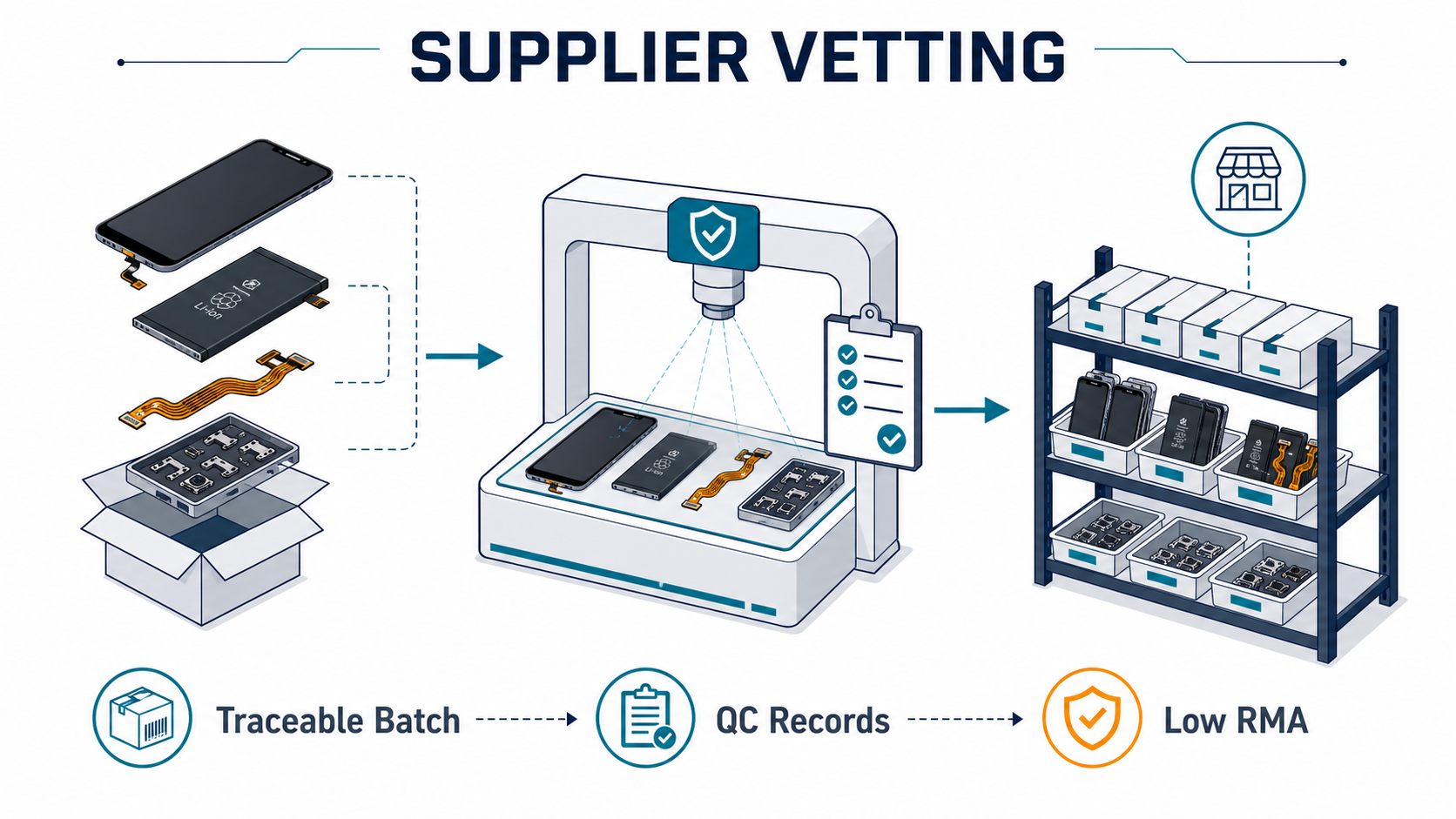
Use our supplier evaluation checklist for a structured vetting process.
Stage 2: Building Consistency (Orders 4-8)
Your goal: Establish a pattern of reliable ordering that makes you a valuable account.
What to do:
- Order on a regular schedule (e.g., every 2 weeks) rather than sporadically
- Pay on time, every time. If payment terms are "pay before shipment," send payment within 24 hours of invoice
- When you receive a good batch, tell them. A simple "Quality on this batch was excellent" builds goodwill
- If there's a defect, report it professionally with photos — not with anger
Milestone: By order 5-6, your supplier should know your name, your typical order pattern, and your quality expectations.
Stage 3: Negotiating Better Terms (Orders 8-15)
Your goal: Use your track record to negotiate improved pricing, payment terms, or both.
This is where most buyers go wrong — they either negotiate too early (no track record) or never negotiate at all (leaving money on the table).
When to negotiate:
- After 2-3 months of consistent orders
- When you can show your cumulative order volume (total units and total spend)
- Before placing a larger-than-usual order
How to negotiate (see detailed tactics below)
Stage 4: Partnership (Orders 15+)
Your goal: Move from buyer-seller to strategic partners who help each other succeed.
At this stage, you should be getting:
- Automatic volume pricing without having to ask
- Advance notice before price increases
- Priority allocation for new model screens
- Payment terms (Net 15 or Net 30)
- Direct communication with a dedicated account manager
What you give in return: Consistent volume, timely payments, constructive feedback on quality, and loyalty — you're not switching suppliers for a $0.50/unit difference from a competitor.
Stage 5: Multi-Supplier Balance
Even the best supplier relationship needs a safety net. The ideal structure:
- Primary supplier (70-80% of orders): Your main relationship — best pricing, highest trust
- Secondary supplier (20-30%): Tested and reliable, keeps your primary honest, provides backup when primary is out of stock
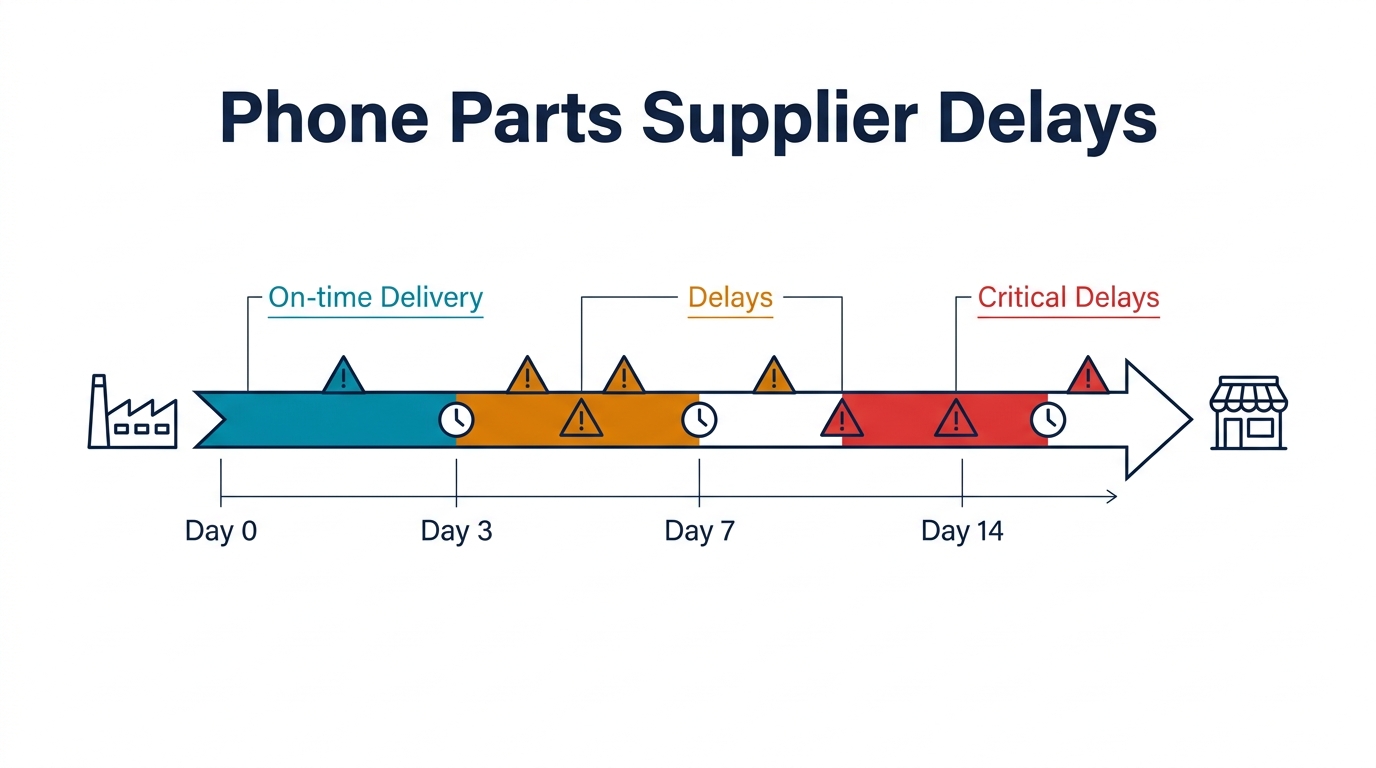
Never go 100% with a single supplier. See our guide on preventing supplier delays for why backup suppliers matter.
6 Negotiation Tactics That Actually Work
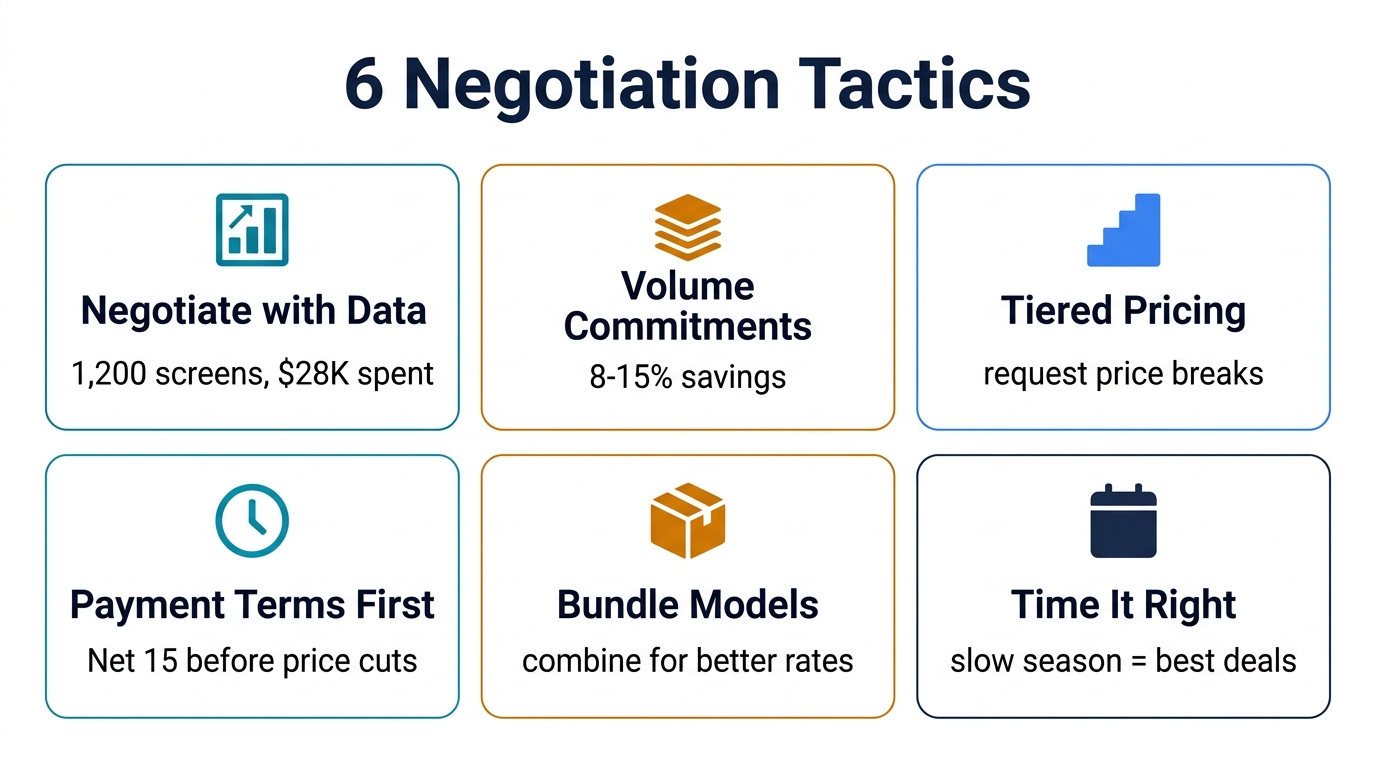
1. Negotiate with Data, Not Demands
Bad: "I need a better price." Good: "I've ordered 1,200 screens over the past 3 months for a total of $28,000. I'm planning to increase to 500/month. At that volume, what pricing can you offer?"
The supplier needs to justify any discount internally. Give them the data to do that.
2. Offer Volume Commitments
Suppliers give better prices when they can predict your orders. A monthly commitment — even informal — is worth more to them than occasional large orders.
"If I commit to a minimum of 300 screens per month for the next 6 months, what per-unit pricing can you offer on iPhone 15 Soft OLED?"
This approach typically unlocks 8-15% better pricing compared to spot ordering.
3. Ask for Tiered Pricing
Request a price list with volume breaks:
| Monthly Volume | Price Per Unit |
|---|---|
| 1-99 units | $22 |
| 100-299 | $19 |
| 300-499 | $17 |
| 500+ | $15 |
Now you know exactly what volume unlocks the next price break, and you can plan your ordering accordingly. Most suppliers have these tiers internally — they just don't publish them. Ask.
4. Negotiate Payment Terms Before Price
Switching from prepayment to Net 15 or Net 30 improves your cash flow without costing the supplier much. It's often an easier win than a per-unit price cut.
"I've been prepaying for 4 months with zero payment issues. Can we move to Net 15 terms? My order pattern won't change."
5. Bundle Models for Better Pricing
Instead of negotiating each model separately, bundle your order:
"I need 100 iPhone 15 Pro Max Soft OLED + 200 iPhone 14 Hard OLED + 150 Samsung A54 aftermarket. What's your best bundle price for all three?"
Bundling gives the supplier a larger order value and simplifies their fulfillment. They'll often offer a better combined rate than individual model pricing.
6. Time Your Negotiations
The best time to negotiate is NOT when you're desperate for stock. Negotiate during:
- Slow season (January-February after holiday rush) — suppliers need orders
- When you have a large order ready — your negotiating position is strongest
- After you've resolved a quality issue gracefully — the supplier feels goodwill
- Before Chinese New Year — suppliers lock in commitments for the year ahead
The worst time: during new iPhone launch season when every repair shop is competing for the same limited stock.
Ready to build a supplier relationship with transparent pricing from day one? We publish our volume tiers upfront — no guessing games. Request our price list.
5 Mistakes That Damage Supplier Relationships
1. Constant Price Shopping
Mentioning a competitor's price in every conversation trains the supplier to see you as a price shopper who'll leave the moment someone undercuts by $0.50. Negotiate fairly, but don't threaten.
2. Disputing Every Minor Issue
Filing a complaint over 2 dead pixels on 1 screen in a 200-unit order destroys goodwill. A 1% defect rate is normal in wholesale. Save disputes for genuine batch problems — when 5%+ of units have issues. Handle minor defects as cost of business.
3. Irregular Ordering Patterns
Ordering 500 units one month and zero the next makes you unpredictable. Suppliers allocate stock and production capacity based on patterns. Inconsistent buyers get deprioritized for consistent ones.
4. Slow Payment
Paying late — even by a few days — signals financial instability. Suppliers immediately tighten terms and deprioritize your orders. If cash flow is tight, communicate proactively: "Payment will be 3 days late this month due to [reason]. It won't happen again."
5. Never Giving Positive Feedback
If you only contact your supplier when something is wrong, they associate your name with problems. A 30-second message — "This batch was great, especially the Samsung S24 Ultra screens" — costs you nothing and makes the supplier want to maintain that quality standard for your account.
How to Evaluate If Your Current Supplier Relationship Is Working
Score your primary supplier quarterly on these metrics:
| Metric | Good | Needs Improvement | Red Flag |
|---|---|---|---|
| Response time | Under 12 hours | 12-48 hours | 48+ hours or no response |
| On-time shipping | >90% of orders | 75-90% | Below 75% |
| Defect rate | Under 2% | 2-5% | Above 5% consistently |
| Price competitiveness | Within 10% of market | 10-20% above market | 20%+ above with no added value |
| Dispute resolution | Resolved within 1 week | 1-2 weeks | Over 2 weeks or unresolved |
| Payment terms | Net 15-30 | Prepayment with trust | Prepayment only, no flexibility |
If your supplier scores "Red Flag" on 2+ metrics after 6 months of consistent ordering, the relationship isn't progressing. Start testing alternatives while maintaining your current supply.
For detailed quality tracking, use the methods in our incoming QC guide.
Frequently Asked Questions
How long does it take to get better pricing from a supplier?
Typically 2-4 months of consistent ordering. Most suppliers review account pricing after 8-10 orders or when cumulative spend reaches a threshold (often $10,000-20,000). You can accelerate this by committing to monthly volume, paying promptly, and explicitly asking for tiered pricing after your third month. Don't expect discounts on your first order — earn them through consistency.
Should I tell my supplier about my other suppliers?
Not directly. Mentioning "I'm also buying from Supplier X" reads as a threat. Instead, frame it positively: "I'm looking to consolidate more of my volume with one primary supplier. If we can agree on pricing for 400 units/month, I'd prefer to route most of my orders through you." This communicates the same information without the adversarial tone.
What's the best way to handle a price increase from my supplier?
First, understand the reason. Raw material cost increases and factory price adjustments affect all suppliers — pushing back won't help. If it's a supplier-specific increase, negotiate: "I understand costs are rising. Can we lock in the current price for the next 3 months if I commit to a minimum volume?" Alternatively, ask if the increase can be phased in gradually rather than all at once.
Is it worth flying to China to meet suppliers in person?
For orders exceeding $50,000 annually, yes. An in-person visit to Shenzhen or a trade fair (Canton Fair, Global Sources Electronics) strengthens the relationship dramatically. You'll see the actual warehouse, meet the team, and negotiate more effectively face-to-face. For smaller operations, video calls and consistent communication achieve 80% of the same relationship benefit at zero travel cost.
How do I switch primary suppliers without burning bridges?
Reduce orders gradually rather than cutting off overnight. Move from 80% to 50% over 2-3 months while increasing volume with your new primary. If asked, be honest: "I'm diversifying my supply chain for business continuity." Most suppliers understand this. Keep the old supplier as your secondary — you may need them again, and maintaining the relationship costs nothing.
Start Building — Your Margins Will Thank You
A strong phone parts supplier relationship is the single highest-ROI investment a repair shop can make in its supply chain. The pricing benefits alone — 10-20% lower per-unit costs — translate directly to thousands of dollars in annual profit. Add priority stock access, flexible payment terms, and faster dispute resolution, and the compounding effect is substantial.
The formula is simple: order consistently, pay on time, communicate clearly, and negotiate with data. Do this for 3-6 months and you'll have a supplier partnership that gives you a genuine competitive advantage.
Looking for a supplier who rewards loyalty with transparent pricing and dedicated support? Start the conversation — we'll send our full price list with volume tiers so you know exactly where you stand from day one.