
Local Supplier vs China Direct: When Paying More Actually Saves Money for Repair Shops
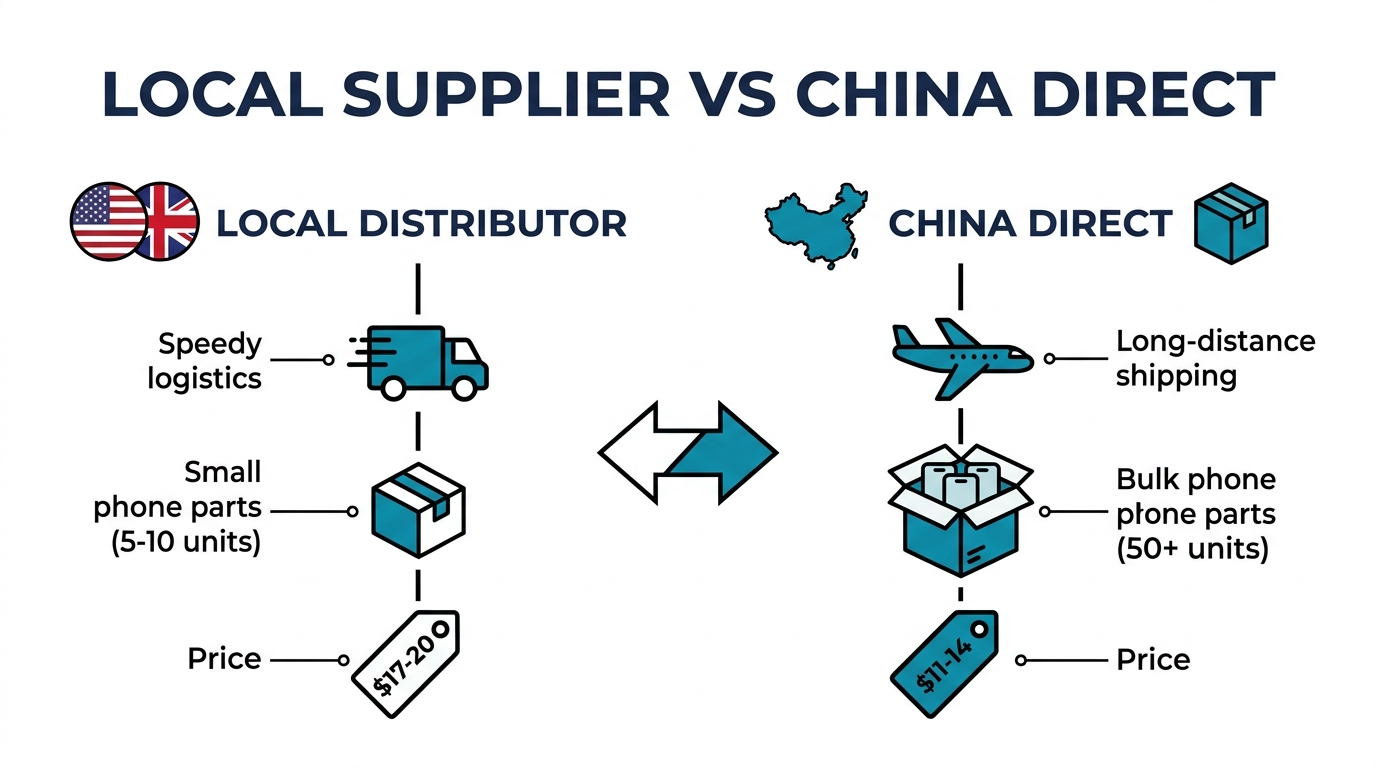
The unit price from a China-based supplier is almost always lower. An Incell iPhone 14 screen that costs $18 from a US distributor might be $11–13 from Shenzhen. For a repair shop doing 15–20 screen repairs a day, that $5–7 gap per unit looks like $2,000+ per month in savings. So why don't all repair shops buy direct from China?
Because unit price is not total cost. When you compare local supplier vs China direct on the full picture — shipping time, minimum order quantities, defect handling, customs, and the cost of downtime when parts don't arrive on schedule — the math changes significantly. For some shops, China direct is clearly the right move. For others, paying more per unit through a local distributor actually produces higher profit.
Here's how to run the real comparison for your specific situation.
Looking for a Reliable Wholesale Parts Supplier?
Factory-direct from Shenzhen — transparent grades, invoices & 12-month warranty.
Get Wholesale QuoteThe True Cost Comparison: It's Not Just Unit Price

Landed cost is the only number that decides this question. It is the invoice price plus freight, customs, payment fees, defect losses, and the cost of capital sitting in boxes on your shelf — divided by the units you actually install. Our data on a single model shows why the invoice comparison misleads: an iPhone 14 HD Incell assembly is $11.15 at our 50+ tier, while a US distributor's entry-level incell for the same generation sits near $20 (our July 2026 price check on MobileSentrix). On paper that is a 44% gap. After freight, duty, and defect handling it is usually a single-digit to mid-teens percentage.
Side-by-Side Landed Cost: iPhone 14 Incell Screen
| Cost factor | Local distributor (US) | PRSPARES factory-direct |
|---|---|---|
| Unit price (50 pcs) | ~$20 (US entry incell, July 2026 check) | $11.15 (published 50+ tier) |
| Freight per unit | $0.50–1.00 (often bundled) | $1.50–3.00 air, falls as order size grows |
| Customs & duty | $0 (already cleared) | Your rate × declared value — verify your own HTS code, rates on China-origin goods changed repeatedly through 2025–2026 |
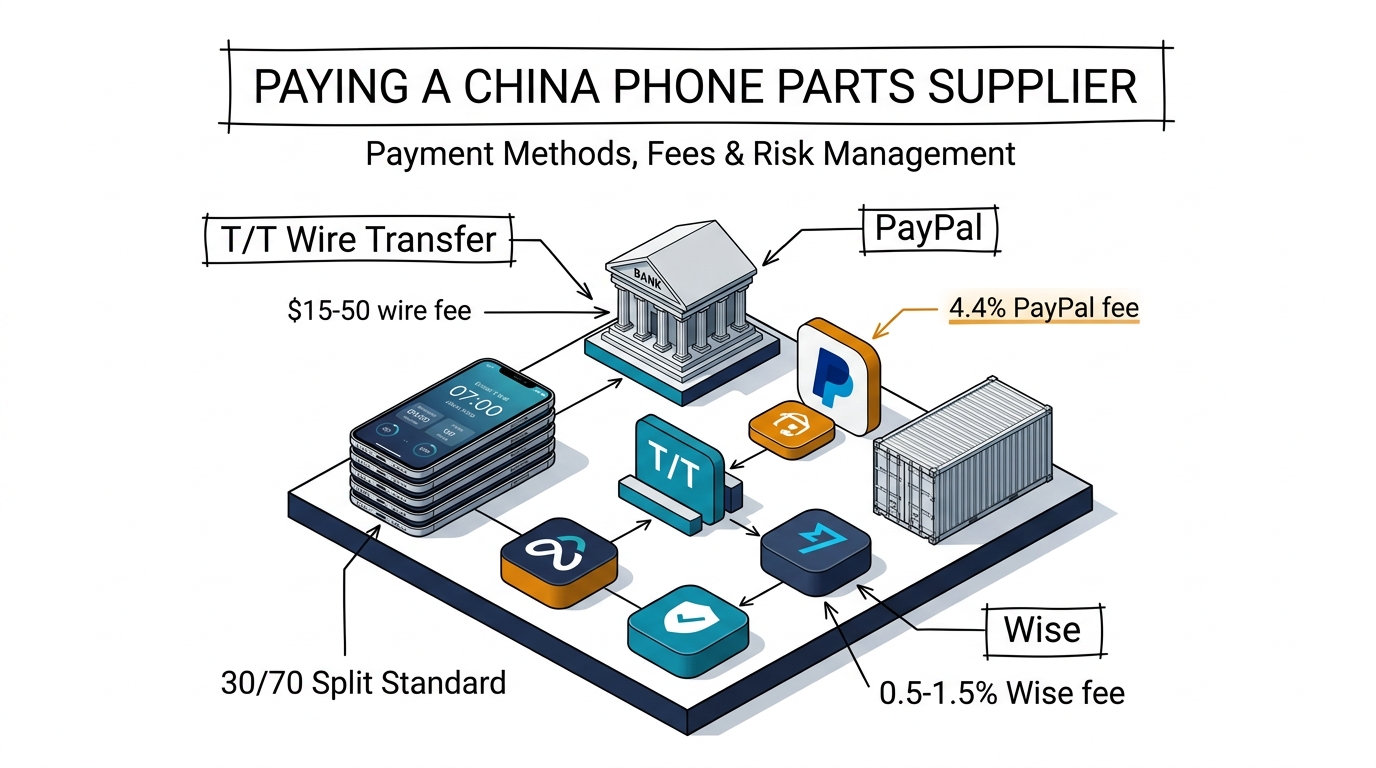
| Payment / FX fees | $0 | ~1–3% (wire or card) |
| Minimum order | 5–10 units | No single-model MOQ — mix categories to 10 pcs and the 10+ tier applies |
| Capital tied up | Small, frequent reorders | One larger order, 2–5 weeks earlier |
| Delivery | 1–3 days | 7–15 days air / 25–40 days sea |
| Defect handling | Return, credit in days | 12-month warranty, credit typically applied to the next order |
The invoice gap of roughly $9 per unit compresses to a few dollars once every line above is filled in. That compression — not the headline unit price — is what you are actually deciding about.
The MOQ myth, corrected
Most "China direct" guides, including an earlier version of this one, tell you a Chinese supplier needs 20–50 units per model. That is true of many factories. It is not true here, and it changes the calculus for small shops: we apply no single-model minimum. A shop can combine 3 screens, 4 batteries, and 3 charging flex cables — 10 pieces total across three categories — and still buy at the 10+ tier. In practice this removes the classic objection that going direct means gambling $600 on 50 units of one model you have not yet proven sells.
Grade Moves Your Cost 5x. Volume Moves It 3%.
The most expensive mistake in this decision is optimizing the wrong variable. We publish our tier pricing, so this is checkable rather than asserted:
| iPhone 14 screen assembly | 10+ | 50+ | 200+ | 10→200 change |
|---|---|---|---|---|
| HD Incell | $11.38 | $11.15 | $11.03 | −3.1% |
| GX Soft OLED | $34.22 | $33.52 | $33.17 | −3.1% |
| Original (glass-change refurbished) | $61.86 | $60.29 | $60.29 | −2.5% |
Going from a 10-piece order to a 200-piece order saves about 3%. Moving between grades on the same model changes the cost 5.4x — $11.03 to $60.29. On an iPhone 15 Pro the spread is wider still: $13.97 for HD Incell against $179.45 for Original, roughly 12.8x.
We found this same confusion inside real inquiries. In one July 2026 case a buyer in a price-driven market told us our quote was above his local wholesale price before freight or duty. He was right — but he had asked for Original grade and was comparing it against incell stock sold locally. The fix was not a discount. It was quoting the grade he was actually competing against.
So before you compare local against direct, make sure both columns hold the same grade. Our screen grade guide defines the four grades we sell against, and the published tier pricing on every screen model lets you rebuild the comparison with our real numbers instead of an estimate.
When Local Distributors Win
Local sourcing makes more financial sense in these situations:
1. Your Monthly Volume Is Under 100 Screens
Volume matters here, but not for the reason most guides give. As the tier table above shows, the unit price barely moves between 10 and 200 pieces. What actually scales is freight and customs clearance: those are close to fixed per shipment, so a 20-piece order carries the same clearance overhead as a 200-piece order and each unit absorbs a larger share of it. If you're doing 50–80 screen repairs per month, ordering locally in 5–10 unit lots gives you:
- Less cash locked in inventory
- Ability to stock more model variety with the same budget
- No risk of sitting on 30 units of a model that turns out to be slow in your market
2. You Need Fast Restocking
Every day without a part in stock is a lost repair. If your top-selling screen runs out on Monday, a local distributor delivers by Wednesday. A China shipment takes 7–15 days by air — that's 5–10 repairs you either turn away or delay.
The math: If your average screen repair generates $40–60 in labor profit, losing 5 repairs while waiting for China shipment costs $200–300. That wipes out the unit price savings on an entire batch.
3. You're Still Learning Your Demand Pattern
New shops (under 6 months operating) don't yet know which models sell fastest or what quality grade their customers accept. Local distributors let you experiment with small orders, test different grades, and pivot quickly. Committing to a 50-unit China order on the wrong model or grade is an expensive lesson. (See our guide on building a starter inventory for more on this.)
4. Defect Resolution Matters to Your Reputation
When a screen from a local distributor is defective, you ship it back and get a credit or replacement in 2–3 days. When a screen from China is defective, you're negotiating over WhatsApp or WeChat, providing photos and videos as evidence, and waiting for a credit on your next order — which might be weeks away.
For a new shop building its reputation, the speed and simplicity of local defect resolution is worth the price premium.
When China Direct Wins
China direct sourcing becomes the clear winner when these conditions are met:
1. Your Monthly Volume Exceeds 200+ Screens
At this volume, the per-unit savings add up fast. Saving $3–4 per screen on 200+ units is $600–800/month — $7,000–10,000 annually. This more than covers the shipping costs, occasional customs fees, and the overhead of managing an international supply chain.
2. You Have 90+ Days of Demand Data
You know exactly which models sell, at what volume, and in which grades. You're not guessing — you're ordering based on data. This means your China orders are precise: the right models, the right quantities, the right grades. Minimal dead stock.
3. You Can Carry 3–4 Weeks of Inventory Buffer
China direct requires larger orders and longer lead times. This only works if you can afford to hold 3–4 weeks of inventory on your top models while waiting for the next shipment. If a $2,000–3,000 inventory investment puts strain on your cash flow, you're not ready for China direct on your core stock.
4. You've Verified Your Supplier
Not all China suppliers are equal. Before committing to volume orders, you need:
- A completed test order with quality verification (see our guide on how to evaluate a supplier with a test order)
- Clear defect resolution terms agreed in writing
- Verified shipping times with your chosen freight method
- Understanding of customs procedures in your country
Without these, the savings on unit price get eaten by quality problems and logistics surprises.
Considering China direct for the first time? PRSPARES offers test orders with low MOQs so you can verify quality, shipping times, and grade consistency before scaling up. Request a test order here.
What You Actually Save Depends on Where You Are
The savings figure quoted across this industry — "30–40% cheaper direct from China" — is not universally true, and we would rather say so than lose a customer over it three weeks after their first order.
United States. The US has the most mature distributor tier in this market. Domestic distributors buy in container volumes, clear customs once, and sell entry-grade incell close to their own landed cost. Comparing like grade against like grade, our July 2026 price checks put a US shop's realistic saving at roughly 0–15% on small orders once freight, duty, and payment fees are counted. The reason to go direct in the US is usually grade control, warranty terms, and access to grades your distributor does not stock — not a dramatic price cut.
Europe, Australia, Latin America, Africa, the Middle East. Where the local distributor tier is thinner or adds two markups instead of one, the same comparison typically lands at 30–40%. This is where factory-direct changes the economics rather than trimming them.
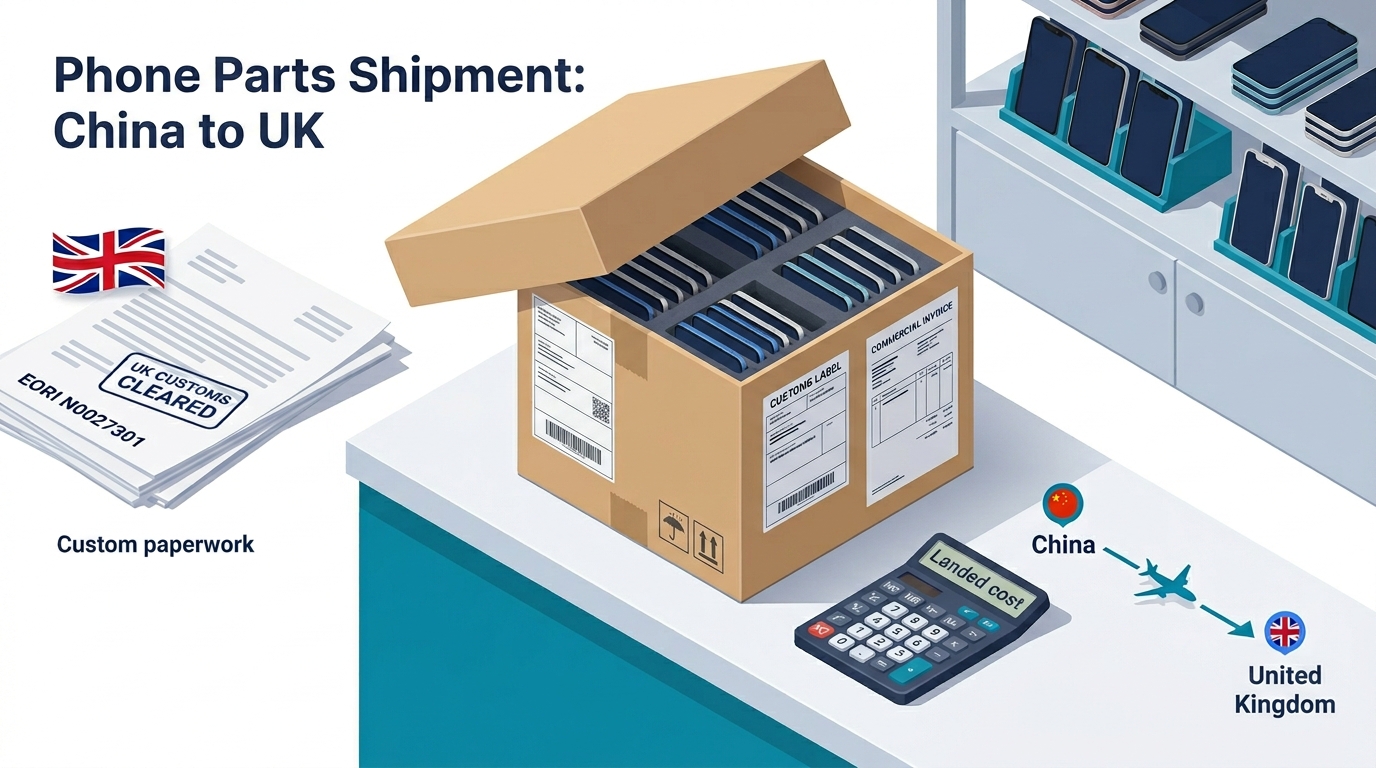
If you are importing into the UK or EU, the customs mechanics matter as much as the price — see our guide on importing phone parts from China into the UK and EU, and air freight versus sea freight for how shipping choice moves the landed number.
The Hybrid Strategy: What Most Successful Shops Actually Do
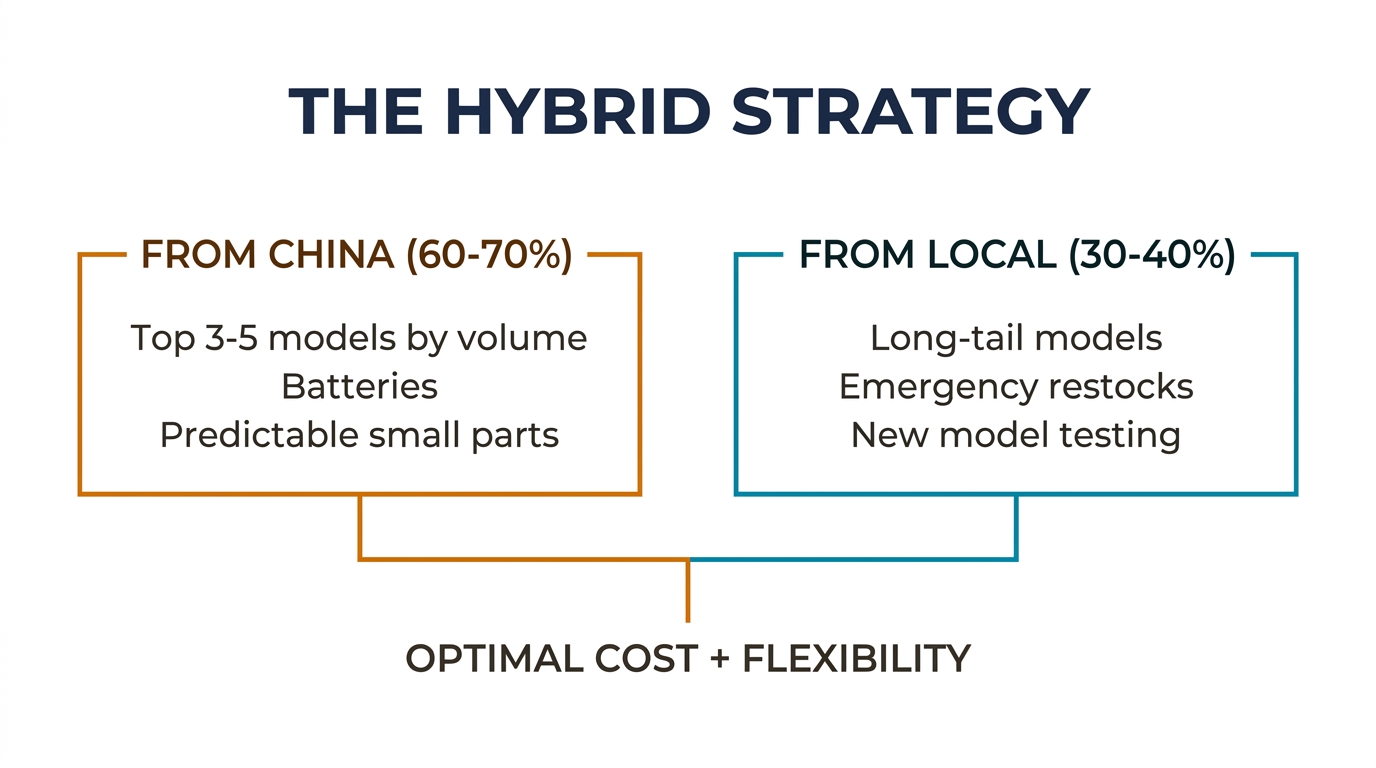
The local supplier vs China direct choice isn't binary. Most profitable repair shops with 100+ monthly screen volume use a hybrid approach:
From China direct (bulk, planned):
- Top 3–5 models by volume — the screens you install every day
- Batteries for high-volume models (lightweight, easy to ship)
- Small parts with predictable demand (charging ports, speakers)
From local distributor (flexible, fast):
- Models outside your top 5 — occasional repairs where you don't want to hold bulk stock
- Emergency restocks when your China shipment is delayed
- New models you're testing before committing to China volumes
- Parts where color variants matter (order specific colors locally on-demand)
The ratio: Many established shops settle around 60–70% China direct (planned bulk orders for top models) and 30–40% local distributor (flexibility buffer and long-tail models). This captures most of the China pricing advantage while maintaining the speed and flexibility of local supply.
How to Transition From Local to China Direct
If you're currently buying everything locally and want to start capturing China-direct savings:
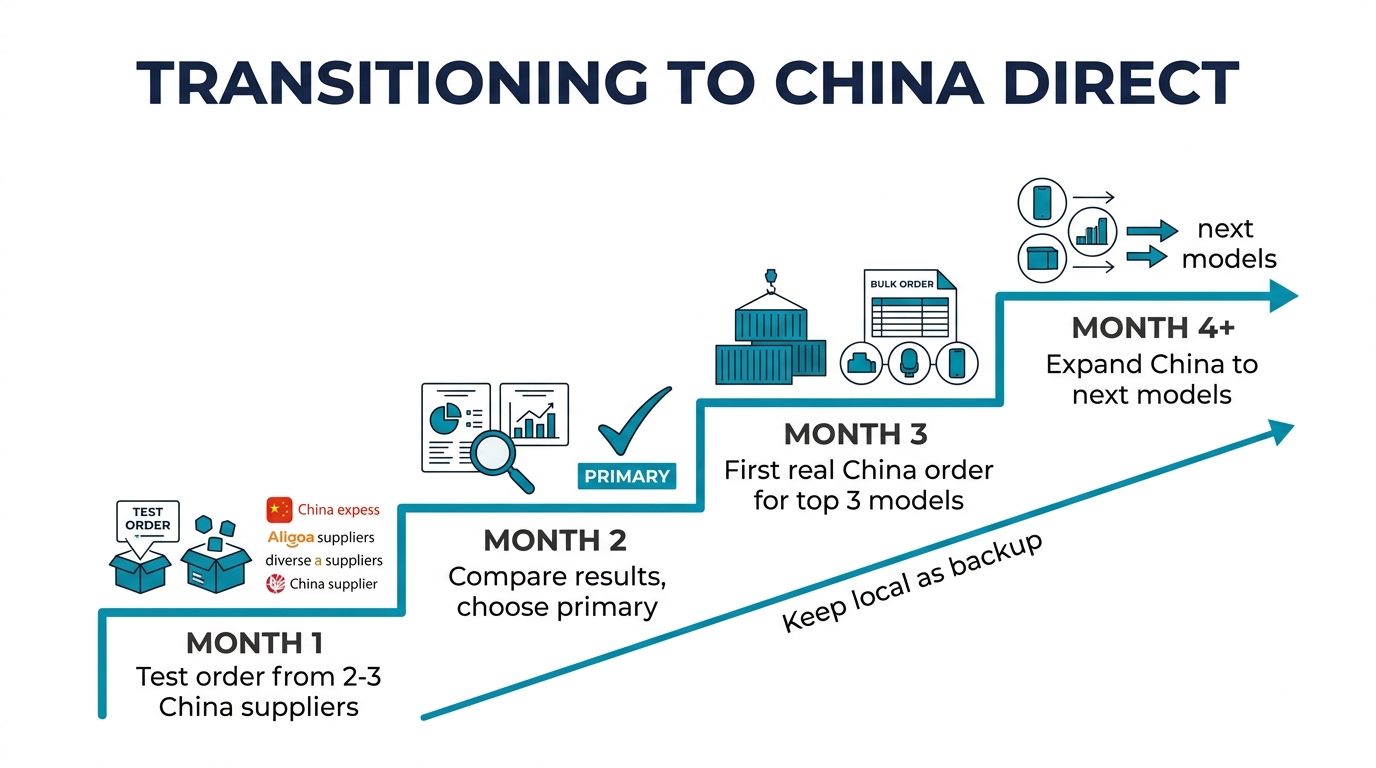
Month 1: Identify your top 3 models by repair volume. Find 2–3 China suppliers and place a small test order (10–20 units per model) from each.
Month 2: Compare test order results — quality, shipping time, packaging, defect rate. Choose your primary China supplier for those 3 models.
Month 3: Place your first real order from China for your top 3 models. Keep buying everything else locally. Monitor: Did the parts arrive on time? Was the quality consistent with the test order? How did defect resolution go?
Month 4+: If Month 3 went well, expand China direct to your next 2–3 highest-volume models. Keep local as your backup and flexibility channel.
For a detailed framework on scaling from test order to bulk, see our guide on structuring the first real order after a test order.
Frequently Asked Questions
Is it legal to import phone parts from China for my repair shop?
Yes, in most countries including the US and UK. Phone repair parts (screens, batteries, small parts) are not restricted imports. However, you may need to pay import duties depending on the value and your country's tariff schedule. In the US, phone parts generally fall under harmonized code categories with 0–2.5% duty rates. The bigger practical concern isn't legality — it's ensuring the parts meet quality standards and that your supplier provides proper commercial invoices for customs clearance.
How do I handle warranty claims on parts bought from China?
Most China suppliers don't offer the same warranty process as local distributors. The standard arrangement is: you report defective units with photo/video evidence, and the supplier credits the value against your next order. This works well for ongoing relationships with regular orders but poorly for one-time buyers. Some suppliers offer free replacement shipments for defective units, but shipping costs may apply. Always clarify the defect resolution process before your first order — get it in writing via email, not just a verbal WeChat promise.
What's the minimum order size that makes China direct worth it?
For most repair shops, China direct starts making financial sense at around 50+ screens per order (across all models combined). Below that, the shipping cost per unit, the MOQ requirements, and the longer lead time eat into the unit price savings. At 100+ screens per order, the economics clearly favor China direct for your high-volume models. But remember: start with a small test order to verify quality before committing to these volumes.
Do I have to order 50 units of one model to buy direct?
No. We apply no single-model minimum order quantity. You can combine categories — for example 3 screens, 4 batteries and 3 charging flex cables — and the 10+ tier still applies to the whole order. This is the main reason a shop can test factory-direct sourcing without committing capital to one model.
How much duty will I pay importing phone parts?
That depends on your country, your commodity code, and the declared value — and rates on China-origin goods have changed repeatedly through 2025 and 2026, so any fixed percentage published in an article ages badly. Verify the current rate for your own tariff code before you build it into your pricing, and treat it as a per-shipment cost that amortizes across units rather than a flat per-unit fee.
Make the Decision Based on Your Numbers, Not Assumptions
The local supplier vs China direct debate has a simple answer: it depends on your volume, your cash flow, and your tolerance for lead time. There's no universal "right" channel — only the right channel for your shop's current stage.
Run the full cost comparison using the framework above. Include shipping, customs, defect rates, and the cost of lost repairs from stockouts. The result will probably surprise you: for many shops, the optimal strategy is neither "all local" nor "all China" — it's a calculated split that captures the best of both.
Ready to test China-direct pricing on your top models? PRSPARES provides transparent pricing with test order options — see the quality and shipping firsthand before committing to bulk. Get a quote for your top models.
Related reading: How to Choose a Reliable Phone Parts Supplier | How New Repair Shops Should Build a Starter Inventory