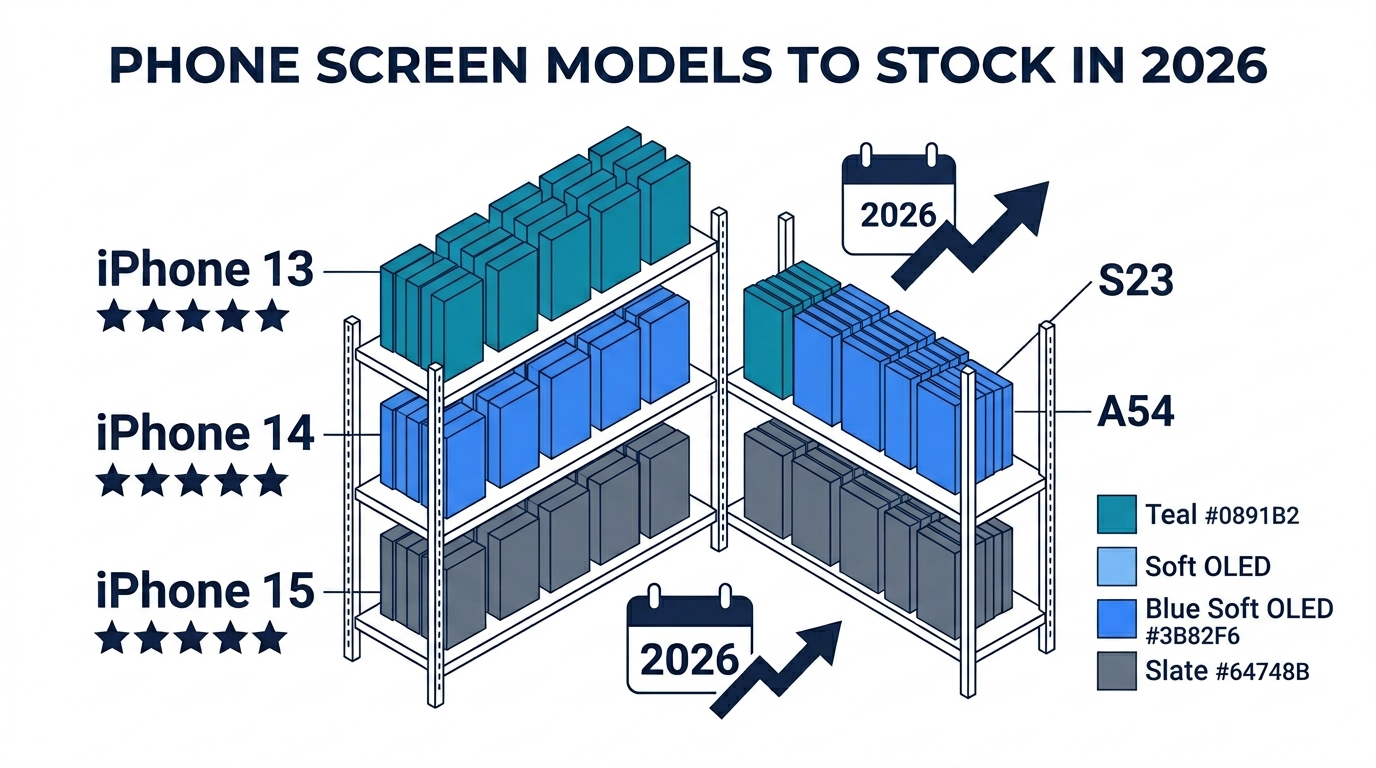

How Repair Shops Should Structure the First Real Order After a Test Order

Your test order arrived, you ran your QC checks, the screens looked good, the batteries tested at the right capacity. Now comes the decision that actually puts real money on the line: your first real order after test order validation.
This is where many repair shops either scale too aggressively (ordering 3 months of inventory based on 10 test units) or too cautiously (reordering the same tiny quantity at higher per-unit cost). Both waste money. The first real order needs a specific structure — enough volume to capture better pricing, enough variety to cover your demand, and enough restraint to protect you if the supplier's quality shifts between test batch and production batch.
Here's how to build that order.
Looking for a Reliable Wholesale Parts Supplier?
Factory-direct from Shenzhen — transparent grades, invoices & 12-month warranty.
Get Wholesale QuoteBefore You Order: What Your Test Order Should Have Told You
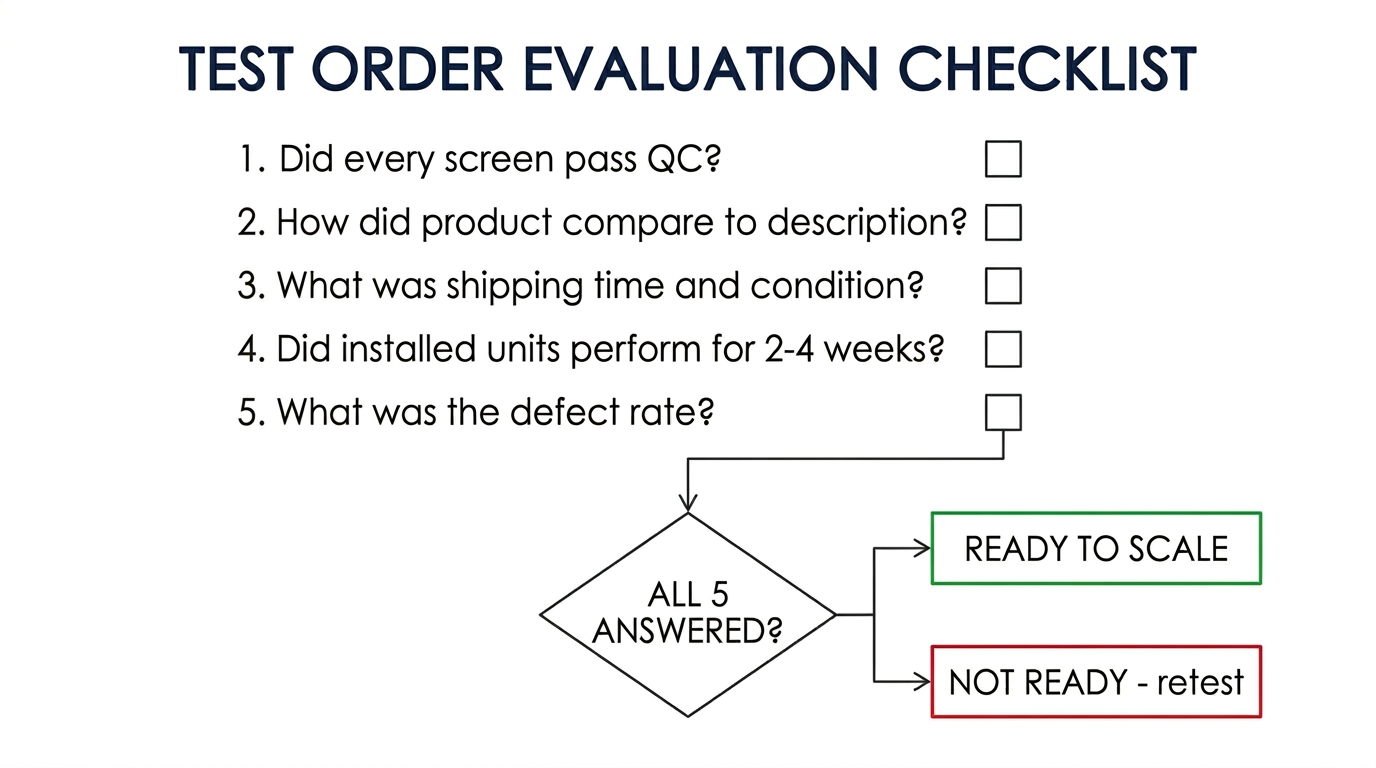
Your first real order should be shaped by data from the test order, not by the supplier's suggested order template. Before placing the bulk order, confirm you've answered these questions from your test results:
| Question | Where to Find the Answer | Why It Matters for Your Bulk Order |
|---|---|---|
| Did every screen pass your QC? | Your incoming QC log | Determines whether you order the same grade or request a higher one |
| How did the actual product compare to the supplier's description? | Your test notes vs. supplier specs | Calibrates your trust in their grade claims |
| What was the shipping time and condition on arrival? | Delivery tracking + packaging inspection | Sets your reorder lead time and inventory buffer |
| Did you install any test units in customer phones? | Customer feedback over 2–4 weeks | The ultimate quality validation — did callbacks happen? |
| What was the defect rate? | QC log: defective units / total units | If test order defect rate was 0%, great. If 10%+, reconsider the supplier entirely |
If you can't answer all five questions, you're not ready to scale. Either run additional tests or order from the same test order quantity one more time before committing to bulk.
For the full test order evaluation framework, see our guide on how to evaluate a supplier with a test order.
The 3x Rule: How to Size Your First Real Order
The most common mistake is jumping from a 10-unit test order to a 200-unit bulk order. That's a 20x scale increase — and it assumes the supplier's quality and logistics are consistent at a volume they haven't yet proven to you.
Use the 3x rule: Your first real order should be approximately 3 times your test order quantity.
- Test order was 10 screens → First real order: 30 screens
- Test order was 20 screens + 20 batteries → First real order: 60 screens + 60 batteries
- Test order was 5 screens per model across 4 models → First real order: 15 per model across the same 4 models
Why 3x and not 5x or 10x?
At 3x, you're large enough to:
- Negotiate a meaningful price improvement over test-order pricing (typically 5–15% better per unit)
- Test the supplier's consistency across a larger batch
- Cover 2–4 weeks of inventory for your top models
But small enough to:
- Limit your financial exposure if quality drops from the test batch
- Avoid sitting on months of inventory if demand shifts
- Pivot quickly if you need to switch suppliers
After 2–3 successful orders at 3x, you'll have enough history to scale further — to 5x, 10x, or whatever your demand data supports.
What to Scale, What to Hold, What to Add
Not everything from your test order should scale equally in your first bulk order.
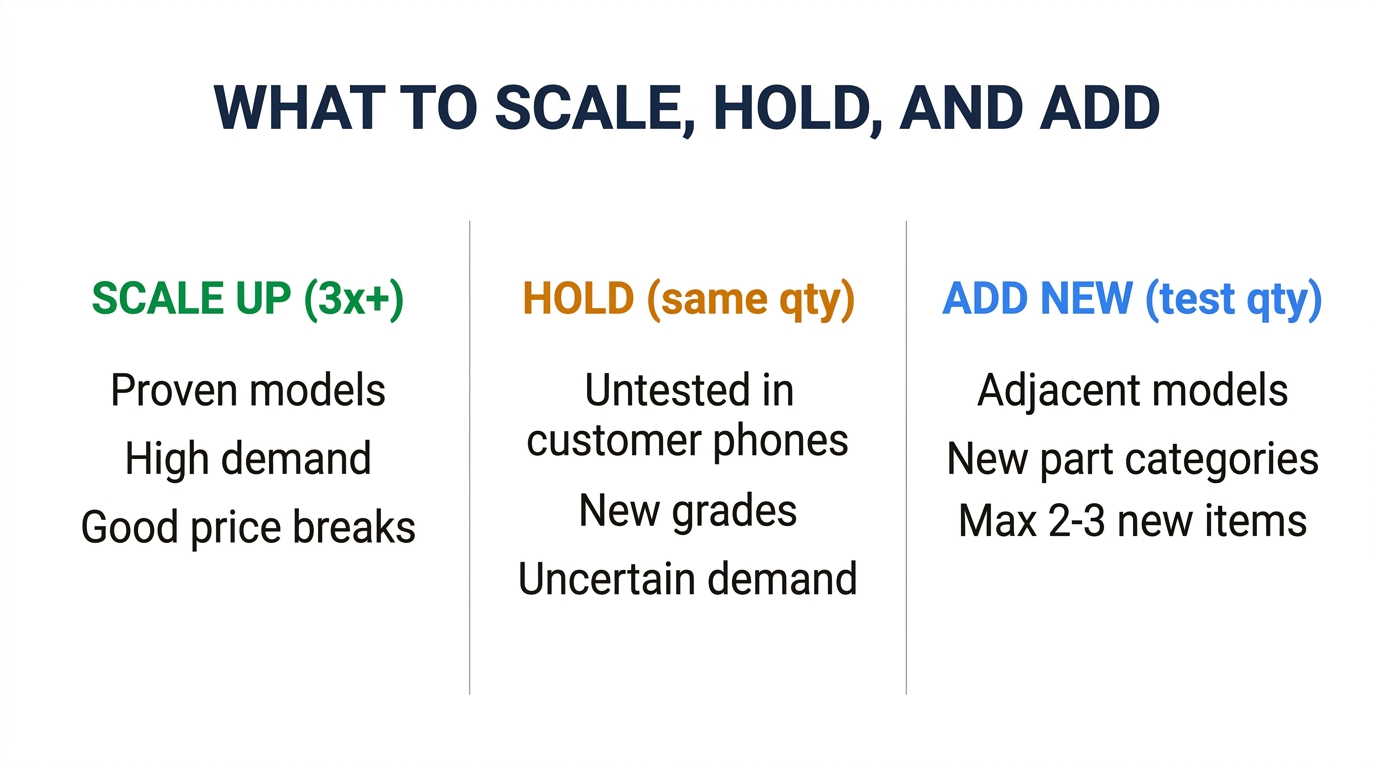
Scale up (order 3x or more):
- Models that passed QC and performed well in customer installs — these are your proven winners
- Parts with consistent daily demand — if you install 2–3 iPhone 14 screens per day, stock accordingly
- Items where per-unit cost drops significantly at higher quantity — ask the supplier for their price breaks
Hold at test quantity (don't scale yet):
- Models you tested but haven't installed in customer phones yet — QC pass is good, but real-world validation is better
- New grades you haven't worked with before — if you tested Hard OLED for the first time and it seemed fine, order the same small quantity again before committing to bulk
- Parts where your demand is uncertain — if you're not sure whether Samsung A15 screens will sell, keep testing at small volume
Add new items (small test quantities):
- Adjacent models you didn't include in the original test — if your test covered iPhone 13–14, add iPhone 15 at test-order quantity
- New part categories from the same supplier — if screens were good, test their batteries or charging ports at 5–10 units
- Don't add more than 2–3 new items per order cycle — mixing too many new unknowns with your scaling order creates confusion if something goes wrong
Order Structure Template
Here's a practical template for a repair shop doing 15–20 screen repairs per day, scaling from a test order:
| Item | Test Order Qty | First Real Order Qty | Reasoning |
|---|---|---|---|
| iPhone 14 Incell screen | 5 | 20 | Proven model, high daily demand, 4x scale |
| iPhone 13 Incell screen | 5 | 15 | Proven model, steady demand, 3x scale |
| iPhone 15 Incell screen | 3 | 10 | Tested well, growing demand, 3x scale |
| iPhone 12 Incell screen | 3 | 5 | Tested OK, declining demand — hold near test qty |
| Samsung S23 OLED | 2 | 5 | Moderate demand, still validating grade |
| iPhone 14 battery | 0 (new) | 10 | New category test with this supplier |
| iPhone 13 battery | 0 (new) | 10 | New category test with this supplier |
| Total screens | 18 | 55 | ~3x overall scale |
| Total batteries | 0 | 20 | New category at test volume |
This order puts the most volume behind your proven high-demand models and uses the same order to test new categories at small quantity.
Scaling up from a test order? PRSPARES offers tiered pricing that kicks in at your first real order volume — no minimum contract and no single-model MOQ — mix models and categories to reach the 10-piece order minimum, then better per-unit rates as quantity increases. Get a quote for your scale-up order.
Protecting Yourself Against Supplier Drift
The biggest risk with your first real order isn't that the supplier sends bad product — you already validated quality in the test order. The risk is supplier drift: the quality, packaging, or sourcing subtly changes between your test batch and your production batch.
This happens because:
- Test orders often get extra attention (the supplier knows you're evaluating)
- Larger orders may come from a different production batch or even a different sub-supplier
- Suppliers sometimes substitute components when their usual source has supply gaps
How to detect drift in your first real order:
Compare directly against your test order reference:
- Pull out 1–2 units from your test order that you saved as reference samples
- Compare flex cable markings, frame finish, and IC chips side by side
- If anything looks different, flag it immediately before installing
Run the same QC process at the same sample rate:
- Don't relax your QC because the test order was good. Your first real order is still an evaluation
- Sample 10–15% with the full incoming QC process (see our guide on incoming screen QC)
Track customer outcomes separately:
- Mark or log which customer repairs used parts from this new bulk order (vs. your previous supplier's stock)
- Monitor callback rate on these specific parts for 30 days
- If callback rate exceeds your baseline by more than 2%, investigate before reordering
Timing and Payment Considerations
When to place the order:
- Ideal timing: When your test-order stock is 70% depleted. This gives you overlap — you still have test-order parts to install while waiting for the bulk shipment
- Don't wait until you're out: If the supplier's shipping time is 10 days and you wait until test stock hits zero, you're losing 10 days of repair revenue on those models
Payment terms to request:
- First real order: Most suppliers still require full prepayment or 50% deposit + 50% before shipping. This is normal — you haven't established a payment history yet
- After 3+ successful orders: Request net-15 or net-30 terms. Reliable suppliers offer this to proven, consistent buyers
- Never pay 100% upfront for an order significantly larger than your previous orders without a clear agreement on defect resolution and return policy
For more on payment methods and terms, see our guide on paying a China phone parts supplier.
Frequently Asked Questions
How long should I wait after a test order before placing my first real order?
Ideally, wait until you've installed test-order parts in customer phones and observed 2–4 weeks of real-world performance. A screen that passes QC on your bench but generates ghost touch complaints after a week of customer use is a screen you don't want to order 50 of. If you can't wait that long (demand is high), at minimum install 3–5 test units in customer phones and monitor for one week before placing the bulk order.
What if the supplier offers a big discount if I skip the 3x step and go straight to 100+ units?
The discount is real, but the risk is too. A 15% better price on 100 screens saves you $150–200. But if the batch has a 5% defect rate that you didn't catch because you scaled too fast, that's 5 defective screens at $15–20 each ($75–100 in parts), plus 5 callback repairs at $30–40 labor each ($150–200), totaling $225–300 in losses. The 3x step costs slightly more per unit but protects you from a problem that would wipe out the entire discount.
Should I stick with one supplier or split my first real order between two?
For your first real order, stick with the supplier whose test order you validated. Splitting an order between two suppliers at this stage means you're comparing two unproven production batches simultaneously — if something goes wrong, it's harder to isolate which supplier's product is the problem. After you've completed 2–3 successful bulk orders with your primary supplier, then test a second supplier with their own test-order cycle.
Your First Real Order After Test Order: Scale Smart, Not Fast
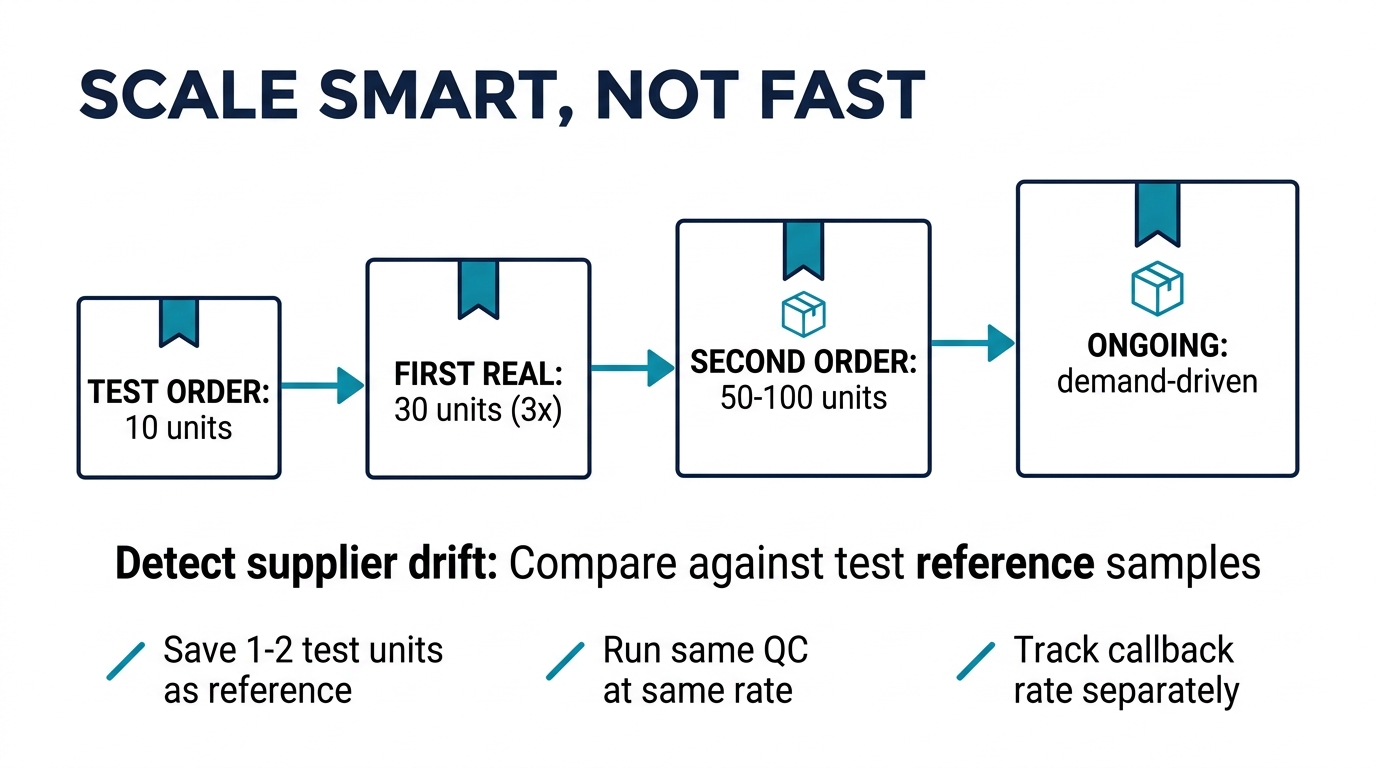
Your first real order after test order validation is a controlled expansion, not a leap of faith. The 3x rule gives you enough volume to improve pricing and test consistency, while keeping your exposure manageable if something changes.
The suppliers who are worth scaling with will understand this approach — because they've seen what happens when a buyer orders 200 units on their second order and then disappears after a bad batch. Smart scaling benefits both sides: you build confidence, they build a recurring customer.
Ready to scale from your test order? PRSPARES provides volume-based pricing tiers with no long-term commitments — scale at your pace with transparent grade documentation at every order size. Get your first bulk order quote.
Related reading: How to Use a Test Order to Evaluate a Phone Parts Supplier | MOQ, Sample Orders, and Lead Time for Wholesale Phone Parts