
If you run an independent phone repair shop, you already know the feeling: some weeks the register barely stops, others you're staring at an empty bench wondering where the customers went.
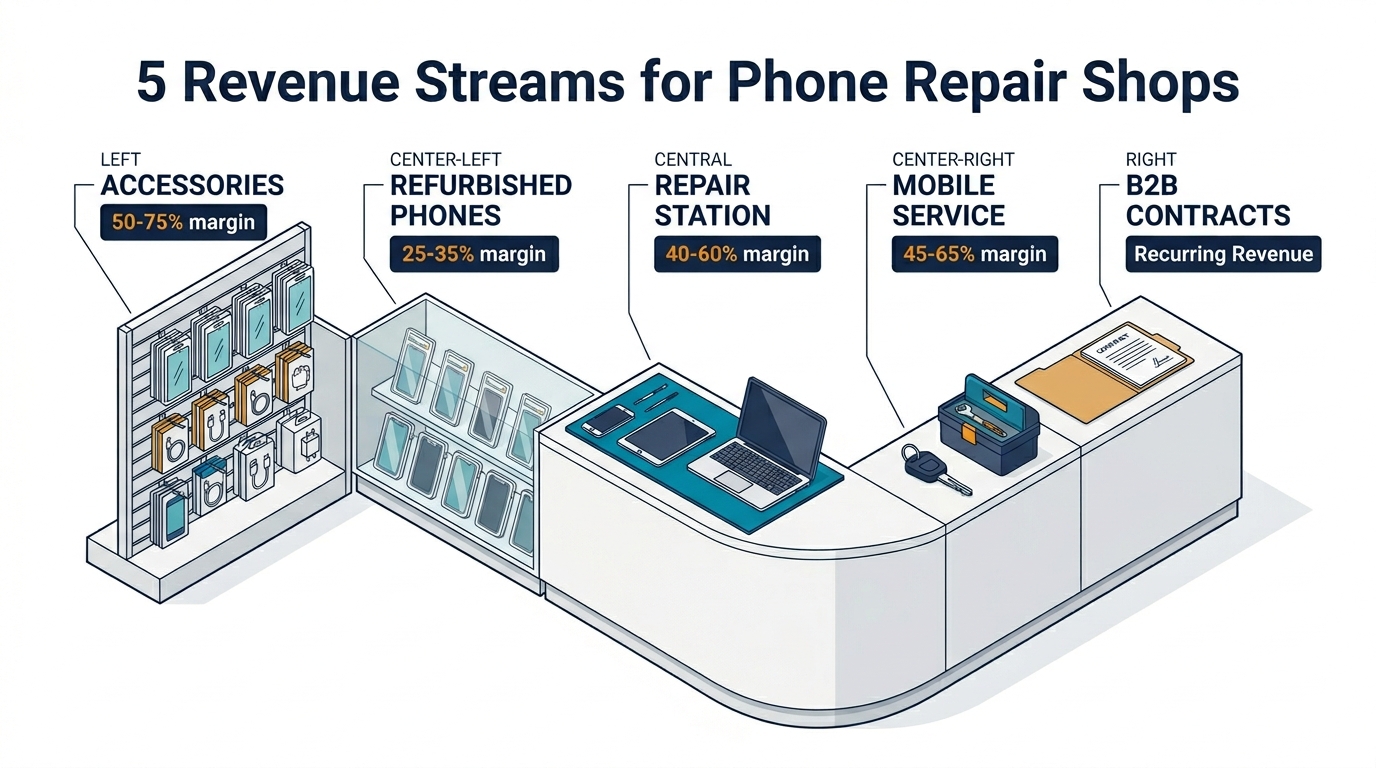
You're not alone. The five best additional revenue streams for phone repair shops in 2026 are: (1) accessories retail, (2) refurbished phone resale, (3) iPad, MacBook, and tablet repair, (4) on-site mobile repair service, and (5) enterprise B2B maintenance contracts. Each one addresses a different gap in your business — from daily cash flow to long-term recurring income.
This guide breaks down the real economics, startup costs, and honest risks for each stream — drawing on industry data, wholesale market reports, and firsthand accounts from repair shop owners on r/mobilerepair.
Why Phone Repairs Alone Aren't Enough in 2026
The US cell phone repair industry is worth roughly $4 billion, and growth has slowed to under 1% annually. That's a mature market — not a dying one, but one where standing still means falling behind.
Here's what's squeezing repair-only shops:
- Carrier trade-in programs are pulling customers away from third-party repair. Why fix a cracked screen when T-Mobile offers $800 toward a new phone?
- Improved phone durability — Ceramic Shield glass, Gorilla Glass Armor, and IP68 ratings mean fewer broken screens per capita.
- Insurance dominance — Asurion and Assurant funnel repair volume to franchise networks like uBreakiFix and CPR, leaving independents fighting for the rest.
One 18-year shop owner on r/mobilerepair put it bluntly: customer volume dropped from 25–30 per day in 2016 to just 12–15 (source).
The average independent shop still pulls $24,000/month — but that number hides a brutal spread. Well-established shops clear $50,000+/month, while struggling ones barely cover rent. The difference? Almost always diversification.
As r/mobilerepair moderator u/thephonegod advises: "You need at least four things that can fully pay the bills. If you're a single operator, you build them one at a time as the business grows, so they all develop together and can sustain you if one fails."
Need Wholesale Phone Repair Parts?
Factory-direct pricing from Shenzhen — OEM-quality screens, batteries & small parts.
Get Wholesale QuoteRevenue Stream #1: Accessories Retail — Low Investment, Immediate Return

Startup cost: $500–$2,000
Gross margin: 50–75% (100–300% markup on cost)
Time to revenue: Immediate
Best for: Any shop with foot traffic
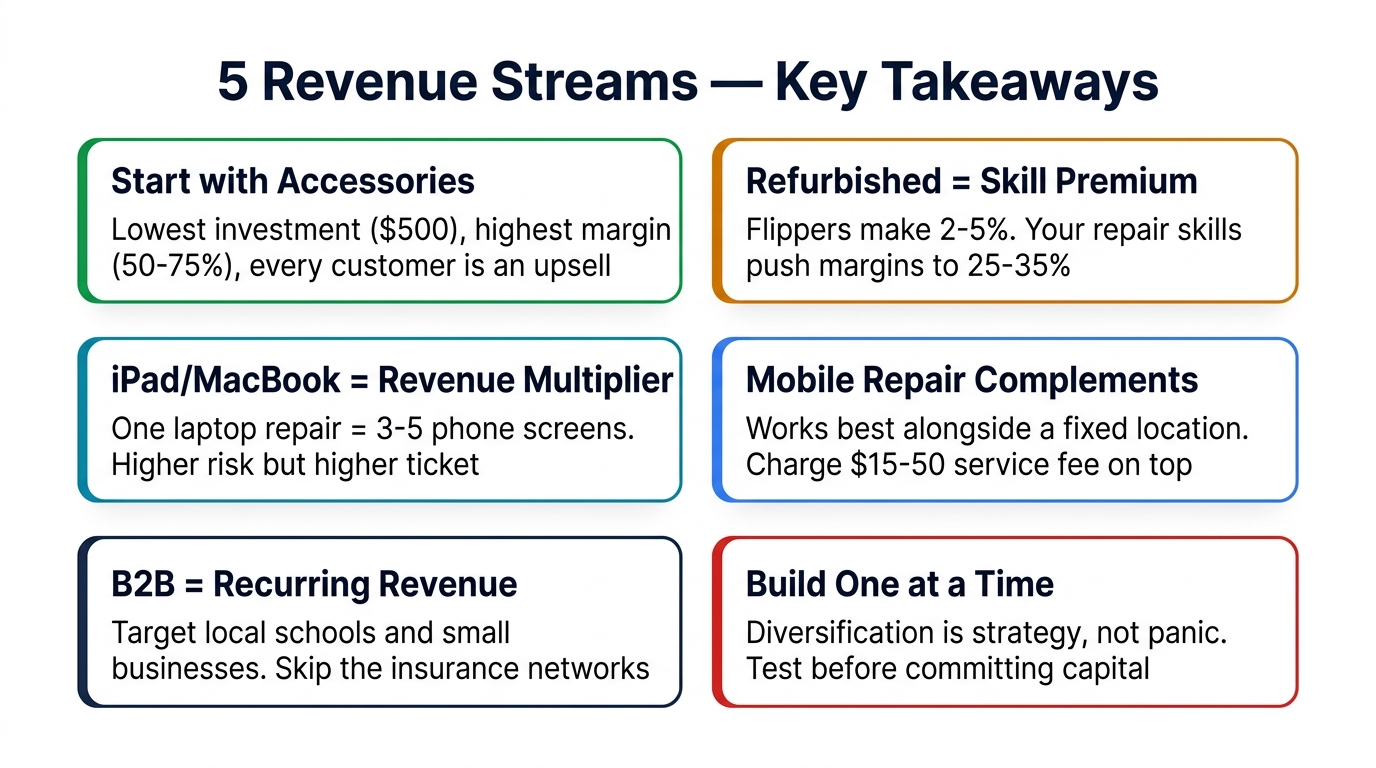
Every screen repair is an upsell opportunity. The customer is already standing at your counter with a freshly fixed phone — a tempered glass protector and a case are the easiest add-on sale in retail.
The global mobile phone accessories market hit $96.5 billion in 2024 and is projected to reach $160.6 billion by 2033, growing at 7.1% CAGR. Critically, offline retail still accounts for roughly 70% of accessories purchases — customers prefer to see and touch cases before buying.
What to stock first
Screen protectors are the anchor product. They're cheap to source (often under $1 wholesale for tempered glass), sell for $10–$30 installed, and every single repair customer needs one. One shop owner on Reddit reported screen protector machines could generate $1,000/day with consistent upselling.
After protectors, add fast chargers, Lightning/USB-C cables, and MagSafe accessories. These move at lower volume but carry similar margins.
The honest risk
Don't over-invest in phone cases. As one repair tech put it: "I don't mess with cases because everyone is so picky and you can't beat Amazon" (source). Cases are commoditized online — customers want a specific brand, color, and style, and Amazon delivers it cheaper. Focus on impulse-buy items customers want right now: protectors, chargers, and cables.
Accessories are also not recession-proof. When the broader economy squeezes consumers, accessory sales drop alongside repairs. Keep inventory lean and rotate stock based on what actually sells.
Where to source: Suppliers like We Accessory, NEM USA, and CoEven offer factory-direct pricing on screen protectors and accessories. If you're already ordering repair parts from a wholesale supplier, ask about bundling accessories with part orders to simplify your supply chain and reduce shipping costs.
Revenue Stream #2: Refurbished Phone Resale — Higher Risk, Higher Reward
Startup cost: $5,000–$15,000 (initial inventory)
Gross margin: 25–35% (with proper grading and light repair)
Time to revenue: 2–4 weeks
Best for: Shops with repair skills and space for inventory
The global used and refurbished phone market is massive — industry estimates put annual shipments in the hundreds of millions of units, and the segment has consistently outgrown new phone sales in recent years. Repair shops have a structural advantage here: you already have the skills and tools to diagnose, repair, and grade devices.
The margin ladder
Not all resale is created equal:
| Business Model | Typical Gross Margin | Source |
|---|---|---|
| Phone flippers (buy/sell, no repair) | 2–5% | WeSellCellular |
| Value-added resellers (testing, regrading) | 10–15% | WeSellCellular |
| Quality refurbishers (repair + proper grading) | 25–35% | Machash |
The takeaway: your repair skills are the margin. Flipping without adding value is a race to the bottom. But if you can buy a cosmetically damaged iPhone, replace the screen, test every function, and grade it properly, you're operating at 25–35% — often double the margin of selling new phones wholesale.
The honest risk
Hidden costs eat margins fast. As one experienced reseller warned: "You can end up with more time and money in repairs than it's actually worth as far as resale value. You have to be careful about how much you're offering" (source).
Watch out for:
- iCloud locks and blacklisted IMEIs — unsellable inventory
- Battery degradation requiring replacement before you can sell
- 90-day warranty obligations — budget for returns
- Testing tool costs — services like PhoneCheck or NSYS Tools add overhead but prevent selling faulty devices
Start small: buy 10–20 devices from a reliable wholesale source (TGWireless, BulkUsedPhones, or local trade-ins), refurbish, sell locally, and reinvest. Don't commit $15K to inventory until you've proven the model.
Tip: The quality of replacement screens directly impacts resale value and return rates. When sourcing parts for refurbished inventory, prioritize suppliers with clear grading systems (OEM, premium aftermarket, budget) so you can match part cost to device resale price.
Revenue Stream #3: iPad, MacBook & Tablet Repair — Higher Ticket, Lower Volume

Startup cost: $2,000–$5,000 (tools + initial parts)
Gross margin: 40–60%
Time to revenue: 1–2 weeks (if you already have repair skills)
Best for: Technically skilled shops looking to increase average ticket value
The single most impactful change a phone repair shop can make is adding tablet and laptop repair. The numbers tell the story:
| Service | Typical Price | vs. Phone Repair ($50–$150) |
|---|---|---|
| iPad screen replacement | $109–$369 | 2–3x higher |
| iPad water damage repair | ~$150 | Comparable but fewer parts needed |
| MacBook logic board repair (third-party) | $200–$625 (vs. $1,200+ at Apple) | 2–6x higher |
| MacBook hard drive replacement | ~$80/hr labor | Higher hourly rate |
Even at third-party pricing, a single MacBook board repair at $400–$500 is worth three to five phone screen replacements. Do two or three tablet/laptop repairs per week and the impact on monthly revenue adds up fast.
Why 2026 is the right time
The convergence of Right to Repair legislation and Apple's expanding programs is making parts access easier than ever:
- 25%+ of Americans now live in states with enforceable Right to Repair laws, with more states adding legislation for products sold after July 2026
- Apple Self-Service Repair has expanded dramatically since 2022, adding iPad support in May 2025 and broadening the Genuine Parts Distributor program
- Manufacturer repairability is trending up: Motorola earned a B+ grade in the 2026 PIRG Failing the Fix report, though Apple and Samsung still lag at D- and D respectively
The honest risk
iPad and MacBook repair requires more specialized tools (hot air stations, microscopes for board-level work) and carries higher parts cost per job. A failed repair on a $500 MacBook logic board job is a much bigger loss than a botched $80 phone screen. Start with simpler services — iPad screen and battery replacements — before investing in microsoldering equipment.
Parts tip: High-ticket repairs demand reliable parts. A bad aftermarket iPad screen that delaminates in two weeks will cost you the customer and a warranty replacement. Source from suppliers with clear quality grading — OEM-equivalent or refurbished OEM — and test every part before installation.
Revenue Stream #4: On-Site Mobile Repair — Capture Customers Who Won't Come to You
Startup cost: $500 (mobile kit) to $10,000–$30,000 (van conversion)
Gross margin: 45–65% (standard repair margin + $15–$50 service fee)
Time to revenue: Immediate (with a car and a toolkit)
Best for: Solo operators or shops looking to expand geographic reach
Not every customer will drive to your shop. On-site mobile repair captures the segment that values convenience over price — and they'll pay a premium for it.
The model is simple: charge your standard repair price plus a $15–$50 service call fee. A $100 screen replacement becomes $130–$150 at the customer's home or office. You're earning more per repair while reaching customers outside your normal radius.
How to start lean
You don't need a $30,000 branded van on day one. Start with:
- A reliable car and a portable repair mat
- Your existing tool kit + a small parts inventory for the top 5 most-requested repairs
- Google Business Profile listing with "mobile repair" in the service area
- Online booking (even a simple Google Form works initially)
Scale to a dedicated vehicle only after you've proven demand in your area.
The honest risk
The biggest challenge with mobile repair is inconsistency. The original poster in our anchor Reddit thread said it directly: "My biggest issue is inconsistency. Some weeks are great, others are dead" (source).
Without a physical storefront driving walk-in traffic and impulse accessory purchases, revenue smoothing is harder. Mobile repair works best as a complement to a fixed location — not a replacement. Also factor in non-billable driving time, fuel costs, and commercial vehicle insurance if you go the van route.
Some jurisdictions require a mobile merchant license for selling goods/services from a vehicle (Chicago, for example, requires a specific mobile merchant license). Check your local requirements before launching.
Revenue Stream #5: Enterprise B2B Contracts — Recurring Revenue, But Not Easy to Get
Startup cost: Low (mostly marketing and relationship-building)
Gross margin: Variable — volume-based pricing
Time to revenue: 1–3 months (contract negotiation cycle)
Best for: Established shops with professional operations and data-security awareness
Over 95% of organizations now allow employees to use personal devices for work. When those devices break, someone has to fix them — and most companies don't have in-house repair capabilities. That's the opening for independent repair shops: schools need Chromebook and iPad fleet maintenance, healthcare facilities need ruggedized tablet repairs, and retail chains need POS device support.
B2B contracts provide what every repair shop owner craves: predictable, recurring income. Instead of waiting for walk-ins, you have a monthly commitment from a school district, healthcare provider, or retail chain.
What B2B repair looks like
- No monthly fees for the client — they pay per repair completed (Gophermods model)
- Volume pricing with SLAs (service level agreements) — e.g., 24-hour turnaround for employee devices
- Key verticals: K-12 schools (Chromebook/iPad fleets), healthcare (ruggedized tablets), retail chains (POS devices), field workforce companies
- Data security compliance is mandatory — enterprise clients in healthcare and finance require documented device handling procedures
How to land your first contract
Most advice about B2B repair focuses on joining Asurion or Assurant networks. The reality for independents: "We tried reaching out to Asurion, but with UBreakIFix in the neighborhood, there's no chance" (source).
Instead of chasing insurance gatekeepers, go direct:
- Target local schools and small businesses — they don't have Asurion contracts and need affordable repair options
- Create a simple one-page proposal covering: per-device repair pricing, turnaround time SLA, data handling policy, and warranty terms
- Offer a pilot program — repair 10 devices at a discount to prove reliability, then negotiate a standing contract
- Leverage existing relationships — if teachers or office managers are already your walk-in customers, ask if their organization needs device repair support
The honest risk
A veteran who's done B2B work for hundreds of shops offered a stark warning: the entire industry is in a "race to the bottom" when it comes to pricing (source). B2B contracts can lock you into low per-device rates that don't account for parts cost increases or complex repairs.
Also be honest about what you're competing with: franchise networks have scale, standardized processes, and insurance relationships that independents can't easily match. B2B works best when you target the local clients that big networks don't bother with — the 50-device school, the 20-person dental practice, the regional retail chain with 5 locations.
Which Revenue Stream Should You Add First?

Not every stream fits every shop. Here's a decision framework:
If you have foot traffic but tight cash → Start with accessories. Lowest investment, immediate return, no new skills needed.
If you have repair skills and $5K+ capital → Add refurbished phone resale. Your existing skills are the margin advantage.
If you want higher-ticket repairs → Expand into iPad/MacBook repair. One laptop repair can match three to five phone screens in revenue.
If you're a solo operator without a storefront → Build a mobile repair service. Your flexibility is your competitive edge.
If you have professional operations and local business connections → Pursue B2B contracts. Recurring revenue smooths out the feast-or-famine cycle.
The moderator advice holds: build one stream at a time. Don't try to launch all five simultaneously — as one commenter warned, "Others branch out into closure/bankruptcy. Be careful" (source).
Other phone repair shop revenue streams worth considering: mail-in repair (expands your service area without a van), trade-in/buyback programs (feeds your refurbished inventory pipeline), loyalty memberships (monthly fee for discounted repairs creates recurring revenue), and microsoldering referral partnerships with other local shops. These five streams aren't the only options — they're the ones with the strongest economics and broadest applicability in 2026.
Startup Cost Comparison at a Glance
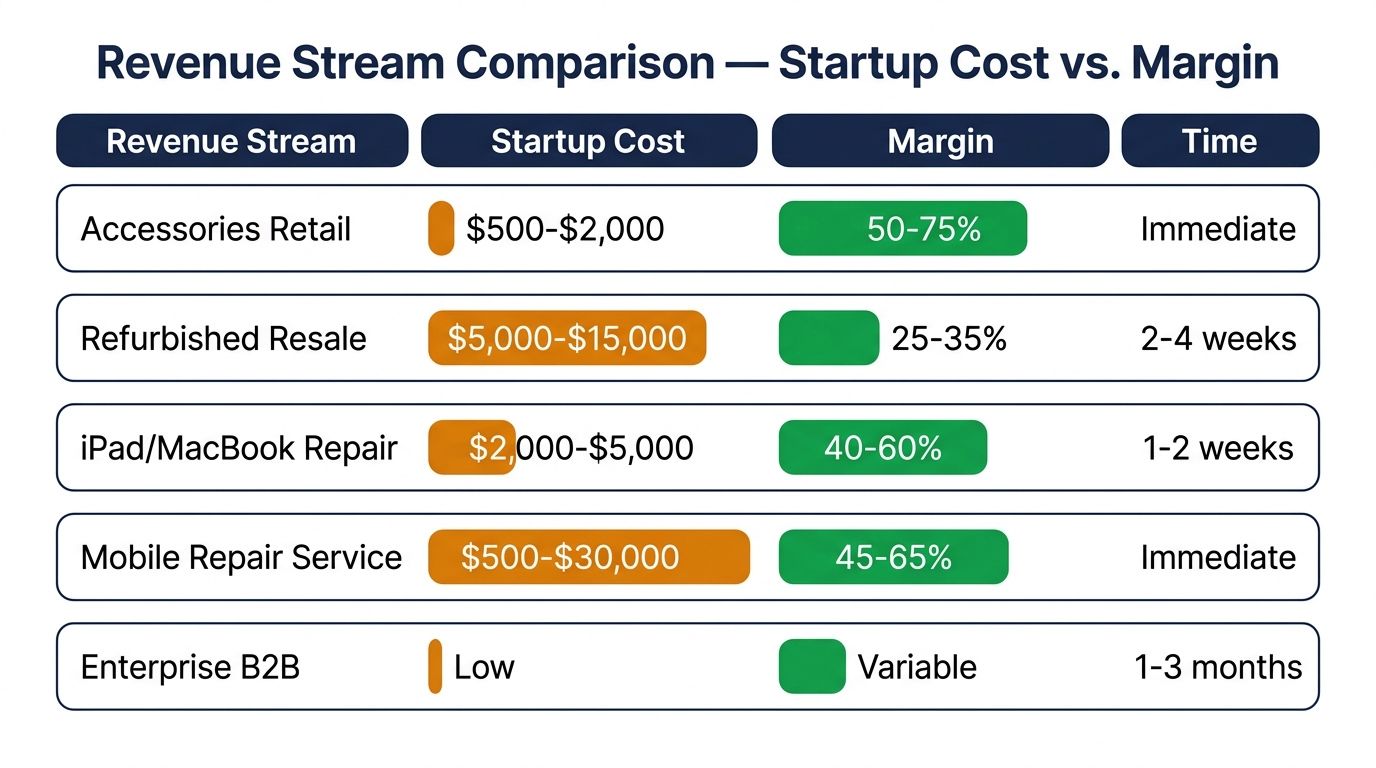
| Revenue Stream | Startup Investment | Gross Margin | Revenue Timing | Skill Requirement |
|---|---|---|---|---|
| Accessories retail | $500–$2,000 | 50–75% | Immediate | Low |
| Refurbished resale | $5,000–$15,000 | 25–35% | 2–4 weeks | Medium |
| iPad/MacBook repair | $2,000–$5,000 | 40–60% | 1–2 weeks | High |
| On-site mobile repair | $500–$30,000 | 45–65% | Immediate | Medium |
| Enterprise B2B | Low (marketing) | Variable | 1–3 months | Medium (+ business dev) |
The Honest Truth: This Won't Save a Broken Business
Diversification is not a magic bullet. If your core repair business is fundamentally broken — bad location, no marketing, poor customer service — adding revenue streams won't fix it.
The repair industry is contracting. Phones are getting more durable. Trade-in programs are pulling volume away from independent shops. A 15-year veteran told r/mobilerepair to "diversify what they offer" — but another 17-year veteran's advice was simply "get out while you can."
The shops that thrive in 2026 share common traits: they treat diversification as a deliberate strategy (not a panic move), they test one stream at a time, and they're honest about what their local market actually supports.
One mall shop owner summed it up: "Even then I couldn't survive if I wasn't selling accessories... I am planning to implement mobile repair service soon to see if I can increase my revenue" (source). That's the right mindset — pragmatic, iterative, and realistic.
Frequently Asked Questions
How much does a cell phone repair shop make per month?
The average independent shop earns roughly $24,000/month (~$288K/year). Well-established multi-service shops can clear $50,000+/month. Profit margins on individual repairs range from 20% to 90% depending on the service type, with screen repairs typically around 50%.
Is a phone repair business profitable in 2026?
Yes, but increasingly dependent on diversification. The US market (~$4B) is growing at under 1% annually. Shops that rely solely on screen and battery repairs face declining volume from trade-in programs and improved phone durability. Adding accessories, refurbished resale, or higher-ticket repairs is how profitable shops are staying profitable.
What are the most profitable phone repairs?
By margin: screen protector installation (near-zero cost, $10–$30 charge), software troubleshooting (labor only), and microsoldering/data recovery. By ticket size: MacBook logic board repair ($200–$625 at third-party shops), iPad screen replacement ($109–$369), and water damage diagnostics.
What accessories should a phone repair shop sell?
Start with tempered glass screen protectors (highest margin, every customer needs one). Then add fast chargers, USB-C/Lightning cables, and MagSafe accessories. Avoid over-investing in phone cases — Amazon dominates that market. Stock what customers want right now at point of sale.
How do I start a refurbished phone business?
Start small: buy 10–20 used devices from a reliable wholesale source (trade-ins, TGWireless, or BulkUsedPhones), test and repair them using your existing skills, grade properly, and sell locally (Facebook Marketplace, Swappa, or in-store). Reinvest profits before scaling inventory. Budget for a testing tool like PhoneCheck to avoid selling faulty devices.
How much does it cost to start a cell phone repair business?
A basic phone repair operation costs $15,500–$72,500+ depending on location type (home, kiosk, retail), tool investment, and initial parts inventory. Adding revenue streams increases startup cost but reduces long-term risk.
How can I get B2B repair contracts?
Skip the insurance networks (Asurion/Assurant heavily favor franchises). Instead, approach local schools, dental practices, and small businesses directly. Create a one-page proposal with per-device pricing and turnaround SLA. Offer a pilot program to prove reliability, then negotiate a standing contract.
Running a repair shop and looking for reliable wholesale parts to support your expanded service lines? PRSPARES supplies quality-graded screens, batteries, and accessories for phones, iPads, and tablets — with wholesale pricing for independent shops. Get a quote →