
How Repair Shops Should Stock iPhone Batteries by Model in 2026

Most repair shops stock iPhone batteries the wrong way. They either order the same quantity across every model — and end up sitting on iPhone 8 batteries for months — or they only restock what ran out last week, constantly scrambling when a customer walks in with an iPhone 12. If you're buying iPhone battery wholesale without a model-by-model plan, you're leaving money on the table.
Battery replacements are one of the highest-margin, lowest-risk repairs you can offer. The parts cost between $3 and $12 at wholesale depending on model and grade, and customers rarely question the price. But that margin disappears fast when you're paying express shipping because you ran out of iPhone 11 batteries mid-week, or writing off dead stock from models nobody brings in anymore.
The fix is straightforward: stock based on actual demand patterns, not gut feeling. This guide breaks down exactly which iPhone battery models to keep on hand in 2026, how many to order, and how to adjust your inventory based on your shop size and market. Whether you run a two-person repair counter or a mid-size operation doing 30+ battery swaps a week, the logic is the same — only the quantities change.
Buying Phone Batteries Wholesale?
OEM-cell batteries with safety packaging — iPhone, Samsung & more, factory-direct.
Get Wholesale QuoteWhy Battery Stocking Decisions Matter More Than You Think
Battery replacements account for roughly 25-35% of all iPhone repairs at most independent shops. Unlike screen replacements, battery swaps are fast — a skilled tech can do one in 15-20 minutes — so your throughput is limited more by parts availability than labor.
Here's what poor battery stocking actually costs:
- Lost revenue from stockouts. A customer who walks in for a battery swap and hears "we need to order it, come back Thursday" has about a 40% chance of going to the shop down the street instead.
- Dead capital in slow models. Twenty iPhone SE (2nd gen) batteries sitting in a drawer for six months is $60-80 tied up doing nothing. Scale that across 4-5 slow models and you've got $300+ in dead inventory.
- Express shipping premiums. Ordering 5 batteries via air freight because you ran out costs 3-5x more per unit than including them in a regular bulk shipment.
The goal isn't to stock every model. It's to match your inventory depth to your actual demand curve — heavy on the models that walk through your door every day, light on the ones that show up twice a month.
The 2026 iPhone Battery Demand Map
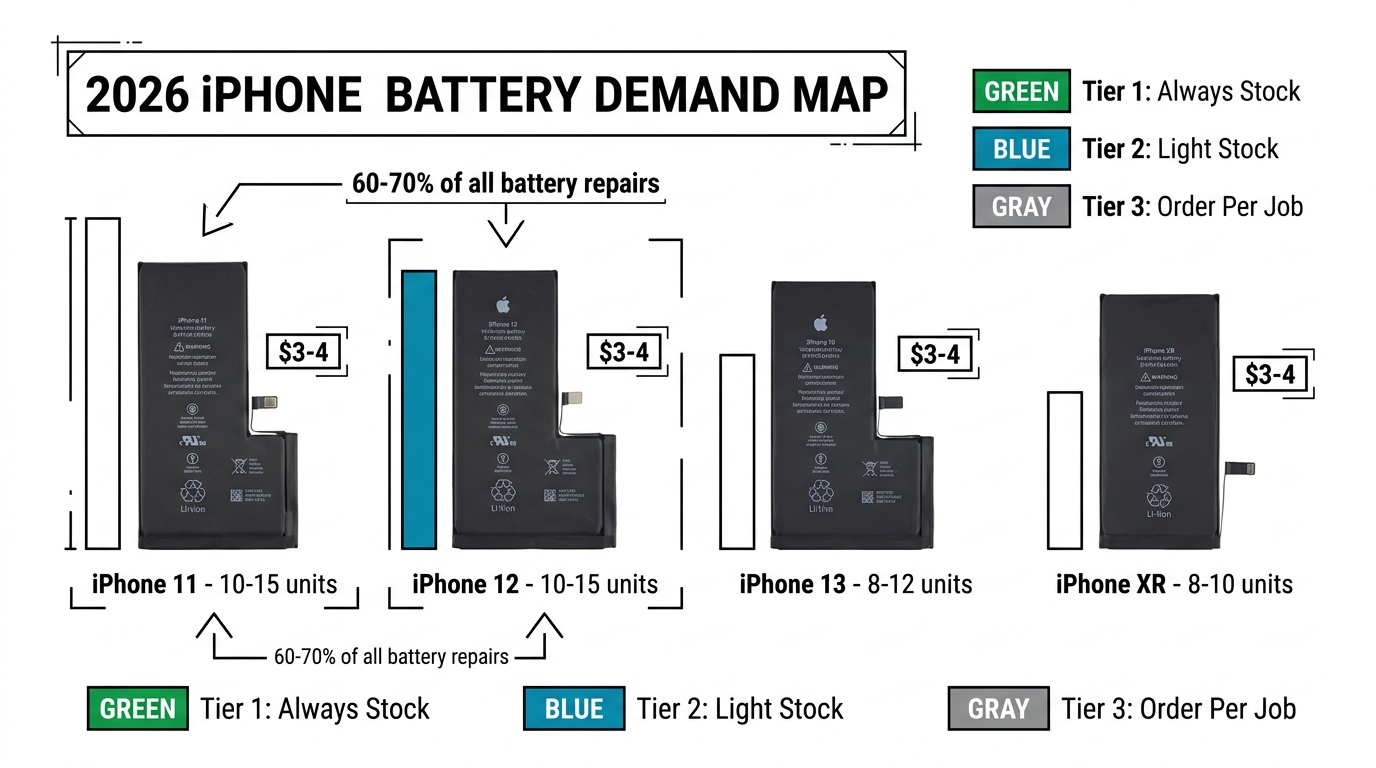
Not all iPhone models generate equal battery replacement demand. Three factors determine which batteries you'll need most:
- Installed base — how many of that model are still actively used in your market
- Battery age — older batteries degrade more, driving replacement demand
- Repair economics — whether the phone is still worth repairing vs. upgrading
Based on current market patterns across repair shops in the UK, Africa, Southeast Asia, and Latin America, here's how iPhone battery demand breaks down in 2026:
Tier 1: Always Stock (High Demand, High Turnover)
| Model | Why High Demand | Suggested Stock (Small Shop) | Suggested Stock (Mid-Size Shop) |
|---|---|---|---|
| iPhone 11 | Massive installed base globally, 6+ year old batteries failing fast | 10-15 units | 30-50 units |
| iPhone 12 / 12 Pro | Peak-era iPhone, heavy usage, batteries hitting 3-4 year degradation | 10-15 units | 25-40 units |
| iPhone 13 / 13 Pro | Still the most common model in many markets, early battery aging starting | 8-12 units | 20-35 units |
| iPhone XR | Budget-friendly iPhone with huge global adoption, batteries well past prime | 8-10 units | 20-30 units |
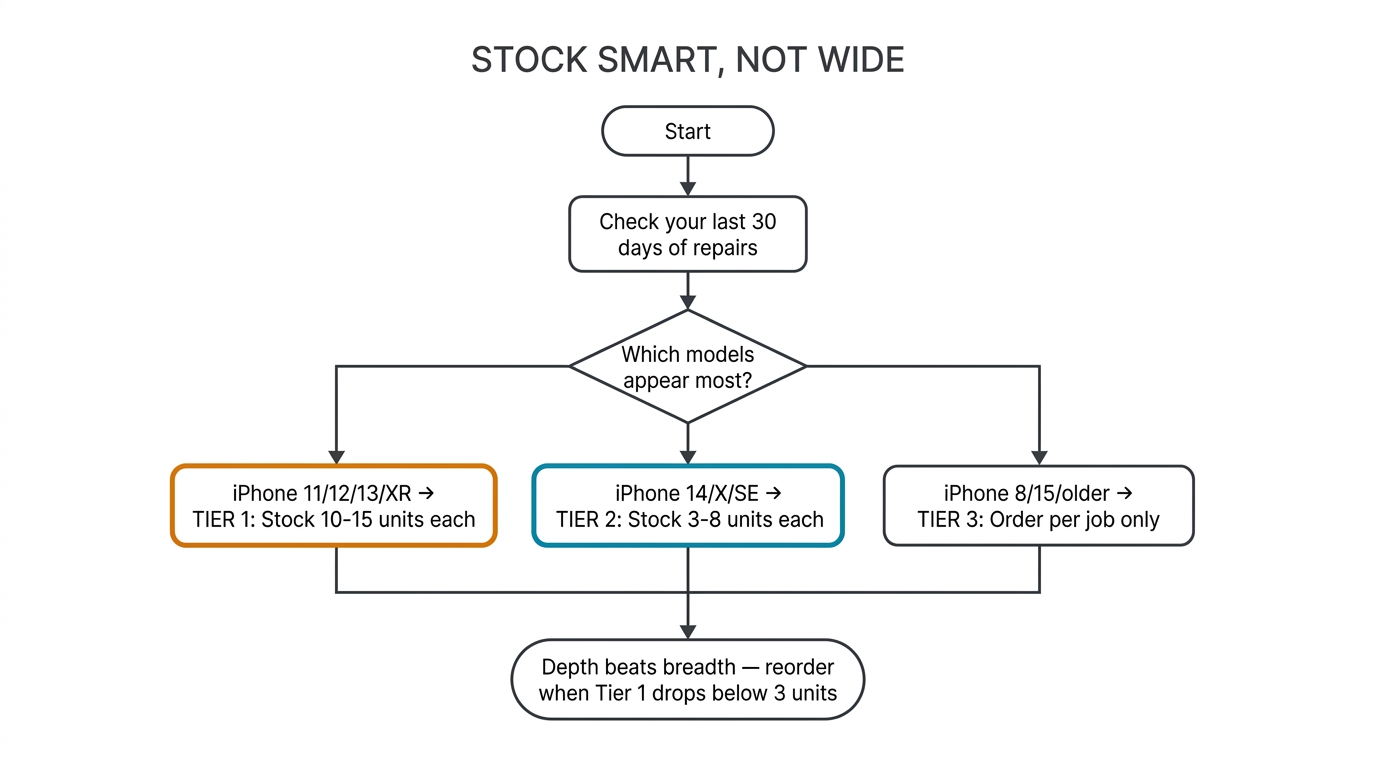
These four model groups will account for 60-70% of your battery replacement jobs in most markets. Never let these run to zero. Set a reorder point — when stock hits 3 units (small shop) or 8 units (mid-size), place your next order.
Tier 2: Light Stock (Moderate Demand, Steady)
| Model | Why Moderate Demand | Suggested Stock (Small Shop) | Suggested Stock (Mid-Size Shop) |
|---|---|---|---|
| iPhone 14 / 14 Pro | Growing repair demand as warranties expire, but many users still under AppleCare | 5-8 units | 10-20 units |
| iPhone X / XS / XS Max | Still circulating in price-sensitive markets, batteries severely degraded | 5-8 units | 10-15 units |
| iPhone SE (2nd/3rd gen) | Popular in business and budget segments, smaller battery degrades quickly | 3-5 units | 8-12 units |
Tier 2 models bring consistent but lower volume. Stock enough to cover 2-3 weeks of demand. You'll rarely run out if you include them in your regular monthly orders.
Tier 3: Order Per Job (Low or Declining Demand)
| Model | Why Low Demand | Approach |
|---|---|---|
| iPhone 8 / 8 Plus | Rapidly declining installed base, most have been retired or recycled | Order when a customer requests, or keep 2-3 units max |
| iPhone 15 / 15 Pro | Too new for significant battery degradation — most are still under warranty | Keep 2-3 units for accidental damage or heavy users |
| iPhone 16 series | Brand new, zero battery replacement demand outside rare defects | Don't stock — order if needed |
| iPhone 7 / 7 Plus | Nearly extinct in most markets | Order per job only |
| iPhone 6S and older | Economically not worth repairing in most cases | Don't stock |
The key mistake repair shops make with Tier 3 is stocking "just in case." Two or three units of each is fine as safety stock. Beyond that, you're tying up capital that should be in Tier 1 batteries.
Small Shop vs Mid-Size Shop: Different Stocking Strategies
Your shop size changes not just the quantities, but the entire procurement approach.
Small Shop (5-15 Battery Replacements per Week)
- Total battery inventory: 40-60 units across all models
- Order frequency: Monthly, sometimes bi-monthly
- Strategy: Concentrate 70% of inventory in Tier 1 models. For Tier 2, keep minimum viable stock (3-5 each). Skip Tier 3 entirely or keep 1-2 of the most common.
- Reorder trigger: When any Tier 1 model drops below 3 units
For small shops, the biggest risk is over-diversifying. It's tempting to stock every model "just in case," but that spreads your limited budget too thin. A small shop with 5 units each of 12 models (60 total) will run out of iPhone 11 batteries while sitting on untouched iPhone 8 stock.
Better approach: 15 units of iPhone 11/12, 10 units of iPhone 13, 8 units of iPhone XR, and 5-8 units split across Tier 2. That's the same 60 units, but aligned to actual demand.
Mid-Size Shop (20-40+ Battery Replacements per Week)
- Total battery inventory: 120-200 units across all models
- Order frequency: Every 2-3 weeks, or set up a recurring monthly order
- Strategy: Full Tier 1 coverage with buffer stock. Tier 2 at comfortable levels. Tier 3 at 2-5 units for common requests.
- Reorder trigger: When any Tier 1 model drops below 8 units, or when total inventory falls below 60% of target
Mid-size shops benefit from volume pricing. When you're ordering 100+ batteries per shipment, you should be negotiating a volume discount — typically 5-10% off list price for orders above 100 units, and 10-15% for 200+. If your supplier doesn't offer volume tiers, you're overpaying. (How to choose battery quality covers what to look for at each price point.)
How to Adjust Your Stocking Plan by Market
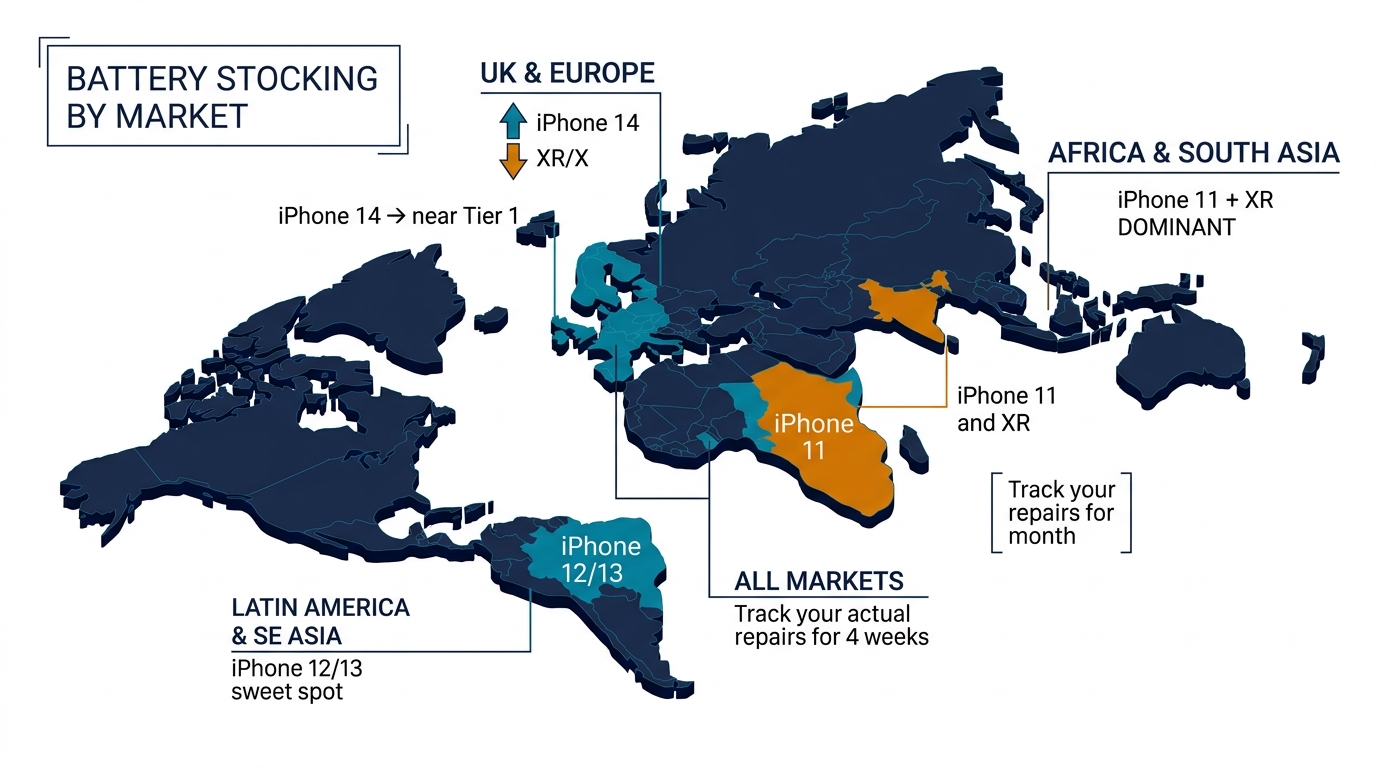
Demand patterns shift depending on where your customers are. The Tier 1/2/3 framework above is a global baseline — here's how to adjust it:
UK and Western Europe
- iPhone 14 moves up to near-Tier 1 status — UK customers upgrade faster, and iPhone 14 warranty expirations are driving a wave of battery demand right now
- iPhone XR/X may drop slightly — fewer older iPhones in active circulation compared to emerging markets
- SE demand is steady because of corporate/enterprise users
Africa, Middle East, and South Asia
- iPhone 11 and XR are dominant — these are the most common iPhones in these markets, and battery demand is extremely high
- iPhone 8 may stay relevant longer — budget market keeps older models in circulation
- iPhone 14/15 demand is lower — fewer units sold at launch in these regions
Latin America and Southeast Asia
- iPhone 12/13 are the sweet spot — mid-range pricing drove heavy adoption 2-3 years ago
- iPhone 11 remains a major player, especially refurbished units entering the market
- iPhone SE has stronger demand in Southeast Asia due to price sensitivity
The adjustment is simple: look at what walks through your door. Track your actual repairs by model for 4 weeks. If iPhone XR shows up more than iPhone 13 in your shop, stock accordingly — no guide can replace your own data.
Battery Quality Grades: What to Stock at Each Tier
Not every battery needs to be the same grade. Smart stocking means matching quality to the repair context. For a detailed breakdown of battery grades and testing, see our guide on what to check before buying iPhone batteries in bulk.
For Tier 1 Models (iPhone 11, 12, 13, XR)
Stock standard replacement grade (Ti-grade or equivalent) as your bread-and-butter. These deliver 95-98% of original capacity at the best margin. Keep a smaller quantity of premium grade (original-capacity or high-capacity cells) for customers willing to pay more.
A typical split: 80% standard grade, 20% premium grade.
For Tier 2 Models (iPhone 14, X/XS, SE)
Standard grade is sufficient for most jobs. Premium grade is worth stocking for iPhone 14 specifically — customers with newer phones expect higher quality and are willing to pay for it.
For Tier 3 Models (iPhone 8, 15, older)
Standard grade only. Customers replacing batteries in old phones are price-sensitive. Customers with iPhone 15 under warranty aren't coming to you anyway — and the few who do are likely insurance or accidental damage cases where standard grade is fine.
Putting It Together: A Sample First Order
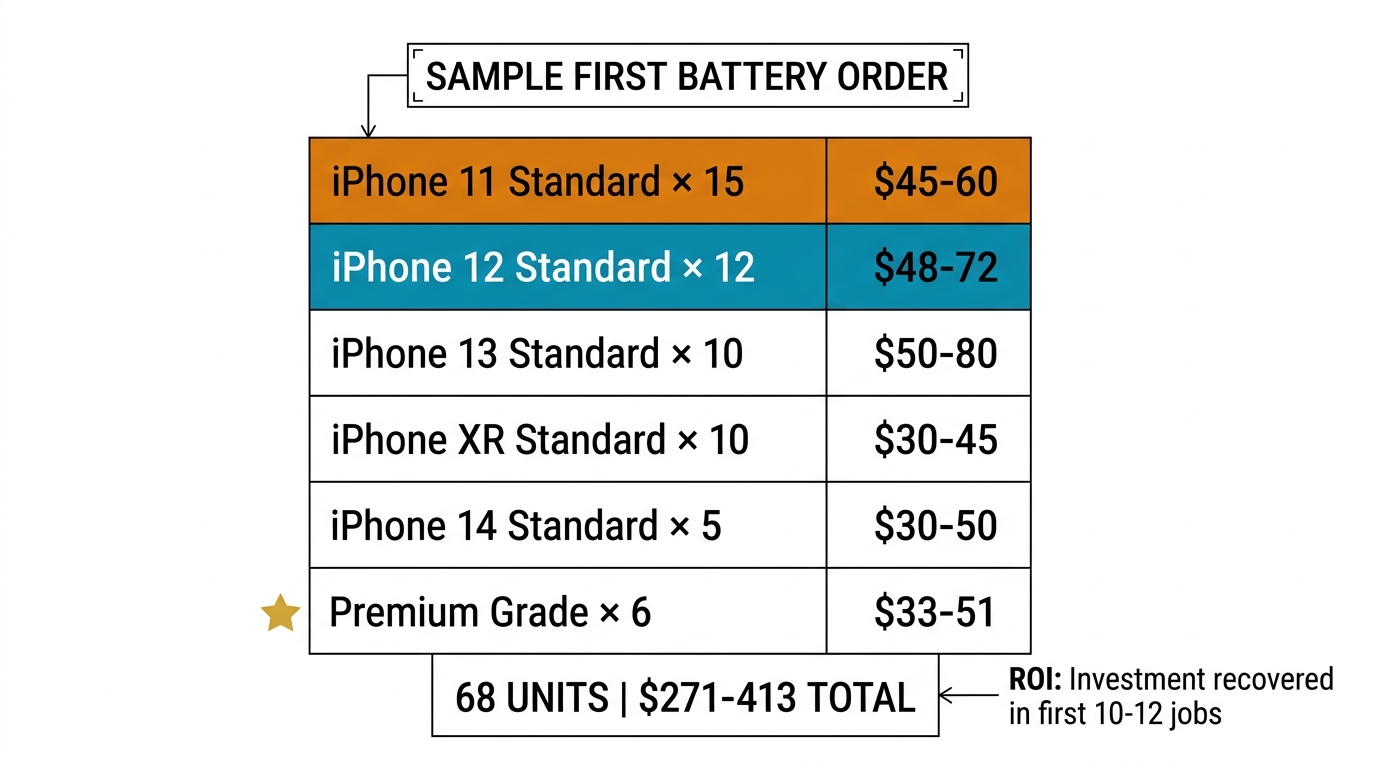
If you're setting up your battery inventory from scratch or resetting after poor stocking decisions, here's a practical starting order for a small repair shop:
| Model | Grade | Quantity | Estimated Cost (USD) |
|---|---|---|---|
| iPhone 11 | Standard | 15 | $45-60 |
| iPhone 12 | Standard | 12 | $48-72 |
| iPhone 13 | Standard | 10 | $50-80 |
| iPhone XR | Standard | 10 | $30-45 |
| iPhone 14 | Standard | 5 | $30-50 |
| iPhone X/XS | Standard | 5 | $20-30 |
| iPhone SE (2nd/3rd) | Standard | 5 | $15-25 |
| iPhone 11 | Premium | 3 | $15-24 |
| iPhone 12 | Premium | 3 | $18-27 |
| Total | 68 units | $271-413 |
That's a complete battery inventory for under $400-$450 wholesale. At typical retail pricing ($35-60 per battery replacement), you'll make back the investment in the first 10-12 jobs.
For guidance on whether specific models are worth stocking batteries for at all, check our iPhone battery replacement cost breakdown — it covers the repair-vs-upgrade economics model by model.
FAQ
How often should repair shops reorder iPhone batteries?
Small shops doing 5-15 replacements per week should reorder monthly. Mid-size shops doing 20+ per week benefit from bi-weekly or recurring orders. The key is setting a reorder point — don't wait until you're out. When Tier 1 models drop below 3 units (small shop) or 8 units (mid-size), it's time to order.
Which iPhone battery models have the highest failure rate after replacement?
Battery callbacks are most common with iPhone X/XS series and iPhone 8 — these models are more sensitive to battery connector alignment. Using higher-grade batteries with proper flex cable quality reduces callback rates significantly. For more on avoiding post-replacement issues, see our guide on choosing battery quality for repair shops.
Should repair shops stock high-capacity iPhone batteries?
High-capacity (extended) batteries can be a profit driver for Tier 1 models — especially iPhone 11 and 12 where customers notice battery life improvements. Stock them in small quantities (3-5 units of your top 2 models) and price them at a $10-15 premium over standard replacements. Don't stock high-capacity versions for Tier 3 models — the demand isn't there.
Is it better to buy iPhone batteries from one supplier or multiple?
Start with one reliable supplier to build volume and negotiate better pricing. Once your monthly order exceeds 100 units, consider a secondary supplier for price comparison and supply security. Splitting small orders across 3-4 suppliers means you never hit volume discounts and spend more time managing logistics. Our guide on stocking cell phone repair parts covers supplier strategy in detail.
How long can iPhone replacement batteries be stored before they degrade?
Quality lithium-ion batteries maintain their rated capacity for 12-18 months in storage at room temperature. Avoid heat and humidity — batteries stored above 35°C (95°F) degrade faster. First-in-first-out (FIFO) rotation is essential: use the oldest stock first. If a battery has been on your shelf for over 12 months, test it before installing.
Stock Smart, Not Wide
The single biggest takeaway: depth beats breadth. Having 15 units of iPhone 11 batteries is infinitely more useful than having 3 units each of five models you rarely see.
Track your actual repairs for a month, map them against the tier system above, and build your order around what your customers actually bring in — not what you think they might bring in.
If you're planning your first battery bulk order or want to restructure your current inventory, reach out to our team for a custom stocking recommendation based on your shop size and market. We ship mixed battery orders with screens and small parts from Shenzhen: in a mixed order that includes screens, battery lines count toward the 10-piece total, while battery-only orders start at 20 pieces with models mixed freely.