

Battery replacement is one of the highest-margin, fastest-turnaround repair services an independent phone repair shop can offer. A skilled technician can complete an iPhone battery swap in 15 to 20 minutes, delivering an immediate, noticeable performance improvement for the customer. But when sourcing wholesale iPhone batteries in bulk, that healthy margin can quickly evaporate if you receive substandard cells.
On the outside, wholesale iPhone batteries look practically identical. Two batteries from different suppliers will feature the same printed capacity, the same dimensions, and similar flexible printed circuit (FPC) connectors. The real differences are concealed inside: cell chemistry purity, Protection Circuit Module (PCM) engineering, internal resistance, and how the battery controller communicates with iOS.
A poor batch of batteries leads to recurring callbacks, swollen cells, spontaneous restarts, and damaged customer trust. Sourcing replacement batteries requires understanding wholesale grades, testing protocols, model demand cycles, and inventory management before placing a bulk order.
Wholesale iPhone Battery Grades: What Repair Shops Are Actually Buying
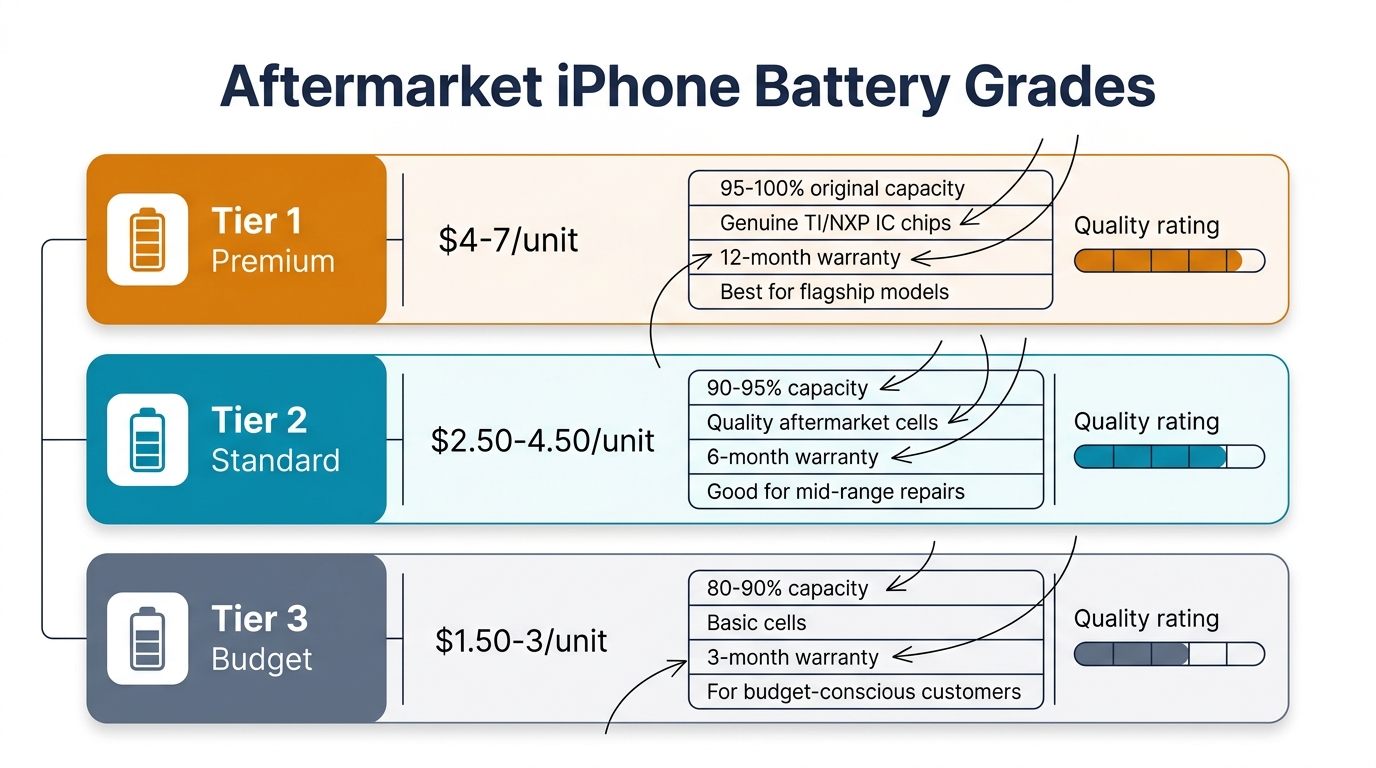
The wholesale market in Shenzhen classifies iPhone batteries into four primary quality grades. Understanding these distinctions is critical for setting warranty terms and managing customer expectations:
1. Brand-New Diagnostic Zero-Cycle Batteries
Brand-new diagnostic zero-cycle batteries represent the highest functional tier for professional workshops. These are brand-new, zero-cycle batteries engineered to run Apple diagnostics successfully. They are not salvaged disassembly units or used pulls from recycled handsets. They allow repair shops to verify battery health through diagnostic software routines, making them ideal for premium repair shops, corporate device refurbishers, and insurance repair centers.
At PRSPARES, these diagnostic batteries are backed by a dedicated 30-day warranty (eligible for return, exchange, or refund within 30 days).
2. High-Capacity Aftermarket Batteries
High-capacity aftermarket batteries carry a higher rated milliamp-hour (mAh) capacity than the original battery in the same physical dimensions. For example, an older model with an original 1,821 mAh capacity can be upgraded to roughly 2,200 mAh.
These cells are particularly popular for legacy devices (such as iPhone 8, iPhone X, and iPhone 11) where customers actively seek extended daily screen-on time. High-capacity batteries provide an excellent upsell opportunity on your service menu.
3. Standard Capacity Aftermarket Batteries
Standard capacity aftermarket batteries are the high-volume workhorse of the independent repair industry. Built with 1:1 OEM rated capacity and matching nominal voltages, they provide dependable daily cycle life at competitive wholesale pricing. When sourced from reputable manufacturers using pure cobalt chemistry and high-grade PCM boards, these cells offer stable performance with negligible return rates.
At PRSPARES, our standard aftermarket batteries are covered by a comprehensive 12-month warranty.
4. Economy / Budget Batteries (What to Avoid)
Budget batteries cut corners across every stage of manufacturing. Factories producing these low-tier cells use blended lithium manganese formulations rather than pure cobalt, recycled copper foils, and cheap single-MOSFET protection circuits. They often suffer from rapid capacity decay within 60 to 90 days, erratic percentage jumping during cold weather, and premature swelling. Saving a dollar or two on an economy battery is an expensive mistake once customer callbacks begin.
Buying Phone Batteries Wholesale?
OEM-cell batteries with safety packaging — iPhone, Samsung & more, factory-direct.
Get Wholesale QuoteMatching Battery Grades to Your Repair Shop Business Model
Different repair shop business models require different inventory grade strategies:
- Premium Repair Workshops: Focus heavily on brand-new diagnostic zero-cycle batteries and premium standard cells. Customers paying top dollar expect flawless iOS performance and verifiable diagnostic health.
- High-Volume Main Street Shops: Keep standard capacity aftermarket batteries as your core baseline, while offering high-capacity upgrades as an optional add-on for older models.
- Device Refurbishers & Resellers: Balance unit cost with diagnostic compliance. Diagnostic zero-cycle batteries allow refurbished devices to pass customer audits with zero cycle counts.
The True Cost of Cheap Batteries: The Callback Math
When evaluating wholesale battery pricing, unit cost is only one element of total landed repair cost. Consider the financial impact of a customer callback caused by a defective budget battery:
- Initial Repair: You purchase a cheap battery, charge the customer your standard repair fee, and book your margin.
- The Callback: Forty-five days later, the customer returns complaining the phone shuts down at 20% charge or experiences battery swelling.
- The Financial Fallout:
- Technician Bench Time: 20 minutes to reopen the device, clean old adhesive, and install a replacement.
- Secondary Replacement Part: Consuming another battery from stock to resolve the issue for free.
- Customer Dissatisfaction: Risk of negative Google reviews and lost lifetime referral value.
A modest saving on a cheap battery is completely wiped out by a single warranty callback. Prioritizing stable, high-grade cells is an investment in shop profitability.
The 8-Point Pre-Purchase Checklist for Bulk iPhone Batteries
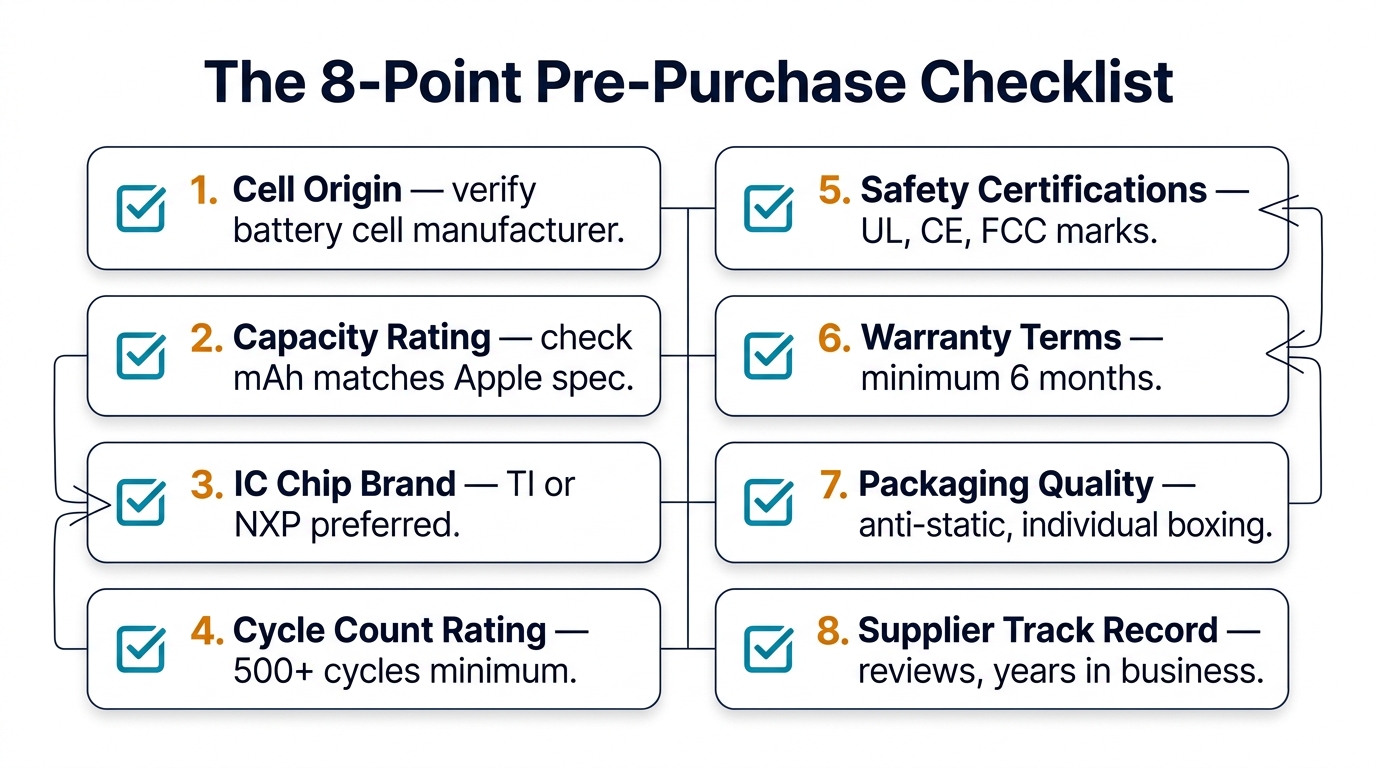
Before placing a bulk battery restock, evaluate your supplier against this 8-point technical checklist:
1. Actual Capacity vs. Labeled Capacity
Substandard manufacturers frequently print inflated capacities on battery wraps. A battery labeled 3,110 mAh may contain an interior cell with only 2,700 mAh of actual chemical capacity.
Verification: Test incoming samples using an external battery capacity analyzer. Discharge the cell from 4.2V to 3.0V at a steady 0.2C rate to confirm that measured capacity matches rated specifications.
2. Cell Chemistry and Formulation Purity
Ask the supplier which cell chemistry and cell source each battery line uses, and test a sample under load (heavy app use, fast charging) before ordering in volume. Cells that sag under load or warm up quickly on the bench will come back as customer complaints.
3. Protection Circuit Module (PCM) Quality
The PCM board sitting at the top of the battery manages over-charge, over-discharge, over-current, and short-circuit protection. High-grade PCM boards feature:
- Dual-MOSFET protection circuits for redundant cut-off safety.
- Precision gas-gauge microcontrollers that communicate accurate state-of-charge data to the phone logic board.
- Multi-layer flexible printed circuits (FPC) with reinforced copper traces that resist metal fatigue during installation bends.
4. Physical Dimensions and Adhesive Fit
Even a fraction of a millimeter variance in cell thickness can cause problems. An oversized battery presses against the back of the OLED panel, creating display pressure marks or lifting the screen frame. Inspect sample cells to verify that length, width, and thickness match factory tolerances, and verify that the connector clips securely onto the motherboard socket with a crisp tactile snap.
5. iOS Battery Health and Diagnostic Communication
On modern iPhone models, the battery controller communicates with iOS via encrypted telemetry protocols. When sourcing batteries:
- For general replacements: Verify that standard aftermarket batteries report stable percentage drops without sudden shutoffs.
- For diagnostic applications: Ensure your supplier provides brand-new, zero-cycle batteries engineered to run Apple diagnostics.
6. Incoming QC Verification on Every Batch
Professional wholesale suppliers maintain strict incoming inspection routines, verifying terminal voltage, internal resistance (mΩ), and visual packaging on every manufacturing batch. Look for suppliers who apply clear grade labels and tracking marks on every SKU.
7. Cycle Life and Warranty Terms
A quality replacement battery should maintain at least 80% of its rated capacity after 500 complete charge-discharge cycles under standard usage conditions. Verify that your supplier offers documented warranty terms:
- Standard batteries: 12-month warranty from delivery.
- Brand-new diagnostic zero-cycle batteries: 30-day warranty.
8. Batch-to-Batch Consistency
A supplier who delivers a flawless 10-piece sample order but ships variable-grade cells on a 100-piece reorder creates severe bench instability. Sourcing from structured B2B suppliers who maintain consistent factory partnerships prevents unexpected quality shifts.
Which iPhone Models Move the Most Batteries? 2026 Demand Map
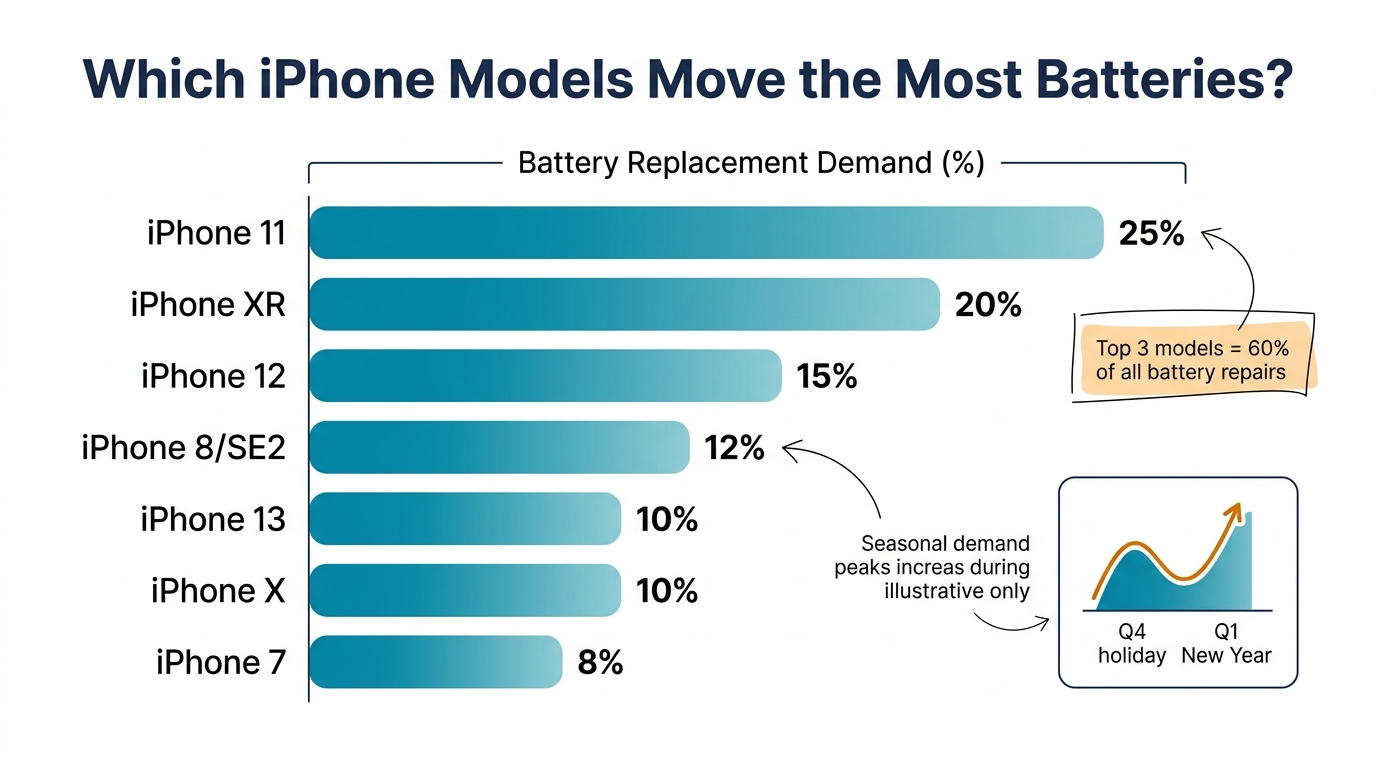
Lithium-ion batteries naturally degrade over time, typically dropping below 80% maximum capacity after 2.5 to 4 years of daily charging. In 2026, the sweet spot for replacement demand centers on devices released between 2020 and 2023.
Tier 1: Core High-Volume Models (Always Stock in Depth)
These models represent the primary volume of walk-in battery replacements across most independent workshops:
- iPhone 11: The undisputed volume leader. Millions of units remain in daily circulation, and their original batteries are well past their prime.
- iPhone 12 / 12 Pro: Heavy daily use and smaller original cell capacities make these models frequent candidates for replacement.
- iPhone 13 / 13 Pro: Entering their prime replacement window. Healthy customer attachment means owners gladly invest in battery renewals.
- iPhone XR: A durable legacy favorite with steady ongoing demand.
Tier 2: Steady Maintenance Models (Keep Light Backup Stock)
These devices see regular weekly demand, but do not require large volume buffers:
- iPhone 14 / 14 Pro: Emerging demand as devices cross the two-year usage mark.
- iPhone SE (2nd & 3rd Gen): Modest battery sizes require periodic swaps among budget-conscious users.
- iPhone X / XS: Older devices that still appear for affordable battery upgrades.
Tier 3: Low-Turnover / On-Demand Models (Order Per Job or Minimal Stock)
- iPhone 8 / 8 Plus: Nearing end-of-life status. Carry only 2 to 3 backup pieces or order per repair request.
- iPhone 15 Series: Newer models whose original batteries are mostly still healthy; stock lightly and order on demand.
Inventory Stocking Strategies by Workshop Size
Carrying too many battery SKUs locks up capital; carrying too few leads to missed walk-in revenue. Calibrate your inventory according to weekly repair volume:
| Workshop Scale | Weekly Battery Volume | Recommended Total Stock | Stocking Allocation Strategy |
|---|---|---|---|
| Small Counter / 1–2 Techs | 5–15 replacements / week | 20–35 units total | 70% Tier 1 (iPhone 11, 12, 13, XR); 30% Tier 2 (iPhone 14, SE, X). |
| Mid-Size Shop / 3–5 Techs | 20–40 replacements / week | 50–90 units total | Maintain 10–15 pcs each of Tier 1; 3–5 pcs each of Tier 2; on-demand Tier 3. |
| Multi-Location Chain | 50+ replacements / week | 150+ units total | Centralize reordering on 50+ or 200+ tiers; restock bi-weekly to avoid aging stock. |
Managing Battery Shelf-Life and Storage
Unlike glass screen assemblies, lithium batteries are chemically active components that slowly self-discharge over time. Storing batteries in a workshop drawer for 6 to 12 months without maintenance can cause cell voltage to drop below the critical 3.0V threshold, triggering copper shunts and permanent capacity loss.
Best practices for battery inventory control:
- Store batteries in a cool, dry environment between 15°C and 25°C, away from direct sunlight.
- Keep stock levels aligned with 2 to 4 weeks of projected repair consumption.
- Follow a strict First-In, First-Out (FIFO) stocking rotation so older inventory is always installed first.
Practical Bench Testing and Installation Protocols
To prevent premature battery degradation and callbacks, professional repair workshops enforce strict handling procedures during testing and installation:
Step-by-Step Bench QC Inspection
- Visual and Dimensional Check: Inspect cell wrapping for dents, punctures, or wrinkles. Check connector alignment and flex cable flexibility.
- Open-Circuit Voltage Measurement: Use a digital multimeter across battery terminals. New storage cells should measure between 3.80V and 3.85V. Any cell reading below 3.60V has suffered excessive self-discharge and should be set aside.
- Tester Diagnostics: Connect the battery to an industry diagnostic programmer. Verify that:
- Cycle count reads 0.
- Design capacity and full charge capacity match rated specifications.
- Temperature sensor responds accurately to ambient room temperature.
- Manufacturer data and battery serial strings register properly.
- Load Discharge Stability: If using an automated battery load tester, apply a simulated 1.0A to 1.5A load for 10 seconds. Voltage should remain steady above 3.65V without abrupt voltage dips that indicate high internal impedance.
Installation Best Practices to Prevent Cell Damage
Even the highest-grade battery can be ruined by improper shop handling. Technicians should observe these fundamental installation rules:
- Avoid Metal Prying Tools: Never use sharp metal spatulas or tweezers near lithium cells. Puncturing the outer aluminum foil layer causes immediate thermal runaway or internal short circuits. Always use anti-static nylon spudgers or dental floss to cut through old adhesive.
- Proper Adhesive Strip Alignment: Always use model-matched stretch-release adhesive strips rather than generic double-sided foam tape. Foam tape insulates heat and makes future replacements nearly impossible without bending the battery.
- FPC Cable Seating Before Gluing: Always connect the battery terminal connector to the logic board socket before pressing the battery down onto the adhesive strips. This ensures the flex cable sits naturally in place without tension, preventing cracked solder pads on the connector.
Common Traps in Wholesale Battery Sourcing
Watch out for these common industry pitfalls when negotiating with wholesale vendors:
- Trapped by Re-Wrapped B-Grade Cells: Some unscrupulous traders buy factory B-grade cells (cells rejected by primary assemblers for slight cosmetic or internal resistance deviations), print clean outer sleeves, and sell them as "OEM Grade." Sourcing from suppliers who maintain strict batch traceability avoids this trap.
- Misleading Certifications: Wholesale replacement batteries are supplied as bare repair components, not retail packaged consumer electronics. Suppliers claiming comprehensive international retail safety certifications on bare bulk parts are often providing generic, unverifiable paperwork. Focus instead on supplier incoming QC standards and documented warranty support.
- Overstocking Rare Models: Tying up capital in 30 units of legacy iPhone 7 or 8 Plus batteries because of a quantity discount is false economy. Keep your capital focused on high-turnover models.
How to Evaluate a Wholesale Battery Supplier
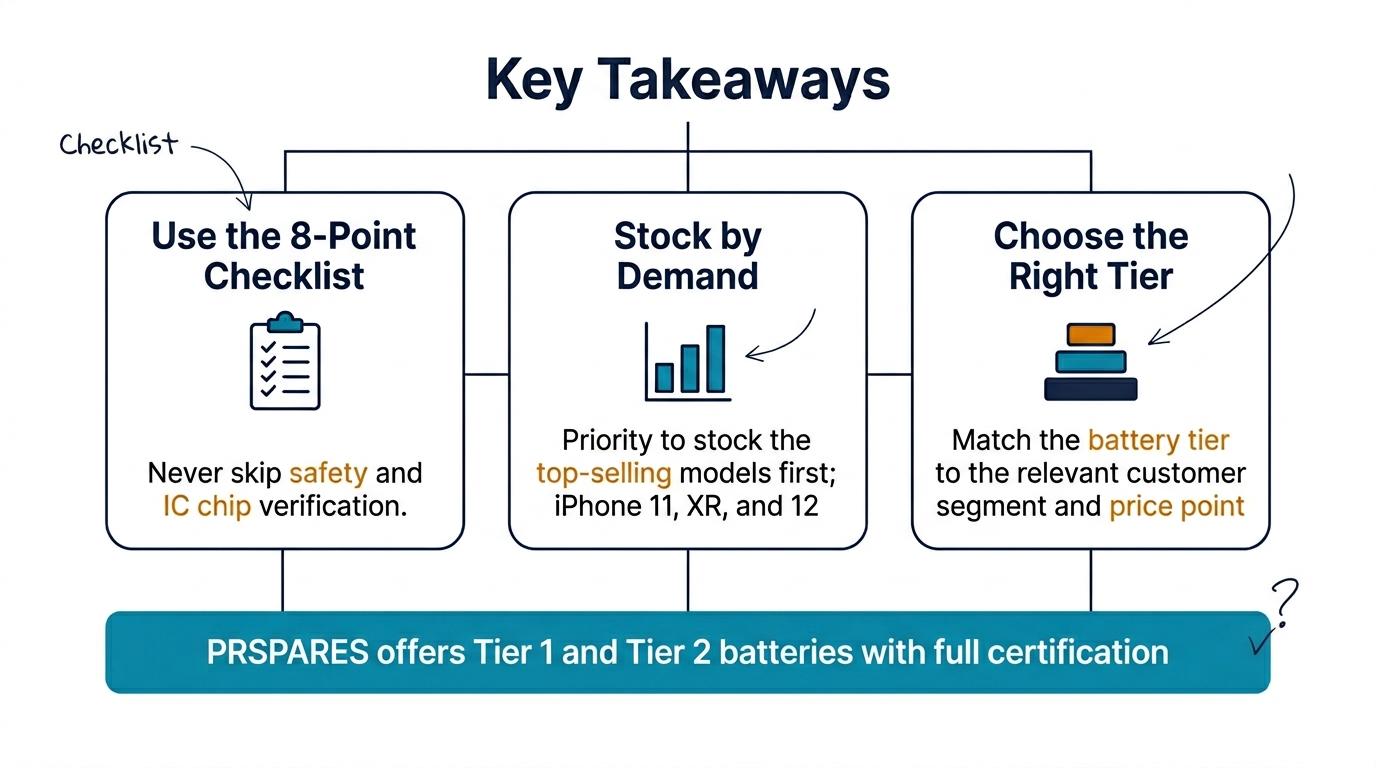
Before establishing an ongoing supply relationship, evaluate the supplier's commercial and operational standards:
Commercial Terms and Payment Policy
- Payment Method: Legitimate B2B parts distributors operate on Bank Wire (T/T). Consumer payment platforms take 3% to 5% fees that force suppliers to inflate prices. Formal bank transfers provide clean transaction records and commercial export invoices.
- Minimum Order Quantities: Look for suppliers with flexible minimums. At PRSPARES, standalone battery orders require a minimum of just 20 pieces across models, while mixed orders containing screens qualify at 10 pieces total, unlocking published 10+ wholesale tier pricing.
- Order Processing and Dispatch: Reliable suppliers test and dispatch packaged shipments the next business day after payment confirmation, utilizing air express couriers (DHL, FedEx, UPS) with 3 to 7 business day delivery timelines.
Transparent Warranty and Hassle-Free RMA
Confirm the supplier's defect handling terms before sending funds:
- Coverage Duration: 12 months for standard replacement batteries; 30 days for brand-new diagnostic zero-cycle batteries.
- Pre-Installation Testing: Perform dry bench testing before applying installation adhesives.
- Straightforward Proof: When a defective cell is identified during incoming inspection, record a clear video showing the defect alongside the supplier QC stamp.
- No Battery Return Required: Defective batteries never need to be shipped back to China. Hazardous materials transport restrictions and international express courier costs make return shipping impractical. Once video proof is verified, the value is credited, refunded, or replaced in your next order.
Frequently Asked Questions
What battery grades are available for wholesale iPhone repair?
The wholesale market offers four primary grades: brand-new diagnostic zero-cycle batteries (engineered to pass Apple diagnostics), high-capacity aftermarket batteries (offering 10%–15% more runtime for legacy models), standard capacity aftermarket batteries (1:1 OEM rated workhorses), and budget economy batteries (which repair shops should avoid due to high callback rates).
What is the minimum order quantity for wholesale iPhone batteries?
At PRSPARES, standalone battery orders have a minimum order quantity of 20 pieces across models. However, if you combine batteries with screens in a mixed order, the minimum is just 10 pieces total across all models and categories, unlocking 10+ wholesale tier pricing.
How are defective wholesale batteries handled under warranty?
Defective batteries identified during pre-installation testing are resolved via next-order replacement, credit, or direct refund once video documentation of the issue is confirmed. Standard batteries carry a 12-month warranty, diagnostic zero-cycle batteries carry a 30-day warranty, and defective batteries never need to be returned to China.
What causes aftermarket batteries to swell or degrade quickly?
Premature swelling and capacity loss are caused by substandard chemical formulations that blend manganese or iron into the cathode, contaminated electrolytes, and low-cost protection boards lacking over-discharge safeguards. Sourcing pure lithium cobalt oxide cells with dual-MOSFET protection modules prevents these failures.
How long can wholesale iPhone batteries be stored before installation?
Wholesale batteries should ideally be installed within 3 to 4 months of delivery. Because lithium-ion cells naturally self-discharge over time, keeping batteries stored longer than 6 months can cause voltage to drop below critical thresholds, leading to irreversible cell degradation.
Can wholesale iPhone batteries run Apple diagnostics?
Yes, brand-new diagnostic zero-cycle batteries are specifically engineered with compatible microcontrollers that successfully run Apple diagnostics. These units are brand-new and zero-cycle, making them the preferred choice for premium repair shops and device refurbishers.
Build a Reliable Battery Supply Chain
Sourcing high-quality iPhone batteries in bulk is the foundation of a profitable, stress-free repair business. By avoiding cut-rate economy cells, matching battery grades to customer needs, and maintaining disciplined inventory levels, your shop can maximize bench throughput while eliminating costly callbacks.
Explore our component grades and wholesale options:
- Wholesale iPhone Replacement Batteries
- Wholesale iPhone & Smartphone Screens
- Wholesale Charging Ports & Small Parts
- Warranty and RMA Policy Details
- How to Choose a Reliable Phone Parts Supplier
Ready to upgrade your battery quality and protect your repair margins? Contact our team or request wholesale pricing to test sample batteries on your bench with next-business-day dispatch.