
How Repair Shops Should Choose iPhone Battery Grades for Wholesale Orders
Most repair shop owners have learned this the hard way: a batch of cheap batteries arrives, half of them trigger iOS health warnings out of the box, and customers start coming back within 60 days. The battery itself cost $3.50 — but the callback, the free replacement, and the lost trust cost $25 or more per unit.
iPhone battery grades wholesale is not just a pricing question. It determines your callback rate, your shop's reputation, and ultimately your margins. This guide breaks down every grade available in the wholesale market, what each one actually delivers, and how to match grades to your business model.
Buying Phone Batteries Wholesale?
OEM-cell batteries with safety packaging — iPhone, Samsung & more, factory-direct.
Get Wholesale QuoteThe Four Battery Grades in the Wholesale Market
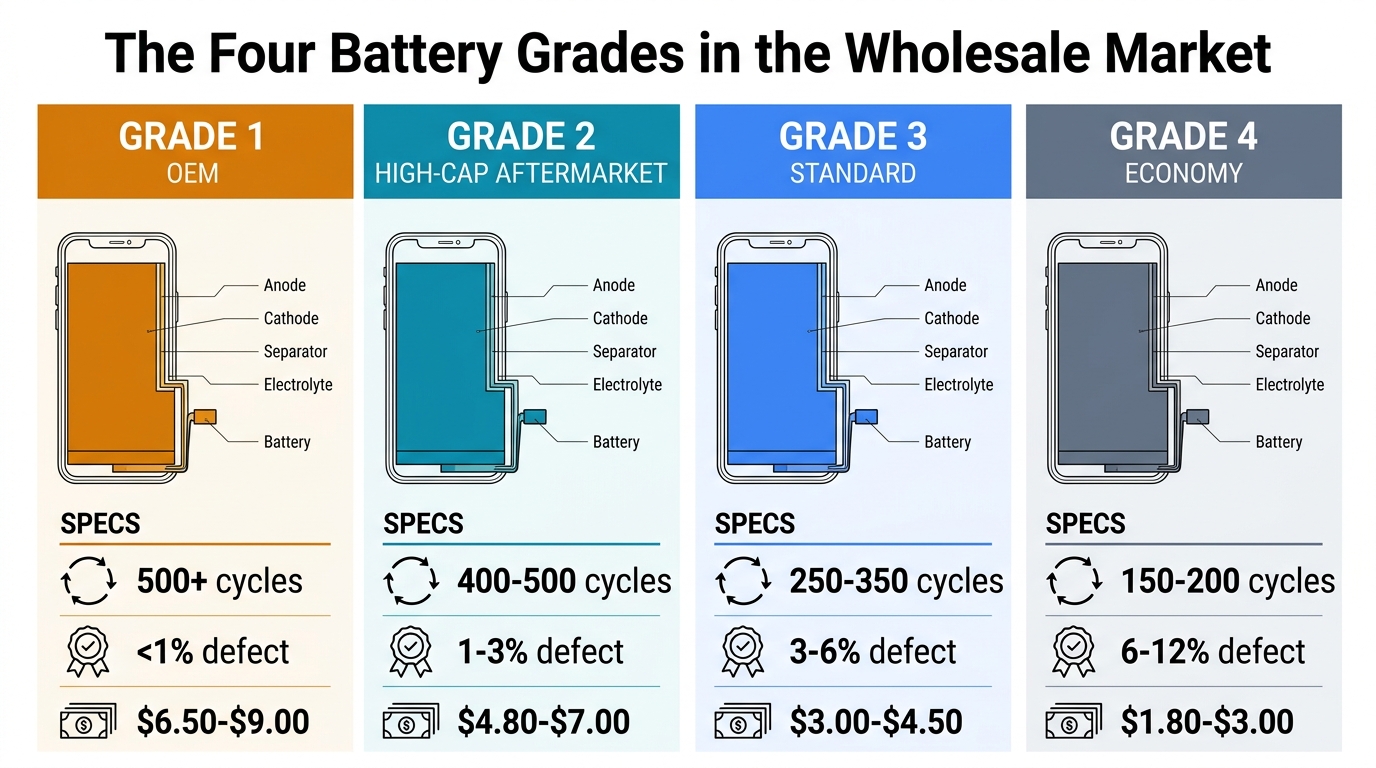
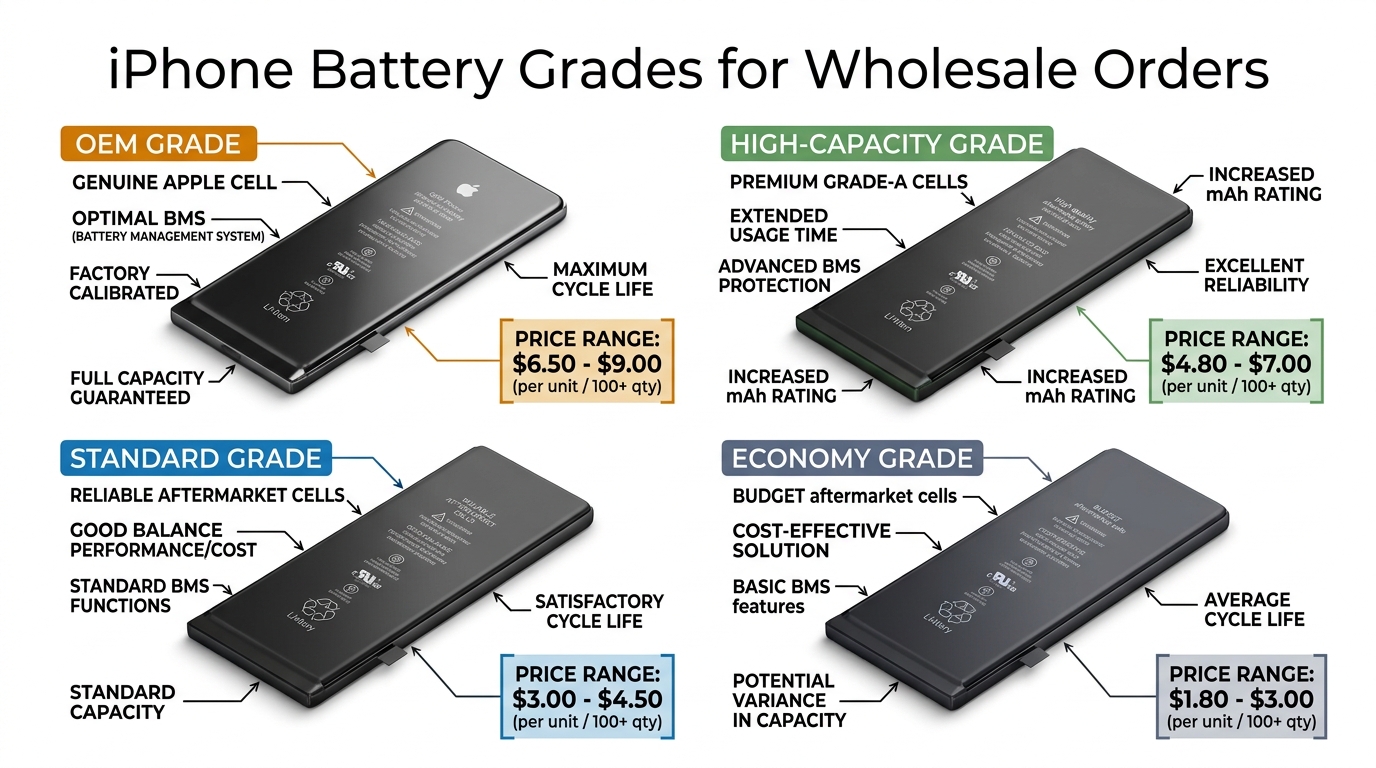
The global aftermarket for iPhone batteries broadly falls into four tiers. Suppliers use different names — "Tier 1," "Premium," "A-grade" — but the underlying product categories are consistent once you know what to look for.
Grade 1: OEM / Original Pull
These are batteries manufactured by the same factories that supply Apple (ATL, Sunwoda, Desay) or pulled from genuine iPhones. They carry Apple's own battery management IC and match factory specifications exactly.
- Cycle life: 500+ full cycles before dropping below 80% capacity
- Capacity retention: Matches Apple's rated mAh within 2%
- iOS compatibility: Full health reporting, no "Service" warnings
- Price range: $6.50–$9.00 per unit (varies by model, MOQ 50+)
- Defect rate: Under 1%
OEM pulls are increasingly scarce for newer models (iPhone 14 and up) and are most available for iPhone 8 through iPhone 12 series. Supply is inconsistent — you cannot always get the model you need when you need it.
Grade 2: High-Capacity Aftermarket (Ti / Premium Aftermarket)
These batteries use high-quality cells (often from the same cell manufacturers as OEM) paired with third-party protection circuits. Many offer capacity above Apple's original spec — for example, 3,400 mAh for iPhone 13 versus the stock 3,227 mAh.
- Cycle life: 400–500 cycles to 80% capacity
- Capacity retention: Rated capacity ±5%, with high-capacity options 5–10% above stock
- iOS compatibility: Most support health reporting on iOS 16+; some models trigger a "Parts and Service" notice on iPhone 15 and newer
- Price range: $4.80–$7.00 per unit (MOQ 50+)
- Defect rate: 1–3%
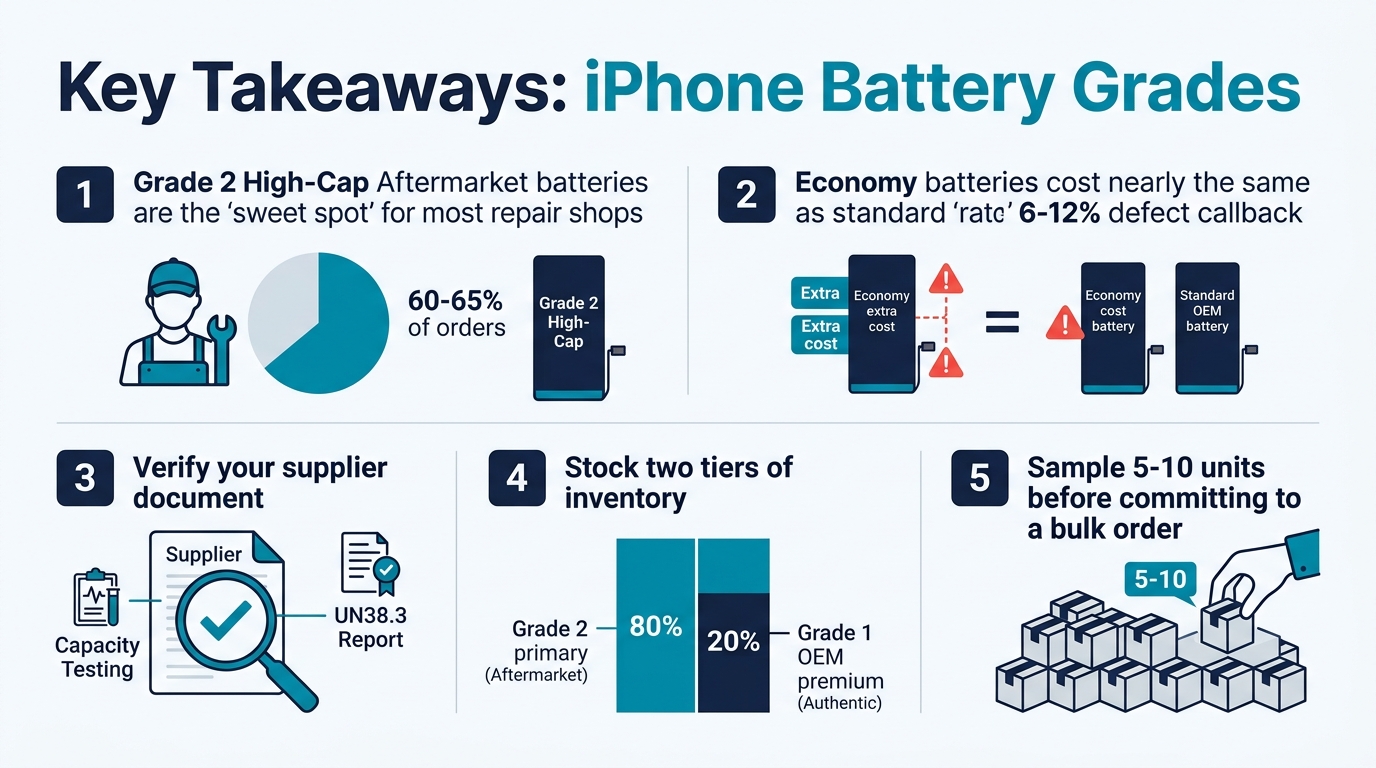
This is the sweet spot for most professional repair shops. You get reliable performance, competitive pricing, and enough margin to offer a 6–12 month warranty without eating into profits.
Grade 3: Standard Aftermarket
Mid-range batteries using decent cells but with cost-optimized protection circuits and less rigorous quality control. They work, but performance degrades faster and capacity often falls 5–10% short of rated specs.
- Cycle life: 250–350 cycles to 80% capacity
- Capacity retention: Actual capacity often 90–95% of rated
- iOS compatibility: Mixed — older models (iPhone 8, X, 11) typically fine; newer models may show warnings
- Price range: $3.00–$4.50 per unit (MOQ 100+)
- Defect rate: 3–6%
Standard aftermarket works for budget-focused shops or markets where customers prioritize price over longevity. If your average customer expects a battery to last 12–18 months at most, this grade can make sense.
Grade 4: Budget / Economy
The cheapest option. These batteries use lower-grade cells, minimal protection circuitry, and often lack meaningful safety certifications. Rated capacity is frequently overstated by 10–20%.
- Cycle life: 150–200 cycles to 80% capacity
- Capacity retention: Real-world capacity often 80–85% of what's printed on the label
- iOS compatibility: Frequent health warnings, poor calibration with iOS battery management
- Price range: $1.80–$3.00 per unit (MOQ 200+)
- Defect rate: 6–12%
We'll be direct: economy-grade batteries are a liability for any shop that offers warranties or cares about repeat business. The per-unit savings disappear once you factor in callbacks and replacement labor.
Grade Comparison Table
| Feature | OEM / Original | High-Cap Aftermarket | Standard Aftermarket | Budget / Economy |
|---|---|---|---|---|
| Price (per unit, MOQ 50+) | $6.50–$9.00 | $4.80–$7.00 | $3.00–$4.50 | $1.80–$3.00 |
| Cycle life (to 80%) | 500+ | 400–500 | 250–350 | 150–200 |
| Actual vs. rated capacity | 98–100% | 95–100% | 90–95% | 80–85% |
| iOS health reporting | Full support | Most models | Mixed | Unreliable |
| Safety certification | UL / UN38.3 | UN38.3, CE | CE (some) | Often none |
| Defect rate | <1% | 1–3% | 3–6% | 6–12% |
| Recommended warranty | 12–18 months | 12 months | 6 months | None / 30 days |
| Best for | Premium shops | Most repair shops | Budget markets | Disposable use |
Matching Battery Grades to Your Business Model
The right grade depends on your market, your pricing, and how much warranty risk you can absorb.
Premium Repair Shops
If you charge $45–$70 for an iPhone battery replacement and promise 12-month warranties, you need Grade 1 or Grade 2 batteries. Your customers are paying for peace of mind. A single callback wipes out the margin on 3–4 successful jobs.
Recommended: OEM for flagship models (iPhone 13 Pro, 14, 15 series); High-Capacity Aftermarket for older models where OEM supply is spotty.
High-Volume / Mid-Market Shops
You're doing 15–30 battery replacements per week, charging $30–$45, and offering 6-month warranties. Consistency and supply reliability matter more than having the absolute best battery.
Recommended: High-Capacity Aftermarket as your primary stock. Keep a small OEM inventory for customers who specifically request it (and charge a premium for it). For deeper guidance on stocking strategy, see our guide on which parts a small shop should stock in 2026.
Budget-Focused or Emerging Market Shops
In markets across Africa, Southeast Asia, and parts of Latin America, the average battery replacement job sells for $15–$25. Customers expect a working battery, but won't pay a premium for extended cycle life.
Recommended: Standard Aftermarket for most models. Upgrade to High-Capacity Aftermarket for high-demand models (iPhone 11, 12) where callback rates hit your margins hardest. Avoid economy-grade even here — a 6–12% defect rate destroys profitability at any price point.
Kiosk or Walk-In Mall Shops
High foot traffic, quick turnaround, limited repeat customer base. Price sensitivity is extreme.
Recommended: Standard Aftermarket with a strict incoming QC process. Test every batch with a capacity tester before putting them into inventory.
How to Evaluate Battery Grade Claims from Suppliers
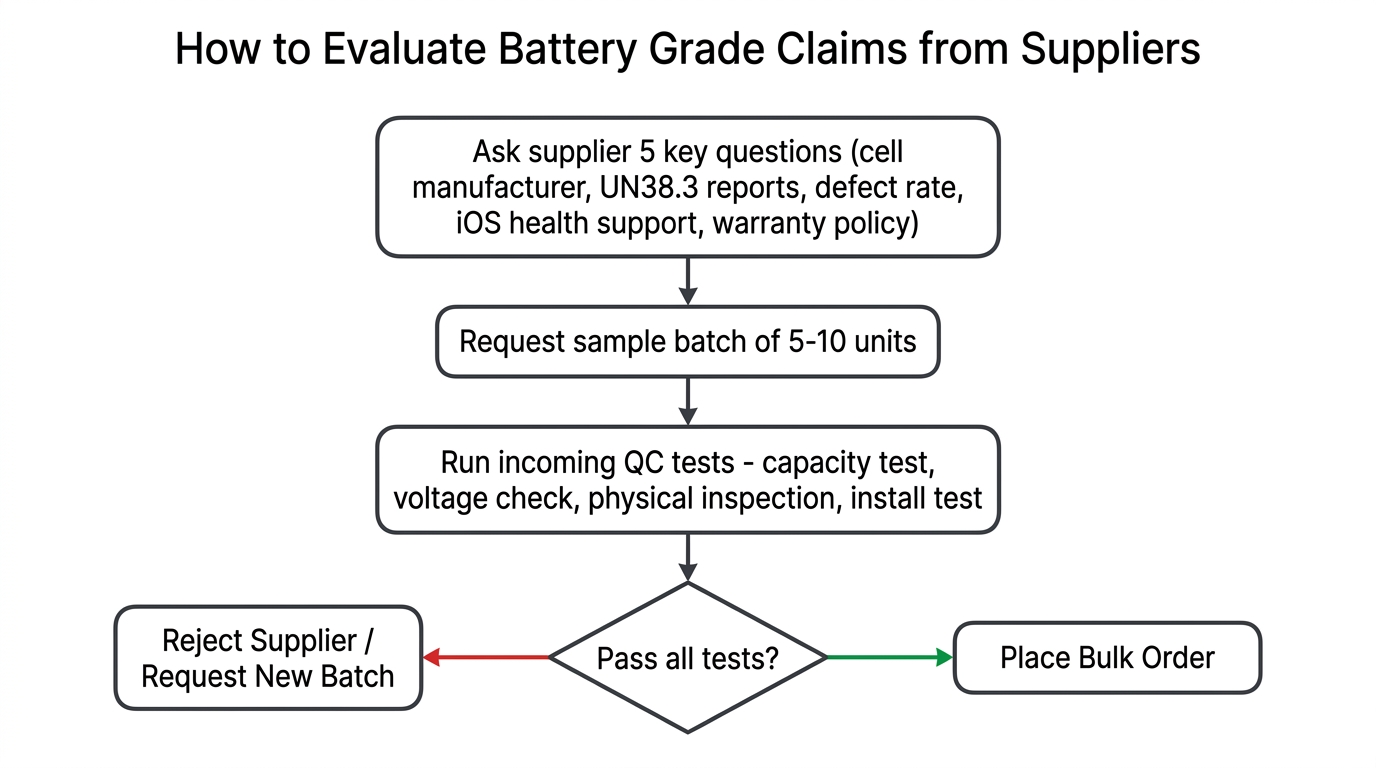
Every supplier claims "premium quality." Here's how to verify what you're actually getting.
Five Questions to Ask Before Ordering
-
"What cell manufacturer do you use?" Legitimate answers: ATL, BYD, Sunwoda, Desay, EVE, CATL. If the supplier can't or won't answer, they're likely repackaging unknown cells.
-
"Can you provide UN38.3 test reports?" This is the international safety standard for lithium batteries in transport. Any serious supplier has these on file. Ask for the report — not just a claim that they have it.
-
"What is your actual defect rate on this SKU over the last 6 months?" Honest suppliers will give you a number. If they say "zero defects," they're either lying or not tracking.
-
"Do your batteries support iOS battery health for iPhone 12 and newer?" This requires a properly programmed battery management IC. It's a concrete technical feature, not marketing fluff.
-
"What is your warranty and replacement policy for DOA units?" Good suppliers replace DOA batteries at no cost and cover shipping. Budget suppliers might offer credit — or nothing.
Incoming Quality Testing You Should Do
Don't rely solely on supplier claims. A basic QC process takes 5 minutes per batch and saves hours of callbacks.
- Capacity test: Use a battery tester (YZXStudio, ChargerLAB, or similar — $30–$80) to verify actual mAh matches rated specs. Reject any batch where average capacity falls below 95% of stated.
- Voltage check: A healthy new battery should read 3.7–3.85V out of the package. Below 3.6V suggests old stock or poor storage.
- Physical inspection: Check for swelling, dented connectors, or uneven adhesive. Inspect the flex cable connector for proper alignment.
- Install test: Put one battery from each new batch into a test device. Run it for 24 hours, checking iOS health status and drain rate.
For a comprehensive pre-purchase checklist, read our article on what to check before buying iPhone batteries in bulk.
The True Cost of Cheap Batteries
Let's run the numbers on a shop doing 80 battery replacements per month.
Scenario A: Standard Aftermarket at $3.50/unit
- Monthly battery cost: $280
- Defect rate: 5% = 4 callbacks/month
- Cost per callback (labor + replacement battery + customer goodwill): ~$20
- Monthly callback cost: $80
- Effective cost per good battery: $4.50
Scenario B: High-Capacity Aftermarket at $5.50/unit
- Monthly battery cost: $440
- Defect rate: 1.5% = 1.2 callbacks/month
- Cost per callback: ~$20
- Monthly callback cost: $24
- Effective cost per good battery: $5.80
The gap between these two grades is $1.30 per unit in effective cost — not the $2.00 sticker price difference. And Scenario B comes with happier customers, better reviews, and more referrals. If your replacement charge is $35+, that extra $1.30 is the best money you spend.
Now consider economy-grade at $2.20/unit with an 8% defect rate. Effective cost jumps to $4.10/unit — nearly the same as standard aftermarket, but with worse customer experience and no basis for warranty confidence. This is why understanding battery quality is non-negotiable for long-term profitability.
A Practical Grade Selection Framework
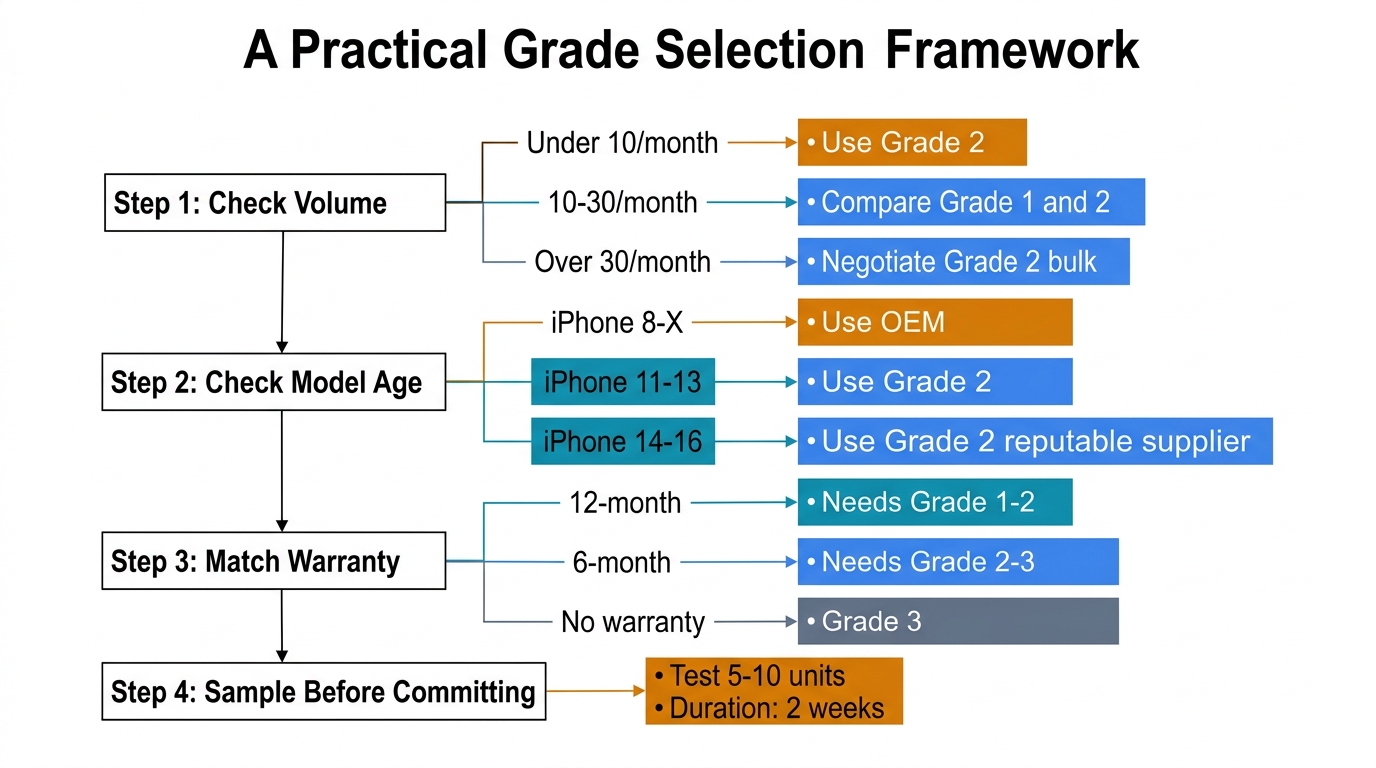
Use this decision tree for each model you stock:
Step 1: Check your replacement volume for that model.
- Under 10/month → Buy Grade 2 (High-Capacity Aftermarket). Not worth optimizing further.
- 10–30/month → Worth comparing Grade 1 and Grade 2 pricing. Test both.
- Over 30/month → Negotiate directly with suppliers for Grade 2 bulk pricing. Consider stocking Grade 1 as an upsell option.
Step 2: Check the model age.
- iPhone 8 / X / XR / XS → OEM pulls are available and affordable. Grade 1 is viable.
- iPhone 11 / 12 / 13 → Grade 2 is the practical choice. OEM supply is tight and expensive.
- iPhone 14 / 15 / 16 → Grade 2 from a reputable supplier. OEM is rarely available in aftermarket channels.
For a model-by-model stocking breakdown, see our iPhone battery stocking guide by model for 2026.
Step 3: Match to your warranty offer.
- 12-month warranty → Grade 1 or Grade 2 only
- 6-month warranty → Grade 2 or Grade 3
- No warranty / 30-day guarantee → Grade 3 (but reconsider your business model)
Step 4: Sample before committing. Order 5–10 units of any new supplier or grade. Test capacity, install in devices, monitor for 2 weeks. Only then place a bulk order.
Stocking Strategy by Grade
Most shops benefit from a two-tier inventory:
- Primary stock (80% of inventory): Grade 2 High-Capacity Aftermarket for your top 5–8 models
- Premium option (20% of inventory): Grade 1 OEM for customers willing to pay more
This lets you capture both price-sensitive and quality-focused customers. List the premium option on your menu or quote sheet — even if only 15–20% of customers choose it, the higher margin improves your overall numbers.
When it comes to knowing whether battery replacement is even worth offering in 2026, the answer is yes — but only if your grade selection keeps callbacks under 3%.
Working with Suppliers: What Good Looks Like
A reliable battery supplier should offer:
- Consistent SKU grading — the same product code always delivers the same grade
- Batch traceability — you can reference a batch number if quality issues arise
- Sample programs — willingness to send 5–10 units for testing before bulk orders
- Technical support — someone who can answer questions about IC compatibility, iOS health reporting, and model-specific issues
- Transparent defect policies — clear DOA replacement terms, ideally within 48 hours of reporting
If you're evaluating multiple wholesale sources, our complete cell phone parts sourcing guide covers how to vet suppliers beyond just batteries.
At PRSPARES, we grade every battery SKU explicitly and provide UN38.3 certification, capacity test data, and iOS compatibility notes per model. We ship from Shenzhen with standard lead times of 3–5 days to most markets.
FAQ
What is the most popular iPhone battery grade for repair shops?
Grade 2 (High-Capacity Aftermarket) accounts for roughly 60–65% of wholesale battery orders from repair shops globally. It offers the best balance of price, performance, and warranty reliability. Most shops find that the 400–500 cycle life and sub-3% defect rate justify the moderate price premium over standard aftermarket.
Can economy-grade iPhone batteries damage a customer's phone?
Low-quality batteries with inadequate protection circuits can cause issues beyond poor battery life. Risks include unexpected shutdowns, overheating during charging, and in rare cases, swelling that damages the display or housing. Batteries without UN38.3 certification have not been tested for thermal runaway protection. The liability exposure alone makes economy-grade a poor choice for professional shops.
How do I tell if a supplier is relabeling economy batteries as premium?
Three red flags: (1) The price is significantly below market average for the claimed grade — if "premium" batteries cost $3.00/unit, something is off. (2) The supplier cannot provide cell manufacturer names or safety test reports. (3) Capacity testing reveals actual mAh is 10% or more below rated specs. Always test a sample batch with a standalone capacity tester before committing to volume orders.
Should I stock OEM batteries for all iPhone models?
No. OEM availability varies dramatically by model. For iPhone 8 through 11, OEM pulls are relatively accessible and reasonably priced. For iPhone 13 and newer, genuine OEM batteries in the aftermarket are scarce and expensive. Stock OEM where supply is reliable and offer it as a premium option. Use High-Capacity Aftermarket as your default for newer models.
How many battery SKUs should a small repair shop stock?
A small shop doing 40–60 repairs per month should stock batteries for 6–8 models that represent their highest demand. Typically this means iPhone 11, 12, 12 Pro, 13, 13 Pro, 14, and one or two SE/XR SKUs. Keep 10–15 units of each in Grade 2. This covers 80%+ of walk-in demand without tying up excessive capital.
Next Steps
Choosing the right iPhone battery grade is a business decision, not just a technical one. It affects your margins, your warranty costs, your online reviews, and your repeat customer rate.
If you're sourcing wholesale iPhone batteries and want to compare grades with actual test data, reach out to PRSPARES for samples and wholesale pricing. We supply repair shops across the UK, Africa, Latin America, and Southeast Asia with graded, certified batteries — and we're happy to send test units before you commit to volume.