
Common iPhone Battery Quality Problems Wholesale Buyers Should Check Before Ordering
If you run a repair shop or resell parts, every battery you install carries your name. A single batch of bad iPhone batteries can trigger a wave of callbacks, one-star reviews, and lost customers. After working in Shenzhen phone parts sourcing for over a decade, I can tell you: most wholesale battery problems are preventable — but only if you know what to check before the order ships.
This guide walks you through the most common iphone battery quality problems wholesale buyers encounter, how to spot supplier red flags, what certifications actually matter, and how to inspect incoming shipments so defective cells never reach your bench.
Buying Phone Batteries Wholesale?
OEM-cell batteries with safety packaging — iPhone, Samsung & more, factory-direct.
Get Wholesale QuoteThe 6 Most Common iPhone Battery Quality Problems in Wholesale Orders
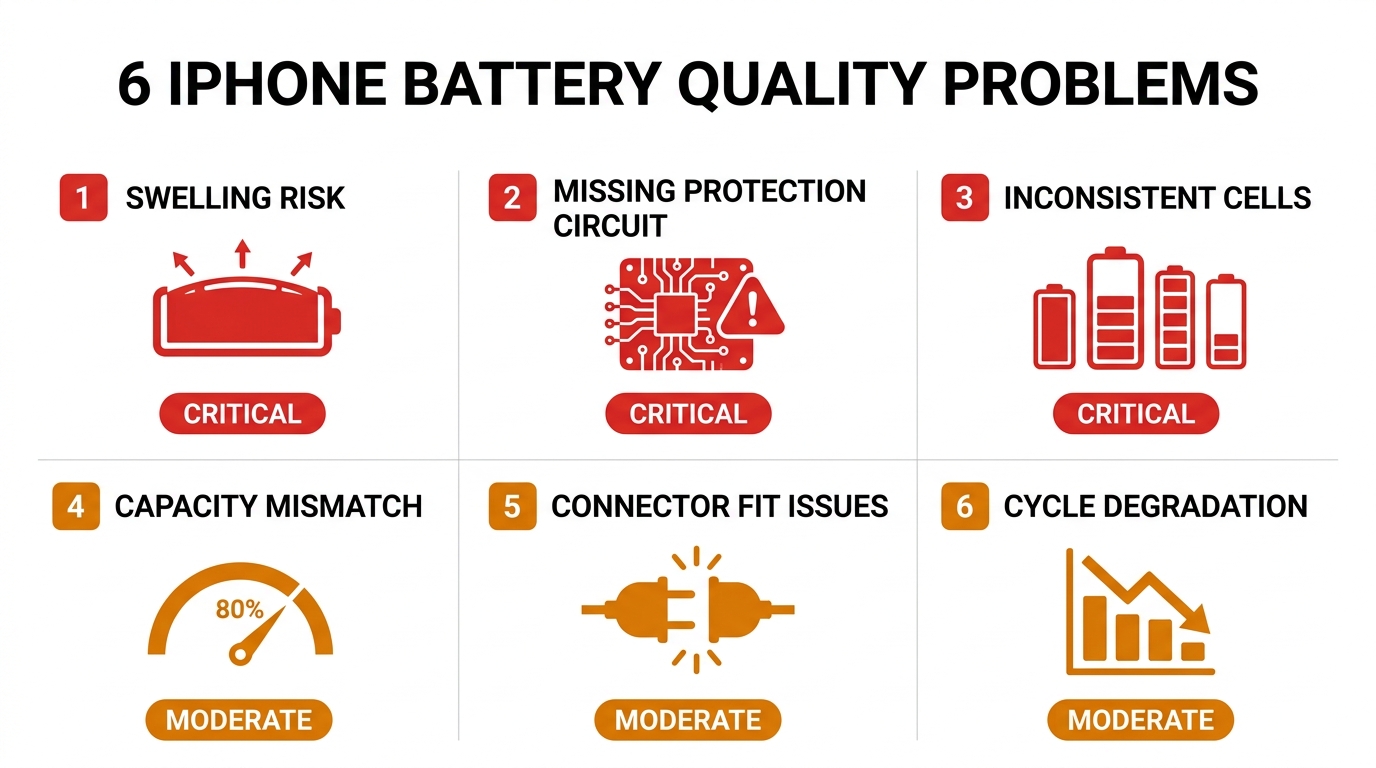
Not all battery defects are equal. Some kill your reputation slowly (premature degradation), others create safety hazards (swelling). Here are the problems I see most frequently in wholesale iPhone battery shipments.
1. Capacity Mismatch — The #1 Hidden Defect
The battery label says 3,279 mAh (iPhone 14 spec). The actual tested capacity? Often 2,600–2,800 mAh on low-grade wholesale units. That is a 15–20% shortfall that your customers will notice within weeks.
Why it happens: Suppliers use B-grade or recycled cells and print original-spec labels. The battery "works" on day one, but runtime is noticeably shorter than a genuine replacement.
How common: In random audits of budget wholesale batteries from marketplace suppliers, capacity mismatch rates run 25–40% of units. Higher-tier suppliers keep this under 3%.
2. Swelling Risk — The Safety Problem
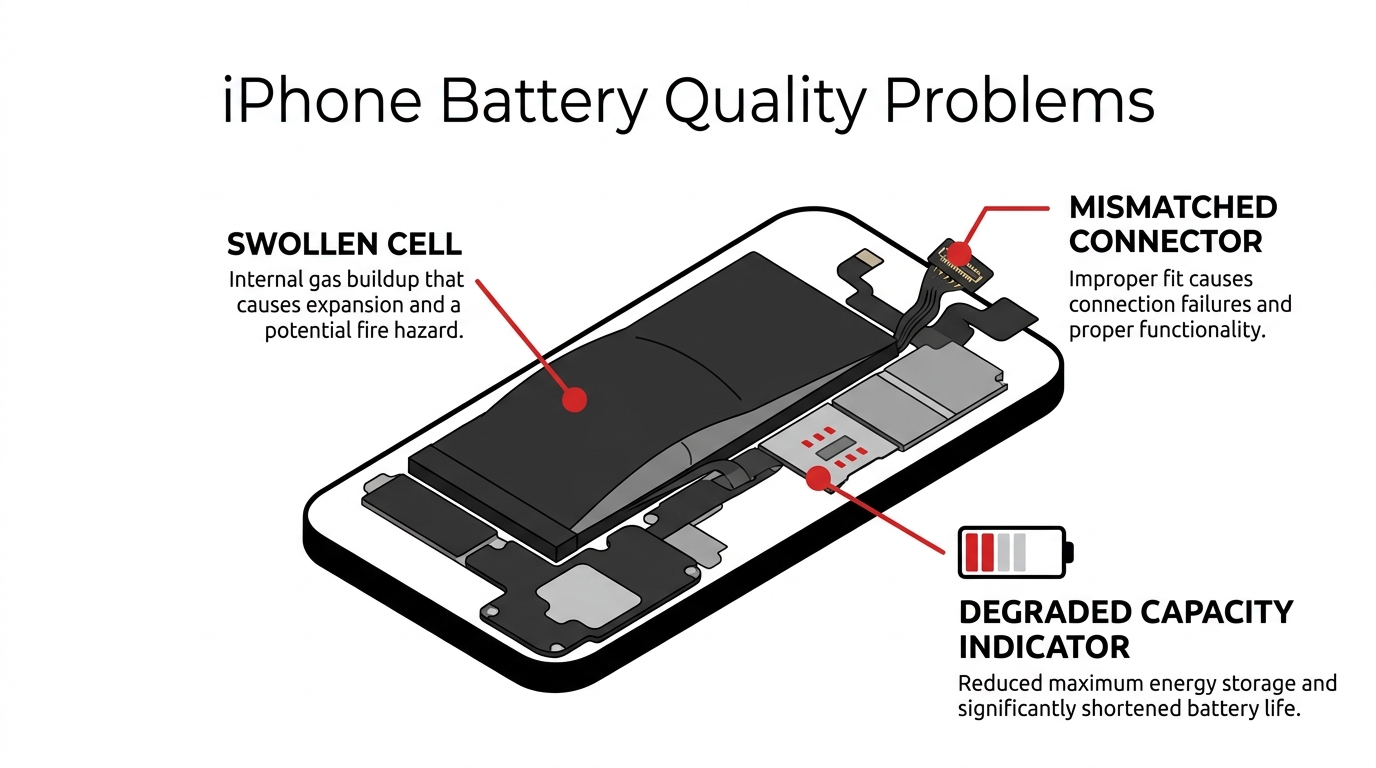
Battery swelling is caused by gas buildup from internal chemical decomposition. It bends screens, damages housings, and in extreme cases leads to thermal events. Swelling typically shows up 2–6 months after installation.
Root causes in wholesale batteries:
- Overcharged cells during manufacturing
- Low-quality separator membranes
- Contaminated electrolyte
- Cells stored in high-temperature warehouses without climate control
Defect rate benchmark: Reputable suppliers maintain swelling rates below 0.5% over 12 months. If your returns for swelling exceed 1%, your supplier has a cell quality problem.
3. Connector Fit Issues — Installation Headaches
The flex cable connector must mate precisely with the iPhone logic board. Poor-quality batteries often have connectors that are 0.1–0.3 mm off spec, causing:
- Loose connections that trigger intermittent "Service" warnings
- Connectors that require excessive force, risking board damage
- FPC (flexible printed circuit) tears during installation
This problem is especially common in batteries for iPhone 12 series and newer, where the battery connector design changed. A 5% connector rejection rate is typical with low-tier suppliers; top-tier factories hold this under 0.5%.
4. Rapid Cycle Degradation
A quality replacement battery should retain 80% capacity after 500 full charge cycles — matching Apple's own benchmark. Low-grade wholesale batteries often drop below 80% after just 150–250 cycles, meaning your customer sees significant battery health decline within 6–8 months.
The telltale sign: Customers return complaining that "Battery Health" in iOS settings shows 85% or lower within 4–5 months of replacement. If you are getting these complaints consistently, your batteries are using cells rated for fewer cycles.
5. Inconsistent Cell Quality Within the Same Batch
This is the most frustrating problem for repair shops. You test 5 batteries from a 100-unit shipment — all pass. Then 15 units from the same batch fail in the field. This happens because low-tier suppliers mix cell sources within a single production run.
What to look for: Slight differences in cell weight (more than 1g variance within the same SKU), different date codes on the cell wrap, or inconsistent adhesive pull tab placement. These are signs of mixed cell sourcing.
6. Missing or Fake Protection Circuits
Every iPhone replacement battery should have a PCM (Protection Circuit Module) that prevents overcharge, over-discharge, and short circuit. Budget batteries sometimes ship with:
- Non-functional PCM boards (components not soldered)
- PCM rated for incorrect voltage cutoffs
- No temperature sensing (NTC thermistor missing or bypassed)
Without proper protection circuitry, the battery becomes a liability. A missing NTC thermistor alone means the iPhone cannot accurately read battery temperature, which can trigger unexpected shutdowns.
Quality Problem Comparison Table
| Problem | Detection Difficulty | Customer Impact | Typical Defect Rate (Low-Tier) | Typical Defect Rate (Top-Tier) |
|---|---|---|---|---|
| Capacity mismatch | Medium (requires testing) | High — short runtime | 25–40% | 1–3% |
| Swelling | Hard (delayed onset) | Critical — safety risk | 2–5% | <0.5% |
| Connector fit | Easy (during install) | Medium — rework time | 3–8% | <0.5% |
| Cycle degradation | Hard (takes months) | High — callbacks | 15–30% | 2–5% |
| Inconsistent cells | Medium (batch testing) | Variable | 10–20% | <2% |
| Fake protection circuit | Hard (requires inspection) | Critical — safety risk | 5–15% | <0.3% |
How to Spot Supplier Red Flags Before Ordering
Before you even request samples, you can filter out risky suppliers by evaluating their listings and communications. Here are the red flags I look for.
Pricing That Defies Physics
If an iPhone 15 Pro Max battery retails at $8–12 wholesale from verified suppliers, and someone offers it at $3.50, the math does not work. Quality 3,274 mAh cells alone cost $2.50–3.00 at component level. Add PCM, flex cable, assembly, and packaging — sub-$5 pricing guarantees compromised cells.
Rule of thumb: If a battery price is more than 35% below the average from 3–4 established suppliers, the savings are coming from the cell quality.
Vague or Missing Specifications
Trustworthy suppliers publish:
- Actual tested capacity (not just "original capacity")
- Cycle life rating (e.g., ">500 cycles to 80%")
- Cell origin (ATL, Sunwoda, BYD, etc.)
- Certification references (UN38.3, UL, CE)
If the listing says only "high quality battery" with no specs, move on. For more guidance on evaluating supplier credibility, see our guide on how to choose a reliable phone parts supplier.
No Sample Policy
Any supplier confident in their product will send 3–5 samples for testing before a bulk order. If a supplier resists sampling, pushes for immediate MOQ commitment, or charges excessive "sample fees" that exceed the product price, they do not want you testing their product. That tells you everything.
No Certifications or Fake Certificates
Ask for UN38.3 test reports (mandatory for lithium battery transport) and check:
- The report should reference a specific battery model matching what you are ordering
- The testing lab should be identifiable and accredited
- Report dates should be recent (within 18 months)
I have seen suppliers send the same UN38.3 certificate for every product they sell, covering a different battery model entirely. Always cross-reference the model number on the certificate with your actual order.
Pre-Order Testing: What to Request from Suppliers
Before committing to a bulk purchase, request the following documentation and test data. Serious suppliers will have these ready.
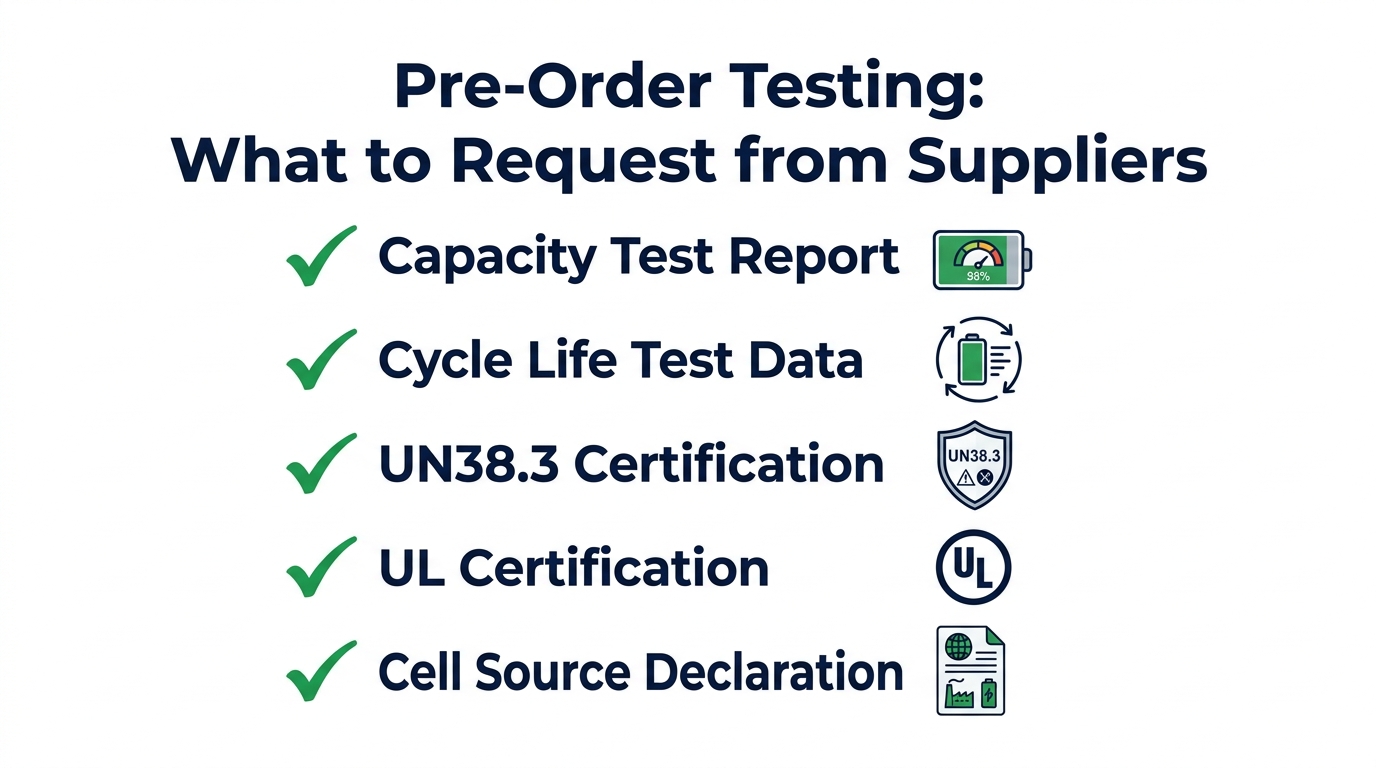
1. Capacity Test Reports
Ask for discharge test data showing actual mAh at 0.2C discharge rate from 4.35V to 3.0V. The measured capacity should be within 5% of the labeled value. Any supplier who cannot provide this does not test their output.
2. Cycle Life Test Data
Request cycle test curves showing capacity retention over at least 300 cycles. The curve should show gradual, predictable decline — not a sharp drop-off. This data reveals cell grade more reliably than any other metric.
3. Safety Certifications
| Certification | What It Covers | Why It Matters |
|---|---|---|
| UN38.3 | Transport safety testing | Legally required for shipping lithium batteries internationally |
| UL 2054 / UL 62133 | Product safety standard | Verifies protection circuit and cell safety |
| CE | European market compliance | Required for EU sales, covers safety directives |
| IEC 62133 | Secondary lithium cell safety | International standard for cell-level safety |
| MSDS / SDS | Material safety data sheet | Required by freight forwarders, details chemical hazards |
4. Cell Source Declaration
Top-tier suppliers will tell you which cell manufacturer they use. Known quality cell brands include ATL (Amperex Technology Limited), Sunwoda, BYD, and CATL for consumer electronics cells. If the supplier claims "original" cells but cannot name the cell manufacturer, the cells are likely from unnamed or recycled sources.
For a deeper dive into battery purchasing decisions, read our guide on what to check before buying iPhone batteries in bulk.
Incoming Inspection: Your Last Line of Defense
Even with a vetted supplier, every incoming battery shipment needs a basic QC check. Here is the inspection protocol we recommend to our wholesale partners.
Visual Inspection (100% of units)
- Label accuracy: Model number, capacity, and voltage match the order
- Wrap condition: No tears, bubbles, or wrinkles in the cell wrap
- Connector: No bent pins, clean solder joints, FPC not creased
- Adhesive pull tabs: Present, properly positioned, not pre-torn
- Overall dimensions: Battery sits flat on a level surface with no warping
Measurement Checks (Sample 10–15% of shipment)
- Weight: Use a 0.01g precision scale. All units of the same model should weigh within 1g of each other. If you see a 3g spread, cells are from different sources.
- Open circuit voltage (OCV): Should read 3.7–3.9V for a fresh battery. Below 3.6V suggests aged or over-discharged cells. Above 4.0V means the cell was overcharged during storage.
- Internal resistance: Use a battery analyzer. For a healthy iPhone battery cell, internal resistance should be under 80 mOhm. Above 120 mOhm indicates degraded cells.
Functional Test (Sample 3–5% of shipment)
- Install in a test device and verify iOS battery health reads 100%
- Run a 30-minute charge cycle — monitor for abnormal heat (surface temp should stay below 40°C)
- Confirm connector seats firmly with no play
This inspection methodology follows similar principles to incoming QC for wholesale phone screens — adapted for battery-specific parameters.
The Real Cost of Bad Batteries
Buying cheap batteries feels like a margin win until the callbacks start. Here is what bad battery quality actually costs a repair shop doing 20 battery replacements per week.
Callback Rate Impact
| Supplier Tier | Avg. Callback Rate | Monthly Callbacks (80 installs) | Cost per Callback* | Monthly Loss |
|---|---|---|---|---|
| Budget marketplace | 8–12% | 6–10 | $25–35 | $150–350 |
| Mid-tier trading company | 3–5% | 2–4 | $25–35 | $50–140 |
| Verified factory-direct | 0.5–1.5% | 0–1 | $25–35 | $0–35 |
Callback cost includes technician time, replacement part, and customer compensation/discount.
At scale, a shop saving $1.50 per battery on a budget supplier loses $2–4 per battery in callbacks and warranty claims. The "cheaper" battery is actually the most expensive option.
Reputation Damage
One swelling battery posted on social media can undo months of positive reviews. In markets like the UK and Southeast Asia where repair shop competition is intense, online reputation directly drives foot traffic. The batteries you install are your brand.
For more on handling customer issues, see our article on common battery complaints after replacement and our analysis of iPhone battery replacement cost in 2026.
Supplier Quality Tier Comparison
Not all supply chains are equal. Understanding where your batteries come from helps predict the quality you will receive.
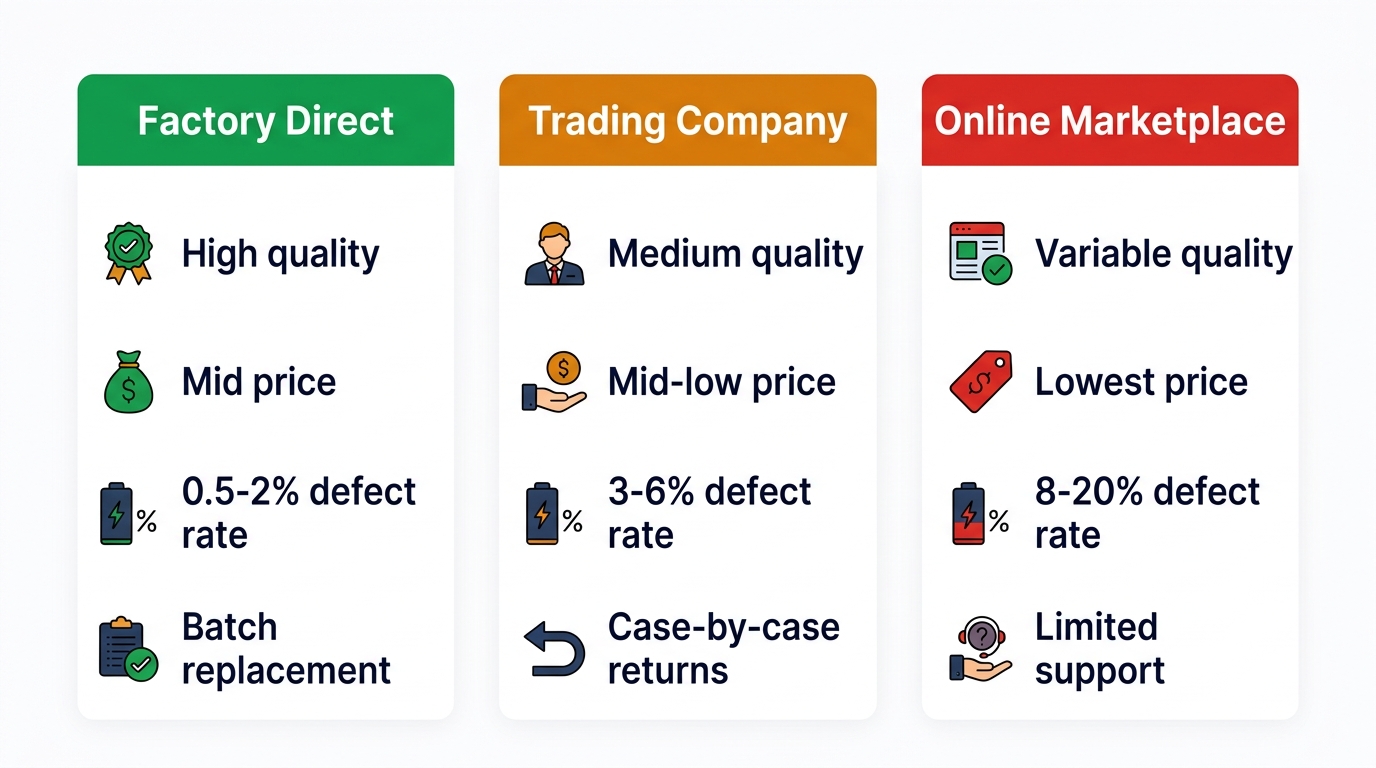
| Factor | Factory-Direct (Verified) | Trading Company | Online Marketplace |
|---|---|---|---|
| Cell source transparency | Full traceability | Partial — may change sources | Rarely disclosed |
| Capacity consistency | 95–100% of rated | 85–95% of rated | 60–90% of rated |
| Certifications | UN38.3, UL, CE verified | Usually available, verify authenticity | Often missing or fake |
| Sample availability | Yes, with test data | Usually yes | Inconsistent |
| MOQ | 50–500 units | 20–100 units | 1+ units |
| Price level | Mid-range | Mid to low | Lowest |
| Defect rate (typical) | 0.5–2% | 3–6% | 8–20%+ |
| After-sales support | Batch replacement, credit | Case-by-case | Limited or none |
| Best for | Established shops, volume buyers | Small shops testing suppliers | Emergency single-unit needs |
The sweet spot for most repair businesses is working with a verified factory-direct supplier who offers reasonable MOQs, sample testing, and batch traceability. Trading companies can work as a secondary source, but verify their cell sourcing every few months — they are more likely to switch suppliers without notice.
For a detailed framework on supplier evaluation, check out how to choose a reliable phone parts supplier and our guide on how repair shops should choose battery quality.
Your Pre-Order QC Checklist
Before placing your next wholesale iPhone battery order, run through this checklist:
- Requested and tested 3–5 samples with a battery analyzer
- Verified capacity is within 5% of labeled specification
- Confirmed connector fits cleanly on target iPhone models
- Reviewed UN38.3 certificate with matching model numbers
- Asked supplier to name cell manufacturer
- Compared pricing against 3+ alternative suppliers (flagged if >35% below average)
- Confirmed supplier provides batch-level traceability
- Agreed on warranty/return terms for defective units
- Checked cell weight consistency across sample units (within 1g)
- Verified OCV readings are in 3.7–3.9V range
Frequently Asked Questions
What is the most common quality problem with wholesale iPhone batteries?
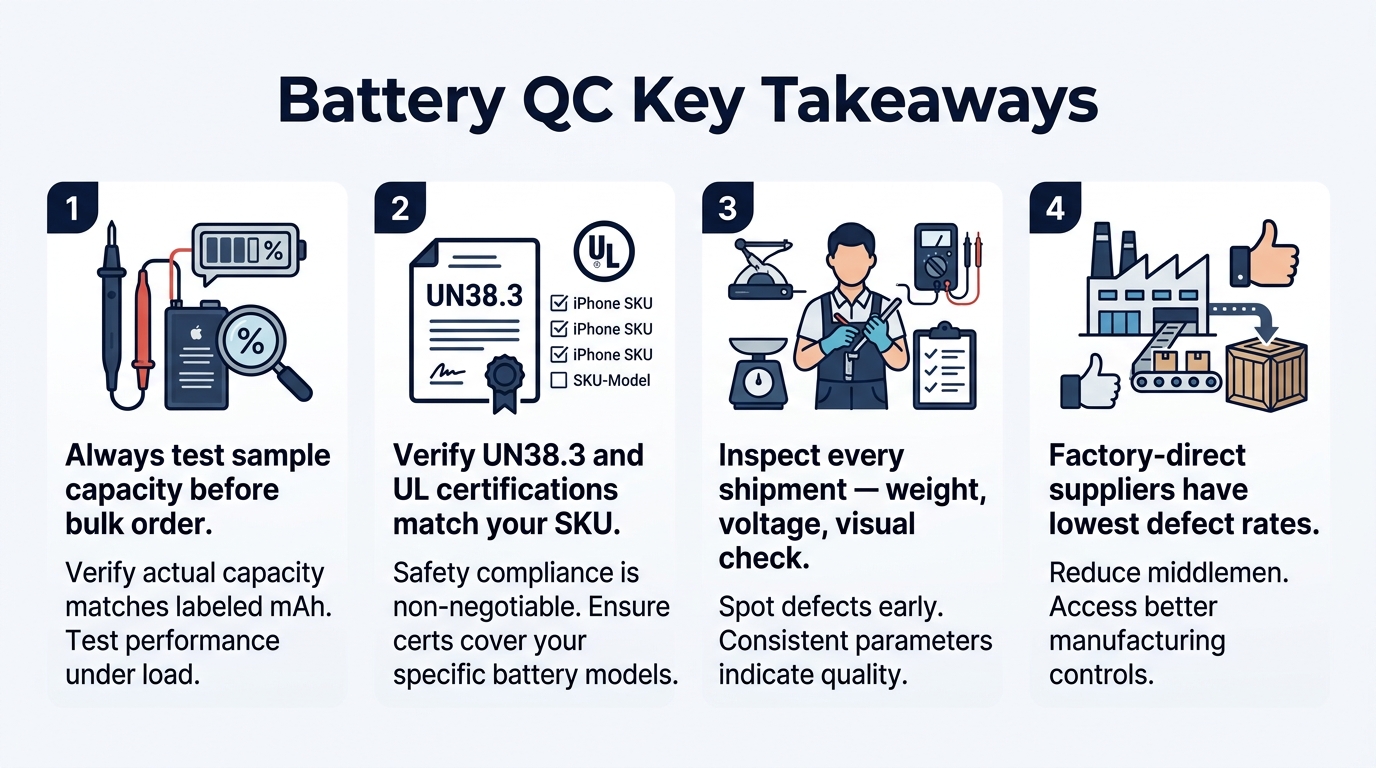
Capacity mismatch is the single most common issue. Budget wholesale batteries frequently deliver 15–20% less actual capacity than the label states. This leads to shorter runtime and faster battery health degradation in iOS, which customers notice within weeks of installation. Always test actual discharge capacity with a battery analyzer before committing to a bulk order.
How can I test iPhone battery quality without expensive equipment?
Start with three free or low-cost checks: (1) weigh batteries on a precision scale — units in the same batch should be within 1g of each other, (2) measure open circuit voltage with a basic multimeter — it should read 3.7–3.9V, and (3) install a sample in a test device and verify iOS reports 100% battery health. For under $50, a USB battery tester can measure actual discharge capacity, which is the most revealing single test.
Are UN38.3 certificates enough to guarantee battery quality?
No. UN38.3 only certifies transport safety — it confirms the battery will not explode during shipping. It does not test capacity accuracy, cycle life, or long-term reliability. UN38.3 is a minimum requirement, not a quality guarantee. Look for additional certifications like UL 62133 or IEC 62133, which cover product-level safety standards including protection circuit testing.
How many batteries should I test from each incoming shipment?
For shipments under 200 units, test 10–15% with measurement checks (weight, voltage, internal resistance) and 3–5% with functional installation tests. For shipments over 500 units, a 5–8% measurement sample and 2–3% functional sample is practical. Visual inspection should cover 100% of units — it takes seconds per battery and catches obvious defects like wrap damage and connector issues.
What callback rate is normal for aftermarket iPhone batteries?
With a quality-verified supplier, expect a callback rate of 0.5–1.5% over 6 months. If your callback rate exceeds 3%, investigate your supplier's cell sourcing. Above 5% means you should switch suppliers immediately — the cost of callbacks and reputation damage far exceeds any per-unit savings.
Stop Guessing, Start Verifying
Every iphone battery quality problem in this guide is preventable with the right supplier and a basic QC process. The repair shops that build lasting businesses are the ones that invest 30 minutes in pre-order verification rather than spending hours on callbacks.
At PRSPARES, we supply verified iPhone replacement batteries with full capacity test data, UN38.3 and UL certification, and named cell sources. Every batch ships with QC documentation, and we offer free samples for testing before you commit to volume.
Browse the wholesale battery catalog, or request verified battery samples — test our quality before you order, not after your customers complain.