
Battery Reset Scams: How Wholesale Buyers Can Check If a Battery Is Really New
A battery arrives with 0 cycle count and 100% health displayed in software. Most buyers would call that "new." But in the wholesale phone parts supply chain, battery reset scams are a real and growing problem — old or degraded cells get their software-visible data wiped to look factory-fresh, then resold at new-battery prices.
The cycle count you see in iOS diagnostics or third-party apps can be reset using widely available tools. It costs about $2 per battery and takes under a minute. So if you're relying on software data alone to verify your incoming stock, you're really just trusting the supplier's programming, not the battery's actual condition.
Here's how to catch reset batteries before they reach your customers — and before the callbacks start.
Buying Phone Batteries Wholesale?
OEM-cell batteries with safety packaging — iPhone, Samsung & more, factory-direct.
Get Wholesale QuoteHow Battery Cycle Count Reset Actually Works
Before you can spot a reset battery, you need to understand what's being manipulated.
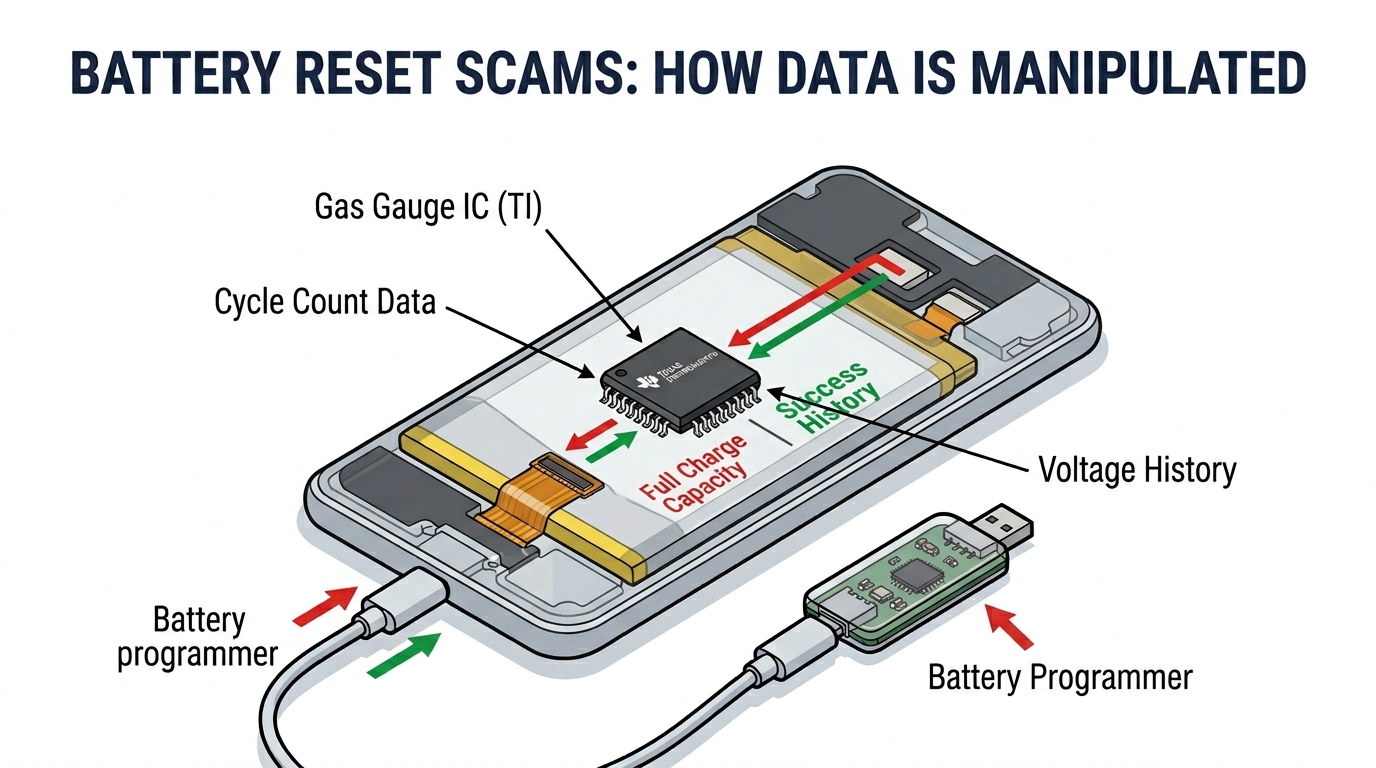
Every iPhone battery has a small Texas Instruments (TI) gas gauge IC that tracks charge cycles, voltage history, and capacity data. This chip communicates with iOS to display "Battery Health" in Settings. The data on this chip can be rewritten using a battery programmer (devices like JC B1/V1S, i2C, or JCID) that connect to the battery's flex cable connector.
What the reset does:
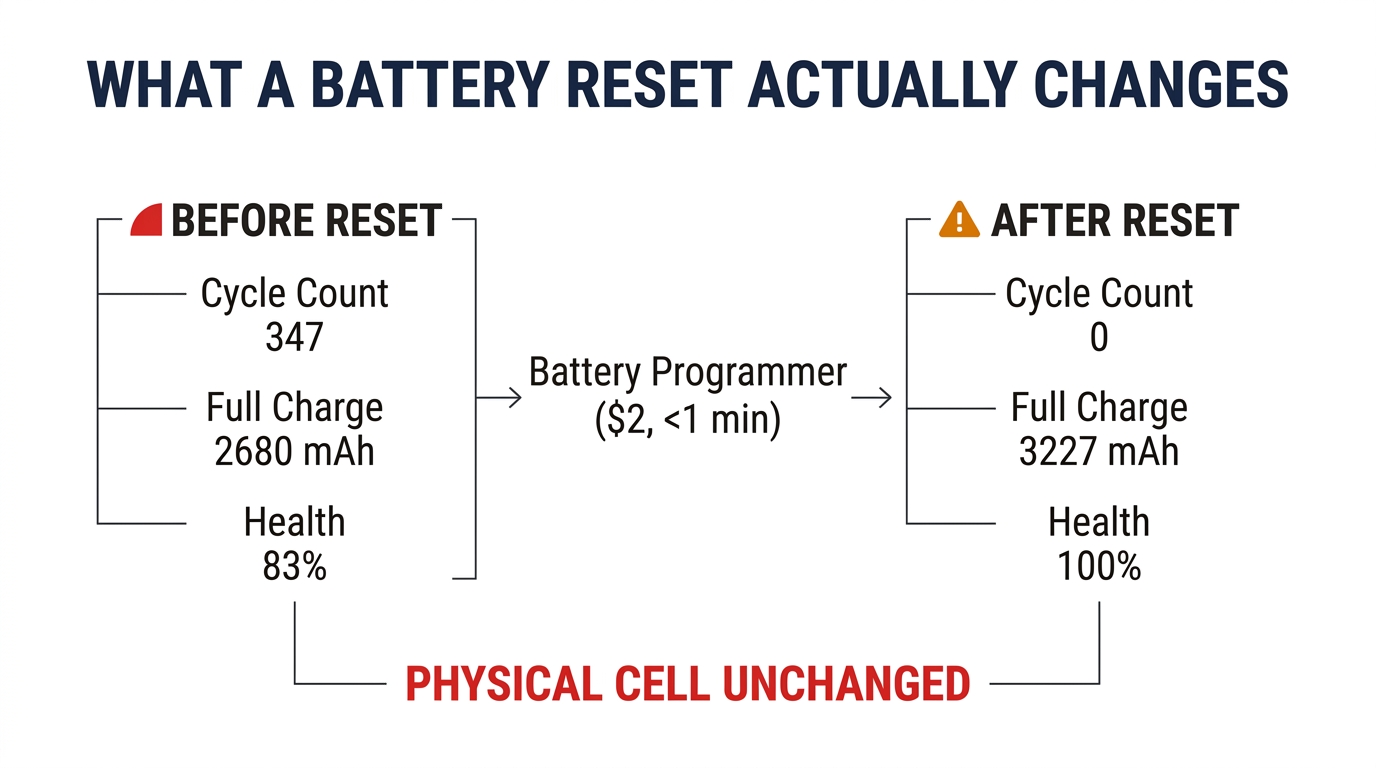
| Data Field | Before Reset | After Reset |
|---|---|---|
| Cycle count | 347 | 0 |
| Design capacity | 3,227 mAh | 3,227 mAh |
| Full charge capacity | 2,680 mAh | 3,227 mAh |
| Battery health (iOS display) | 83% | 100% |
The problem is obvious: the physical cell hasn't changed — only the chip's reported data has. The actual chemical capacity of the cell is still degraded. The customer gets a battery that shows 100% health but starts draining abnormally fast within weeks, leading to complaints and callbacks.
This is why software-reported data is not a verification method for wholesale buyers — it's just a label that anyone with a $30 programmer can rewrite.
4 Hardware Tests That Reveal Reset Batteries
Software lies. Hardware doesn't. These four checks catch what cycle count display can't.
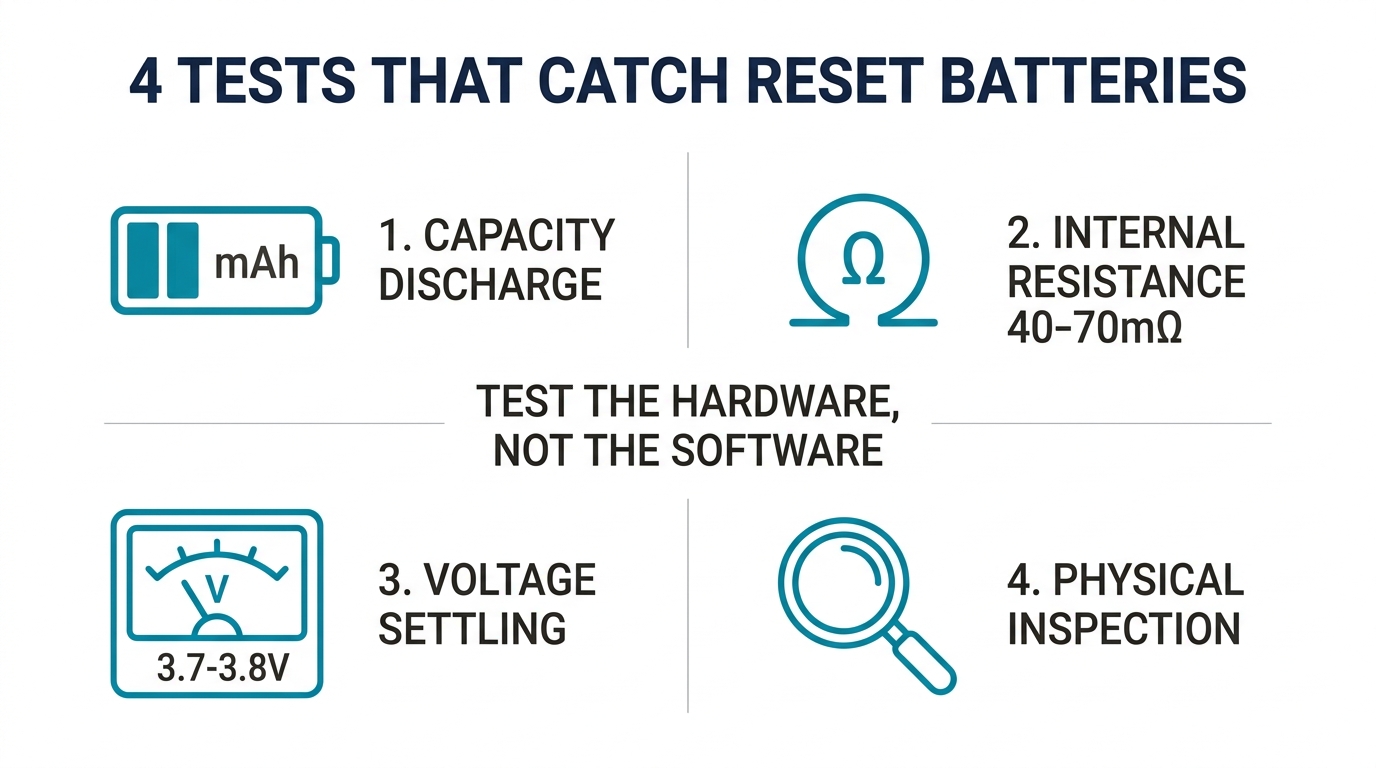
1. Actual Capacity Discharge Test
This is the single most reliable test. Use a battery capacity tester (like YZXStudio ZY1280 or similar USB load tester with logging) to fully discharge the battery from 100% to cutoff voltage and measure the actual mAh delivered.
- New iPhone battery: Should deliver 95–100% of its rated design capacity (e.g., 3,227 mAh for iPhone 13 → expect 3,060–3,227 mAh)
- Reset/used battery: Typically delivers 75–90% of rated capacity, despite showing 100% health in software
- Heavily degraded reset battery: Below 75% — these are the ones that generate customer complaints within the first week
Time cost: About 2–3 hours per battery for a full discharge cycle. Not practical for every unit, but critical for sample testing from a new batch or supplier.
2. Internal Resistance Measurement
Battery internal resistance increases as cells age. A new lithium-polymer cell should have low and consistent internal resistance. You can measure this with a battery tester that supports IR measurement, or with the battery programmer itself (many display IR readings).
- New cell: Typically 40–70 mΩ for iPhone batteries (varies by model)
- Used/aged cell: 80–150+ mΩ
- Red flag: If cycle count reads 0 but internal resistance is above 90 mΩ, the data has almost certainly been reset
Internal resistance is harder to fake because it's a physical property of the cell chemistry, not a software value.
3. Voltage Settling Behavior
A genuinely new battery that's been stored properly (at ~50% charge, as manufacturers recommend) will show a resting voltage around 3.7–3.8V when you first receive it.
Watch for these red flags:
- Resting voltage below 3.5V: The cell has been deeply discharged at some point — either from extended use or poor storage. New cells from reputable manufacturers don't ship this low.
- Voltage drops rapidly under light load: Connect a small load (100–200mA) and watch if voltage sags more than 0.1V within seconds. Excessive sag under light load signals an aged cell.
This test takes under a minute with a multimeter and catches the most obvious reset batteries.
4. Physical Inspection of the Cell and Wrapper
Old cells that have been reset and repackaged often show physical signs:
- Wrapper condition: New batteries have crisp, smooth shrink-wrap with no wrinkles, bubbles, or re-sealed edges. Rewrapped cells often show subtle edge irregularities or slightly different wrapper material.
- Adhesive pull tabs: OEM batteries have specific pull tab colors and adhesive patterns. If the pull tab looks replaced or the adhesive pattern doesn't match known OEM specs, the cell may have been extracted from another device and repackaged.
- Swelling or deformation: Even slight puffiness indicates chemical degradation. No new cell should show any swelling. Check by placing the battery on a flat surface — it should sit completely flat with zero wobble.
- Date codes: Some battery cells have production date codes printed or embossed on the cell (under the wrapper, sometimes visible through it). A date code from 2+ years ago on a "new" battery is a clear mismatch.
Batch-Level Red Flags for Wholesale Buyers
Individual testing matters, but when you're receiving 50–200 batteries per shipment, pattern recognition across the batch is equally important.
Signs the batch is genuinely new stock:
- All batteries show consistent resting voltage (within 0.05V of each other)
- Wrapper quality is uniform across the batch — same material, same print quality, same pull tab style
- Capacity discharge tests on 3–5 random samples all land within 95–100% of rated capacity
- Batteries were stored at approximately 50% charge (3.7–3.8V resting), consistent with manufacturer storage guidelines
Signs the batch may contain reset or mixed-age cells:
- Resting voltage varies widely across the batch (some at 3.5V, others at 3.9V) — suggests cells were sourced from different aged devices
- Wrapper quality varies within the same batch — different shades, different adhesive patterns
- Capacity test results on random samples vary by more than 10% from each other
- Cycle count on every single battery reads exactly 0 with exactly 100% health — genuinely new batteries from the same manufacturing batch will show minor variations (99–100% health, 0–1 cycles from factory QC testing)
Want to verify battery quality before committing to a bulk order? We can send sample batteries with full test data — capacity readings, IR measurements, and grade documentation. Request battery samples here.
How to Protect Yourself in Repeat Orders
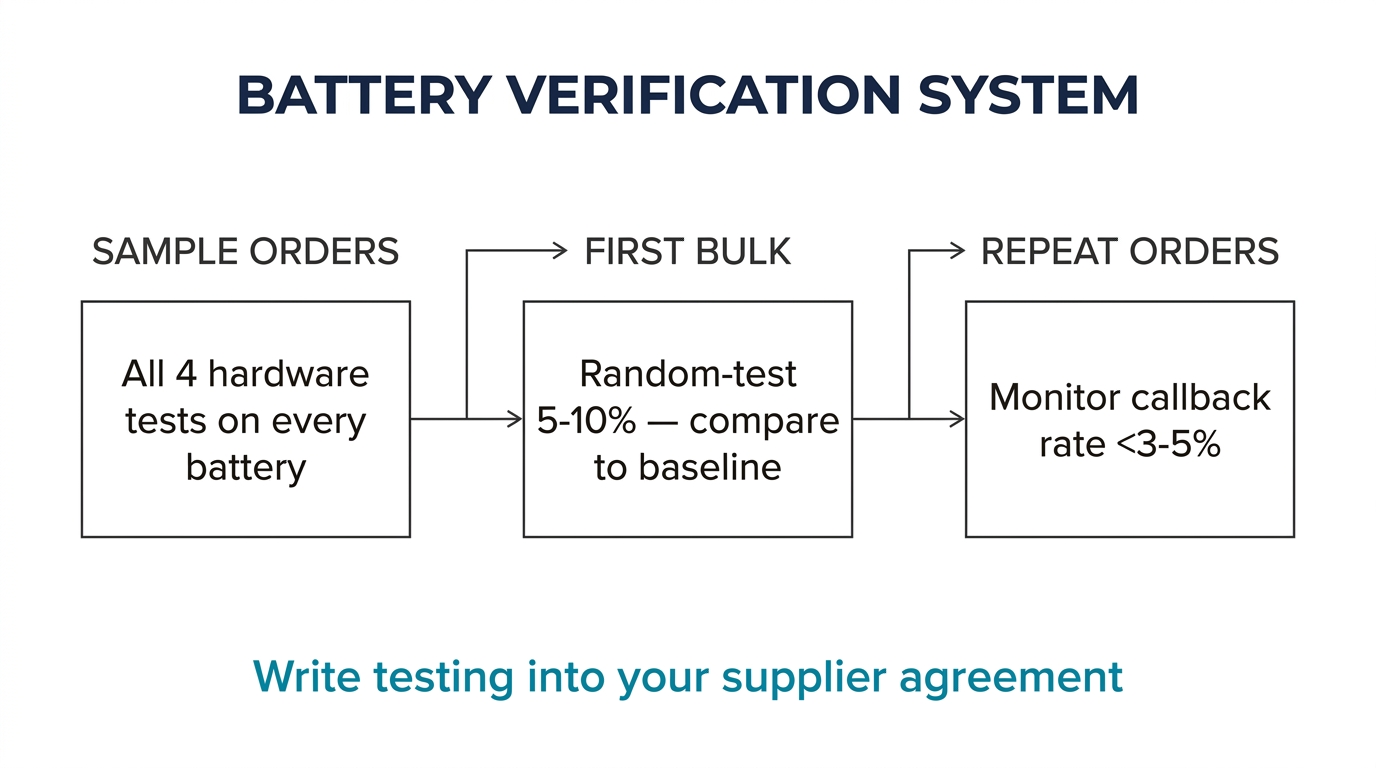
Catching a bad batch once is a lesson. Preventing it from happening again is a system. Here's how to build battery verification into your ordering process:
For sample/test orders: Run all 4 hardware tests on every sample battery. Record capacity, IR, voltage, and physical condition. These become your baseline reference numbers for that supplier's "new" grade.
For first bulk orders: Random-test 5–10% of the batch using discharge capacity and IR measurement. Compare against your sample baseline. If capacity drops more than 5% from baseline, or IR increases more than 20%, flag the batch immediately.
For repeat orders: Monitor your customer callback rate on battery replacements. This is your most honest long-term metric. If callback rate on batteries from a specific supplier starts creeping above 3–5% within the first 30 days post-installation, something has changed in their sourcing — run a full test on the next batch.
Write it into your agreement: Tell suppliers upfront that you test incoming batteries with capacity discharge and IR measurement. This alone filters out suppliers who rely on reset batteries, because they know their product won't pass hardware testing. Legitimate suppliers welcome this — it protects them from being confused with the reset-and-resell operators.
For more on structuring repeat order verification, see our guide on what to check before placing a repeat order with the same supplier.
Frequently Asked Questions
Does Apple's "genuine parts" battery warning mean the battery is fake?
Not necessarily. Starting with iPhone 11, iOS shows a "service" warning for any battery not installed through Apple's official process, even if the cell itself is genuine OEM. The warning tells you the battery wasn't paired by Apple's software — it doesn't tell you whether the cell is new, used, or reset. For wholesale buyers, hardware testing is far more reliable than iOS warnings.
Can a reset battery still perform well enough for customers?
It depends on how much actual capacity remains. A reset battery with 90%+ true capacity might work acceptably for a few months. But the customer paid for — and expects — a genuinely new battery. When it starts degrading noticeably faster than a real new cell, you'll get the callback. The cost of that callback (labor, replacement part, customer trust) almost always exceeds the savings from buying cheaper reset stock. See our analysis of battery complaints after replacement for the real-world callback patterns.
How much does it cost to test batteries properly?
A decent USB capacity tester with logging costs $20–40. A multimeter for voltage checks costs $10–15. Battery programmers that also display IR readings cost $50–100 (and you may already own one for data transfer). The total investment is under $150 — less than the cost of callbacks from a single bad batch of 50 reset batteries.
The Real Cost of Ignoring Battery Reset Scams
Battery reset scams persist because they're cheap to execute and hard to detect with software alone. A $2 reset job turns a $3 used cell into a $7 "new" battery. At wholesale scale, that margin is attractive enough that some suppliers build their entire business model around it.
As a buyer, your defense is simple: test the hardware, not the software. A $30 capacity tester and 10 minutes of spot-checking per batch will catch what a 100% health reading never will.
The best suppliers will tell you exactly what grade of battery they sell — new A-grade cells, B-grade cells with 90%+ capacity, or refurbished with honest cycle history. The worst suppliers will sell everything as "new, 0 cycles." Your testing is what separates the two.
Looking for batteries with verified capacity and honest grading? PRSPARES tests every battery batch with discharge capacity and IR measurement before shipping. Request a quote with test data included.
Related reading: Common iPhone Battery Quality Problems Wholesale Buyers Should Check | Buying iPhone Batteries in Bulk for Your Repair Business