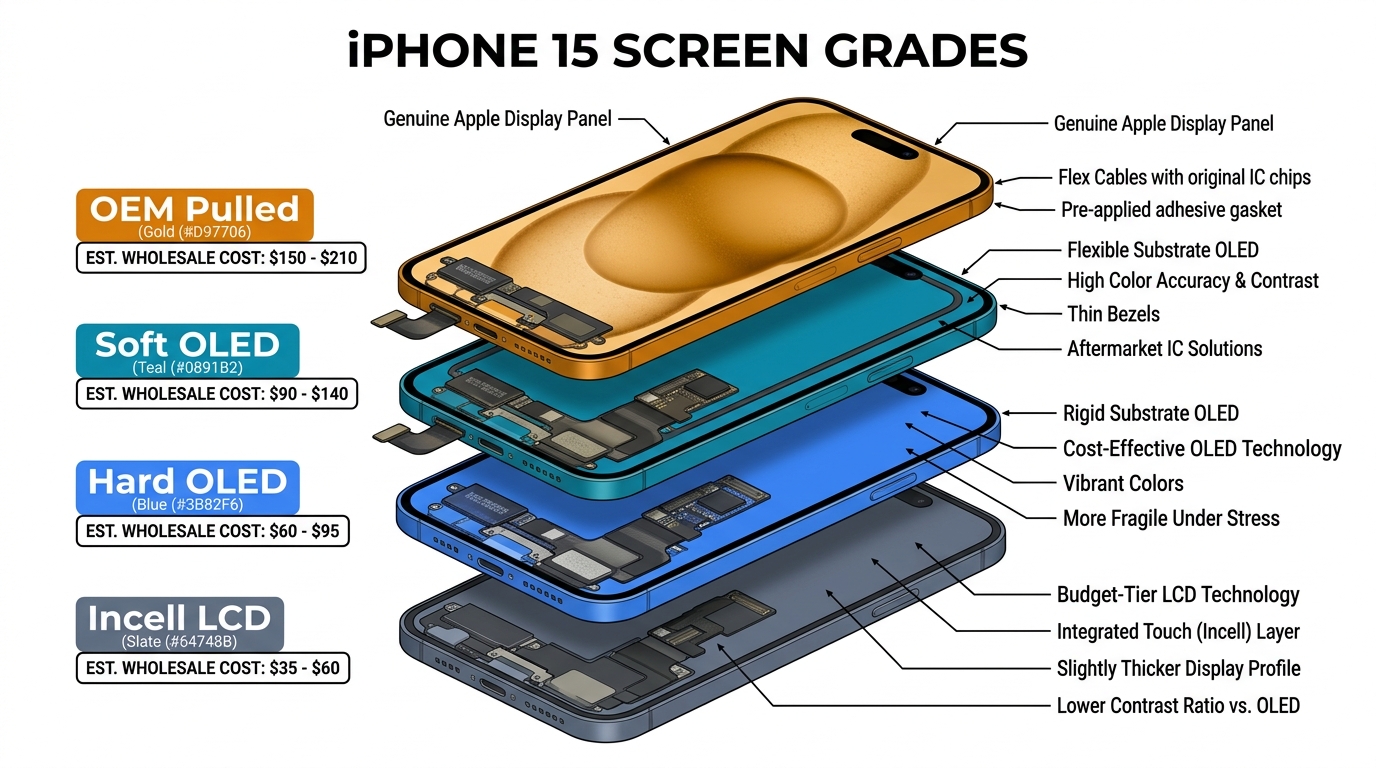

iPhone 15 Screen Replacement Cost: How Repair Shops Should Price It in 2026

The UK market is currently charging £80–£165 for standard iPhone 15 screen replacement at independent shops, and £145–£379 for Pro models depending on grade. Apple's own service runs £289–£429 depending on model. That spread exists because shops are using different screen grades — and the pricing decisions you make around those grades directly determine your margins and your callback rate.
This guide is for repair shops setting prices, not customers comparing quotes. It covers what the market currently charges, what wholesale parts cost, the margin math by grade, and how to handle the iPhone 15 Pro pricing conversation without losing the job.
Sourcing Replacement Screens in Bulk?
Incell / Hard OLED / Soft OLED grades — wholesale pricing, grade comparison on request.
Get Wholesale QuoteWhat UK Shops Actually Charge in 2026
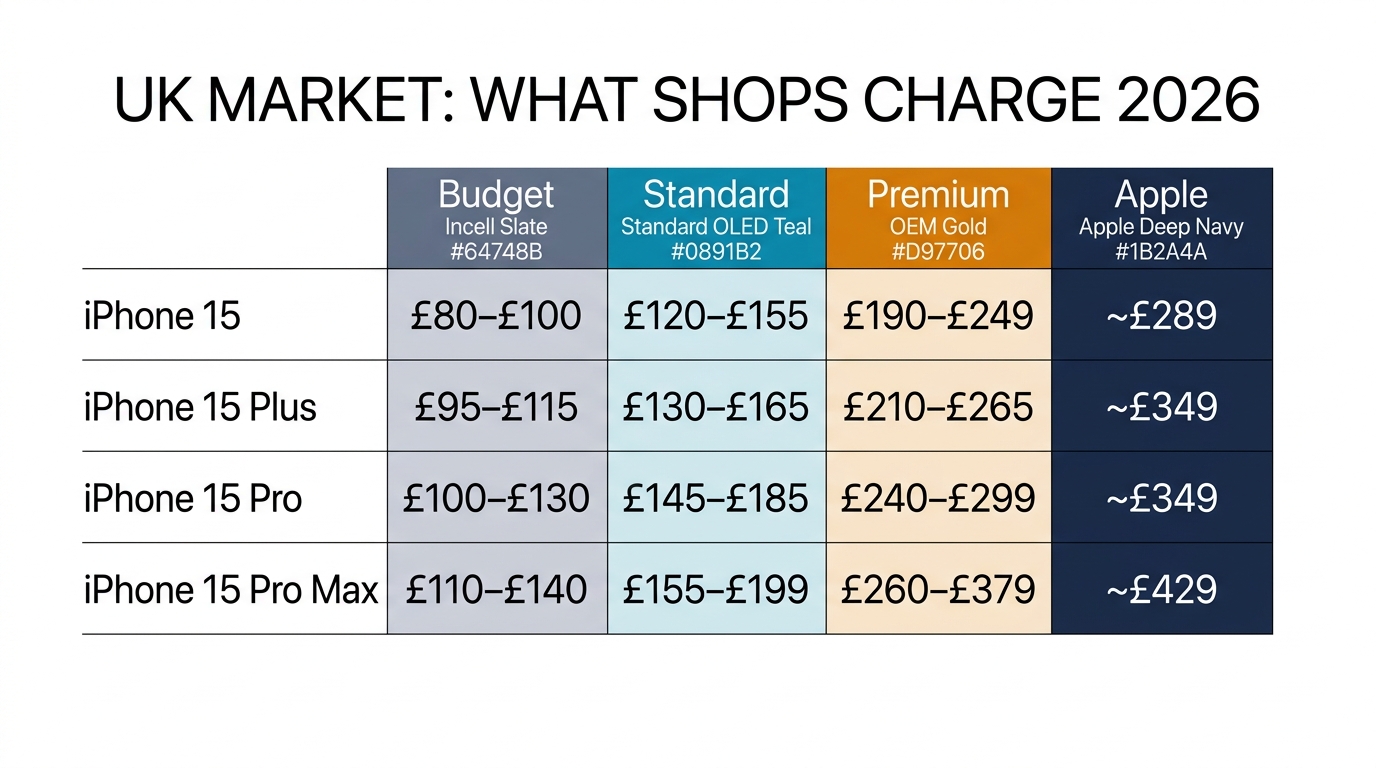
Based on publicly listed prices from UK repair shops (as of early 2026):
| Model | Budget (Incell/LCD) | Standard (Hard/Soft OLED) | Premium (OEM/Genuine) | Apple Store |
|---|---|---|---|---|
| iPhone 15 | £80–£100 | £120–£155 | £190–£249 | ~£289 |
| iPhone 15 Plus | £95–£115 | £130–£165 | £210–£265 | ~£349 |
| iPhone 15 Pro | £100–£130 | £145–£185 | £240–£299 | ~£349 |
| iPhone 15 Pro Max | £110–£140 | £155–£199 | £260–£379 | ~£429 |
See the full four-grade comparison with live wholesale prices: iPhone Screen Grade Guide
Sources: iSmash (£149 iPhone 15 base OLED), iDoctor UK (£109.99 LCD / £289.99 OEM), celltechmobilerepairs.co.uk (grade-based pricing for Pro models), repairmycrack.co.uk (independent average ~£233).
The budget LCD tier is more compressed than on older models — partly because Incell on an OLED-native phone is a harder sell, and shops have learned to position it more carefully. The gap between standard OLED and Apple Store pricing is wider on the Pro models, which creates more room to price well without feeling like you're undercutting on quality.
What Parts Cost You at Wholesale
You can't set profitable prices without knowing your true parts cost. Wholesale pricing for iPhone 15 screens at 50+ unit quantities (USD to GBP at ~0.80):
| Grade | Wholesale cost (approx GBP) | What you're buying |
|---|---|---|
| Incell LCD | £23–£26 | Non-OLED, lower brightness, 60Hz |
| Hard OLED | £40–£45 | Rigid OLED, 60Hz, more fragile than Soft OLED |
| Soft OLED | £48–£53 | Flexible OLED, closest to OEM quality, 60Hz (standard) |
| Soft OLED LTPO (15 Pro) | £48–£55 | Flexible OLED with 120Hz ProMotion support |
| Soft OLED LTPO (15 Pro Max) | £100–£115 | Larger panel; Pro Max LTPO costs significantly more |
| OEM Pulled/Refurb | £83–£108 | Original Apple panel, native True Tone |
Source: iphonelcd.net at 50+ unit quantities. LTPO pricing from REPART/Kelai JK supplier listings. Note: iPhone 15 Pro Max LTPO Soft OLED runs ~$130–$140 at wholesale — roughly double the Pro — factor this into Pro Max pricing separately.
The jump from Incell (£23–£26) to Soft OLED (£48–£53) roughly doubles parts cost — but retail prices don't double. That's why your Good/Better/Best tier structure needs to be deliberate, not just cost-plus.
The Margin Math by Grade
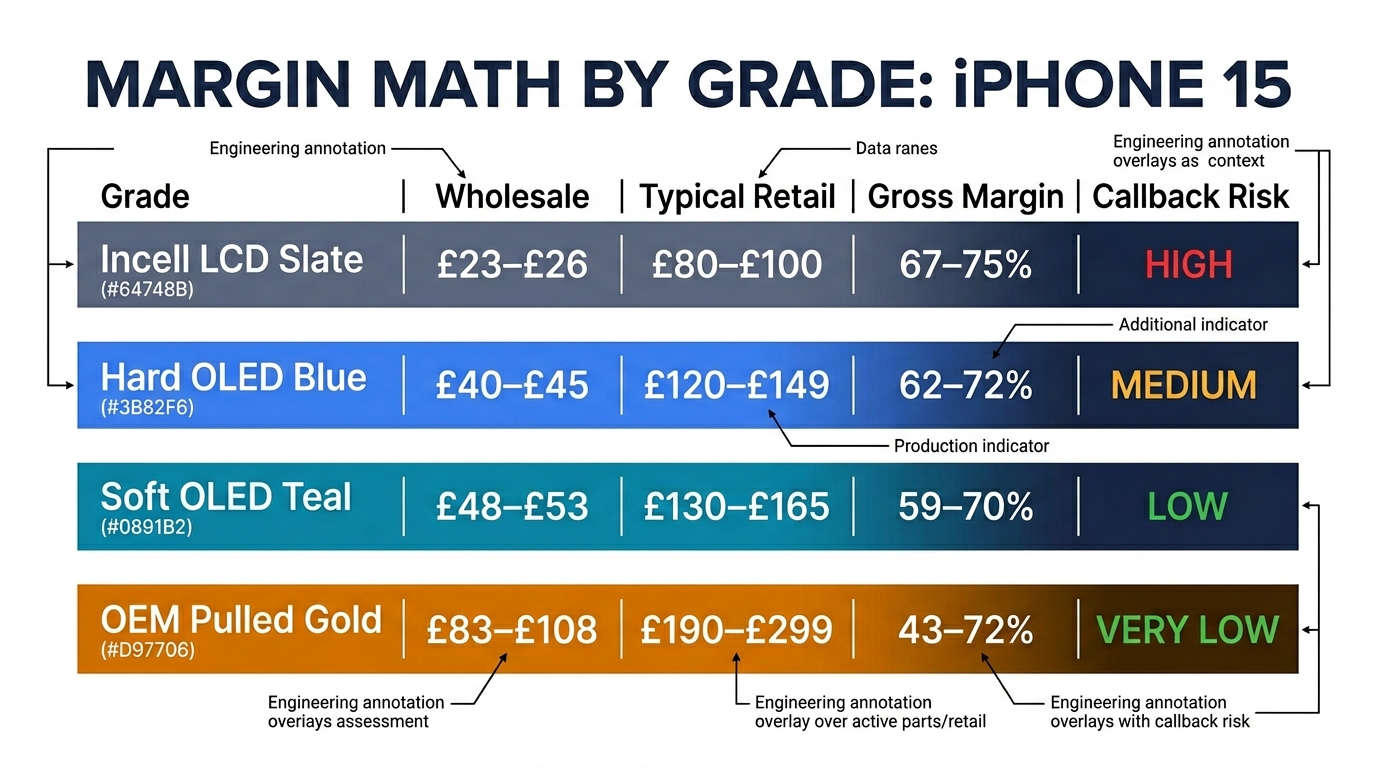
Here's how the numbers shake out when you map wholesale cost against typical UK shop retail pricing:
| Grade | Wholesale cost | Typical retail | Gross margin | % margin | Callback risk |
|---|---|---|---|---|---|
| Incell LCD | £23–£26 | £80–£100 | £54–£77 | ~67–75% | High |
| Hard OLED | £40–£45 | £120–£149 | £75–£109 | ~62–72% | Medium |
| Soft OLED | £48–£53 | £130–£165 | £77–£117 | ~59–70% | Low |
| Soft OLED LTPO (Pro) | £55–£65 | £155–£185 | £90–£130 | ~58–70% | Low |
| OEM Pulled | £83–£108 | £190–£299 | £82–£216 | ~43–72% | Very Low |
In percentage terms, Incell gives the highest gross margin — but that doesn't make it the best choice. The absolute margin on Soft OLED is comparable or better, the callback rate is significantly lower, and customers are more satisfied. Shops that compete purely on Incell pricing are buying volume at the cost of quality complaints and repeat labour.
OEM-pull gives the widest range. At the premium end (£299 for a Pro), the absolute margin is excellent. But OEM-pull sourcing requires care — a pulled screen from a heavily used device may have degraded OLED, and this shows up as burn-in or brightness drop within months. Source from suppliers who test pulled panels for brightness and pixel integrity.
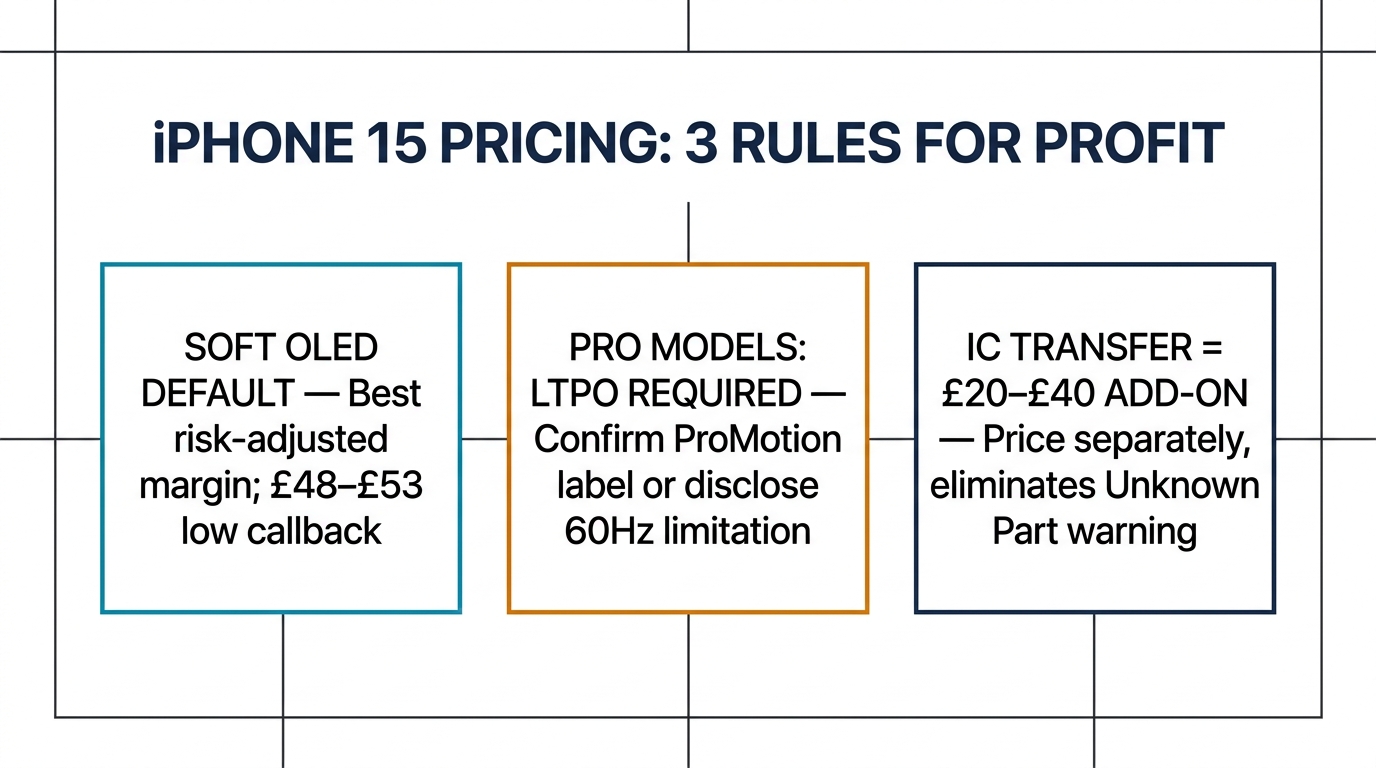
The strongest position for most shops: Soft OLED as the default offering, Incell available for budget-conscious customers who explicitly ask, OEM-pull as an upsell for customers who want "genuine quality" and are willing to pay for it.
iPhone 15 Pro Pricing: The 120Hz Conversation
The Pro models require a different pricing conversation because they're worth more to the customer — and the screen replacement is genuinely more complex.
The iPhone 15 Pro and Pro Max both use LTPO OLED displays with adaptive 1–120Hz ProMotion. This is the hardware behind the fluid scrolling that Pro users specifically pay for. When you're pricing a Pro screen replacement, the grade decision has more weight:
- Hard OLED on a Pro: the phone works fine, but ProMotion is gone — it drops to 60Hz fixed. Some customers won't notice, but the ones who specifically bought the Pro for the display will. This should be disclosed and reflected in price: you're charging less because you're delivering less.
- Soft OLED without LTPO: also locks at 60Hz. Not all Soft OLED panels on the market are LTPO — check supplier specs explicitly.
- Soft OLED with confirmed LTPO: restores full 1–120Hz ProMotion. This is the correct part for Pro customers who want what they had before.
For repair shops, this creates a two-tier pricing structure for Pro models:
- Standard repair (Hard OLED or non-LTPO Soft OLED): £145–£175. Customers are told upfront the display will operate at 60Hz.
- Full ProMotion restoration (LTPO-grade Soft OLED or OEM-pull): £185–£299. Positioned as the complete repair that preserves what made the Pro worth buying.
Don't assume customers won't pay the premium. A customer with a £1,100+ iPhone 15 Pro Max who cares enough about the display to bring it in for repair is often the exact customer who will pay an extra £30–£50 to get the 120Hz back.
How to Explain iPhone 15 Pricing to Customers
When a customer asks why their iPhone 15 screen costs more than their old 13, here are three points that land cleanly at the front desk:
"The parts are newer, so they cost more." Aftermarket supply for the iPhone 15 is still maturing — panels haven't yet reached the volume that brings prices to iPhone 13 levels. Incell for a 13 runs about £15–£18 at wholesale; iPhone 15 Incell is still £23–£26. It'll compress over the next year or so as supply grows.
"The port design added labour time." The iPhone 15's USB-C assembly is more integrated than Lightning — any repair opening the bottom takes longer. That labour is real and belongs in the quote.
"iOS now flags screen replacements, so we do extra work to prevent that." IC transfer — moving the original screen's chip onto the new panel — adds 20–30 minutes and specialist equipment, but it eliminates the "Unknown Part" notification and restores True Tone. Price it explicitly as an add-on (£20–£40) rather than absorbing it into the base repair cost. If you have access to Apple Repair Assistant, OEM-pull screens can also be calibrated via that route — the "Used" label remains, but full functionality is restored.
For more on IC transfer and the Unknown Part warning, see our iPhone Unknown Part warning and IC transfer guide.
Three Pricing Mistakes to Avoid
Pricing Incell the same as Hard OLED. Customers who later discover they got an LCD on an OLED phone feel shortchanged — even if the price was fair. If you're offering Incell as a budget option, the pricing should be lower and the conversation should be clear.
Not disclosing grade when quoting over the phone. Under UK consumer law, failing to disclose material information — like fitting a non-genuine part — can constitute a misleading omission. A customer quoted £130 and not told they're getting an aftermarket OLED will often dispute the bill when they see the "Unknown Part" notification. Price transparency protects you commercially and reduces legal exposure.
Competing on price for Pro model repairs with the wrong part. If you're quoting the lowest price on an iPhone 15 Pro repair by using Hard OLED, you're likely to get the job and lose the customer. A technician who charges £165 for a Pro repair and delivers 60Hz on a phone the customer bought specifically for 120Hz will hear about it. Either price the Pro repair at the level the correct part requires, or be explicit about what the customer is getting.
For Shops Ordering iPhone 15 Screens at Wholesale
The pricing above assumes you're sourcing properly. For Soft OLED on Pro models, confirm with your supplier that the panel is LTPO-grade and specifies ProMotion compatibility — not all Soft OLED panels in the market are. Suppliers like REPART and Kelai JK label their Pro-compatible panels explicitly as LTPO or 120Hz-ready.
For IC transfer, the screen must have solder-ready IC pads. Most Incell screens don't support this; Hard OLED varies by supplier (some, like REPART's Pro range, do support IC transfer — check the spec sheet). Verify compatibility before ordering if IC transfer is part of your service offering.
Need wholesale pricing for iPhone 15 screens by grade? Request a quote or sample order →
Advanced Notes for Shop Owners
iPhone 15 Pro vs Pro Max: price them differently. The LTPO Soft OLED for the Pro Max costs roughly £100–£115 at wholesale — significantly more than the Pro's £48–£55. If you're using a single "Pro" price for both models, you're either over-charging Pro customers or under-charging Pro Max customers. Split your tier pricing by model on your quote sheet.
Test Incell before it leaves the bench. The standard bench test (brightness, touch, colour) won't catch every fault on Incell panels fitted to OLED-native iPhones. Before returning any iPhone 15 with an Incell screen, run a multi-touch stress test and check for boot stability over 5–10 minutes. There are reported cases of Incell triggering reboot loops on first real-world use — catching this on the bench is far cheaper than a callback.
The "Used" notification has a customer retention angle. A customer who sees "Used Part" in Settings and wasn't warned will assume something went wrong. A customer who was told in advance — "the part is genuine Apple hardware pulled from another device, iOS will flag it as Used, that's normal" — is usually fine with it. Proactive communication on OEM-pull repairs measurably reduces callbacks on this specific issue, and positions your shop as more transparent than competitors who say nothing.
Related: iPhone 15 Screen Replacement: Grades, IC Transfer, and ProMotion — Full Guide · iPhone 15 Repair Cost Benchmarks and Grade Comparison · Wholesale iPhone Screen Pricing Guide