
Which iPhone Models Bring the Best Repair ROI for Small Shops in 2026

Not every iPhone repair is worth your time. Some models deliver $50+ margins in under 20 minutes. Others eat up 40 minutes of bench time and barely cover your overhead. If you run a small repair shop doing 8-15 jobs a week, knowing which models to prioritize — and which to turn away — directly determines whether you're profitable or just busy.
This guide breaks down the most profitable iPhone to repair in 2026, model by model, with real wholesale parts costs, typical repair pricing, and margin-per-minute calculations. No guesswork. Just numbers.
Need Wholesale Phone Repair Parts?
Factory-direct pricing from Shenzhen — OEM-quality screens, batteries & small parts.
Get Wholesale QuoteWhy ROI Per Model Matters More Than Repair Volume
A shop that does 12 repairs a week on high-margin models will outperform one doing 20 repairs on low-margin ones. The math is simple: if your average margin is $45 instead of $25, that's a $240 weekly difference at the same volume. Over a year, that's $12,000+ in extra profit — just from choosing which jobs to prioritize.
The best iPhone to repair for profit isn't always the newest model. It's the one where parts are cheap, demand is steady, and the repair itself is fast. That sweet spot shifts every year as older models phase out and newer ones become repairable with aftermarket parts.
iPhone Repair ROI Breakdown: Model by Model
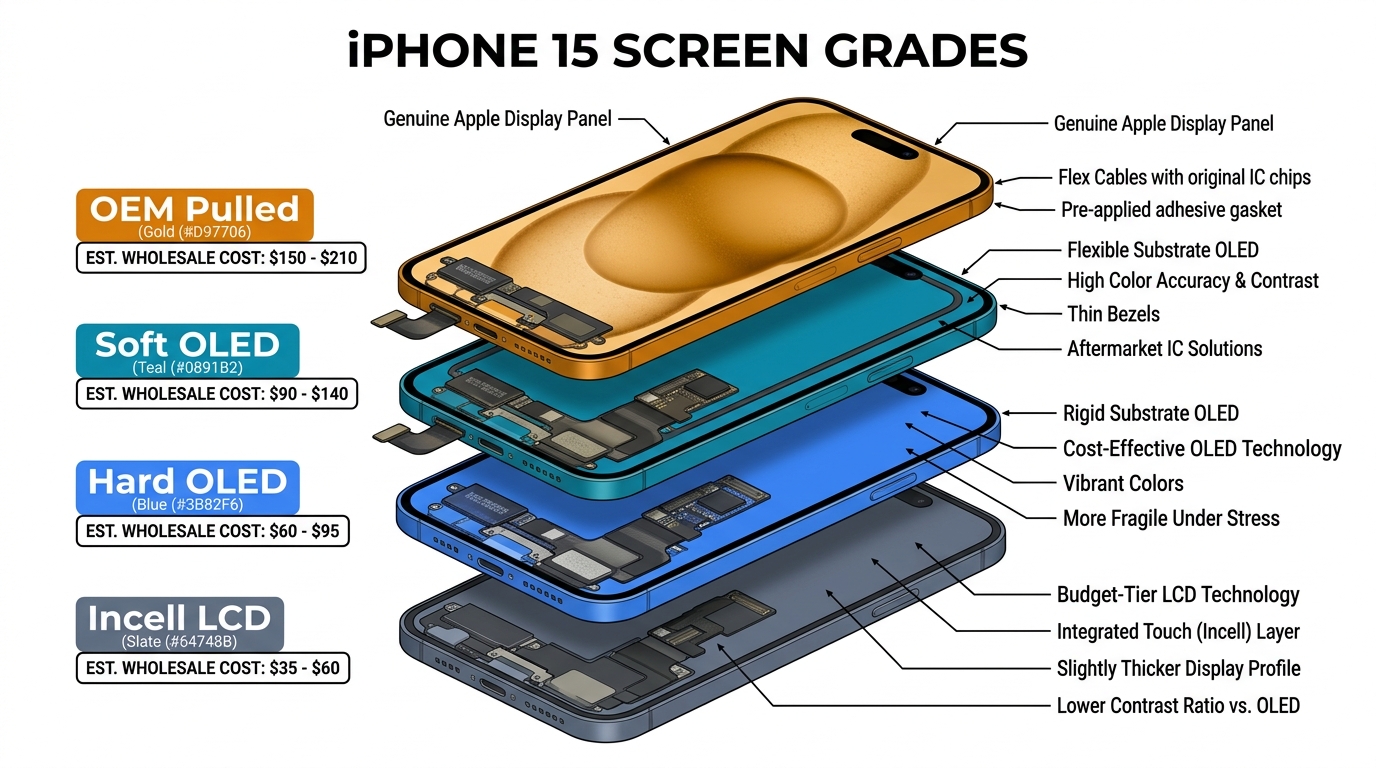
Let's get into the numbers. The data below is based on Q1-Q2 2026 wholesale pricing for Incell-quality screens and standard replacement batteries, paired with average repair pricing across independent shops in the US, UK, and mixed global markets.
Screen Replacement ROI Table
| Model | Wholesale Screen Cost | Typical Repair Price | Gross Margin | Repair Time | Margin Per Minute |
|---|---|---|---|---|---|
| iPhone 8/SE2 | $5-7 | $30-40 | $25-33 | 15-20 min | $1.45/min |
| iPhone X/XS | $8-12 | $40-55 | $32-43 | 20-25 min | $1.67/min |
| iPhone XR | $7-10 | $35-50 | $28-40 | 20-25 min | $1.51/min |
| iPhone 11 | $8-11 | $40-60 | $32-49 | 20-30 min | $1.62/min |
| iPhone 12 | $9-12 | $45-65 | $36-53 | 25-30 min | $1.62/min |
| iPhone 13 | $13-18 | $50-70 | $37-52 | 25-35 min | $1.45/min |
| iPhone 14 | $15-22 | $55-80 | $40-58 | 30-40 min | $1.40/min |
| iPhone 15 | $22-30 | $65-95 | $43-65 | 30-40 min | $1.54/min |
| iPhone 16 | $30-42 | $80-120 | $50-78 | 35-45 min | $1.56/min |
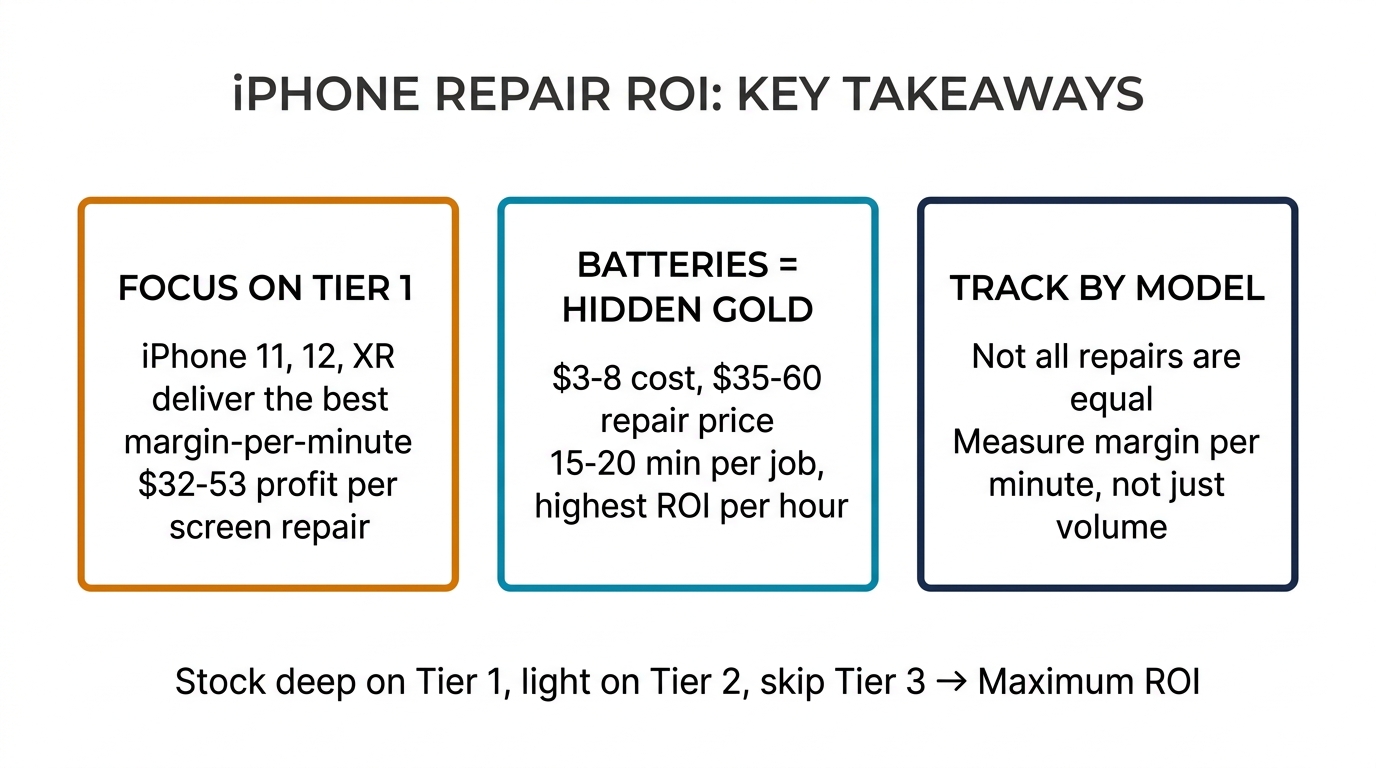
A few things jump out immediately. The iPhone X/XS and iPhone 11 deliver the best margin-per-minute ratio, which makes them the most profitable iPhone to repair on a per-job basis when you account for bench time. The iPhone 16 has the highest raw margin, but the longer repair time and higher parts investment bring its efficiency down.
Battery Replacement ROI Table
| Model | Wholesale Battery Cost | Typical Repair Price | Gross Margin | Repair Time | Margin Per Minute |
|---|---|---|---|---|---|
| iPhone 8/SE2 | $2.50-4 | $30-40 | $27-36 | 10-15 min | $2.52/min |
| iPhone X/XS | $3-5 | $35-45 | $32-40 | 15-20 min | $2.06/min |
| iPhone XR/11 | $3-5 | $35-50 | $32-45 | 15-20 min | $2.20/min |
| iPhone 12 | $3.50-6 | $35-55 | $31-49 | 15-20 min | $2.29/min |
| iPhone 13 | $4-7 | $40-55 | $33-48 | 15-20 min | $2.31/min |
| iPhone 14 | $5-8 | $40-60 | $35-52 | 15-25 min | $2.18/min |
| iPhone 15 | $6-9 | $45-60 | $36-51 | 20-25 min | $1.93/min |
| iPhone 16 | $7-11 | $50-65 | $39-54 | 20-25 min | $2.07/min |
Battery replacements are the highest-ROI service you can offer. Period. With parts costing $3-8 and repairs taking 15-20 minutes, you're looking at $2+ per minute of bench time across nearly every model. If you're not pushing battery replacements, you're leaving the easiest money on the table. For a deeper look at battery costs and pricing strategy, check out our battery replacement cost breakdown for 2026.
The Profit Tier List: Where to Focus Your Inventory
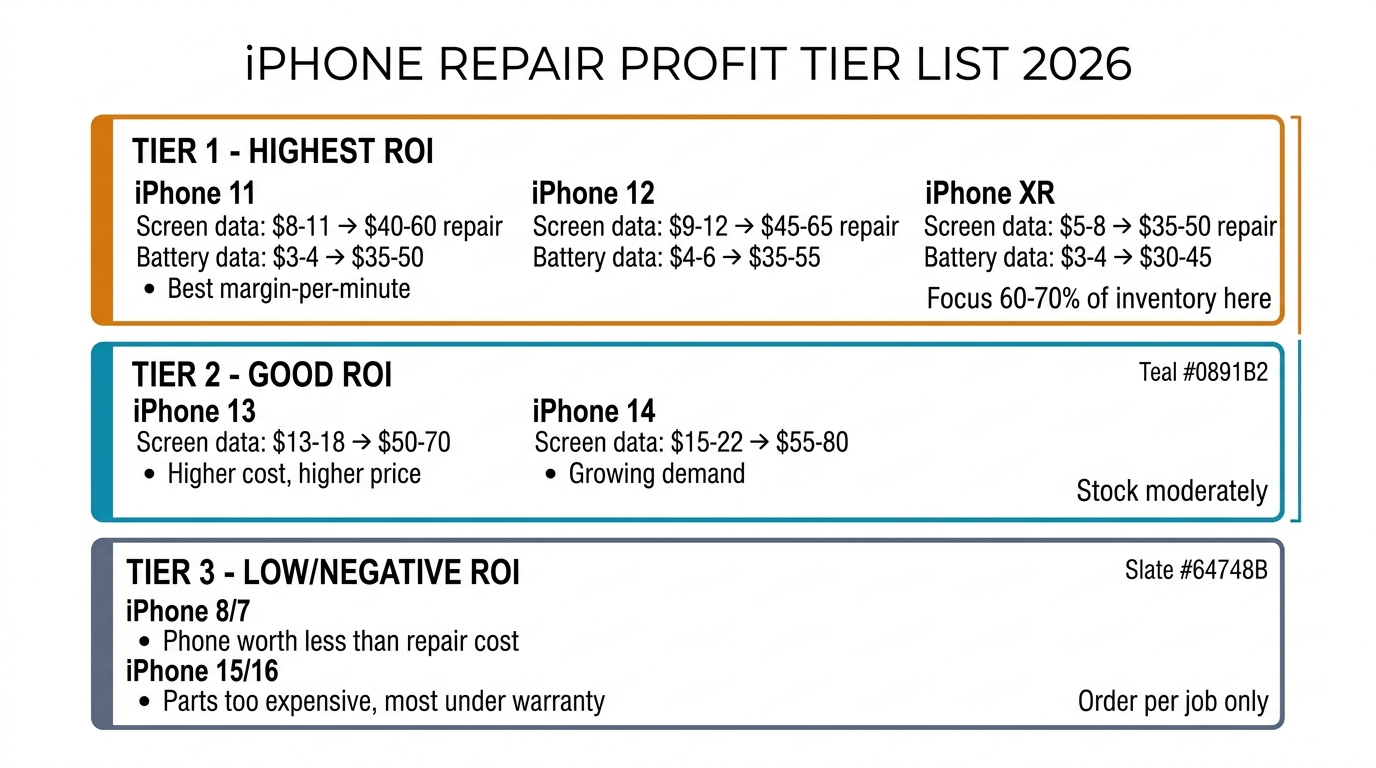
Based on the ROI tables above, here's how each model stacks up for iPhone repair shop profitability in 2026.
Tier 1: High Demand + High Margin (Stock These First)
iPhone 11, iPhone 12, iPhone 13
These three models are the bread and butter for any small repair shop right now. The iPhone 11 is still the most repaired phone globally — three years after its production ended, millions are still in active use. Parts are cheap and widely available. The iPhone 12 and 13 sit right behind it in repair volume.
Demand is strong because these are the phones people are still using but not upgrading. A cracked iPhone 12 screen is worth fixing when a new phone costs $800+. Your customers do that math, and they come to you.
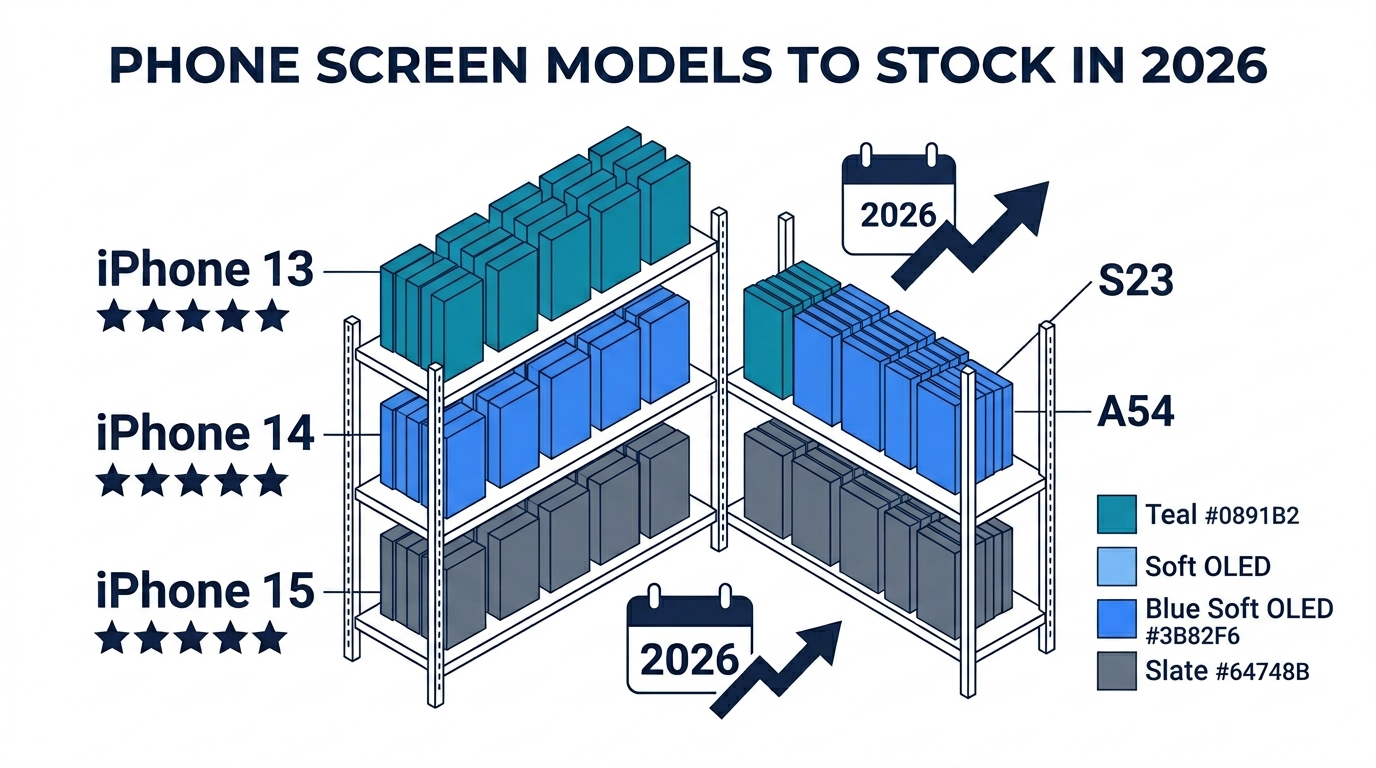
Stock at least 3-5 screens and 5-8 batteries for each of these models at all times. If you're unsure how to structure your first parts order, our first wholesale order templates walk you through exact quantities by shop size.
Tier 2: Good Margin, Moderate Demand (Stock Selectively)
iPhone X/XS, iPhone XR, iPhone 14
The iPhone X and XS are aging out but still show up regularly. Their margin-per-minute is actually the best in the lineup for screens. The catch: demand is declining quarter over quarter. Stock 1-2 screens and a handful of batteries — enough to handle walk-ins without sitting on dead inventory.
The iPhone 14 is entering its repair sweet spot. Warranty periods have ended for early buyers, and aftermarket parts are now priced competitively. Expect this model to move into Tier 1 by late 2026.
Tier 3: Low Margin or Low Demand (Order On-Demand)
iPhone 8/SE2, iPhone 15, iPhone 16
The iPhone 8 and SE2 are at end of life. Repair demand still trickles in — mostly battery swaps — but customers increasingly decide the phone isn't worth fixing. The margin is fine, but volume doesn't justify keeping stock.
iPhone 15 and 16 are the opposite problem. Demand exists, but parts cost $22-42 per screen. That's real capital tied up in inventory. For a small shop, ordering these on-demand from a reliable supplier with fast shipping makes more sense than stocking them. Your margin per job is good, but the investment risk is higher if a part sits on your shelf for weeks.
For a broader stocking strategy beyond just iPhones, see our complete small shop stock guide.
Which iPhone Is Most Repairable?
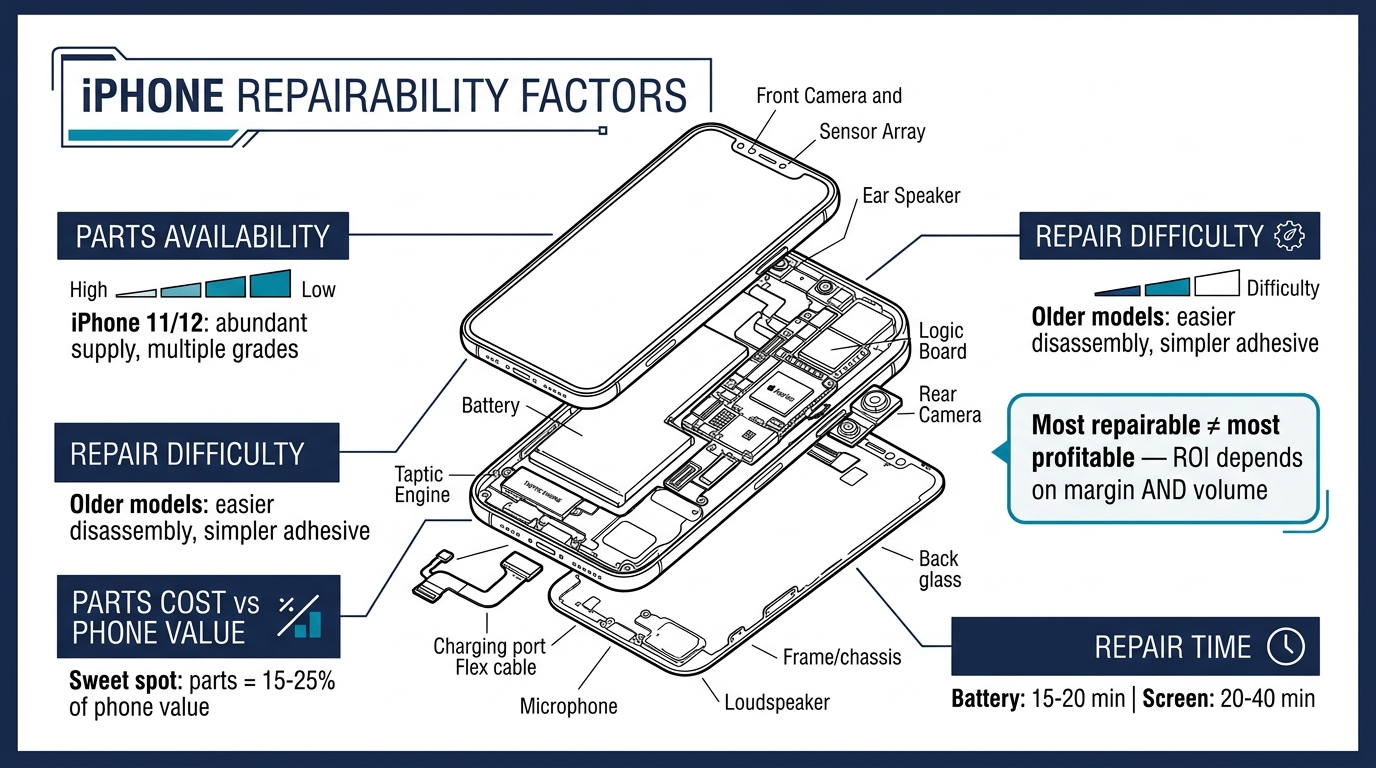
Repairability and profitability aren't the same thing, but they overlap. The iPhone 11 through 13 series are the most repairable iPhones in circulation. Apple used similar internal layouts across these generations, and the aftermarket parts ecosystem is mature. Screen calibration is straightforward, battery pull tabs work reliably, and there are fewer adhesive-heavy components compared to the iPhone 14+ lineup.
The iPhone 14 introduced a redesigned internal frame that made some repairs slightly more involved. The iPhone 15 and 16 use more integrated components, which means certain repairs (like back glass) require specialized equipment. For screen and battery work — which accounts for 75-80% of all repair jobs — every model from iPhone 8 onward is manageable with standard tools.
How Much Money Can You Make Repairing iPhones?
Let's run real numbers for a small shop.
Small shop scenario: 10 repairs per week
- 6 screen replacements (average margin: $42)
- 4 battery replacements (average margin: $38)
- Weekly gross margin: $252 + $152 = $404/week
- Monthly gross margin: $1,616/month
Mid-size shop scenario: 30 repairs per week
- 18 screen replacements (average margin: $44)
- 12 battery replacements (average margin: $40)
- Weekly gross margin: $792 + $480 = $1,272/week
- Monthly gross margin: $5,088/month
These figures are gross margin only — before rent, tools, and your time. But they show that iPhone repair business profit is real and scalable. The key lever is repair volume, and volume comes from two things: local demand and turnaround speed. Faster repairs mean more jobs per day, which is exactly why margin-per-minute matters more than margin-per-job.
A shop that can do a battery swap in 15 minutes and a screen replacement in 25 minutes will consistently outperform one that takes 30 and 45 minutes on the same jobs.
How Repair ROI Changes by Market
The tables above reflect blended global pricing, but your actual margins depend heavily on where you operate.
UK and Western Europe
Repair prices are higher ($50-90 for screens, $40-60 for batteries), and customers are willing to pay for quality. However, rent and overhead are also higher. Net margins are similar to the US — around 55-65% on parts. The iPhone 11 and 12 dominate repair requests. iPhone 13 and 14 repairs are growing fast.
Africa (Nigeria, Kenya, South Africa)
Older models dominate. The iPhone 8, X, and 11 make up the bulk of repair demand. Customers are extremely price-sensitive, so repair pricing is lower ($25-45 for screens). But parts costs are also lower if you're sourcing wholesale from China. Margins hover around 50-60%. Battery replacements are particularly popular because people keep phones longer.
For shops in these markets, stocking iPhone 8 through 11 parts heavily makes sense. The battery stocking by model guide has specific recommendations for markets where older models dominate.
Latin America (Mexico, Brazil, Colombia)
A mix of old and new. iPhone 11 through 13 are the highest-volume repair models. Repair prices sit between African and European levels. Import duties on parts can eat into margins if you're not sourcing efficiently — finding a wholesale supplier with experience shipping to LATAM matters more here than in other regions.
Southeast Asia (Philippines, Vietnam, Indonesia)
High repair volume, competitive pricing. Shops compete aggressively on price, which compresses margins to 40-55% on screens. Battery replacements remain profitable because parts are so cheap. Speed is everything in these markets — the fastest technician wins.
Practical Stocking Decisions Based on ROI
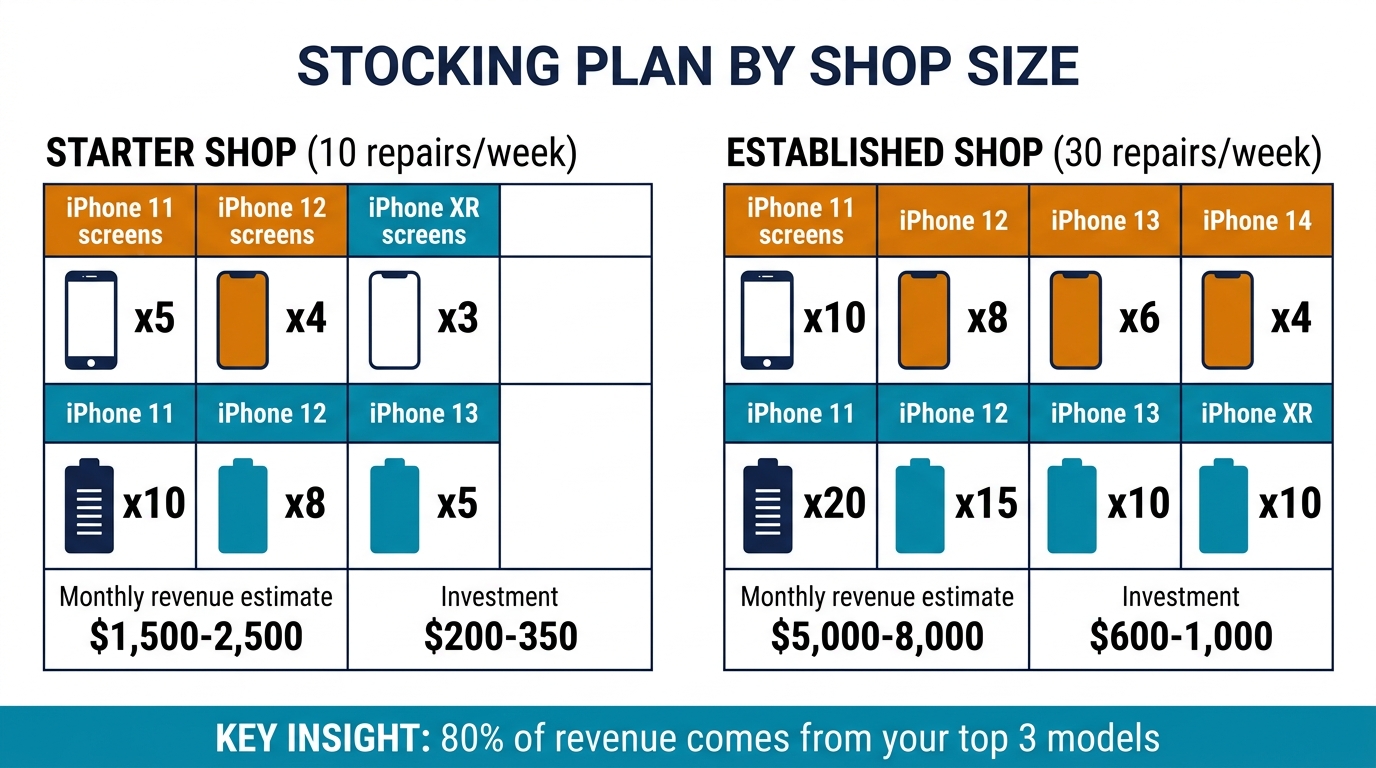
Here's a quick-reference stocking guide based on everything above.
If You're Just Starting Out (8-12 Repairs/Week)
| Category | Models to Stock | Suggested Quantity |
|---|---|---|
| Screens | iPhone 11, 12, 13 | 2-3 each |
| Batteries | iPhone 11, 12, 13, 14 | 3-5 each |
| On-demand | Everything else | Order as needed |
Total initial parts investment: $150-250. That's it. Start lean, track which models walk through your door for 4-6 weeks, then adjust.
If You're Established (25-40 Repairs/Week)
| Category | Models to Stock | Suggested Quantity |
|---|---|---|
| Screens | iPhone 11, 12, 13, 14 | 5-8 each |
| Screens | iPhone X/XS, XR, 15 | 2-3 each |
| Batteries | iPhone X through 15 | 5-10 each |
| On-demand | iPhone 8/SE, 16 | Order as needed |
Total parts investment: $500-900. This covers 85-90% of walk-in requests with same-day turnaround.
Models to Avoid Stocking
- iPhone 6/6S/7: Parts exist but demand is near zero. These phones are worth less than the repair cost in most markets. Turn these customers away or offer a trade-in suggestion.
- iPhone 16 Pro Max: Screen costs $45-60 wholesale. One unsold screen ties up capital that could buy 4-5 iPhone 12 screens. Stock only if you're seeing consistent demand.
- Any model with serialized parts you can't program: Some iPhone 14+ components require proprietary calibration tools. If you don't have the equipment, the repair isn't worth attempting.
Maximizing Your Repair ROI: The Non-Obvious Stuff
Beyond model selection, a few operational tweaks boost your effective ROI significantly.
Batch similar repairs. If you have three iPhone 12 screen replacements queued, do them back-to-back. Your per-unit time drops because you're not context-switching between different model layouts and screw patterns. Experienced techs report 15-20% faster times when batching.
Upsell battery + screen combos. When a customer brings in a cracked iPhone 12, check the battery health. If it's below 82%, offer a combo deal — "$10 off if we replace the battery while it's open." Your added cost is $4-6 in parts and 5 extra minutes. The customer pays $25-35 more. That's pure margin.
Track your actual repair times. The tables in this article use industry averages. Your numbers may be faster or slower. If you're consistently taking 40 minutes on iPhone 13 screens, that model's ROI is lower for you than the table suggests. Measure, then optimize.
FAQ
Which iPhone model has the best repair ROI in 2026?
The iPhone 11 and iPhone 12 offer the best overall repair ROI when you factor in parts cost, repair price, demand volume, and repair speed. Battery replacements on these models cost $3-6 in parts, sell for $35-55, and take 15-20 minutes — delivering over $2 per minute of bench time.
How much profit can a small iPhone repair shop make per month?
A small shop doing 10 repairs per week can expect $1,400-1,800 in monthly gross margin on parts alone. A mid-size shop doing 30+ repairs per week can hit $4,500-5,500. These figures cover parts margin only — you'll need to subtract rent, tools, and labor to get net profit.
Is it still worth repairing older iPhones like the iPhone 8?
For battery replacements, yes — the margin is strong and the repair is fast. For screen replacements, it depends on your market. In price-sensitive regions (Africa, Southeast Asia), iPhone 8 screen repairs are still viable. In the US and Europe, many customers decide the phone isn't worth the repair cost, so demand is low.
What are the most common iPhone repairs in 2026?
Screen replacement and battery replacement account for roughly 80% of all iPhone repair jobs. Charging port repairs make up another 8-10%, followed by back glass replacement and camera module issues. For small shops, focusing on screens and batteries covers the vast majority of demand.
Should I stock iPhone 15 and 16 parts?
Only if you're seeing consistent walk-in demand for those models. Screen parts for iPhone 15 cost $22-30 and iPhone 16 costs $30-42 — that's significant capital for a small shop. Most small shops are better off ordering these on-demand from a supplier with 2-3 day shipping rather than tying up inventory dollars.
Start Stocking Smarter
The difference between a struggling repair shop and a profitable one often comes down to inventory decisions. Focus your capital on the models that move fast and deliver strong margins — iPhone 11, 12, and 13 for screens; iPhone 11 through 14 for batteries. Let everything else be on-demand.
If you're ready to place a wholesale order built around these ROI numbers, reach out to our team for current pricing on the models that matter most. We work with small and mid-size repair shops worldwide and can put together a starter or restock order matched to your market.
The data in this article is based on Q1-Q2 2026 wholesale pricing. Parts costs shift quarterly, so revisit your stocking math every 90 days. The models change, but the approach doesn't: buy cheap, repair fast, and stock what your customers actually bring through the door.