
When Should Repair Shops Restock Fast-Moving Phone Parts Instead of Ordering Case by Case
Every repair shop starts the same way: a customer walks in, you diagnose the problem, order the part, wait for delivery, then complete the repair. It works — until it doesn't.
At some point, ordering case by case starts costing you more than stocking ahead. The question is: when exactly does that shift happen? This guide gives you the specific numbers, formulas, and restock cycles to restock fast moving phone parts at the right time — before you lose jobs and margin to slow turnaround.
Need Wholesale Phone Repair Parts?
Factory-direct pricing from Shenzhen — OEM-quality screens, batteries & small parts.
Get Wholesale QuoteThe Hidden Costs of Ordering Case by Case
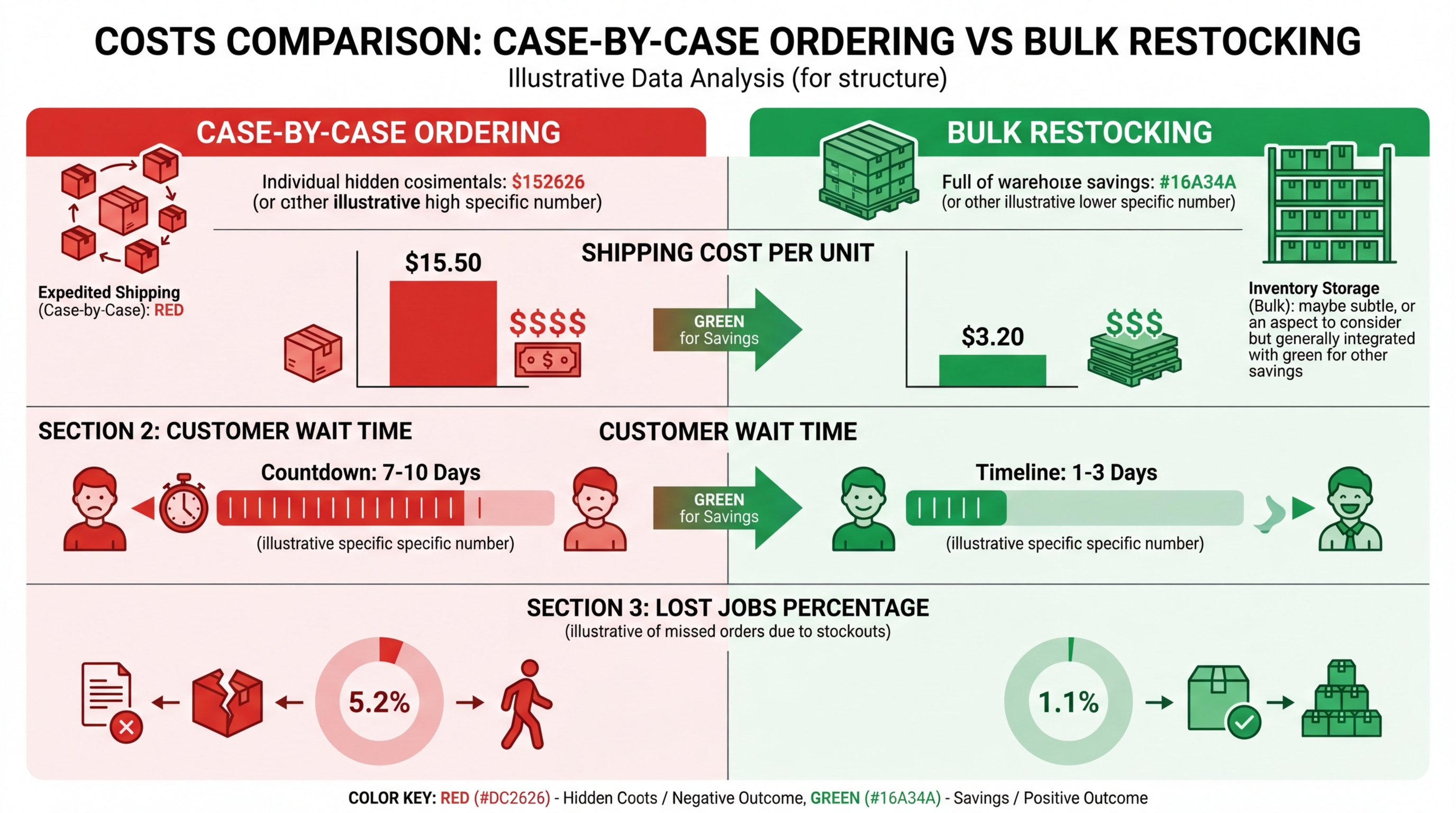
Most shop owners calculate part cost per unit but ignore the overhead that comes with single-order purchasing. Here's what case-by-case ordering actually costs:
Shipping adds up fast. A single express shipment from China for one iPhone 16 screen might cost $15-25 in freight. Order 10 screens in one shipment and that per-unit freight drops to $2-3. Over a month of individual orders, you could spend $200+ on shipping alone for parts that would cost $30-40 total to ship in bulk.
Customer wait time kills revenue. If a screen replacement takes 3-5 days because you're waiting on parts instead of 1 hour because it's on your shelf, roughly 30-40% of walk-in customers will go to a competitor. That's not a guess — it's consistent feedback from repair shops across our network in the UK, Nigeria, and the Philippines.
Supplier minimums and surcharges. Many wholesalers charge small-order fees or apply higher per-unit pricing below their MOQ. A single battery that costs $4.50 in a batch of 50 might cost $6.80 as a one-off. Over 50 repairs, that's $115 in unnecessary spend.
Your time has a cost. Each individual order means a separate invoice, payment, tracking number, and customs clearance (for international orders). If you're spending 20 minutes per order on admin, and you place 15 orders a month, that's 5 hours of unpaid work.
| Cost Factor | Case-by-Case (Monthly) | Bulk Restock (Monthly) | Savings |
|---|---|---|---|
| Shipping (10 screen orders) | $180 | $35 | $145 |
| Per-unit pricing premium | $115 | $0 | $115 |
| Admin time (15 orders × 20 min) | 5 hours | 1 hour | 4 hours |
| Lost customers (walk-aways) | ~8 jobs | ~1 job | 7 jobs |
| Total estimated monthly loss | $260 + 7 jobs |
If you're not sure which parts to keep on hand, start by tracking what you actually repair most.
The "3 Repairs Per Week" Threshold
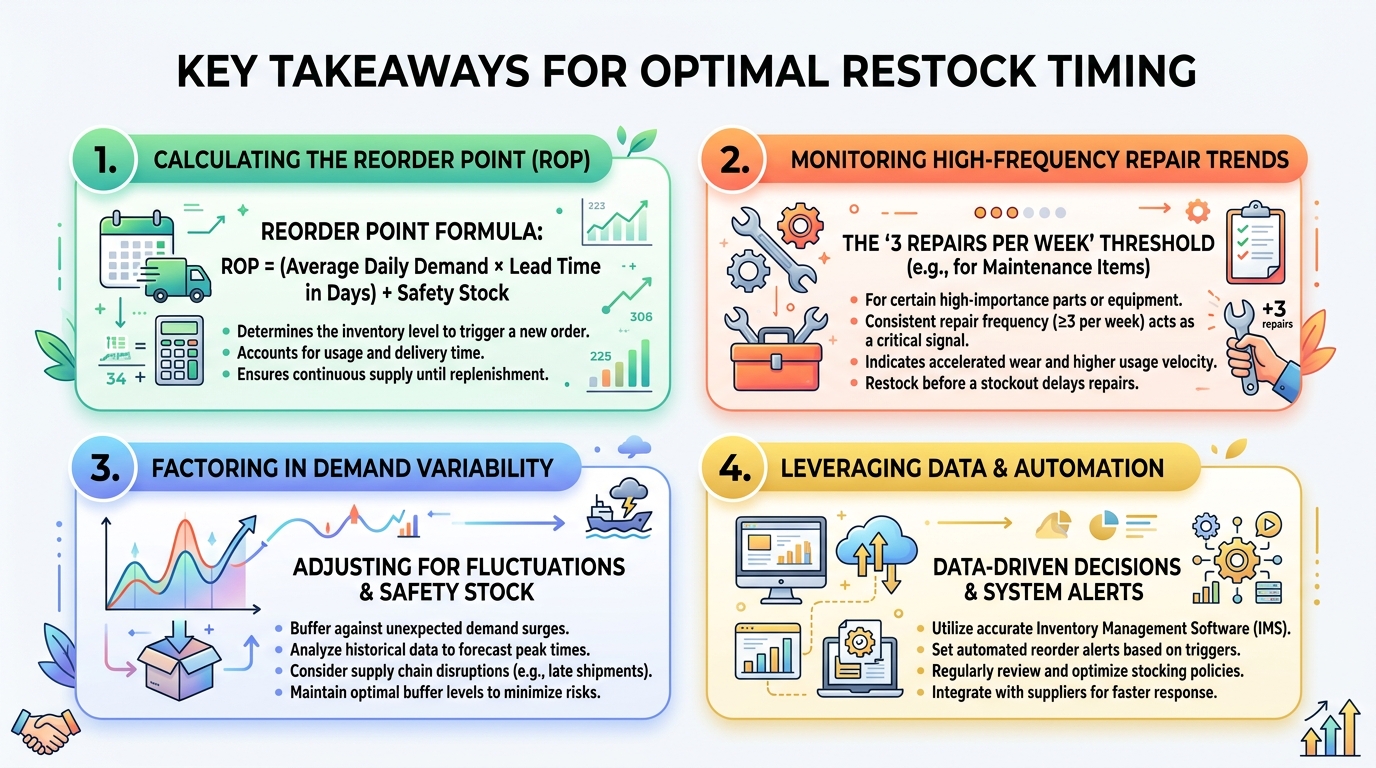
Here's the simplest rule for deciding when to shift from ordering per job to proactive restocking: if you're doing 3 or more repairs per week for any single part type, you should stock it.
Why 3? Because at that volume:
- Bulk pricing kicks in with most suppliers (5-10 unit minimums)
- Per-unit shipping drops below $3
- You'll use the stock before it becomes outdated by newer models
- The cash tied up in inventory ($50-150 per SKU) pays for itself within 2 weeks through faster turnaround and reduced shipping
Below 3 repairs per week, case-by-case ordering or small mixed orders make more sense. You can still combine low-volume parts into mixed orders to hit supplier minimums without overstocking.
Between 1-2 repairs per week, consider keeping 2-3 units as buffer stock and reordering when you hit 1 unit remaining.
How to Identify Your Fast-Movers
You don't need inventory software to figure this out. Here's a practical method:
Step 1: Track every repair for 2-4 weeks. Use a simple spreadsheet or even a paper tally. Record: date, device model, part replaced, part source (in stock vs. ordered).
Step 2: Sort by frequency. After 2-4 weeks, rank parts by total repair count. Your top 5-8 parts are your fast-movers.
Step 3: Flag the "almost fast-movers." Parts that appear 6-10 times in a month are candidates for light stocking (2-3 units). Parts that appear 12+ times per month should be stocked consistently.
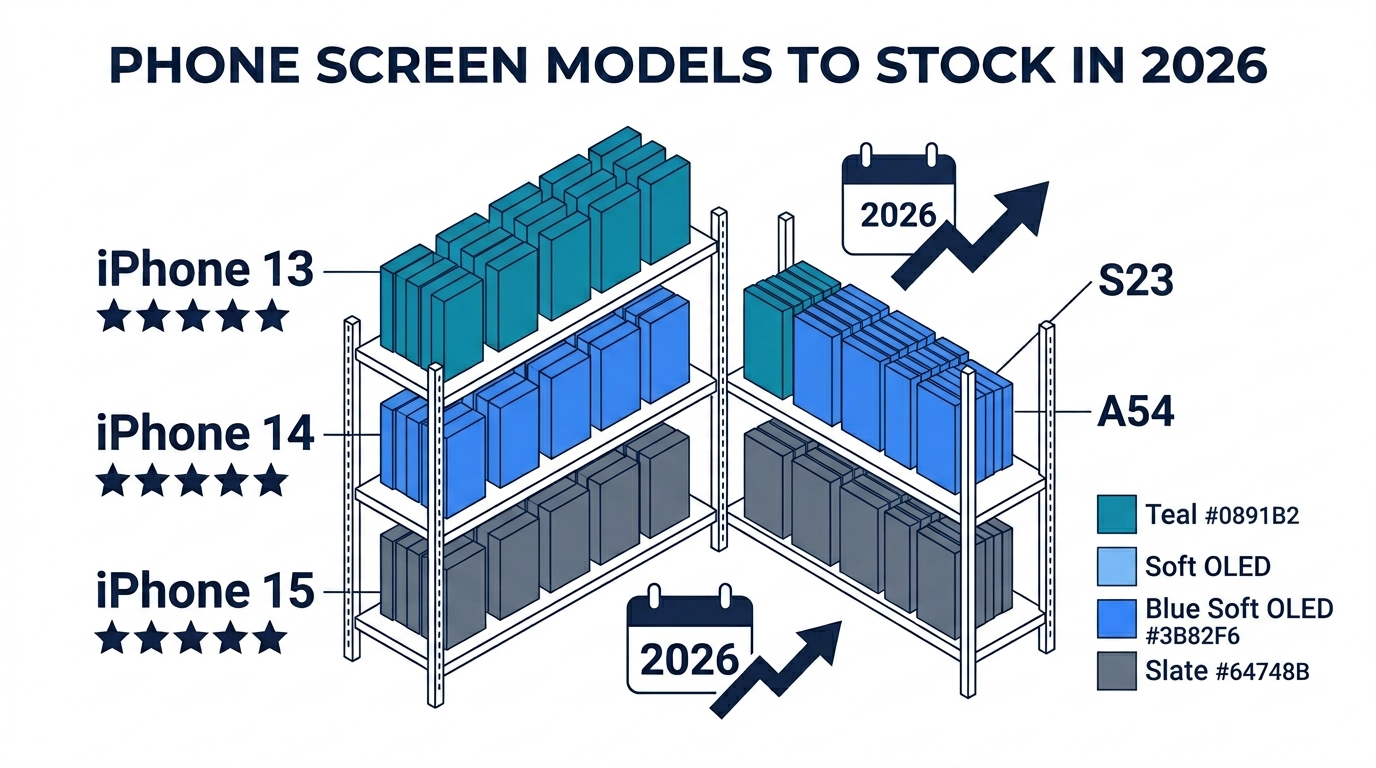
Typical fast-movers for a general repair shop in 2026:
- iPhone 15 / 16 screens
- iPhone 14 / 15 batteries
- Samsung Galaxy A15 / A16 screens
- USB-C charging ports (iPhone 15/16, Samsung A-series)
- iPhone 15 / 16 back glass
Your specific mix depends on your local market. A shop in Lagos sees more Samsung A-series and Tecno repairs than a shop in Manchester. But the tracking method is the same.
For detailed guidance on which screen models move fastest in 2026, we maintain updated rankings based on order data across 40+ countries.
The Reorder Point Formula for Small Shops
Enterprise inventory management uses complex formulas. You don't need that. Here's a simplified reorder point calculation that works for repair shops:
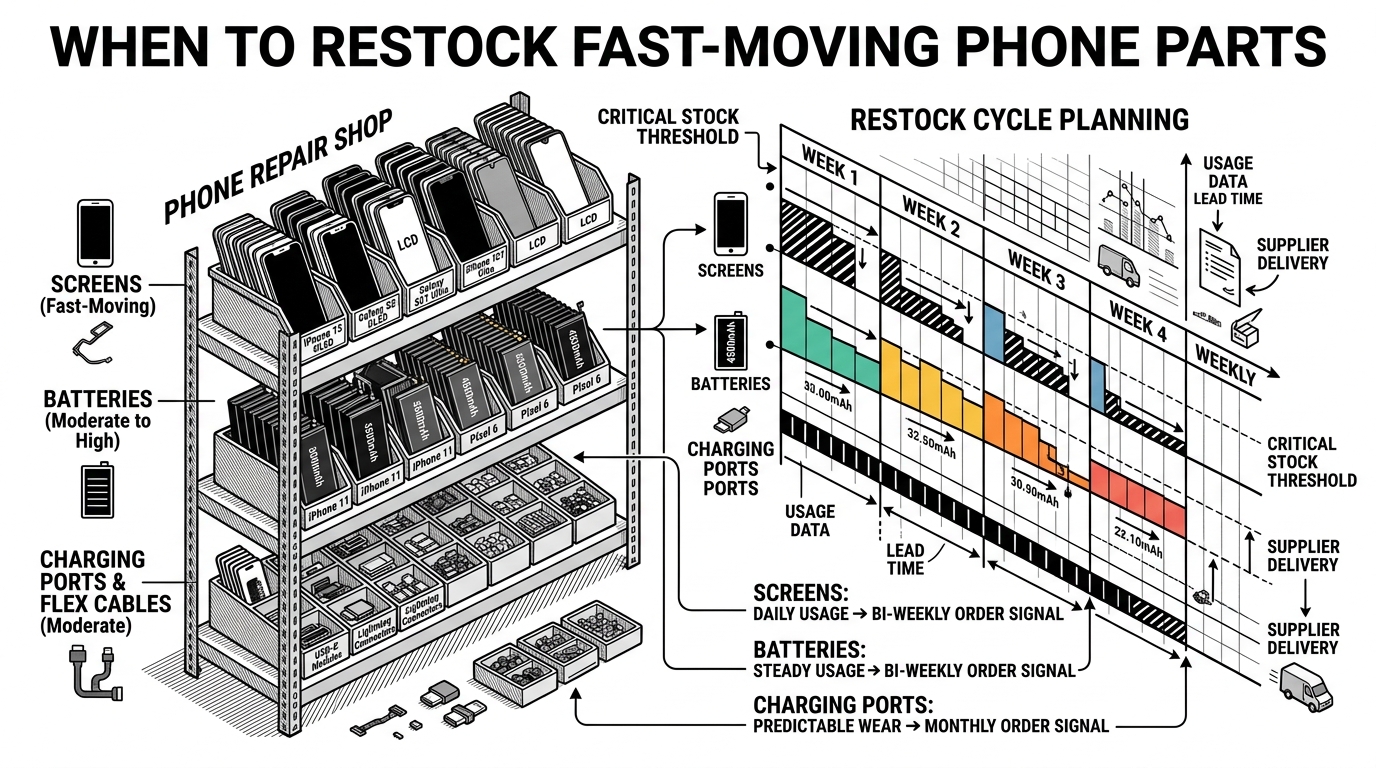
Reorder Point = (Weekly Usage × Lead Time in Weeks) + Safety Stock
Let's break it down with a real example:
- Weekly usage: You replace 5 iPhone 16 screens per week
- Lead time: Your supplier ships from Shenzhen, air freight takes 5 days, plus 2 days customs = 1 week total
- Safety stock: 50% of weekly usage = 2.5, round up to 3
Reorder point = (5 × 1) + 3 = 8 screens
When your iPhone 16 screen inventory hits 8 units, place your next order. You'll have enough stock to cover demand during the lead time, plus a buffer for unexpected spikes.
Adjust safety stock based on demand variability:
| Demand Pattern | Safety Stock Multiplier | Example |
|---|---|---|
| Very consistent (±10% weekly) | 30% of weekly usage | Batteries |
| Moderate variation (±25%) | 50% of weekly usage | Screens |
| Highly variable (±50%+) | 75-100% of weekly usage | Charging ports, new model parts |
If you're placing your first wholesale order, use the higher safety stock multiplier until you have 4-6 weeks of demand data.
Restock Cycles by Part Category
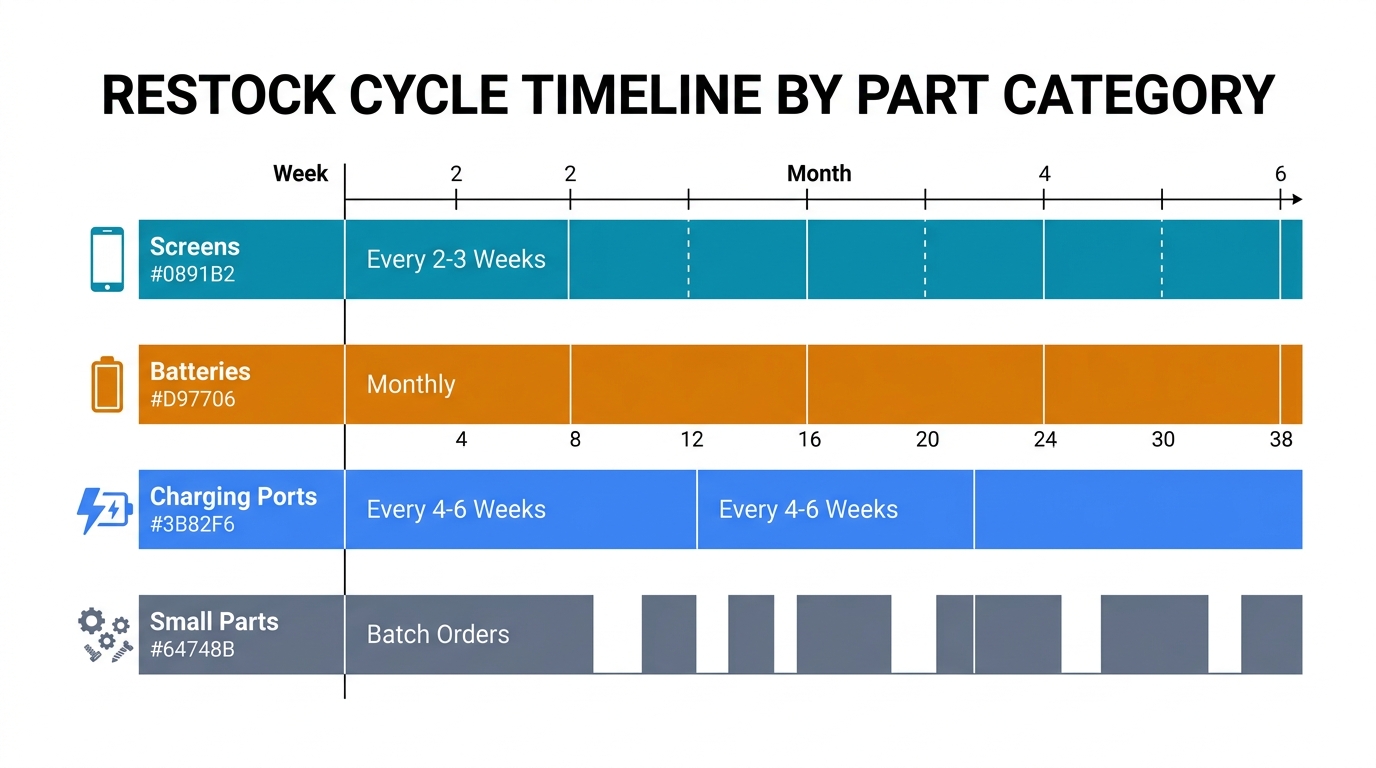
Different parts move at different speeds and have different economics. Here's a practical restock schedule based on aggregate order data from repair shops ordering through PRSPARES:
| Part Category | Typical Weekly Volume (Mid-Size Shop) | Recommended Restock Cycle | Order Quantity | Estimated Restock Cost |
|---|---|---|---|---|
| iPhone screens (top 3 models) | 8-15 units | Every 2-3 weeks | 20-30 units | $200-400 |
| Samsung screens (top 3 models) | 4-8 units | Every 3-4 weeks | 15-20 units | $120-250 |
| Batteries (top 5 models) | 10-20 units | Monthly | 40-60 units | $180-300 |
| Charging ports (USB-C) | 3-6 units | Every 4-6 weeks | 15-25 units | $30-75 |
| Back glass / housing | 2-4 units | Every 4-6 weeks | 10-15 units | $40-90 |
| Small parts (flex cables, buttons, speakers) | 1-3 per SKU | Batch order when 3+ SKUs run low | Mixed lot | $50-120 |
Key insight: Screens drive the most revenue per unit but tie up the most cash. Batteries are high-volume, low-cost, and rarely go obsolete within a model cycle. Batteries and charging ports also generate the most repeat business, so keeping them in stock directly protects your recurring revenue.
For small parts, don't restock each SKU individually. Wait until 3 or more small-part SKUs hit low stock, then place a combined batch order. This keeps shipping costs reasonable.
How Lead Time from China Affects Your Restock Timing
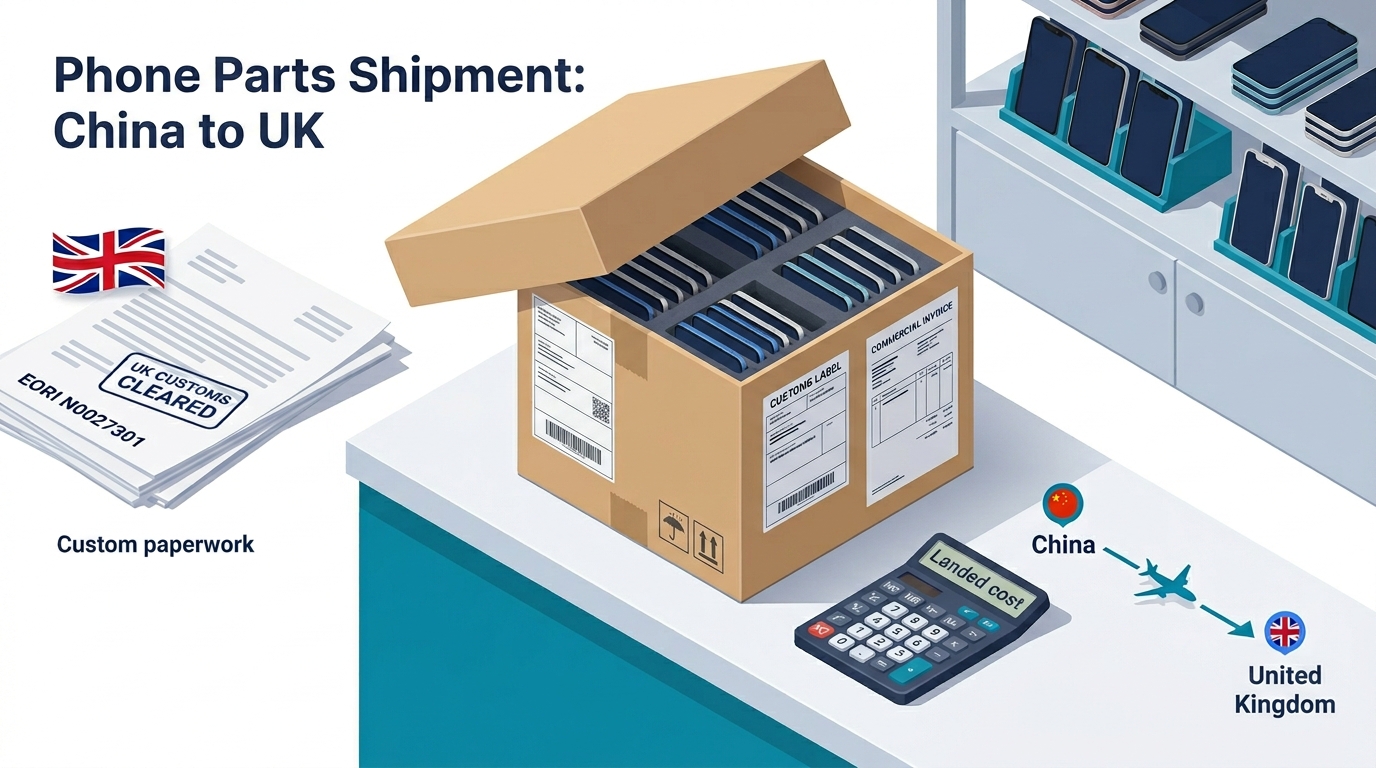
If you're sourcing from Shenzhen (where most phone parts are manufactured and warehoused), your lead time is the single biggest variable in your reorder point calculation.
Air freight: 3-5 days transit + 1-3 days customs
- Total lead time: 4-8 days
- Best for: Screens, urgent restocks, high-value parts
- Cost: $5-8/kg (DDP to most countries)
- Use when: You need parts within 1 week
Sea freight: 15-25 days transit + 3-7 days customs
- Total lead time: 18-32 days
- Best for: Batteries (air-restricted), large bulk orders, low-urgency restocks
- Cost: $1.5-3/kg (DDP to most countries)
- Use when: You're planning 4-6 weeks ahead
Express courier (DHL/FedEx/UPS): 2-4 days door-to-door
- Total lead time: 2-4 days
- Best for: Emergency restocks, sample orders
- Cost: $8-15/kg
- Use when: You've run out and have customers waiting
For details on MOQ, sample orders, and lead time expectations, we've published a complete breakdown.
Practical lead time strategy: Most experienced shops use a dual approach:
- Monthly sea freight for batteries and non-urgent bulk items (plan 5-6 weeks ahead)
- Bi-weekly air freight for screens and fast-movers (plan 1.5-2 weeks ahead)
This combination cuts average shipping cost by 40-50% compared to air-only ordering while keeping stock levels healthy.
Seasonal Patterns That Affect Restock Timing
Phone repair demand isn't flat. Adjust your restock quantities for these predictable spikes:
Back-to-school (August-September): Screen repairs increase 20-30%. Students returning to school are hard on phones. Stock extra screens for models popular with younger users (iPhone 15, Samsung Galaxy A-series).
Holiday season (November-December): Two effects — more phones in use (gifts) and more accidental damage (parties, travel). Screen and battery repairs both spike 15-25%. Also, shipping from China slows during this period due to carrier congestion. Place December restock orders by mid-November.
Chinese New Year (January-February): Factories and warehouses in Shenzhen shut down for 1-3 weeks. If you depend on China-sourced parts, place a larger-than-normal order in early January to cover the gap. This is the single biggest supply disruption of the year.
New model launch cycles (September-October for Apple, March and August for Samsung): Demand for new-model parts starts slow, then ramps up 8-12 weeks after launch as warranty periods expire and repair prices become attractive. Don't overstock new-model parts immediately — wait for actual demand data.
Rainy/monsoon seasons (varies by region): Water damage repairs increase 30-50% in tropical markets. Stock extra charging ports and batteries, as these are the parts most affected by moisture damage.
Cash Flow Management: Balancing Inventory vs. Working Capital
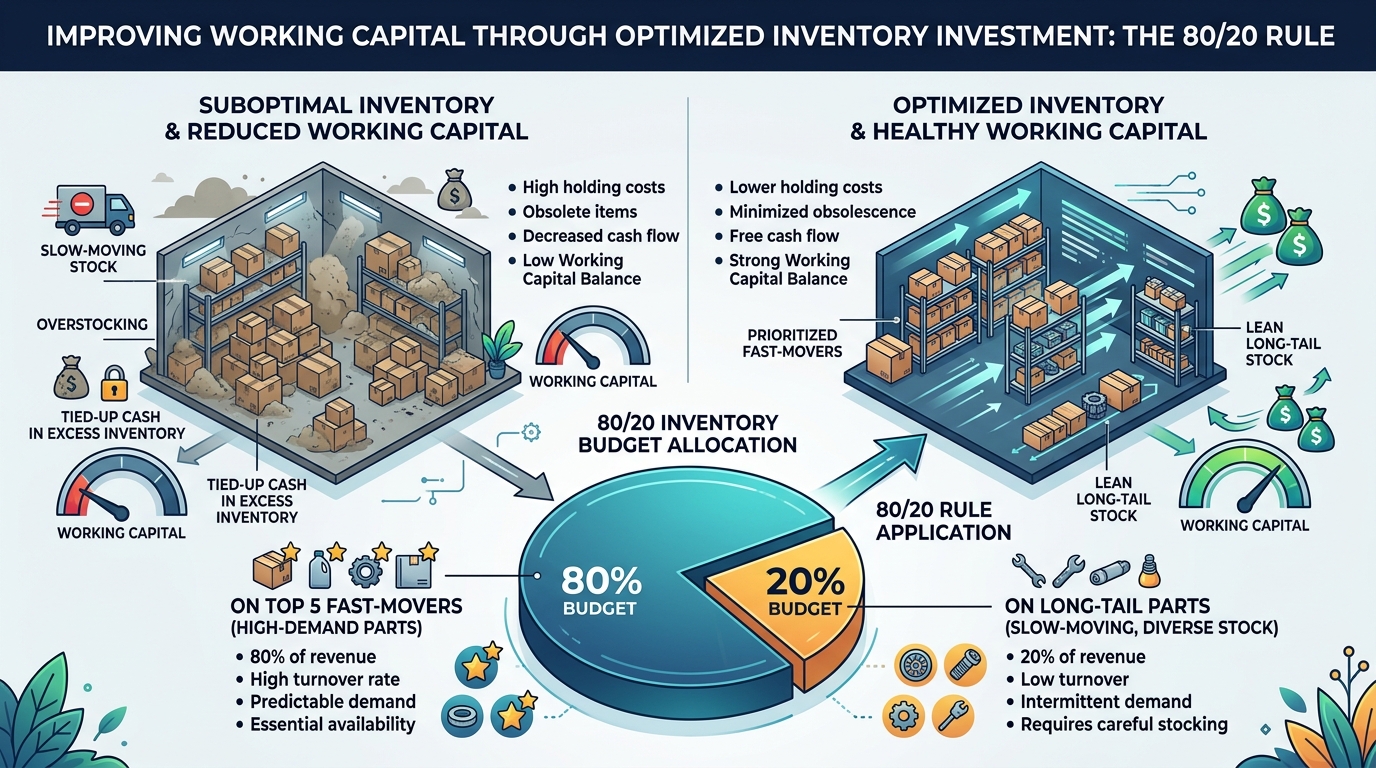
The biggest objection to restocking ahead is: "I don't want to tie up cash in parts sitting on a shelf." Fair concern. Here's how to manage it:
Start with your top 3 parts only. Don't try to stock everything at once. Identify your 3 highest-volume parts and stock those first. For most shops, this means 2 screen models and 1 battery model. Total investment: $300-600.
Calculate your inventory turnover target. Healthy turnover for phone parts is 2-4 weeks. If a part sits on your shelf for more than 6 weeks, you've overstocked.
Use the 80/20 rule. Roughly 20% of your part SKUs generate 80% of your repair revenue. Stock that 20% proactively. Order the remaining 80% case by case or in mixed batches.
Negotiate payment terms. Once you've established a track record with a supplier like PRSPARES (typically after 2-3 orders), ask about net-15 or net-30 payment terms. This lets your repair revenue come in before you pay for the parts.
Set a monthly inventory budget. A practical starting point: allocate 25-35% of your previous month's parts spend as your inventory investment budget. As your volume grows, this percentage can decrease because bulk pricing improves your margins.
| Shop Size | Monthly Repair Volume | Recommended Inventory Budget | SKUs to Stock |
|---|---|---|---|
| Solo / micro shop | 30-60 repairs | $300-500 | 5-8 SKUs |
| Small shop (2-3 techs) | 60-150 repairs | $500-1,200 | 10-15 SKUs |
| Mid-size shop (4-6 techs) | 150-300 repairs | $1,200-3,000 | 20-30 SKUs |
Putting It All Together: Your Restock Action Plan
Here's the step-by-step process to shift from case-by-case ordering to a structured restock system:
- Track repairs for 2-4 weeks. Record every part used, every model serviced.
- Identify your top 5-8 fast-movers. Anything at 3+ repairs per week gets stocked.
- Calculate reorder points. Use the formula: (weekly usage × lead time in weeks) + safety stock.
- Set up a restock calendar. Screens every 2-3 weeks (air freight), batteries monthly (sea freight), small parts in batches.
- Review and adjust monthly. Compare actual usage to your forecasts. Drop slow parts, add emerging fast-movers.
- Plan for seasonality. Pre-order before known demand spikes and supply disruptions.
The shops in our network that follow this system typically reduce their per-unit part cost by 15-25%, cut average repair turnaround from 2-3 days to under 2 hours, and report 20-30% fewer lost walk-in customers.
FAQ
How many SKUs should a small repair shop stock at minimum?
Start with 5-8 SKUs covering your top screen models (2-3), top battery models (2-3), and 1-2 charging port types. This covers roughly 60-70% of common repairs for most general shops. Expand from there based on your tracking data.
What if I overstock a part and demand drops?
Phone parts for current-generation models hold value well for 12-18 months. If you've overstocked, reduce your next reorder quantity rather than stopping orders entirely. For parts approaching end-of-cycle (2+ year old models), switch to case-by-case ordering and sell remaining stock at a slight discount to clear shelf space.
Should I use air or sea freight for regular restocks?
Use both. Air freight for screens and urgent restocks (3-5 day delivery), sea freight for batteries and large bulk orders where you can plan 4-6 weeks ahead. Batteries are classified as dangerous goods for air transport in many markets, making sea freight the default choice anyway. This dual approach saves 40-50% on shipping compared to air-only.
How do I handle restocking when I have limited cash flow?
Start small — stock only your top 3 parts with a $300-500 initial investment. Use the revenue from faster repairs to fund the next restock cycle. After 2-3 consistent orders with your supplier, negotiate net-15 or net-30 payment terms so you collect repair fees before the parts invoice is due.
How often should I review my restock plan?
Monthly at minimum. Review which parts moved faster or slower than expected, adjust reorder points, and check for new model launches or seasonal shifts. A 15-minute monthly review prevents both stockouts and dead inventory.
Ready to Set Up a Restock Schedule?
If you're doing 3 or more repairs per week on any single part, you're already losing money by ordering case by case. The math is straightforward: bulk pricing, lower shipping costs, and faster turnaround pay for the inventory investment within the first cycle.
PRSPARES ships from Shenzhen with air and sea freight options to repair shops worldwide. We support mixed orders (combine screens, batteries, and small parts in one shipment), flexible MOQs for first-time buyers, and structured restock schedules for repeat customers.