
What Phone Parts Should Repair Shops Reorder Monthly Instead of Buying Case by Case

Most small repair shops buy phone parts the same way: a customer walks in, you check if you have the part, you don't, you order it from a local distributor or rush-ship it from a wholesaler. The repair waits a day or two. The customer is annoyed. You pay a premium for a single unit plus express shipping.
This reactive approach costs more than you think. Switching to a phone parts reorder monthly rhythm changes the math completely. When you buy one repair at a time — one screen here, two batteries there — you're paying the highest possible per-unit price, the highest possible shipping cost per item, and losing revenue every time a customer walks out because you don't have the part in stock.
The fix isn't complicated: figure out which parts you use predictably every month and order them in advance as a batch. This article gives you a practical framework for deciding which parts belong on a monthly reorder list and which should stay as case-by-case purchases. If you're already familiar with when to restock fast-moving parts, this takes the next step — defining exactly what goes on that reorder list and how to size it.
Need Wholesale Phone Repair Parts?
Factory-direct pricing from Shenzhen — OEM-quality screens, batteries & small parts.
Get Wholesale QuoteThe Real Cost of Buying Case by Case
Before changing your buying approach, it helps to understand what reactive purchasing actually costs. Most shop owners underestimate this because the costs are spread across many small transactions.
Shipping Eats Your Margin
Every individual order carries a shipping cost. If you order from a local distributor, you might pay $5-15 per delivery. If you order from an overseas wholesaler with express shipping, it's $25-50 per shipment.
When you order 3 iPhone 13 Incell screens as a one-off, that shipping cost adds $8-17 per screen. When you order 20 screens as part of a monthly batch shipped by air freight, the shipping cost drops to $2-4 per screen. Over a year, the difference on screens alone can be $1,000-3,000 — money that goes directly to your bottom line.
Emergency Pricing Costs More Than Wholesale
Local distributors charge 20-40% more than direct wholesale prices. That's their margin for holding inventory and offering same-day availability. Every time you buy a single battery or charging port from a local source because you ran out, you're paying that premium.
A standard iPhone 12 battery might cost $3.50 wholesale in a batch of 50. The same battery from a local distributor: $5-6. If you replace 15-20 batteries a month, that's $22-50 in unnecessary cost — every month.
Lost Revenue from Stockouts
This is the cost most shops ignore. When a customer needs an iPhone 14 screen replacement and you say "I need to order the part, come back tomorrow," some percentage of those customers go to the shop down the road that has it in stock. You'll never see that revenue in your books because it never happened — but it's real.
A shop doing 8-12 screen repairs per day that loses even one customer per week to stockouts is losing $50-80 per week in labor revenue, plus the part margin. That's $200-320 per month.
Which Parts Qualify for Monthly Reorder
Not every part belongs on a monthly reorder list. The criteria are straightforward:
Monthly reorder makes sense when:
- You use the part at least 3-4 times per month (predictable demand)
- The per-unit cost is low enough to stock without straining cash flow
- The part doesn't change frequently (no new model every month)
- Storage is easy (small, doesn't require special conditions)
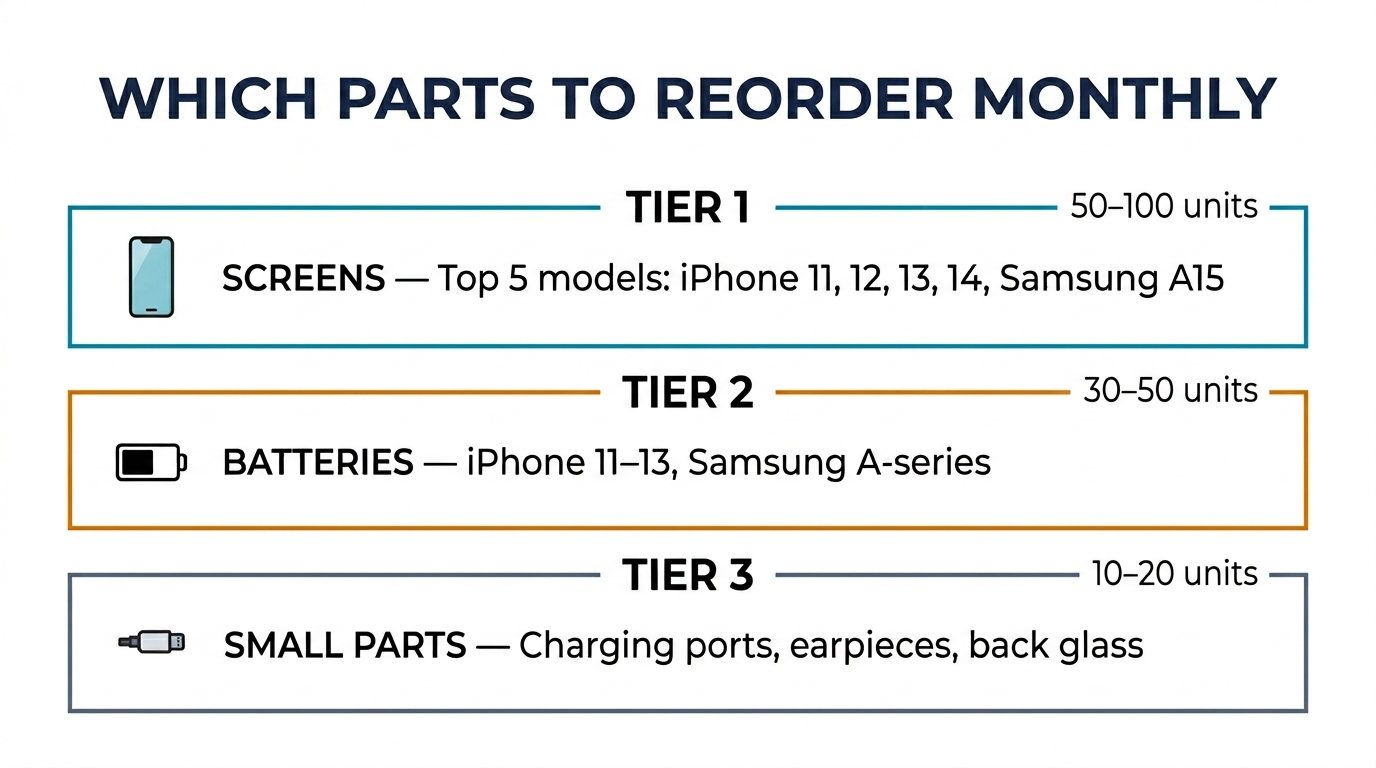
Tier 1: Screens for Your Top 5 Models
Screens are your highest-value, highest-frequency repair item. Identify the 5 models you repair most often and stock those monthly.
For most shops in 2026, the monthly screen reorder list looks something like this:
| Model | Grade | Why Monthly |
|---|---|---|
| iPhone 12 / 12 Pro | Incell | Still the single highest-volume repair model globally |
| iPhone 13 / 13 Pro | Incell + some Soft OLED | Growing rapidly as 2-3 year old devices start breaking |
| iPhone 11 | Incell | High volume, very affordable parts, steady demand |
| iPhone 14 | Incell | Increasing as warranty periods expire |
| Samsung A15 / A14 | LCD | Dominant in budget markets (Africa, LATAM, parts of Asia) |
See the full four-grade comparison with live wholesale prices: iPhone Screen Grade Guide
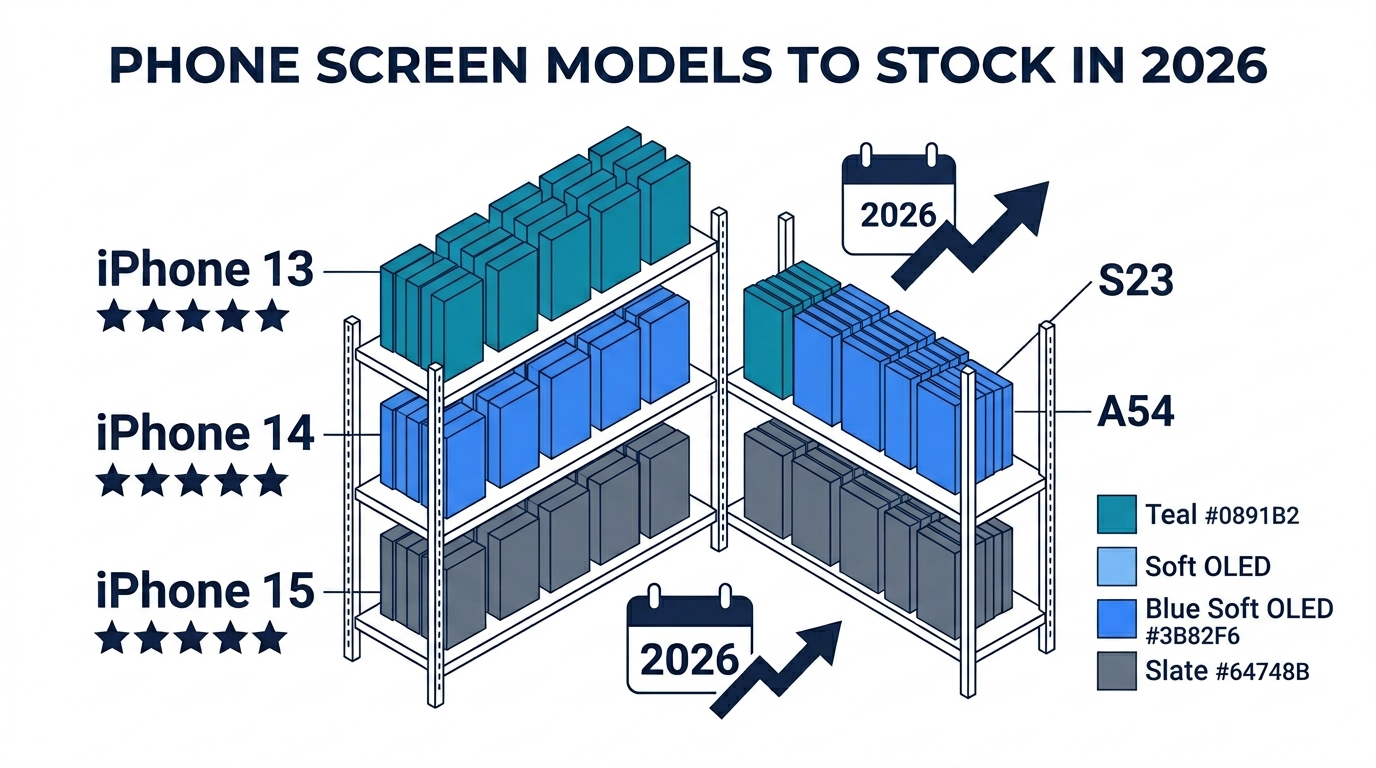
Your specific list depends on your market. A UK shop might have iPhone SE 3rd gen on the list. A shop in Lagos might stock Samsung A05 and A06 instead of iPhone 14. Use your own repair data — not guesses. For guidance on which models to stock in 2026, we've published a detailed breakdown.
Tier 2: Batteries for High-Volume Models
Batteries are cheaper per unit, easier to store, and have predictable demand. If you're replacing batteries at all, you're doing multiples per week on the same models.
Monthly battery reorder candidates:
- iPhone 11, 12, 13 series — the three highest-volume battery replacement models right now
- iPhone SE 2nd/3rd gen — budget iPhone buyers tend to keep devices longer, battery health drops faster
- Samsung A-series (A14, A15, A34) — if you serve budget Android markets
Batteries are also ideal for monthly reorder because the cost per unit is low ($2.50-5.00 wholesale), so stocking 20-30 batteries ties up only $50-150 in inventory.
Tier 3: Common Small Parts
Small parts — charging ports, earpieces, speakers, home buttons — are low-cost and high-frequency for certain models. The ones worth monthly reorder:
- Charging port flex cables for iPhone 8 through iPhone 14 — charging port repairs are the second or third most common job in most shops
- Earpieces for iPhone 11-13 — common failure, cheap to stock ($1-2 each)
- Back glass for iPhone 12-14 — increasingly common repair, and glass is fragile enough that you want spares on hand
If you're already building mixed orders with screens, batteries, and small parts, adding these to your monthly reorder is straightforward.
Which Parts Should Stay Case by Case
Monthly reorder isn't for everything. Some parts are better purchased only when you have a confirmed repair job.
Rare or Low-Volume Models
If you repair a Samsung S24 Ultra screen once every two months, don't stock it. The capital tied up in that single high-value screen isn't justified by the demand. Order it when the customer commits to the repair and pays a deposit.
Rule of thumb: If you use fewer than 2 units per month of a specific part, it stays case-by-case.
High-Value OEM and Soft OLED Screens
A Soft OLED screen for iPhone 13 Pro Max costs $35-50 wholesale. Stocking 5 of these ties up $175-250 in a single SKU. Unless you're doing 8+ premium screen repairs per month on that model, keep these as order-on-demand items.
The exception: if your shop specifically markets premium repairs and charges accordingly, Soft OLED stock may be justified. But for most shops, Incell covers 70-80% of screen repairs — stock Incell monthly and order Soft OLED per-job.
Brand-New Models in the First 3-6 Months
When a new iPhone launches, aftermarket screens take 2-3 months to stabilize in quality and pricing. Early batches from suppliers often have higher defect rates and premium pricing. Wait until the supply chain matures before adding a new model to your monthly reorder.
During this period, buy small quantities per-job and test different suppliers' versions. Once you've found consistent quality at stable pricing, add it to your monthly list.
How to Calculate Your Monthly Reorder Quantities
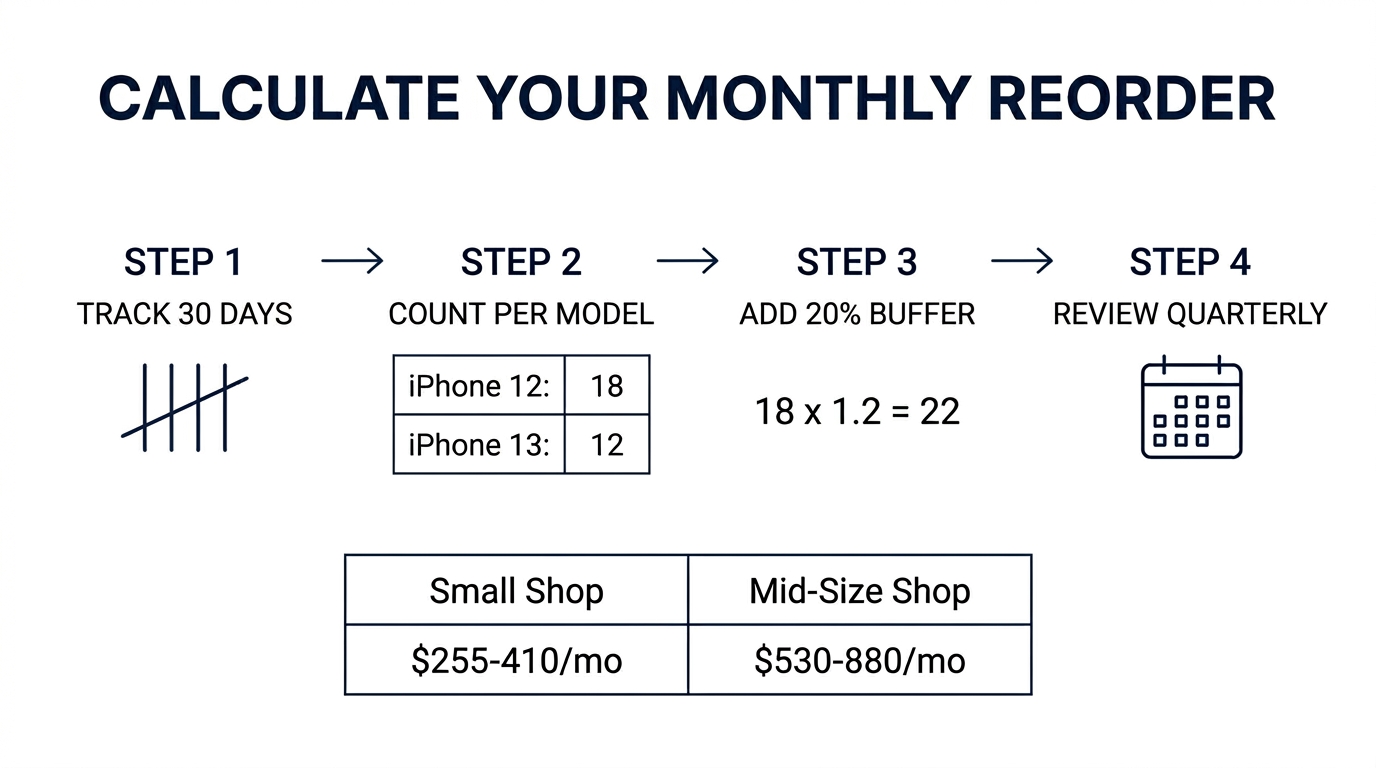
Guessing leads to either overstocking (cash trapped in slow inventory) or understocking (back to case-by-case buying). Here's a simple method that works:
Step 1: Track for 30 Days
Record every repair you do for one full month. A simple spreadsheet works:
| Date | Model | Part Type | Grade |
|---|---|---|---|
| May 1 | iPhone 12 | Screen (Incell) | A |
| May 1 | iPhone 13 | Battery | Standard |
| May 2 | iPhone 11 | Screen (Incell) | A |
| ... | ... | ... | ... |
If you don't track already, start now. Even a tally sheet on paper next to the register works.
Step 2: Calculate Monthly Averages
At the end of 30 days, count how many of each part you used. Example:
| Part | Monthly Count | Monthly Reorder? |
|---|---|---|
| iPhone 12 Incell Screen | 18 | Yes — order 20-22 |
| iPhone 13 Incell Screen | 12 | Yes — order 14-15 |
| iPhone 11 Battery | 8 | Yes — order 10 |
| Samsung S23 Ultra Screen | 1 | No — case by case |
Step 3: Add a 20% Buffer
Your reorder quantity should be your monthly average plus 20%. This covers demand spikes without massive overstock. For the iPhone 12 screen example: 18 repairs × 1.2 = ~22 units per month.
Step 4: Review and Adjust Quarterly
Phone repair demand shifts as new models age and old models phase out. Every 3 months, review your actual usage vs. your reorder quantities and adjust. For a detailed look at MOQ and lead time planning, see our guide.
Monthly Reorder Templates by Shop Size
Here's what a typical monthly reorder looks like for two shop sizes:
Small Shop (1-2 Technicians, 5-8 Repairs/Day)
| Category | Items | Quantity | Est. Cost |
|---|---|---|---|
| Screens | iPhone 11 Incell, iPhone 12 Incell, iPhone 13 Incell | 8 + 10 + 6 = 24 | $180-280 |
| Batteries | iPhone 11, 12, 13 | 6 + 8 + 5 = 19 | $55-95 |
| Small Parts | Charging ports (iPhone 11-13), earpieces | 10 + 5 = 15 | $20-35 |
| Total | ~58 units | $255-410 |
Mid-Size Shop (3-5 Technicians, 12-20 Repairs/Day)
| Category | Items | Quantity | Est. Cost |
|---|---|---|---|
| Screens | iPhone 11-14 Incell, Samsung A14/A15 LCD | 40-50 total | $400-650 |
| Batteries | iPhone 11-14, Samsung A-series | 30-40 total | $90-160 |
| Small Parts | Charging ports, earpieces, speakers, back glass | 25-35 total | $40-70 |
| Total | ~100-125 units | $530-880 |
These are starting points. Your actual numbers depend on your market, model mix, and repair volume. For ready-to-use first order templates, we have specific configurations by shop type.
How Monthly Reorders Work with Wholesale Suppliers
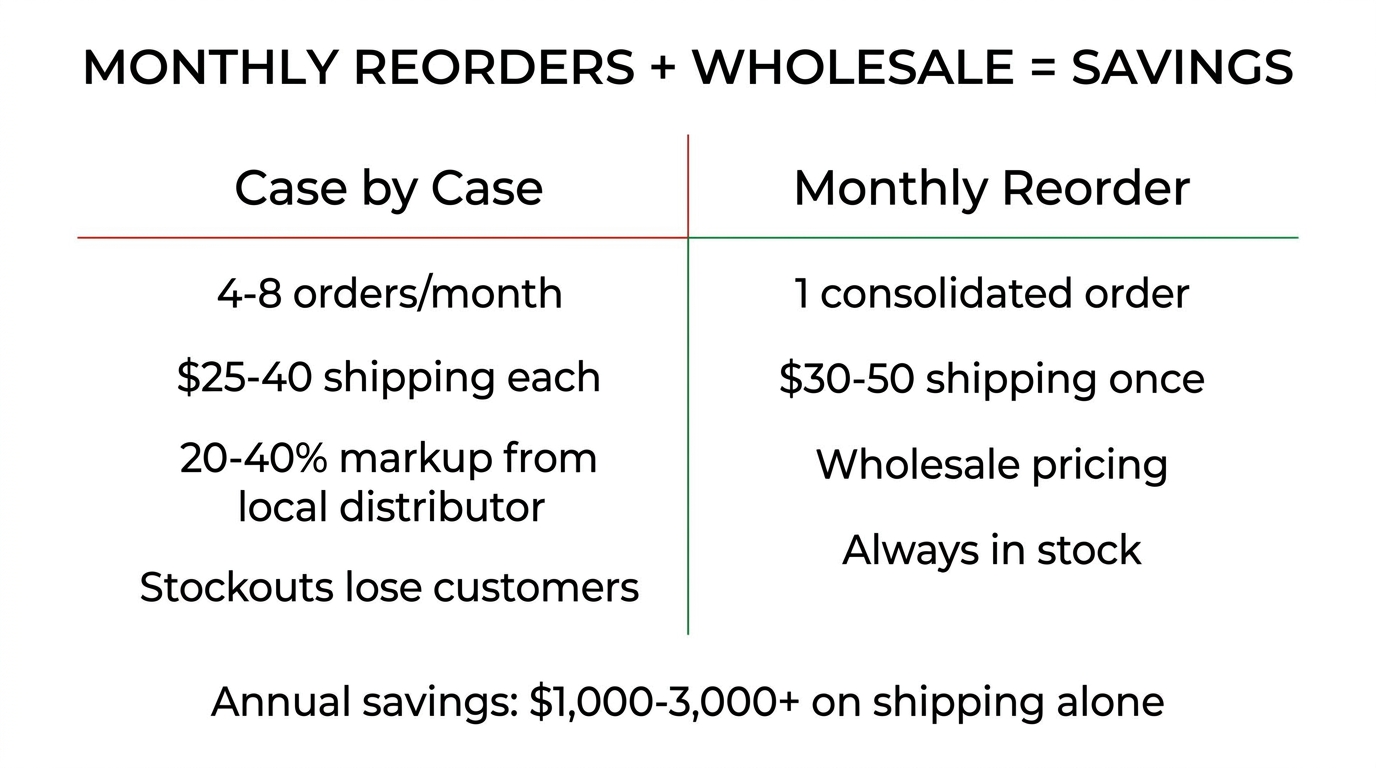
Switching to monthly reorders changes your relationship with your supplier — for the better.
MOQ Becomes Easy to Meet
Most wholesale suppliers have minimum order quantities of $200-500 per shipment. When you buy case by case, hitting MOQ means either overstocking one item or waiting until you need enough different parts. With a monthly reorder covering screens, batteries, and small parts, you naturally hit $300-800 per order — comfortably above most MOQ thresholds.
Shipping Costs Drop Dramatically
One consolidated shipment per month vs. 4-8 small orders means:
- Air freight: $30-50 once vs. $25-40 four times = savings of $70-110/month
- Sea freight (for larger shops): Even cheaper per unit, though lead time is 15-25 days
Your Supplier Prepares for You
When you order the same models every month, your supplier starts reserving stock for you. They know your pattern. They prepare your order faster. Some suppliers will even alert you when a model you regularly order has a price drop or a new grade becomes available.
This predictability is the foundation of the kind of long-term supplier relationship that gets you better pricing, priority stock allocation, and more flexible terms over time.
Frequently Asked Questions
How do I handle months where demand is higher or lower than usual?
Stick to your baseline reorder quantity and adjust with small top-up orders if you run low mid-month. It's better to place one main order plus an occasional small supplement than to guess high every month and tie up cash in excess inventory. Review your baseline quarterly.
Should I reorder from the same supplier every month?
Ideally, yes. Consistent ordering builds the relationship, earns better pricing, and ensures you know exactly what quality to expect. Splitting orders across multiple suppliers makes sense only if you need different product categories that one supplier can't cover well.
What if my supplier's MOQ is higher than my monthly need for one item?
This is exactly why mixed orders work. You might only need 5 Samsung A15 screens per month, but combined with your iPhone screens, batteries, and small parts, your total order easily exceeds MOQ. Wholesale suppliers expect mixed orders — it's how most repair shops buy.
How much working capital do I need to switch to monthly reorders?
For a small shop, budget $300-500 for your first monthly order. This replaces what you'd spend anyway on case-by-case purchases over the month — you're just paying it upfront instead of spread out. After the first month, the cycle sustains itself as repair revenue from installed parts funds the next order.
Stop Buying One Part at a Time
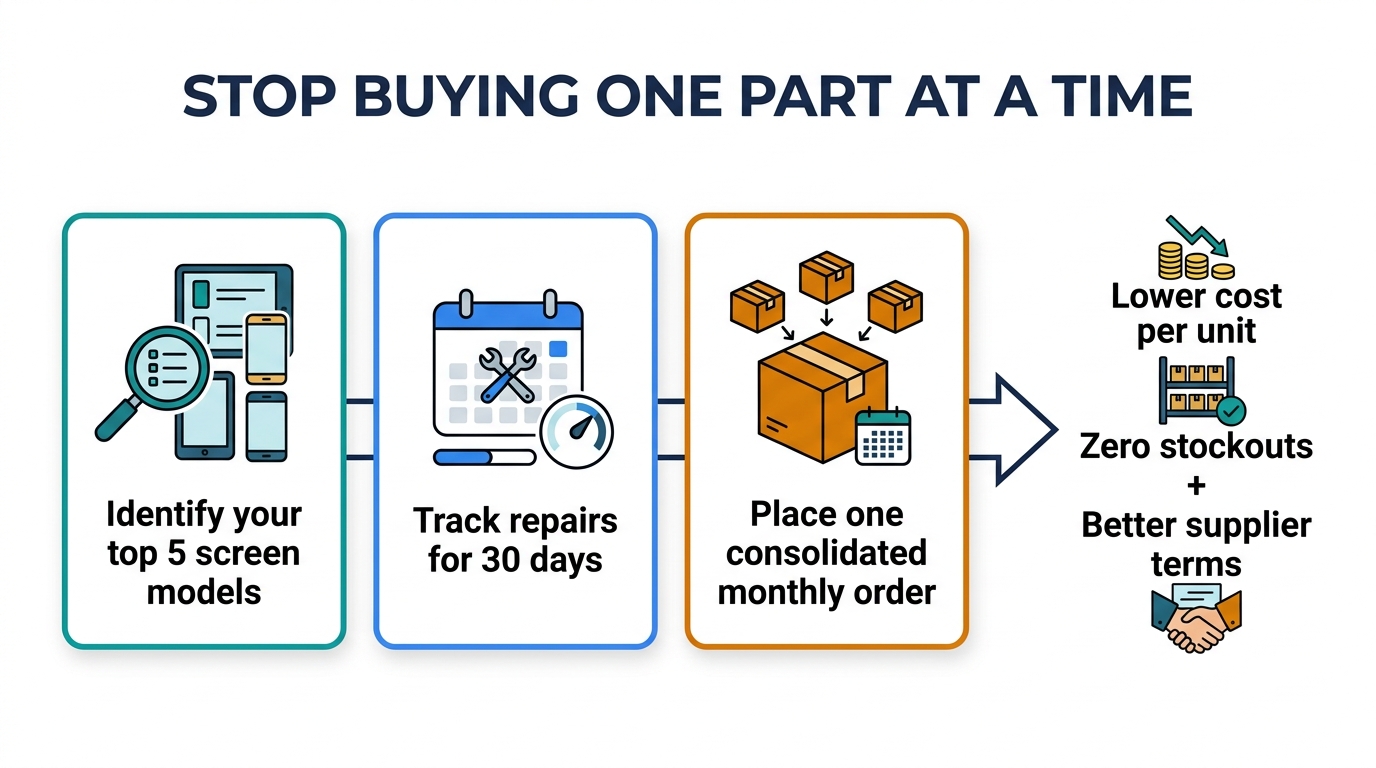
The shift from reactive purchasing to monthly reorders is one of the simplest changes a repair shop can make — and one of the most impactful. You spend less per unit, waste less on shipping, lose fewer customers to stockouts, and build a supplier relationship that improves over time.
Start with your top 5 screen models and most-used batteries. Track your repairs for 30 days if you haven't already. Build a reorder list. Place one consolidated order instead of a dozen small ones.
Ready to set up a monthly reorder? Send us your model list and repair volumes, and we'll help you build a reorder template sized for your shop. We work with repair shops at every scale — from 5 repairs a day to 50.
Related reading: