
iPhone 15 Screen Replacement: Which Grade Should Repair Shops Use?

The iPhone 15 series is entering the sweet spot for third-party repair. Launched in September 2023, most units are now past Apple's standard one-year warranty, and AppleCare+ coverage is expiring for early adopters. Walk-in iPhone 15 screen replacement volume is climbing in most shops — and the grade you put in these phones matters more than on older models.
Here's why: the iPhone 15 is still a high-value phone. Customers who crack a $500–$700 device expect a repair that looks and feels like the original. Put a cheap Incell LCD in an iPhone 15 and you'll hear about it — the downgrade from the original OLED is immediately obvious, and these customers are more likely to leave negative reviews or demand a redo.
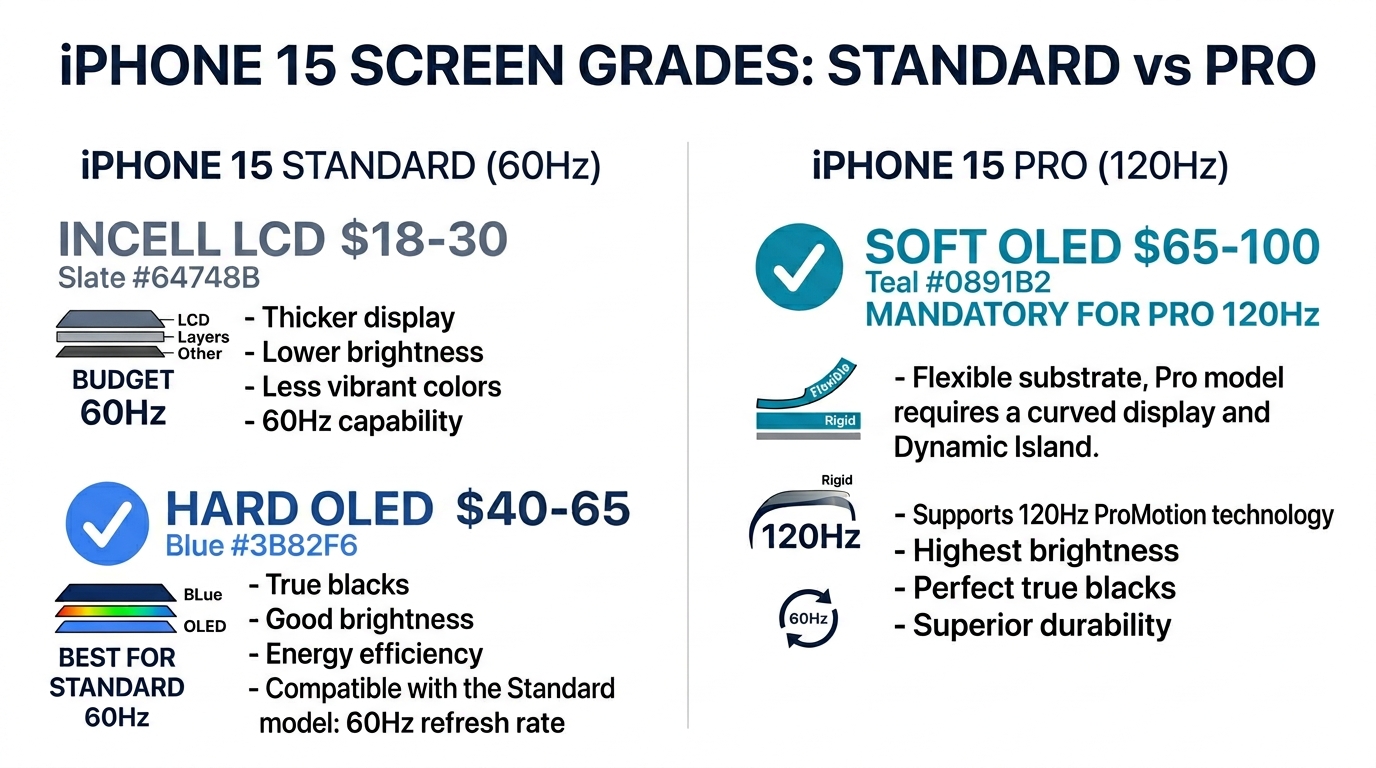
The grade decision also splits at the iPhone 15 standard vs Pro line. The standard iPhone 15 runs at 60Hz, which means Hard OLED works well. The iPhone 15 Pro and Pro Max run at 120Hz with ProMotion, which changes the equation entirely. This guide covers which grade to use for each model, what it costs, and where the margins land.
Sourcing Replacement Screens in Bulk?
Incell / Hard OLED / Soft OLED grades — wholesale pricing, grade comparison on request.
Get Wholesale QuoteThe iPhone 15 Display Specs That Matter for Grade Selection
Before choosing a replacement grade, understand what the customer's phone originally shipped with.
iPhone 15 / iPhone 15 Plus (Standard)
- Display: Super Retina XDR OLED
- Resolution: 2556 × 1179 (6.1") / 2796 × 1290 (6.7")
- Refresh rate: 60Hz
- Brightness: 1,000 nits typical, 1,600 nits HDR, 2,000 nits peak outdoor
- Dynamic Island: Yes
The standard iPhone 15 uses OLED but is locked to 60Hz. This is important because both Hard OLED and Soft OLED can handle 60Hz without issues. The grade choice becomes a quality/cost decision, not a technical compatibility one.
iPhone 15 Pro / iPhone 15 Pro Max
- Display: Super Retina XDR OLED with ProMotion
- Resolution: 2556 × 1179 (6.1") / 2796 × 1290 (6.7")
- Refresh rate: 1–120Hz adaptive (ProMotion)
- Brightness: 1,000 nits typical, 1,600 nits HDR, 2,000 nits peak outdoor
- Always-On Display: Yes
- Dynamic Island: Yes
The Pro models require 120Hz support. This eliminates Incell LCD entirely (can't do 120Hz) and makes Hard OLED risky — some Hard OLED panels support 120Hz but with visible flickering or uneven refresh. Soft OLED is the only aftermarket grade that reliably supports 120Hz ProMotion on iPhone 15 Pro models.
Screen Grades for iPhone 15: What Each Grade Actually Delivers
Incell LCD — Not Recommended for iPhone 15
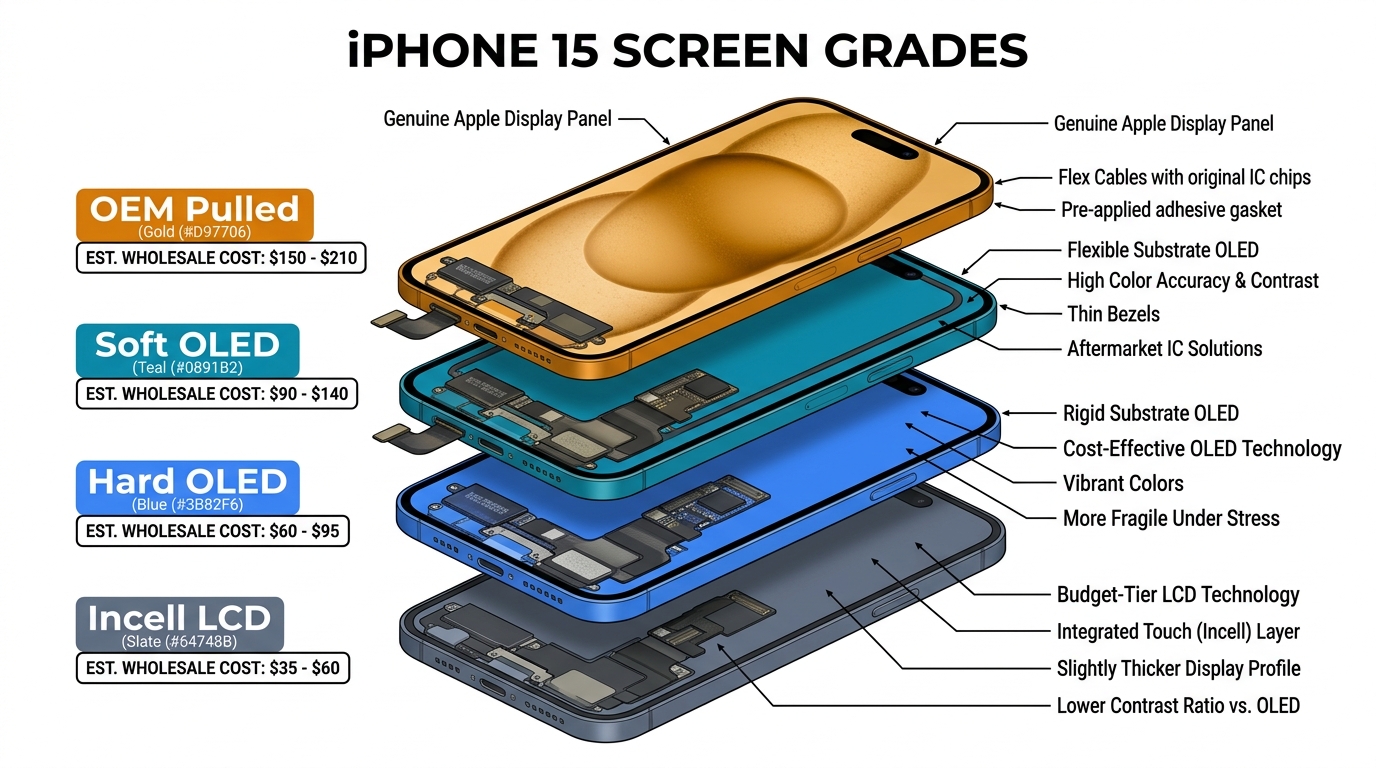
Incell LCD screens for the iPhone 15 cost $15–$25 wholesale. They work. Touch is responsive. But the display quality is a significant and obvious downgrade from the original OLED.
The problems are the same as on iPhone 12, 13, and 14 — no true blacks, lower contrast, washed-out colours — but they feel worse on the iPhone 15 because the original display was brighter and more refined than previous generations. The 2,000-nit peak outdoor brightness on the original versus the ~600 nits on a typical Incell makes an especially visible difference in direct sunlight.
For iPhone 15 Pro/Pro Max: Incell doesn't support 120Hz ProMotion or Always-On Display. Installing Incell on a Pro model will result in a phone that feels sluggish and loses two flagship features. Don't do it.
When Incell might be acceptable: Only on the standard iPhone 15/15 Plus, only when the customer explicitly chooses the cheapest option after hearing the trade-offs, and only if you make clear it's an LCD in a phone that originally had OLED.
Hard OLED — Good for Standard, Risky for Pro
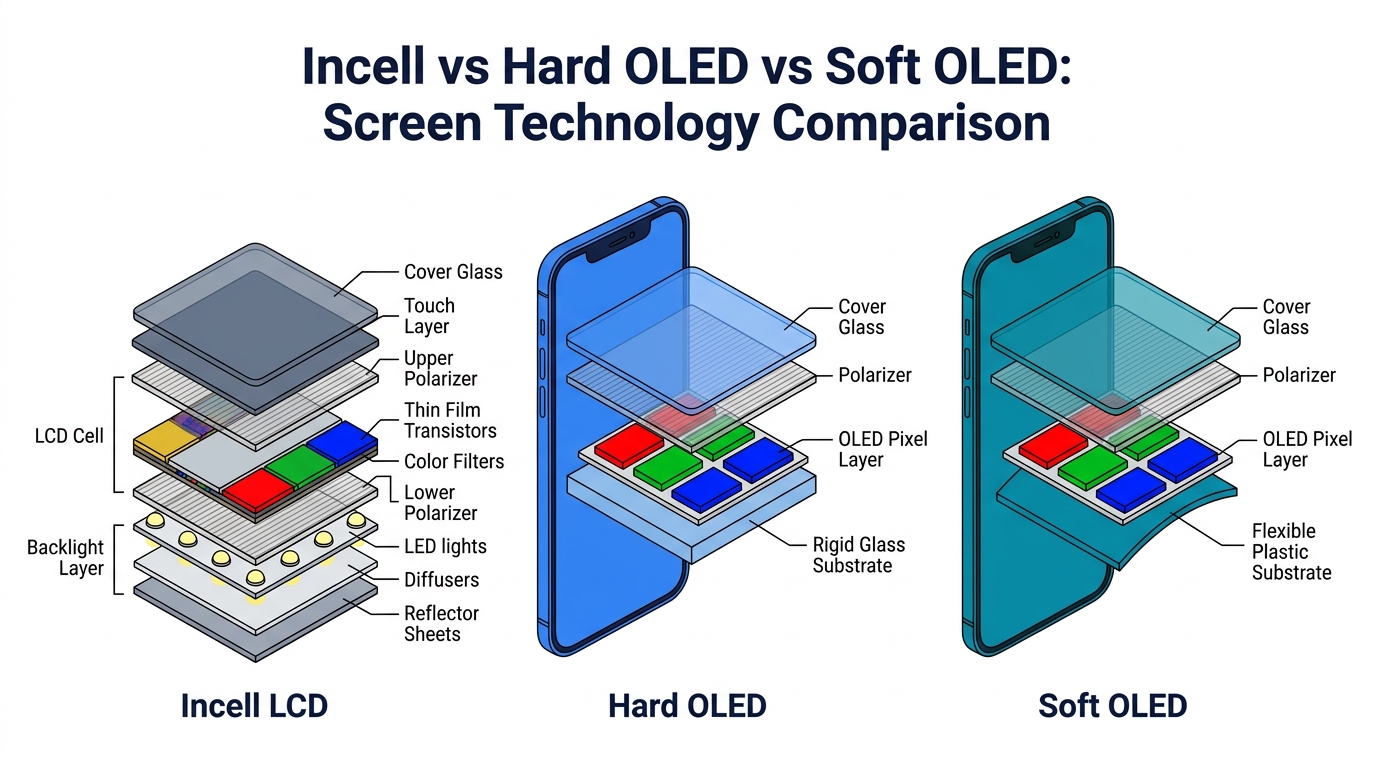
Hard OLED uses a rigid glass substrate OLED panel. Wholesale cost is $40–$65 for the iPhone 15 standard models and $55–$80 for Pro models.
On the standard iPhone 15 (60Hz), Hard OLED delivers a strong experience: true blacks, good contrast, and colour accuracy close to the original. Most customers can't distinguish it from the original screen in normal use. The rigid substrate makes it slightly more prone to cracking on impact, but that's a known trade-off at this price point.
On the iPhone 15 Pro (120Hz), Hard OLED is less reliable. Some panels handle 120Hz acceptably, but quality varies by supplier and batch. Common issues include:
- Slight green tint at low brightness
- Inconsistent frame timing causing subtle judder during scrolling
- Always-On Display not rendering correctly
Recommendation: Stock Hard OLED for iPhone 15 standard models. Avoid it for Pro models unless you've tested a specific supplier's panels extensively and confirmed consistent 120Hz performance.
Soft OLED — The Universal Choice
Soft OLED uses a flexible plastic substrate matching Apple's original display construction. Wholesale cost is $60–$95 for standard models and $80–$130 for Pro models.
This is the grade that works properly across the entire iPhone 15 lineup. On standard models, it's near-identical to the original — same blacks, similar brightness, accurate colours. On Pro models, it supports 120Hz ProMotion and Always-On Display without the consistency issues that plague Hard OLED.
For iPhone 15, Soft OLED is worth the premium over Hard OLED because:
- The phone's residual value is high enough to justify the screen cost
- Customers paying for an iPhone 15 repair expect quality
- The callback risk on cheaper grades is higher with this customer demographic
Recommendation: Stock Soft OLED for all iPhone 15 Pro/Pro Max repairs. For standard iPhone 15, offer Soft OLED as the premium option alongside Hard OLED as the standard.
Grade Comparison Table
| Screen Grade | Wholesale (Standard) | Wholesale (Pro) | 60Hz Support | 120Hz Support | Always-On | Best For |
|---|---|---|---|---|---|---|
| Incell LCD | $15–$25 | $20–$30 | Yes | No | No | Budget only, standard models |
| Hard OLED | $40–$65 | $55–$80 | Yes | Inconsistent | Partial | Standard models (default) |
| Soft OLED | $60–$95 | $80–$130 | Yes | Yes | Yes | All models, Pro required |
| OEM Original | $150–$250 | $200–$350 | Yes | Yes | Yes | OEM restoration |
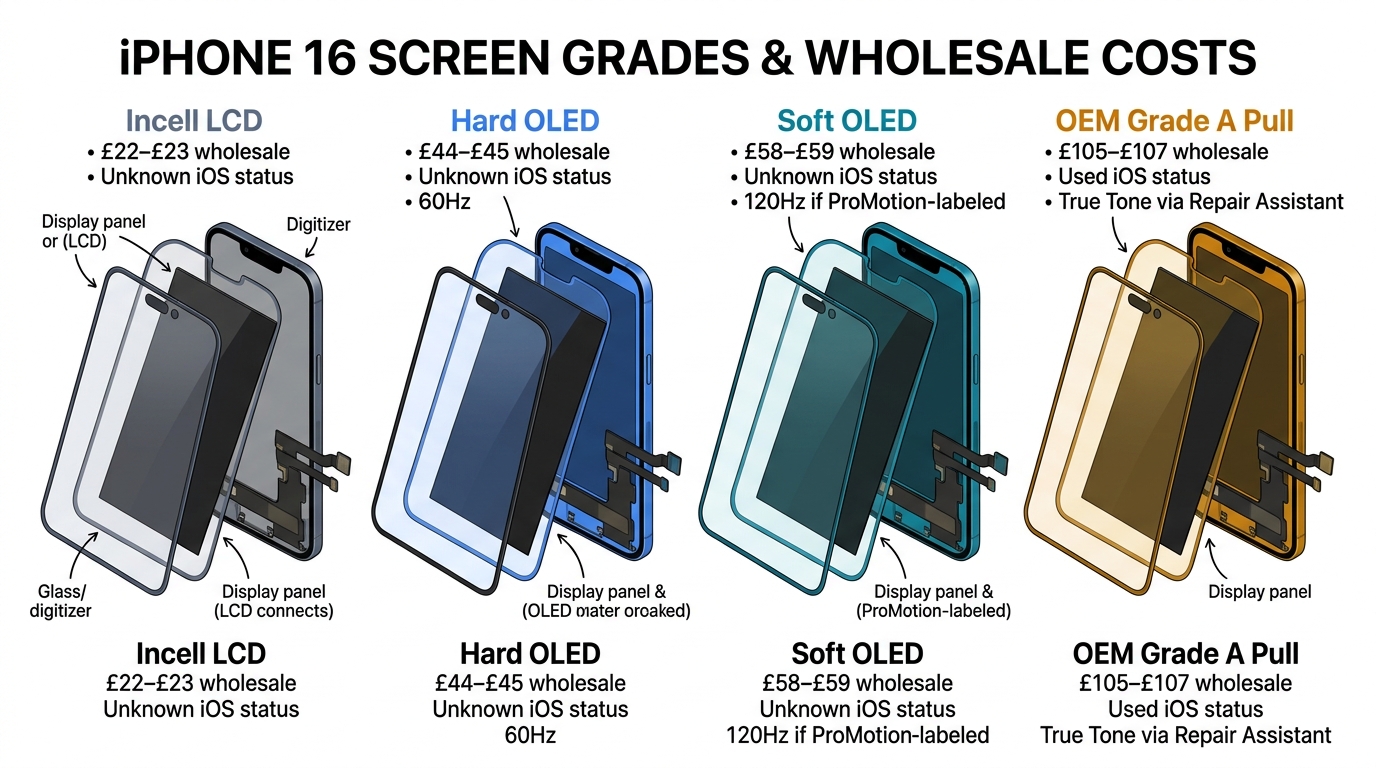
See the full four-grade comparison with live wholesale prices: iPhone Screen Grade Guide
For a deeper comparison of screen technologies across all iPhone models, see our Soft OLED vs Hard OLED vs Incell guide.
iPhone 15 Screen Replacement Cost: What Shops Should Charge

Apple charges $279 for iPhone 15 standard screen replacement and $329 for iPhone 15 Pro/Pro Max. These prices set the ceiling. Third-party shops need to price below Apple while maintaining margins that justify the work.
Recommended Pricing by Grade
iPhone 15 / iPhone 15 Plus:
| Screen Grade | Wholesale Cost | Recommended Charge (US) | Recommended Charge (UK) |
|---|---|---|---|
| Incell LCD | $20 | $89–$109 | £69–£79 |
| Hard OLED | $52 | $149–$179 | £119–£139 |
| Soft OLED | $78 | $199–$229 | £149–£179 |
iPhone 15 Pro / iPhone 15 Pro Max:
| Screen Grade | Wholesale Cost | Recommended Charge (US) | Recommended Charge (UK) |
|---|---|---|---|
| Hard OLED | $68 | $179–$219 | £139–£169 |
| Soft OLED | $105 | $249–$289 | £189–£229 |
Pricing rationale: The iPhone 15 is still worth $400–$600 in working condition. Customers accept higher repair charges on newer phones because the repair-to-value ratio makes obvious sense. A $199 Soft OLED repair on a $550 phone is an easy "yes" — the customer saves $350+ versus buying new.
For detailed pricing strategies by grade and model, see our phone screen repair pricing strategy guide.
Margin Analysis: Where the Money Is

iPhone 15 screen repairs produce higher absolute margins than older models because shops can charge more — customers expect to pay more for a newer phone's repair.
US Market Margins — iPhone 15 Standard
| Screen Grade | Wholesale | Charge | Gross Margin | Margin % |
|---|---|---|---|---|
| Incell LCD | $20 | $99 | $79 | 80% |
| Hard OLED | $52 | $159 | $107 | 67% |
| Soft OLED | $78 | $209 | $131 | 63% |
US Market Margins — iPhone 15 Pro
| Screen Grade | Wholesale | Charge | Gross Margin | Margin % |
|---|---|---|---|---|
| Hard OLED | $68 | $199 | $131 | 66% |
| Soft OLED | $105 | $269 | $164 | 61% |
Key insight: Soft OLED on iPhone 15 Pro generates $164 gross margin per repair — the highest absolute margin of any iPhone screen job in the shop. Even at 61% margin percentage, the dollar amount is significantly more than Incell on iPhone 12 ($64) or Hard OLED on iPhone 13 ($97).
The iPhone 15 Pro Max margin is even higher because shops typically charge $20–$30 more for the larger screen while the wholesale cost increase is only $10–$15.
UK Market Margins — iPhone 15 Standard
| Screen Grade | Wholesale | Charge | Gross Margin | Margin % |
|---|---|---|---|---|
| Incell LCD | £16 | £79 | £63 | 80% |
| Hard OLED | £42 | £129 | £87 | 67% |
| Soft OLED | £62 | £169 | £107 | 63% |
Stocking iPhone 15 screens? We supply Incell LCD, Hard OLED, and Soft OLED for the full iPhone 15 series at wholesale pricing. Our Soft OLED panels are tested for 120Hz compatibility on Pro models. Request a quote for bulk pricing and sample options.
The Dynamic Island Factor
The iPhone 15 was the first full lineup (all four models) to feature Dynamic Island, replacing the notch used in iPhone 14 standard and earlier. This has repair implications.
Proximity sensor and Face ID: The earpiece speaker, proximity sensor, and Face ID components are housed differently with Dynamic Island compared to the notch. The flex cable transfer is slightly different from iPhone 14 and requires attention. Shops experienced with iPhone 14 Pro (which also had Dynamic Island) will find the process familiar. New technicians should practice on a training board or damaged unit first.
True Tone calibration: Like iPhone 12 and later, True Tone data must be transferred from the original screen's IC chip to the replacement. Use a programmer tool (JC V1S, iCopy Plus, or similar) to maintain True Tone. This takes 2–3 minutes and is expected by iPhone 15 customers — skipping it will generate questions and complaints.
Screen quality expectations: Dynamic Island draws attention to the top of the display. Any colour inconsistency between the Dynamic Island area and the rest of the screen is more noticeable than a similar issue would be with a notch design. This is another reason to avoid Incell on iPhone 15 — the backlight bleed around the Dynamic Island cutout is more visible on LCD than on OLED.
What to Stock: Inventory Recommendations by Shop Volume
Low Volume (Under 5 iPhone 15 repairs/week)
- Standard iPhone 15: 2 Hard OLED + 1 Soft OLED on hand
- iPhone 15 Pro: 1 Soft OLED on hand, order additional on-demand
- iPhone 15 Pro Max: Order on-demand (Soft OLED only)
- Incell: Don't stock. Order only if specifically requested.
Moderate Volume (5–15 iPhone 15 repairs/week)
- Standard iPhone 15: 3–5 Hard OLED + 2–3 Soft OLED
- iPhone 15 Pro: 2–3 Soft OLED
- iPhone 15 Pro Max: 1–2 Soft OLED
- Incell: Keep 1–2 units for budget requests
High Volume (15+ iPhone 15 repairs/week)
- Standard iPhone 15: 5–8 Hard OLED + 3–5 Soft OLED
- iPhone 15 Pro: 4–6 Soft OLED
- iPhone 15 Pro Max: 2–3 Soft OLED
- Incell: 2–3 units
Reorder point: Set at 2 units per model/grade combination. When you drop below 2, place your next order. iPhone 15 screen supply chains are well-established, with typical lead times of 3–5 days from domestic suppliers.
For a broader inventory strategy covering all models, see our small repair shop stock guide.
Common Mistakes with iPhone 15 Screen Repairs
Using Hard OLED on Pro Models
This is the most expensive mistake. A Hard OLED panel that can't maintain stable 120Hz will cause the customer to notice subtle but persistent judder during scrolling, animation stuttering, and Always-On Display issues. The callback rate on Hard OLED for iPhone 15 Pro is significantly higher than for standard models. Use Soft OLED for Pro — the extra $30–$50 in parts cost is much cheaper than a redo.
Not Testing Dynamic Island Functionality
After screen replacement, test the Dynamic Island specifically — not just Face ID, but the animations, the island expansion when playing music, and the integration with phone calls. Dynamic Island rendering issues can indicate a poor connection or incompatible flex cable that won't show up in a basic touch/display check.
Pricing iPhone 15 Like iPhone 13
Some shops apply iPhone 13-era pricing to iPhone 15 repairs. The phones are different tiers — iPhone 15 has higher residual value, customers have higher expectations, and the parts cost more. Charge accordingly. A shop charging $99 for an iPhone 15 Soft OLED repair is leaving $100+ on the table compared to the market rate.
Skipping Battery Health Check on a 2.5-Year-Old Phone
iPhone 15s entering repair in 2026 are 2–2.5 years old — right when battery health typically drops below 90%. Check it and offer the upsell while the phone is open. For battery quality guidance, see our iPhone battery quality guide.
Frequently Asked Questions
How much does iPhone 15 screen replacement cost in 2026?
Apple charges $279 for iPhone 15/15 Plus and $329 for iPhone 15 Pro/Pro Max screen replacement. Third-party shops charge $89–$229 for standard models and $179–$289 for Pro models, depending on screen grade. Budget Incell LCD repairs cost $89–$109, Hard OLED costs $149–$179, and Soft OLED (near-original quality) costs $199–$229 for the standard iPhone 15.
Which screen grade is best for iPhone 15?
For the standard iPhone 15 (60Hz), Hard OLED offers the best balance of quality and cost — true blacks, good colour accuracy, and consistent 60Hz performance. For iPhone 15 Pro/Pro Max (120Hz ProMotion), Soft OLED is the only grade that reliably supports the adaptive refresh rate and Always-On Display. Incell LCD is a visible downgrade on any iPhone 15 model and should only be used when budget is the absolute priority.
Can you use Hard OLED on iPhone 15 Pro?
Technically some Hard OLED panels work at 120Hz, but quality is inconsistent across suppliers and batches. Common issues include green tint at low brightness, scrolling judder, and Always-On Display problems. For reliable results, use Soft OLED on all iPhone 15 Pro and Pro Max repairs. The extra $30–$50 in parts cost is justified by the significantly lower callback rate.
Does iPhone 15 screen replacement affect Face ID?
It can, if the proximity sensor flex cable isn't transferred properly from the original screen. The iPhone 15's Dynamic Island housing is different from the notch design on older models, so technicians need to follow the correct transfer procedure. With proper handling, Face ID works normally after replacement. Always test Face ID before returning the phone.
Is iPhone 15 screen replacement profitable for repair shops?
Very profitable. Soft OLED on iPhone 15 Pro generates $164 gross margin per repair at 61% margin percentage — the highest absolute dollar margin of any iPhone screen job. Even Hard OLED on the standard iPhone 15 produces $107 per repair at 67%. The key is using the right grade for each model: Hard OLED for standard, Soft OLED for Pro.
Grade Selection Is the Profit Lever
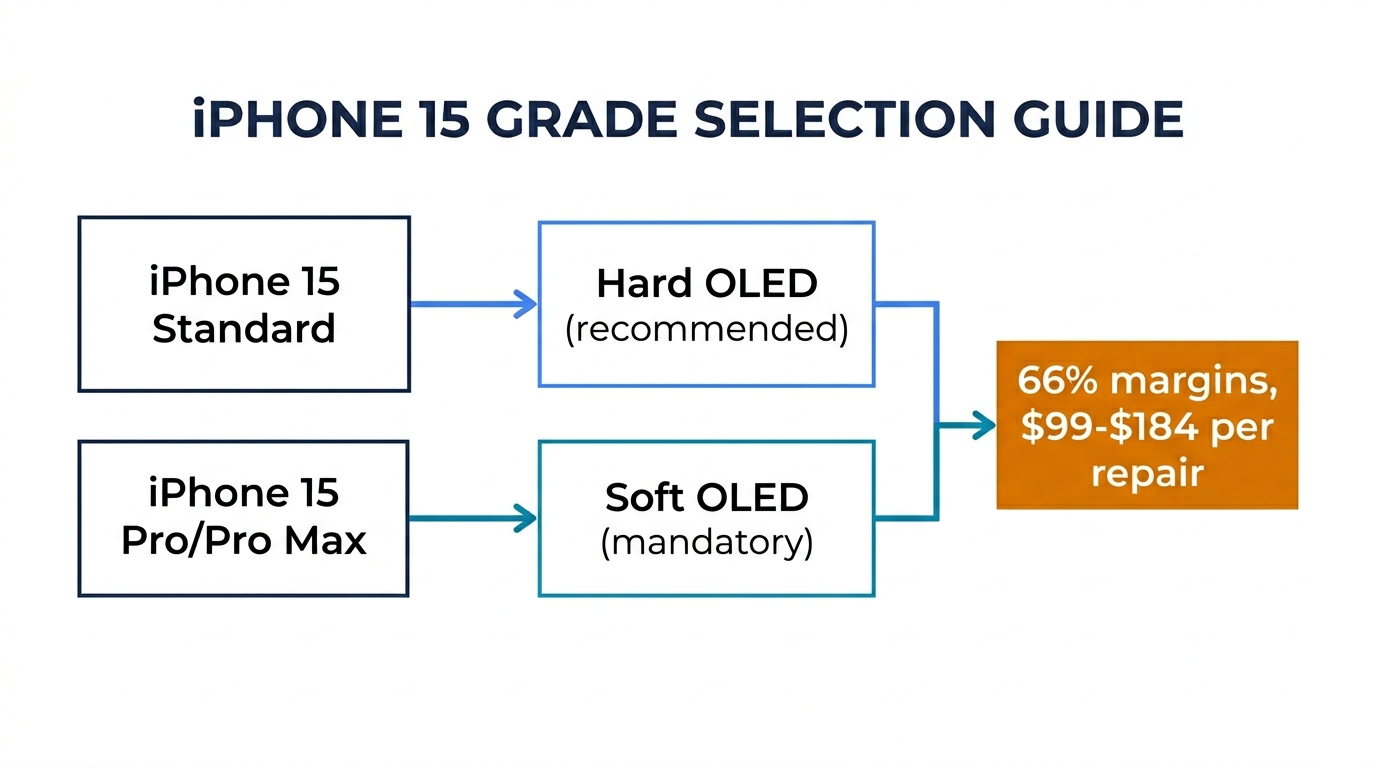
The iPhone 15 is one of the most profitable screen repair jobs available in 2026, but only if you match the right grade to the right model. Hard OLED on standard iPhone 15 delivers strong quality at good margins. Soft OLED on Pro models is non-negotiable — the 120Hz requirement and customer expectations demand it.
Stock accordingly: Hard OLED as your default for iPhone 15 standard, Soft OLED for all Pro repairs, and keep Incell only for the rare budget request. The iPhone 15 repair wave is building as warranties expire — shops with the right screens in stock will capture the volume.
Need wholesale iPhone 15 screens? We supply tested Incell LCD, Hard OLED, and Soft OLED for the full iPhone 15 series, with 120Hz-verified Soft OLED panels for Pro models. Request a wholesale quote to get grade samples and volume pricing.