
Incell vs Hard OLED vs Soft OLED: Which Screen Type to Order for Each iPhone and Samsung Model
The short answer: use Incell for LCD-native and budget repairs, Hard OLED for standard OLED repairs when margin matters, and Soft OLED or a verified premium OLED lane for Pro, AOD, curved, or quality-sensitive repairs. Grade and brand labels are only starting points: in the PRSPARES catalog the price order between JK and GX Soft OLED reverses by iPhone model, so the exact model, SKU, batch and 10/50/200 tier all have to be compared rather than assumed. For wholesale buying, the real decision is not "which screen is best?" It is which grade fits the phone model, customer promise, callback risk, and quantity tier.
Sourcing Replacement Screens in Bulk?
Incell / Hard OLED / Soft OLED grades — wholesale pricing, grade comparison on request.
Get Wholesale QuoteProcurement Snapshot
| Screen lane | Best fit | Main risk to check before bulk order | PRSPARES sourcing note |
|---|---|---|---|
| Incell LCD | LCD-native models, budget repair tiers and price-sensitive jobs | It is still LCD, so black levels, thickness and outdoor visibility differ from OLED-native phones | Quote by model and quantity tier; do not sell it as OLED quality |
| Hard OLED | Standard OLED-native iPhones where the buyer wants OLED contrast with better margin | Rigid substrate, drop fragility, and supplier-dependent behavior on ProMotion models | Good standard lane when the buyer has tested samples |
| Soft OLED | Premium repair tier, Pro models, quality-focused customers and higher-ticket jobs | Grade labels vary by supplier; verify brightness, color, IC workflow and AOD/120Hz behavior | Do not assume every "Soft OLED" label means the same quality |
| OLED quote lane | Rows labeled JK OLED, GX OLED or similar in a supplier price index | The label may not prove Soft OLED | Use exact SKU wording until grade mapping is confirmed |
| Original OLED / refurbished OLED | Premium lane, newer models and some curved Samsung screens | Higher cost and availability swings | Quote current stock, grade, origin wording and warranty terms clearly |
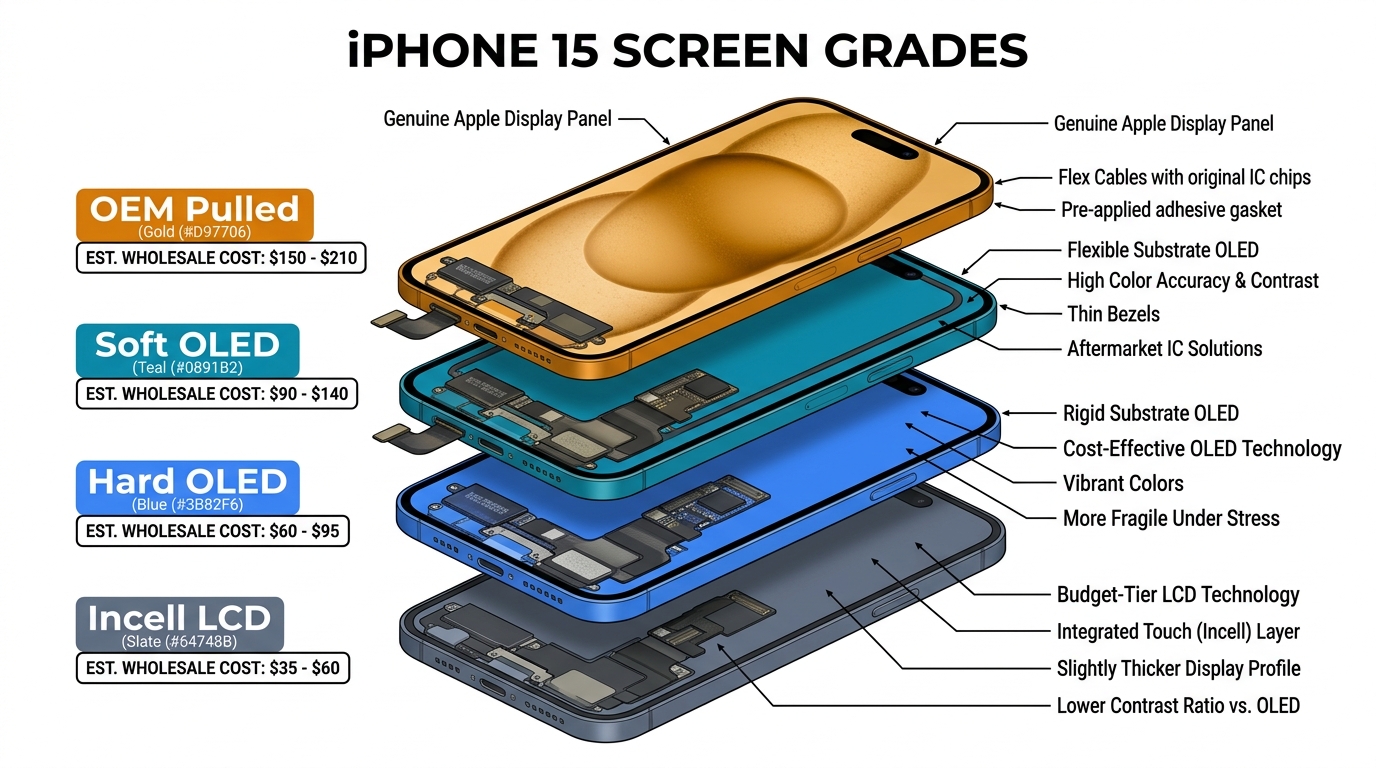
See the full four-grade comparison with live wholesale prices: iPhone Screen Grade Guide
PRSPARES is a wholesale supplier, so the best RFQ is specific: model list, grade lane, quantities at 10+, 50+ or 200+, destination country, packaging needs, warranty expectations, and whether the buyer wants samples before a bulk order.
Incell vs Hard OLED vs Soft OLED: Core Differences
| Factor | Incell LCD | Hard OLED | Soft OLED |
|---|---|---|---|
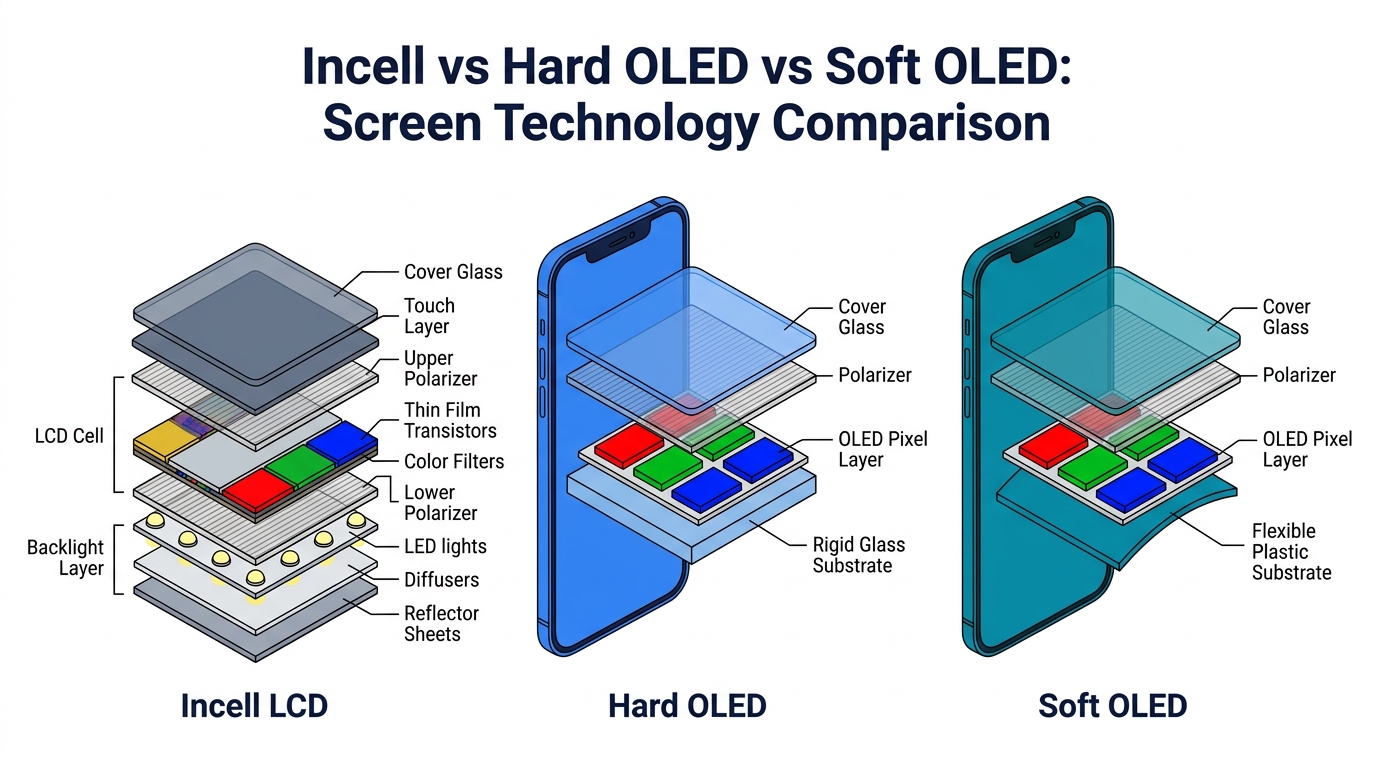
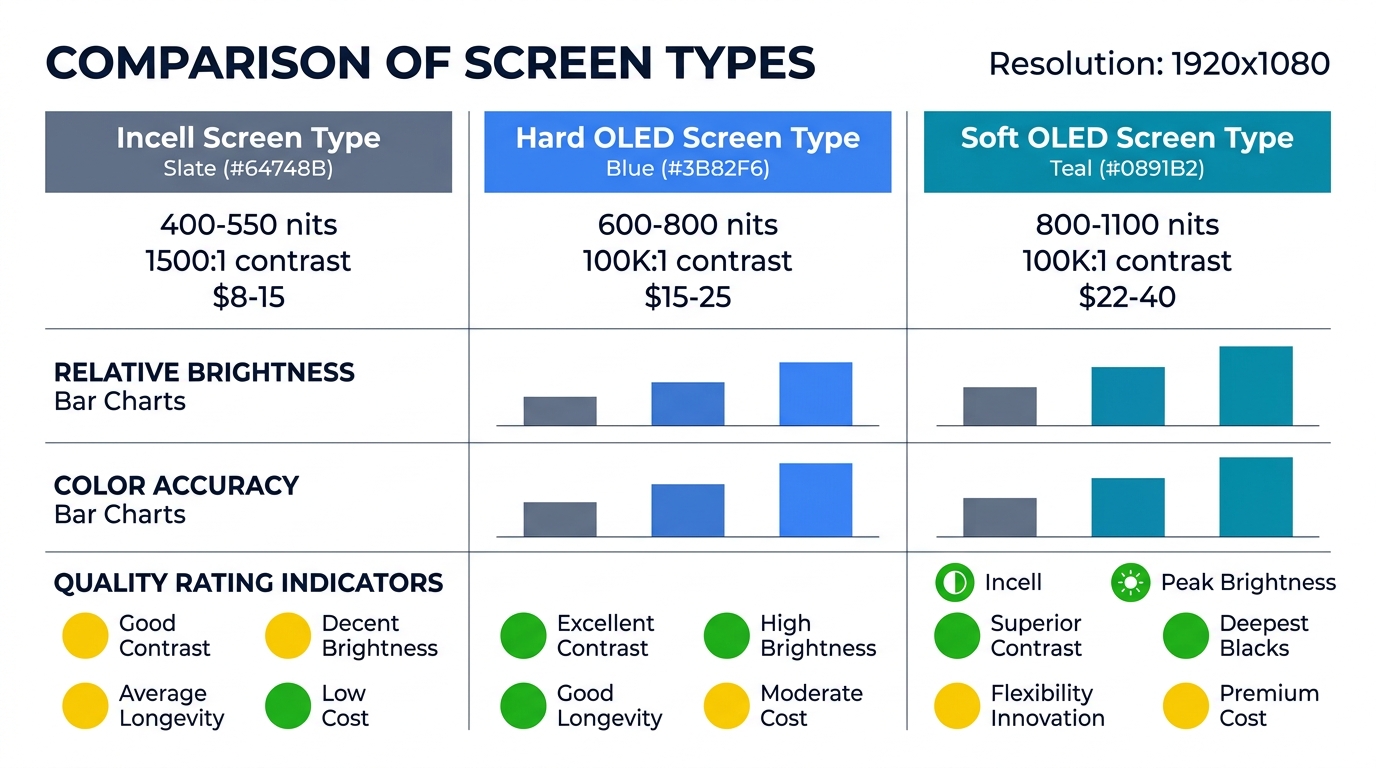
| Display technology | LCD with touch integrated into the LCD cell | OLED on a rigid substrate | OLED on a flexible substrate |
| Backlight | Yes | No | No |
| Black level | Dark gray black because the backlight remains on | True black because pixels can turn off | True black because pixels can turn off |
| Structure | Thicker LCD stack | Thinner OLED stack, but rigid | Flexible OLED stack, closer to original flexible OLED structure |
| Drop behavior | Rigid LCD assembly | Rigid glass substrate is less forgiving under impact | Flexible substrate is more forgiving under impact |
| Typical buyer use | Budget lane and LCD-native phones | Standard OLED lane with margin control | Premium lane and quality-sensitive repairs |
| What to verify | Color, thickness, touch, frame fit | Drop risk, color, touch, 120Hz/AOD behavior if used on Pro models | Grade consistency, IC/True Tone workflow, brightness, 120Hz/AOD behavior |
Incell is not a cheap OLED. It is LCD technology with the touch layer integrated into the LCD cell, so it still needs a backlight. OLED panels are different: each pixel emits its own light, which is why OLED can produce true black and thinner assemblies.
Hard OLED and Soft OLED are both OLED categories. The practical difference is the substrate. Hard OLED uses a rigid substrate, which is why it can be cheaper but less forgiving under pressure or drop impact. Soft OLED uses a flexible substrate, which is closer to the structure used by original flexible OLED displays. That does not make every Soft OLED SKU equal; it only means the category has a better structural starting point.
Current PRSPARES Price-Index Examples
These are exact examples pulled from the local PRSPARES price index for this July 2026 draft. They are reference examples for comparing lanes, not a live quotation. Prices can change by batch and availability, so request a current quote before placing a 10+, 50+ or 200+ order. Rows labeled JK/GX OLED are quoted under their exact SKU label until a PRSPARES rep confirms the public grade name for that batch.
| Model | Price-index label | Display grade to quote | 10+ | 50+ | 200+ |
|---|---|---|---|---|---|
| iPhone 11 | HD Incell LCD Touch Assembly | Incell LCD | $9.02 | $8.83 | $8.65 |
| iPhone 12 / 12 Pro | HD Incell LCD Touch Assembly | Incell LCD | $10.05 | $9.85 | $9.75 |
| iPhone 12 / 12 Pro | GX OLED LCD Touch Assembly | OLED, verify exact grade | $27.83 | $27.26 | $26.98 |
| iPhone 13 | HD Incell LCD Touch Assembly | Incell LCD | $11.38 | $11.15 | $11.03 |
| iPhone 13 | GX Hard OLED LCD Touch Assembly | Hard OLED | $34.22 | $33.52 | $33.17 |
| iPhone 13 | JK OLED LCD Assembly | OLED, verify exact grade | $39.11 | $38.31 | $37.91 |
| iPhone 14 | HD Incell LCD Touch Assembly | Incell LCD | $11.38 | $11.15 | $11.03 |
| iPhone 14 | OLED LCD Touch Assembly GX | OLED, verify exact grade | $34.22 | $33.52 | $33.17 |
| iPhone 14 | Super Retina XDR OLED Original | Original OLED | $61.86 | $60.29 | $60.29 |
| iPhone 15 | HD Incell LCD Touch Assembly | Incell LCD | $13.47 | $13.19 | $13.05 |
| iPhone 15 | JK OLED LCD Assembly | OLED, verify exact grade | $41.18 | $40.34 | $39.92 |
| iPhone 16 | HD+ Incell LCD Touch Assembly | Incell LCD | $14.96 | $14.66 | $14.66 |
| iPhone 16 | JK OLED LCD Assembly | OLED, verify exact grade | $40.43 | $39.60 | $39.19 |
| iPhone 16 | Original Super Retina XDR OLED LCD Assembly | Original OLED | $147.75 | $145.50 | $145.50 |
Why Model Beats A Brand-Wide Price Ranking
A Soft OLED label does not create one universal brand price order. In the PRSPARES catalog snapshot reviewed on August 24, 2026, JK is priced above GX on iPhone 16 Pro Max, while GX is priced above JK on iPhone 15 Pro Max. Both comparisons use the same canonical grade and the same 10/50/200 wholesale tiers, from source rows valid through May 27, 2026.
| Model | Canonical grade | JK wholesale-index band | GX wholesale-index band | Observed order |
|---|---|---|---|---|
| iPhone 16 Pro Max | Soft OLED | about $73-75 | about $59-64 | JK above GX |
| iPhone 15 Pro Max | Soft OLED | about $40-44 | about $54-59 | GX above JK |
These two comparisons do not prove that JK is the better panel on iPhone 16 Pro Max, or that GX is the better panel on iPhone 15 Pro Max. They prove only that a brand-wide price hierarchy is unsafe to assume. Brightness, touch response, refresh rate, bezel fit and failure rate still need model-specific QC evidence, and the bands above are dated wholesale-index evidence rather than a live quotation.
Our data shows why the grade question changes the entire repair-shop margin plan. In the current PRSPARES price index, iPhone 13 examples run from $11.38 at 10+ for HD Incell LCD, to $34.22 at 10+ for GX Hard OLED, to $39.11 at 10+ for a JK OLED quote lane. At 200+, those same rows move to $11.03, $33.17 and $37.91. On iPhone 16, the example spread is wider: $14.96 at 10+ for HD+ Incell, $40.43 at 10+ for JK OLED, and $147.75 at 10+ for Original Super Retina XDR OLED. The useful takeaway is not that every model has the same spread. It is that a wholesale buyer should compare actual quote lanes for the exact model and quantity tier before building the retail repair menu.
Which Screen Type To Order For iPhone Models
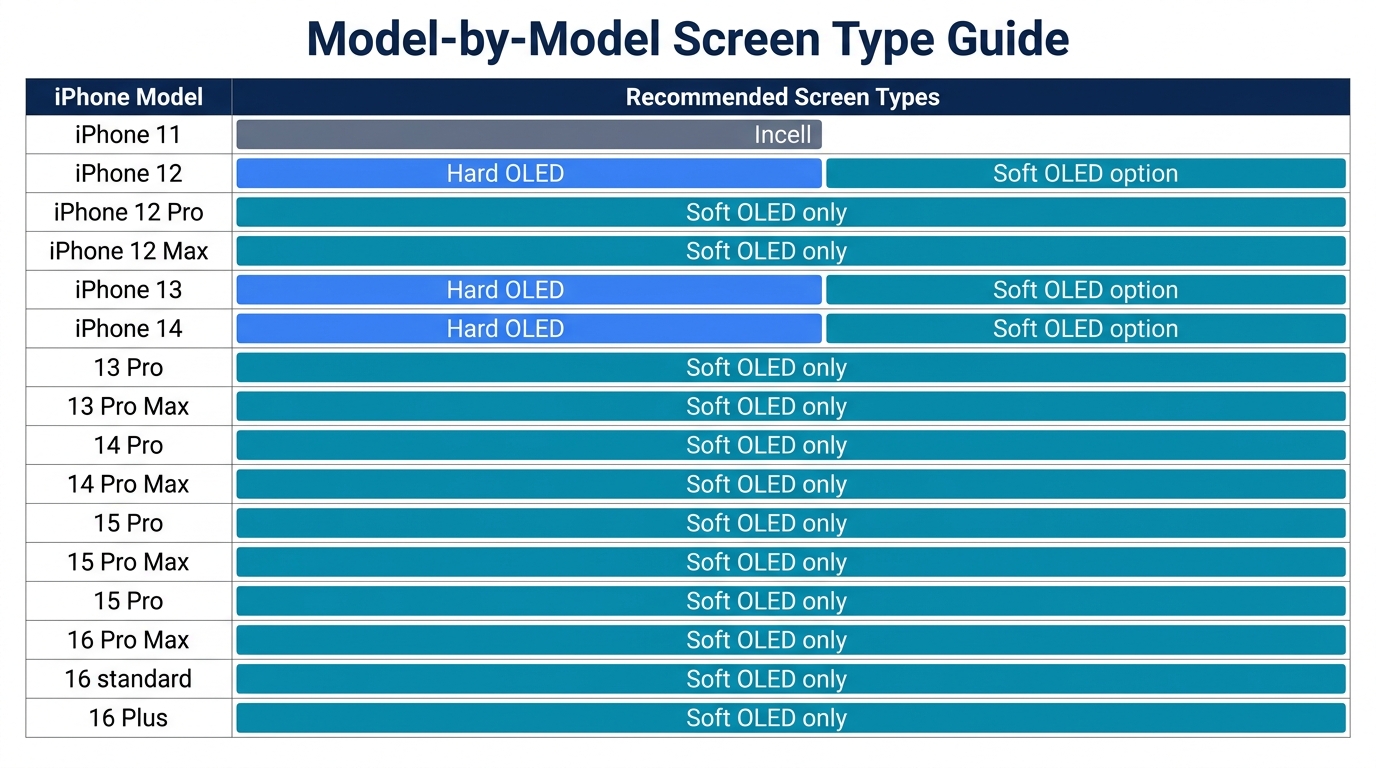
The safest iPhone buying rule is to match the screen lane to the original display category first, then add feature checks for premium models. Apple lists ProMotion with adaptive refresh rates up to 120Hz on iPhone 13 Pro and newer Pro models, and it lists Always-On Display on iPhone 14 Pro and newer Pro models. That does not prove one aftermarket grade always works or fails. It means a 50+ or 200+ wholesale order for Pro models should require sample proof for 120Hz behavior, AOD behavior, warning behavior, IC workflow and True Tone programming before the buyer commits.
| iPhone model group | Original display type | Recommended wholesale lane | Why this is the safer buying decision |
|---|---|---|---|
| iPhone XR, iPhone 11, iPhone SE series | LCD | Incell LCD | The phone is LCD-native, so an Incell LCD replacement matches the display category better than paying for an OLED lane the original phone did not use. |
| iPhone X, XS, XS Max, 11 Pro, 11 Pro Max | OLED | Hard OLED for budget/standard jobs; Soft OLED or premium OLED lane for quality-sensitive customers | These are OLED-native phones. Incell can function as a budget downgrade only if the customer accepts the LCD trade-off. |
| iPhone 12 / 12 mini | OLED | Hard OLED or OLED quote lane for volume; Soft OLED or premium lane for higher-ticket repair | Standard iPhone 12 models do not have ProMotion. The main checks are color, brightness, touch, True Tone/IC workflow and drop-risk tolerance. |
| iPhone 12 Pro / 12 Pro Max | OLED | Soft OLED or verified premium OLED lane first; Hard OLED only as a clearly positioned budget lane | Pro buyers are more likely to notice display downgrade, color shift and thickness differences. Quote two lanes if the buyer sells both standard and premium repair tiers. |
| iPhone 13 / 13 mini | OLED | Hard OLED for standard volume; OLED quote lane or Soft OLED for premium tier | The price index already shows a concrete iPhone 13 Incell, Hard OLED and JK OLED spread. Use samples to decide whether the premium lane is worth the higher unit cost. |
| iPhone 13 Pro / 13 Pro Max | OLED with ProMotion up to 120Hz | Soft OLED or verified premium OLED lane; require 120Hz proof before bulk order | Apple lists ProMotion adaptive refresh rates up to 120Hz for iPhone 13 Pro. Do not buy a Pro model aftermarket screen only because the supplier says "OLED"; require sample results for refresh behavior, warnings and IC workflow. |
| iPhone 14 / 14 Plus | OLED | Hard OLED or OLED quote lane for standard repairs; premium OLED lane for quality-focused buyers | These standard models do not have the same ProMotion/AOD requirement as the Pro models. The decision is mainly margin vs display expectation. |
| iPhone 14 Pro / 14 Pro Max | OLED with ProMotion and Always-On Display | Soft OLED, premium OLED or Original OLED/refurbished lane depending on budget | Apple lists both ProMotion up to 120Hz and Always-On Display for iPhone 14 Pro. Before bulk buying, ask the supplier to prove AOD behavior, refresh behavior, warning behavior and sample pass rate. |
| iPhone 15 / 15 Plus | OLED | Hard OLED or OLED quote lane for standard jobs; premium lane for better customer experience | For standard models, the buyer can build two repair tiers. Quote exact grade and test samples rather than assuming every OLED row has the same panel quality. |
| iPhone 15 Pro / 15 Pro Max | OLED with ProMotion and Always-On Display | Soft OLED, premium OLED or Original OLED/refurbished lane | Treat the display as a premium repair. AOD and 120Hz behavior are not optional checks for a shop that sells quality-focused repairs. |
| iPhone 16 series | OLED; Pro models include ProMotion and AOD | Quote current stock by exact SKU label; sample first for new lanes | Aftermarket supply changes quickly on newer models. Use current price-index rows as examples, then confirm grade, IC workflow, display warnings and availability before committing to 50+ or 200+. |
Which Screen Type To Order For Samsung Models
| Samsung model group | Buying direction | Why |
|---|---|---|
| Galaxy A-series LCD models such as A15 / A25 | Compatible LCD or Incell-style LCD lane | If the original phone is LCD/PLS, match the category and avoid overbuying premium OLED lanes. |
| Galaxy A-series AMOLED models such as A35 / A55 | Verified OLED/AMOLED lane; sample color profile before bulk order | Samsung buyers often notice color temperature and saturation differences. Do not rely on grade names alone; compare sample color, brightness, fingerprint behavior and frame fit. |
| Galaxy S-series standard and Plus models | Premium OLED, Original OLED/refurbished, or supplier-verified aftermarket OLED depending on the repair tier | These are higher-ticket jobs. Quote at least two lanes if the repair shop sells both standard and premium repair options. |
| Galaxy Ultra curved models | Original OLED/refurbished or a premium curved assembly with sample verification | Curved screens add fit, edge-touch, fingerprint and lamination risk. The buyer should not bulk order from a new supplier without samples and warranty terms. |
Samsung RFQs need stricter lane separation than iPhone RFQs because the same model can appear in the price index with TFT, OLED and Original-labeled assemblies. July 2026 price-index examples show the spread: Galaxy A25 SM-A256B TFT LCD Touch Assembly with Frame is $9.60 at 10+, while Galaxy A25 Original LCD Touch Assembly with Frame is $56.74 at 10+. Galaxy A35 SM-A356B OLED LCD Touch Assembly with Frame is $31.04 at 10+. Galaxy S23 Ultra examples range from $25.58 at 10+ for a TFT LCD assembly with frame, to $65.11 at 10+ for a 6.78-inch OLED assembly with frame, to $220.64 at 10+ for an Original LCD Touch Assembly. Use those rows to structure the RFQ, then confirm exact grade, frame, fingerprint and curved-edge behavior before bulk ordering.
Inventory Mix: Use A Worksheet, Not A Universal Ratio
For 2026 screen sourcing, the better method is to turn the shop's recent repair mix into the stock mix. A shop that mostly repairs iPhone 11, iPhone XR and LCD Samsung A-series phones should not copy the same order structure as a shop selling premium iPhone 15 Pro, iPhone 16 and Galaxy Ultra repairs. The price-index examples show why: one iPhone 16 row is $14.96 at 10+ for Incell, while another is $147.75 at 10+ for Original OLED.
Use this worksheet instead:
| Last 60-90 days repair data | What to count | Buying action |
|---|---|---|
| LCD-native jobs | iPhone 11/XR/SE and Samsung LCD models | Stock Incell or compatible LCD for the repeat models. |
| OLED standard jobs | iPhone X-15 standard models and similar OLED-native phones | Stock Hard OLED or standard OLED quote lanes after sample testing. |
| Premium OLED jobs | Pro iPhones, newer flagships and customers buying higher repair tiers | Keep premium OLED, Original OLED/refurbished or PRSPARES-confirmed Soft OLED lanes. |
| Callback-sensitive jobs | Business customers, warranty-sensitive repairs and repeat resellers | Prioritize stable grade and supplier consistency over lowest unit cost. |
For a 100-piece screen replenishment order, do not start from a generic internet ratio. Start from the last 100 screen jobs your shop actually completed, split them into LCD-native, standard OLED and premium OLED groups, then ask PRSPARES to quote those groups at 10+, 50+ and 200+ tiers. That creates a stock mix tied to demand instead of a guessed ratio.
Common Sourcing Mistakes
Mistake 1: Selling Incell As If It Were OLED
Incell can be a valid budget lane, but it is still LCD. On an OLED-native iPhone, the buyer should expect different black levels, thickness, brightness behavior and customer perception. If a repair shop sells Incell as a clear budget option, it can protect margin. If it sells Incell as equivalent to OLED, it creates a trust and warranty problem.
Mistake 2: Treating Hard OLED As One Universal Grade
Hard OLED is a category, not a guaranteed quality level. The right question is not only "is it Hard OLED?" It is whether the sample passes touch, color, frame fit, pressure, warning, True Tone/IC and warranty checks for the exact model. This matters most when a buyer is moving from a 10+ test order to a 50+ or 200+ replenishment order.
Mistake 3: Checking ProMotion And AOD Too Late
iPhone 13 Pro and newer Pro models need 120Hz behavior checks. iPhone 14 Pro and newer Pro models also need Always-On Display checks. The buyer should confirm those functions before a 50+ or 200+ order, not after selling the first repairs and hearing that scrolling, wake behavior or display warnings feel different.
Mistake 4: Calling JK/GX OLED "Soft OLED" Without Grade Mapping
Supplier labels such as JK OLED or GX OLED can be useful quote lanes, but the label alone does not prove the substrate or public grade name. In the RFQ, ask the supplier to state the grade, substrate if available, IC workflow, True Tone support, warranty terms and sample policy before publishing that lane as Soft OLED to your customers.
Mistake 5: Buying Only The Cheapest Lane
The cheapest screen can raise hidden cost through redo labor, returns, warranty pressure and reputation damage. A better RFQ compares part cost, selling tier, customer expectation, warranty policy and redo-labor risk. For example, a shop may still choose a $9.60 Samsung A25 TFT lane for budget repairs, but it should not confuse that lane with a higher-priced Original-labeled assembly.
Copyable RFQ Template
A good screen RFQ makes the supplier quote the same model across the same quantity tiers. For PRSPARES, that means 10+, 50+ and 200+ pricing, plus the exact grade lane for each model. A buyer comparing iPhone 13 Incell at $11.38, iPhone 13 GX Hard OLED at $34.22 and iPhone 13 JK OLED at $39.11 is making a different decision than a buyer asking only for "iPhone 13 screen price." The RFQ should force the comparison to stay model-specific, grade-specific and quantity-specific.
Use this when asking PRSPARES for a screen quote:
Buyer type: repair shop / distributor / refurbisher / reseller
Market: US / UK / EU / other
Models needed:
- iPhone 13: Incell / Hard OLED / OLED quote lane / Original OLED, quantity:
- iPhone 14 Pro: premium OLED / Original OLED / refurbished OLED, quantity:
- Samsung model(s): grade requested, quantity:

Quantity tier to quote: 10+ / 50+ / 200+
Target repair tier: budget / standard / premium
Must-check features: 120Hz ProMotion / Always-On Display / fingerprint / curved edge / True Tone / IC transfer
Packaging requirement: bulk pack / individual pack / reseller label
Warranty expectation: 12-month PRSPARES warranty terms
Destination country:
Sample request before bulk order: yes / no
Notes:
Who PRSPARES Is Not For
PRSPARES is not the right fit for one-off retail DIY buyers, local walk-in repair customers, or buyers who only want the cheapest possible part without caring about grade, warranty, packaging or repeat supply. PRSPARES is a better fit when the buyer has a model list, recurring demand and a need to compare quality lanes before a wholesale RFQ.
📲 Sourcing screens for a repair business? Message us on WhatsApp — send your model list and get a written wholesale quote by grade. No forms needed.
FAQ
Is Incell better than Hard OLED?
No. Incell and Hard OLED serve different jobs. Incell is LCD-based and best for LCD-native or budget repairs. Hard OLED is OLED-based and better suited to OLED-native phones when the buyer wants OLED contrast at a lower cost than premium lanes. In the current PRSPARES price-index examples, iPhone 13 Incell is $11.38 at 10+, while iPhone 13 GX Hard OLED is $34.22 at 10+. That price difference is why the repair menu should separate budget LCD repairs from OLED-grade repairs.
Is Soft OLED always the best option?
No. Soft OLED is usually the premium aftermarket direction because of its flexible substrate, but it is not automatically the best purchase for every order. A budget repair shop may make more money with Incell or Hard OLED lanes on the right models, while a premium repair shop may prefer Soft OLED, Original OLED or refurbished OLED for higher-ticket repairs.
Can I use Incell on iPhone 12, 13, 14 or 15?
Yes, but only as a clear budget downgrade. Those phones are OLED-native, so Incell changes the display category to LCD. If the customer expects OLED quality, use Hard OLED, Soft OLED, premium OLED or Original OLED/refurbished lanes instead.
Can Hard OLED support 120Hz on iPhone Pro models?
It depends on the exact SKU and supplier. Apple lists ProMotion up to 120Hz on iPhone 13 Pro and newer Pro models, so a wholesale buyer should require sample proof of refresh behavior before ordering Hard OLED for those models. In a 2026 RFQ, do not rely on the word "OLED" alone; ask for 120Hz behavior, display-warning behavior, IC workflow and sample results before approving a 50+ or 200+ order.
Is JK or GX Soft OLED more expensive?
Neither brand is always more expensive. In the PRSPARES wholesale-index rows valid through May 27, 2026, JK Soft OLED sits above GX on iPhone 16 Pro Max, while GX Soft OLED sits above JK on iPhone 15 Pro Max, across the listed 10/50/200 tiers. Compare the exact model and request a current quotation; price on its own does not establish display quality.
Which screen type has the lowest defect rate?
Do not choose only by screen type. Defect and callback rates depend on manufacturer, batch, model, QC process, shipping protection and installation workflow. Ask the supplier for recent QC data, warranty terms and sample policy. PRSPARES can discuss grade options and 12-month warranty terms during RFQ.
Do I need different tools for Incell, Hard OLED and Soft OLED?
Usually the model determines the repair workflow more than the display grade name. The buyer still needs to check adhesive, frame, flex, IC transfer, True Tone programming, warning behavior and model-specific functions before bulk ordering.
What should I send PRSPARES to get a useful quote?
Send the model list, quantity tier, grade lane, destination country, target repair tier, packaging needs, warranty expectation and whether you want samples first. A quote request that says only "iPhone screens price" is too broad to produce a useful wholesale comparison.
Next Step
Build your screen RFQ around the actual models and customer tiers you sell. PRSPARES can quote Incell, Hard OLED, OLED quote lanes and Original OLED/refurbished options by 10+, 50+ and 200+ tiers. If the order includes ProMotion or AOD models, ask for sample proof before moving from a 10+ test order to a 50+ or 200+ replenishment order. For example, an iPhone 13 buyer should compare the $11.38 Incell row, the $34.22 Hard OLED row and the $39.11 JK OLED quote-lane row before deciding what to sell as budget, standard and premium repair.
Browse the wholesale screen category, or request a sample comparison and current quote.
Related reading: