
Top 10 Phone Parts Suppliers in China (2026): The Transparent Sourcing Map
A repair shop owner emails us some version of the same story every month. They found a "factory" on a marketplace, the iPhone 13 screens were $9 instead of $12, the first 20 units looked fine — and then batch two arrived with different flex cables, different brightness, and a return rate that ate the entire saving. When they messaged the supplier, the answer was: "same quality, different batch."
Nobody lied to them, exactly. They just never knew which of China's ten supplier channels they were actually buying from.
Here is the answer most guides bury: "China phone parts suppliers" are not one category. They are at least ten distinct channel types — factory-direct exporters, panel-brand factories, model specialists, battery specialists, trading companies, marketplace storefronts, Huaqiangbei market booths, re-glass refurbishers, recycler channels, and overseas-warehouse distributors. The same iPhone 13 Incell screen legitimately sells for $11.38 in one channel and $25+ in another — and neither price is a scam. The skill is matching the channel to your order, not hunting one "best supplier."
This guide maps all ten. For each type you get: what it actually is, real 2026 price behavior, who should use it, and a fast test to verify you're really talking to one.
Looking for a Reliable Wholesale Parts Supplier?
Factory-direct from Shenzhen — transparent grades, invoices & 12-month warranty.
Get Wholesale QuoteWho Is This List For — and Who Should Skip It?
👉 This guide is written for trade buyers: repair shops ordering 10–50+ units a month, distributors and refurbishers buying 50–500+ mixed units, and online resellers who need consistent grades.
If you need one screen for your own phone, this is the wrong page — a local repair shop or a retail marketplace will serve you faster than any wholesale channel in this list. Wholesale channels quote in tiers (10+/50+/200+) and none of them are set up for single-unit retail.
Why Trust a Supplier Ranking Written by a Supplier?
Transparency first: PRSPARES is a Shenzhen/Huaqiangbei factory-direct wholesale supplier, and we appear in this list under the channel type we belong to. You should treat any "Top 10 suppliers" page — including this one — as marketing until it proves otherwise. So here is how this page is different, and you can verify every claim:
- We don't invent competitor names. Most supplier listicles pad their rankings with company names you can't verify. We rank channel types, not made-up companies, and we don't name specific competitors — good or bad.
- Every price in this article is real. The ranges come from our own live catalog of 188 iPhone screen SKUs and 26 battery SKUs (July 2026 price sheet), computed automatically — the same numbers published on our wholesale screens page. Most channels in this list won't publish prices at all; we do, so you have a calibration point.
- We tell you when China-direct is NOT the cheapest option. Section 10 includes the honest math on when a domestic distributor beats us. A ranking that never argues against its own author isn't a ranking.
Our evaluation lens, from 10+ years buying and QC-ing parts in Huaqiangbei: (1) grade labeling honesty, (2) batch-to-batch consistency, (3) price transparency, (4) warranty recourse, (5) mixed-order capability, (6) export logistics competence, (7) communication traceability — can they tell you which factory a batch came from?
What Does China's Phone Parts Supply Chain Actually Look Like?
The Chinese phone parts market is a layered supply chain, not a directory of companies. Panels are made by display factories, assembled into screens by assembly factories, branded by panel-brand lines, resold through booths and trading companies, listed on marketplaces, and stocked abroad by distributors. Every layer adds either value (QC, warranty, logistics) or just margin. Your job as a buyer is to enter the chain at the highest layer your order size justifies.
The ten channel types, ranked by how well they serve a professional trade buyer:
| # | Channel type | Typical role | Price level (same part) |
|---|---|---|---|
| 1 | Factory-direct exporters | Assembly + QC + export under one roof | Baseline |
| 2 | Panel-brand factories (JK/GX/DD/RJ) | Branded panel production lines | Baseline (via #1) |
| 3 | Model-specialist factories | Deep runs of a few models | Baseline to −10% |
| 4 | Battery specialists | Cells, packing, DG shipping | Baseline |
| 5 | Trading companies / sourcing agents | Aggregation + English service | +10–25% |
| 6 | B2B marketplace storefronts | Listings + escrow | +10–30% |
| 7 | Huaqiangbei market booths | Cash-and-carry spot stock | −5% to +15%, high variance |
| 8 | Re-glass refurbishers (后压屏) | "Original" screen supply | Baseline for Original grade |
| 9 | Recycler / pulled-parts channels | Tear-down harvesting (拆机) | Cheap but unsorted |
| 10 | Overseas-warehouse distributors | Local stock, local returns | +15–40% over China-direct |
Price calibration for the whole article, from our July 2026 catalog (10+ unit tier, per piece): Incell LCD assemblies $8.23–$45.13 · Soft OLED $13.65–$120.17 · Hard OLED $34.22–$74.96 · Original (re-glassed genuine panel) $18.81–$304.37 · iPhone replacement batteries $4.42–$28.34. The full four-grade definition matrix is in our iPhone Screen Grade Guide. Keep these bands in mind — when a quote lands far outside them, the interesting question is never "is it cheap," it's "which channel am I actually in?"
1. Which Suppliers Offer True Factory-Direct Wholesale Pricing?
A factory-direct exporter is a supplier that assembles or sources parts at the factory layer in Shenzhen, runs its own incoming-material QC, and exports to trade buyers without a trading-company middle layer. This is the channel PRSPARES operates in, so read this section knowing that — and then verify it the same way you'd verify anyone.
What the channel looks like when it's real:
- Prices are published or quoted instantly by model and grade — because the price list is theirs, not forwarded from someone else. (Ours is public: 188 iPhone screen SKUs with live 10+/50+/200+ tiers.)
- Grades are labeled per line item. Every SKU on a real factory-direct list says Incell / Soft OLED / Hard OLED / Original — not "high quality" or "OEM grade."
- Mixed orders aggregate for tier pricing. 5 pcs each across 10 models should price as a 50-unit order. Channels that refuse mixed aggregation are usually reselling someone else's minimums.
- They can answer the factory question. Ask: "这批货是哪条线的?" ("Which line did this batch come from?") A factory-layer supplier answers in seconds. A reseller stalls.
Real 2026 anchor prices in this channel: iPhone 13 Incell from $11.38, iPhone 14 Pro Max Incell from $15.36, iPhone 15 Pro Max Soft OLED from $41.37, iPhone 16 Pro Max Original from $242.31 (all 10+ tier, EXW Shenzhen).
Best for: any repeat trade buyer at 10+ units — this is the default channel to price everything else against.
📲 Shortcut: message us on WhatsApp and you'll get the current price list without filling a form.
2. What Are Panel-Brand Factories Like JK and GX — and Why Do Their Names Matter?
Panel-brand factories are production lines whose aftermarket panels circulate under two-letter trade names — JK, GX, DD, RJ — that function as de-facto quality tiers inside the trade. These names almost never appear on Western marketplaces, which is exactly why insiders use them: they carry real batch reputation.
What the brand tokens tell you, with real catalog data:
- JK — the widest aftermarket line in our catalog: 40 SKUs across 23 iPhone models, $12.90–$120.17, spanning both Incell and Soft OLED. The "safe default" of branded aftermarket. (JK screen list)
- GX — 23 SKUs across 18 models, $9.21–$64.12, mostly Soft OLED — the value-OLED play for Pro/Pro Max repairs. (GX screen list)
- DD — a Hard OLED specialist: 20 SKUs, $40.24–$74.96. Good color, thicker glass, no flexible substrate.
- RJ — a small Incell-focused line (7 SKUs, $16.88–$26.89).
Hidden rule of the trade: if a price list has no brand tokens at all, you are buying blind. Unbranded "OLED assembly" quotes are how 混货 (mixed-batch) inventory gets moved — three factories' output in one carton, one label. You can't reorder consistency you can't name.
Best for: buyers who care about batch-to-batch consistency and want to specify quality by name instead of trusting adjectives. You normally buy these lines through a factory-direct exporter (channel #1) rather than from the line itself.
3. Who Are the Model-Specialist Factories Behind "Cheap" iPhone Screens?
Model-specialist factories run deep production of a narrow model family — say, only iPhone 11–13 Incell — and win on volume cost for exactly those models. When you see an iPhone 11 Incell assembly at $8–10 that tests fine, it usually traces to one of these lines (our own iPhone 11 Incell floor: $8.23).
The trap: specialists are brilliant inside their range and improvise outside it. Order "the same thing but for iPhone 15" and you'll get a sourced-in panel of unknown lineage at a made-up price. The specialist's price list is a cliff — flat and low in-range, chaos beyond it.
Best for: high-volume shops standardizing on economy repairs for 2–4 generations-old models. Test: ask for their best price on a model outside their obvious range. If it's suspiciously close to their in-range pricing, they're brokering, not making.
4. Which Suppliers Should You Use for Batteries Instead of Screens?
Battery specialists are a separate channel because batteries have a different risk profile: cell sourcing, capacity honesty, and dangerous-goods (UN38.3 / DG) shipping competence matter more than cosmetic grading. A screen supplier who "also does batteries" is often just forwarding a battery vendor's stock.
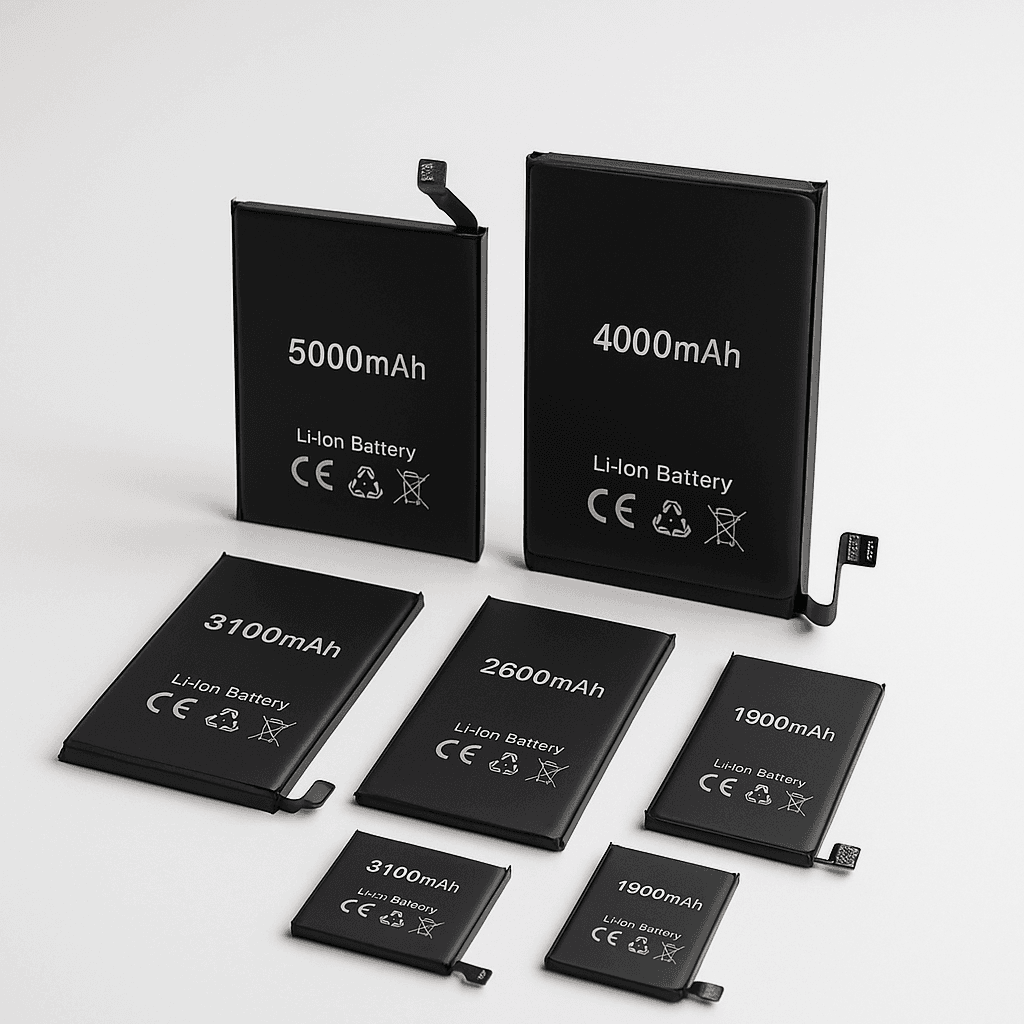
Real battery economics, July 2026: our 26-SKU iPhone battery range runs $4.42–$28.34 per unit at the 10+ tier — iPhone 13 (3227 mAh) at $6.07, iPhone 16 Pro Max (4685 mAh) at $28.34. When a quote undercuts floors like these by 30–40%, you are almost always looking at re-wrapped used cells or capacity-inflated labels ("300mAh placeholder" specs are a known catalog-padding trick in this trade).
What competence looks like: brand-new 0-cycle cells from a mature cell factory, per-batch capacity/voltage/IC testing, neutral packaging by default, and the ability to quote DG-compliant express routes without hesitation. Test question: "Which courier routes do you use for DG battery shipments to my country?" A real battery channel answers with named routes and packing rules; a forwarder goes quiet.
Best for: any buyer ordering batteries at 10+ units — and if a screen order and battery order can consolidate into one shipment, run the batteries through the screen supplier's battery line, not their afterthought.
5. Are Trading Companies and Sourcing Agents Ever Worth the Markup?
A trading company buys from factories and booths, adds 10–25%, and sells to you with better English, consolidated shipping, and one invoice. That markup is not automatically evil — it buys real services: aggregation across many part types, communication, sometimes credit terms.
The honest decision rule: pay a trading margin for breadth, never for parts you can buy one layer up. If 80% of your order is iPhone screens and batteries, the trading layer adds cost without adding QC. If your order is 40 SKUs across six brands including obscure flexes and tools, an agent may genuinely be cheaper than your time.
The tell that you're talking to a trading company pretending to be a factory: the 2 a.m. reply. Factories have shifts; booths and traders have hungry salespeople online at all hours. Speed of reply is a sales signal, not a manufacturing one. Combine with the factory question from section 1 and the picture is usually clear in one message.
6. What Do You Actually Get From B2B Marketplace Storefronts?
Marketplace storefronts are listings layered on top of channels 1–8, plus an escrow system. The platform's buyer protection is real and matters for first contact with an unknown counterparty. What the listing does not tell you is which channel type is behind it — a "manufacturer" badge routinely fronts a trading desk.
Priced honestly, escrow costs you 10–30% over factory-direct on like-for-like grade — partly platform fees, partly the anonymity premium. And grade language on marketplaces is at its loosest: "OEM quality," "original quality," "AAA+" are unfalsifiable phrases. Our advice stays what it has always been: use marketplaces to discover counterparties, then move serious volume into a direct, named-grade relationship — whoever you choose for it. (Deeper dive: Are Chinese phone parts suppliers really worth the risk?)
7. Should You Ever Buy From Huaqiangbei Market Booths Directly?
Huaqiangbei market booths (档口) are the spot market of the parts world: thousands of stalls trading cash-and-carry stock with same-hour availability and zero paperwork. It is a genuinely great channel — for people physically standing in Shenzhen with the skill to test on the spot.
For remote buyers it's the highest-variance channel on this list. Booth stock is whatever moved through this week: factory overruns, rejected QC lots, repacked returns — often side by side on the same shelf, which is how 混货 batches are born. Prices swing from 5% below factory to 15% above depending on the day's inventory, and there's a reason the trade has a word — 杀熟价, "newcomer markup" — for what first-time foreign buyers get quoted.
Best for: buyers with a trusted person physically in Shenzhen (many factory-direct exporters, us included, effectively act as your QC layer over exactly this market — that's what "incoming-material QC" means in practice). Never for: unaccompanied remote orders of grade-critical parts.
8. Who Supplies "Original" Screens — and What Do Re-Glassing and Pulls Really Mean?
Two channels feed almost every "Original" screen sold in this market, and understanding them kills most grade confusion:
Re-glass refurbishers (后压屏 specialists) take a genuine factory panel with broken glass, remove the damaged layer, and laminate new glass onto the untouched OLED cell. The display, True Tone behavior and brightness are the original panel's — because it is the original panel. This is what honest suppliers mean by "Original" grade, and why it prices $18.81–$304.37 by model instead of at new-part levels. It's a refurbished panel and should be sold as exactly that.
Recycler channels (拆机) harvest pulled parts from scrapped devices — screens, cameras, housings — and sell them unsorted or lightly graded. This is the raw material layer feeding the re-glassers. Buying pulls directly is cheap and legitimate for cameras or small parts, but for screens you're taking on the sorting and lamination risk yourself.
Hidden rule #2: "OEM Original" as a grade name doesn't exist at the factory layer. Anyone quoting "OEM Original" without defining whether it's a re-glassed pull, a Service Pack unit, or an aftermarket panel is reselling mystery stock. Make them pick a word. (Full definitions with live prices: iPhone Screen Grade Guide.)
9. When Do Overseas-Warehouse Distributors Beat China-Direct?
Overseas-warehouse distributors import from channels 1–8, stock parts in the US/EU/UK, and resell with local shipping and local returns. They are this list's most honest "expensive" option — and here is the math no China supplier likes to publish:
If you're a US buyer ordering small and often, a good domestic distributor is frequently within 0–15% of China-direct pricing once you add express freight — and sometimes effectively equal. Next-day arrival and domestic RMA are worth real money at low volumes. China-direct wins on structure, not always on sticker: mixed-order aggregation into 50+/200+ tiers, access to named panel brands, and grade control at the source.
For buyers in Europe, Australia, Africa, the Middle East and Latin America, the gap widens to 30–40% — local distributor markups are higher and the freight difference smaller, which is why most of our fastest-growing buyer segments are outside the US.
Best for: US shops under ~20 units/month, anyone who can't float a 5–7 day lead time. Switch signal: the month your order would hit a 50+ aggregate tier China-direct, re-run the math — that tier break usually pays for the freight.
10. How Do You Spot a Fake Supplier Before You Pay?
Beyond channel confusion sits actual fraud. From our own inbound RFQ screening, real scam attempts cluster into a recognizable four-signal pattern — and it's the combination that convicts, not any single signal:
- Off-catalog asks: requesting goods the supplier never listed (scrapped whole devices, bulk used phones) — testing whether you'll transact outside your lane.
- Look-alike domains: an email domain one letter off from a real company's.
- Prices ~30%+ below the floors in this article for allegedly new, graded stock.
- Odd payment/logistics choreography: untraceable payment channels, third-country "agents," or elaborate photo-before-shipping rituals that substitute theater for verification.
Run the price math as your first filter. Real example from our own catalog: an iPhone 13 Incell floor of $11.38 means a "$7 Incell, original quality, unlimited stock" quote isn't a bargain — on a 50-unit test order, the ~$220 you "save" is the cheapest tuition fraud ever charges, because the next order (the real one) is where the money disappears. For the systematic version of this screening, use our 12-point supplier QC vetting checklist and the 10 questions framework; for payment-stage protection, see how to pay a China supplier safely.
What Should You Do Monday Morning?
- Classify your current suppliers against the ten types above — one message each: "Which factory/line did my last batch come from?" Instant answers are channel 1–4; stalls are channel 5–7.
- Re-price one SKU across two channels. Take your top-selling screen, get a factory-direct quote and compare it to what you paid. If the gap is over 15% on a like-for-like grade, you're paying a layer that isn't adding QC.
- Name your grades. Rewrite your next RFQ using the four-grade vocabulary (Incell / Soft OLED / Hard OLED / Original) and, for aftermarket, ask which brand line (JK/GX/DD/RJ). Suppliers who can't answer in that vocabulary have told you which channel they are.
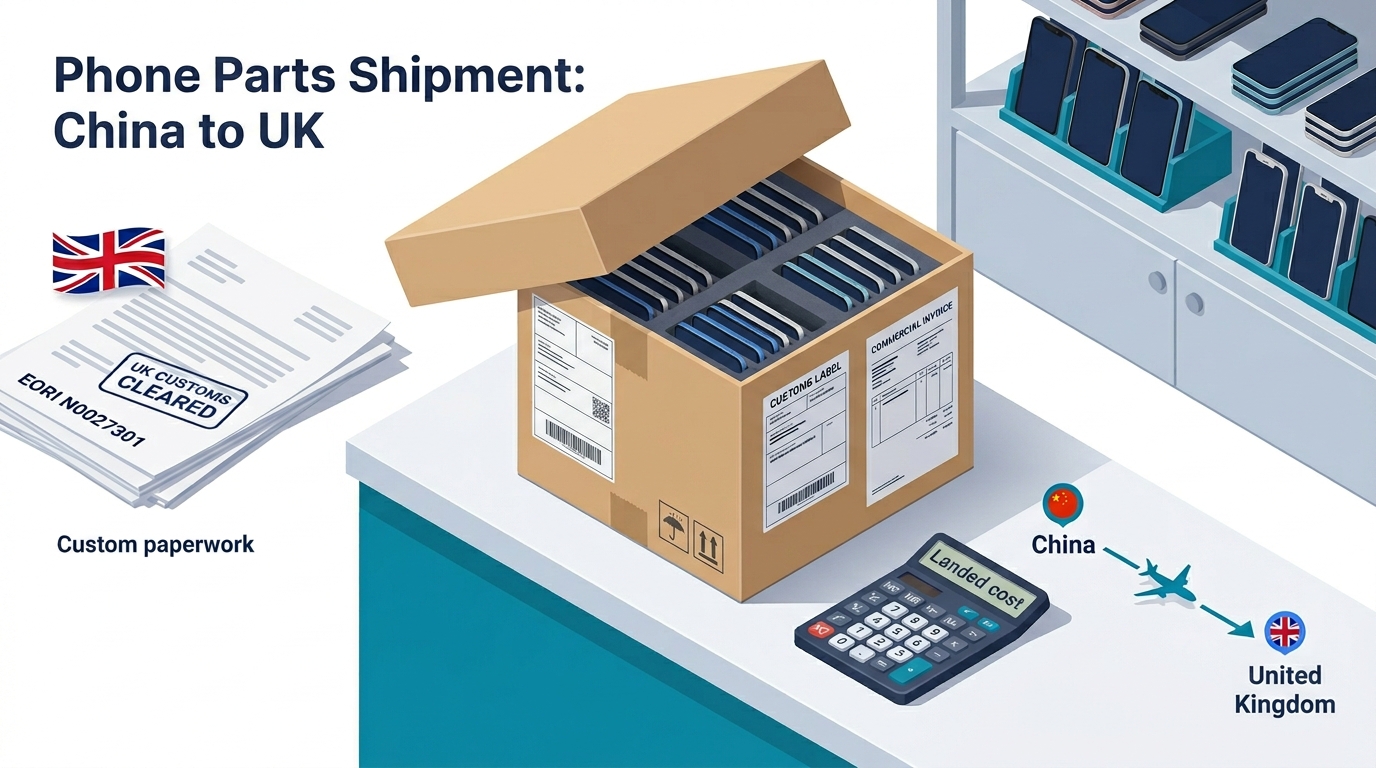
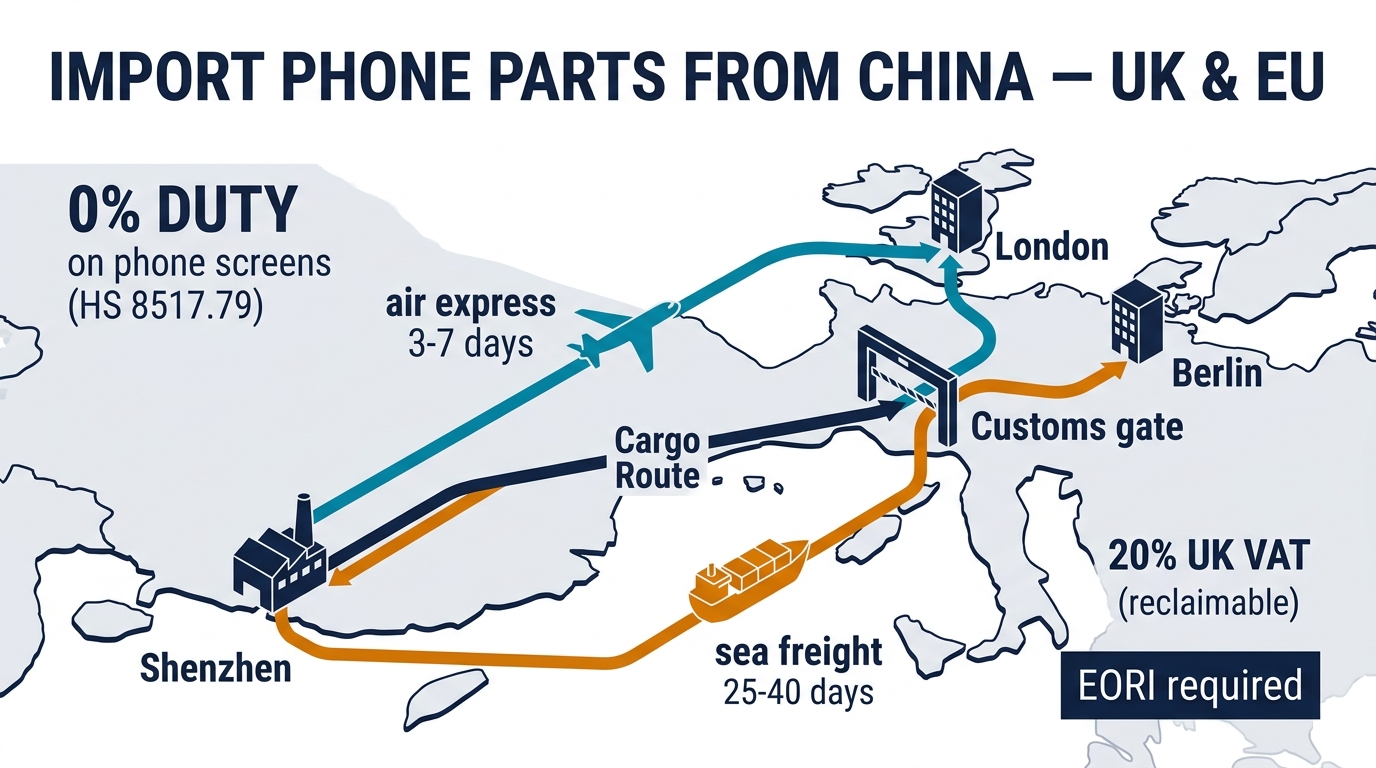
- If you want our numbers as your calibration baseline: the full live price list is at /products/screens, UK/EU import specifics are covered here, or send one WhatsApp message with your model list — we'll quote it by grade and brand line, in writing, against everything you just read.
FAQ
What is a factory-direct phone parts supplier?
A factory-direct phone parts supplier is a company that sources and assembles parts at the factory layer in Shenzhen, runs its own incoming-material QC, and exports directly to trade buyers without a trading-company middle layer. The practical tests: published per-grade pricing, mixed-order tier aggregation, and the ability to name which line a batch came from.
How much do wholesale iPhone screens cost from China in 2026?
Wholesale iPhone screen pricing in 2026 spans four grades: Incell LCD assemblies run $8.23–$45.13, Soft OLED $13.65–$120.17, Hard OLED $34.22–$74.96, and Original (re-glassed genuine panels) $18.81–$304.37 per unit at the 10+ tier, EXW Shenzhen. Model examples: iPhone 13 Incell from $11.38, iPhone 15 Pro Max Soft OLED from $41.37, iPhone 16 Pro Max Original from $242.31.
What is the difference between JK, GX, DD and RJ screens?
JK, GX, DD and RJ are panel-brand trade names for aftermarket production lines, functioning as de-facto quality tiers. JK is the widest line (Incell + Soft OLED, 40 SKUs, $12.90–$120.17), GX is a value Soft OLED line (23 SKUs, $9.21–$64.12), DD specializes in Hard OLED ($40.24–$74.96), and RJ is a small Incell line ($16.88–$26.89). Price lists without brand tokens usually indicate mixed-batch stock.
What is a re-glassed (后压) Original screen?
A re-glassed Original screen is a genuine factory panel whose broken outer glass has been removed and replaced with new glass, keeping the original OLED cell intact. Display quality, brightness and True Tone behavior match the stock screen because the panel itself is unchanged. It is a refurbished part and honest suppliers label it as such rather than calling it "new."
How do I verify a Chinese phone parts supplier is legitimate?
Verify a Chinese parts supplier with three checks: ask which factory or line a specific batch came from (factory-layer suppliers answer immediately), demand per-line-item grade labels using the four-grade vocabulary instead of adjectives like "AAA+", and compare quoted prices against published calibration ranges — quotes 30%+ below documented grade floors for new stock are a fraud signal, not a deal.
Is buying phone parts from China cheaper than a local distributor?
For US buyers at low volumes, often not by much: after express freight, China-direct typically saves only 0–15% versus a good domestic distributor on like-for-like grades. The structural savings appear at 50+ aggregated tiers and for buyers in Europe, Australia, Africa and Latin America, where the gap widens to roughly 30–40% because local markups are higher.