
Samsung S23 Screen Replacement in 2026: Cost, Grades, and Repair Margins
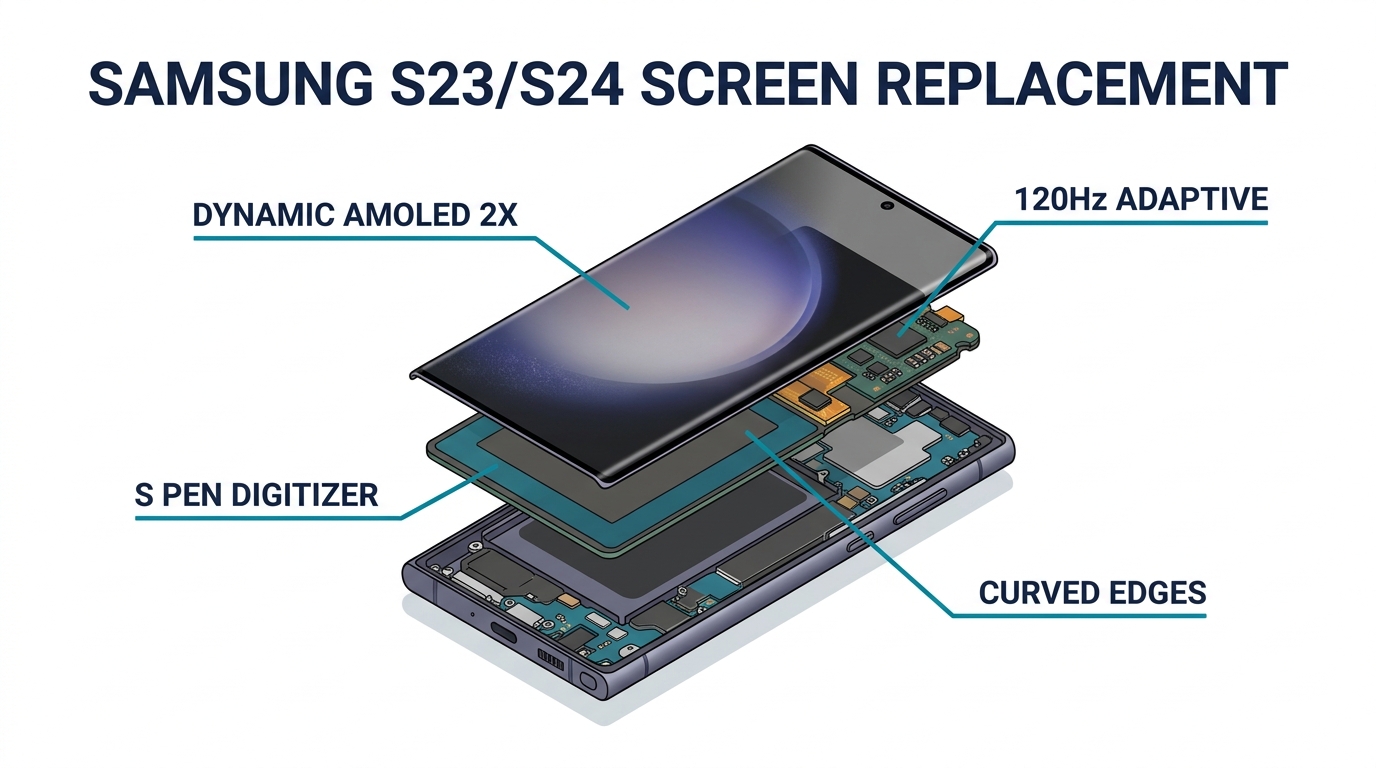
Samsung Galaxy S23 and S24 repairs represent the second-largest revenue stream in most repair shops after iPhone. These flagship models use Samsung's own Dynamic AMOLED 2X displays — some of the best screens on any smartphone — and replacing them properly requires understanding a different grade ecosystem than iPhone repairs.
The Samsung S23 screen replacement market differs from iPhone in several important ways. Samsung uses AMOLED technology exclusively on its flagship line, so there's no "budget LCD that matches the original" option like iPhone 11. The aftermarket grade selection is narrower, wholesale costs are generally higher than equivalent iPhone screens, and Samsung's official repair pricing creates a different competitive dynamic. Samsung charges $174–$340 depending on model, which is often competitive with or even below third-party shops — making grade selection and pricing strategy critical.
This guide covers both the S23 series (launched February 2023, now 3 years old) and the S24 series (launched January 2024, now 2 years old) because they share similar display technology and the same repair economics logic applies to both.
Sourcing Replacement Screens in Bulk?
Incell / Hard OLED / Soft OLED grades — wholesale pricing, grade comparison on request.
Get Wholesale QuoteSamsung S23 Screen Replacement Cost: Every Option Compared
| Model | Samsung Official | Third-Party (OLED) | Third-Party (Incell) | DIY |
|---|---|---|---|---|
| Galaxy S23 | $174–$257 | $120–$180 | $80–$110 | $40–$70 |
| Galaxy S23+ | $194–$263 | $140–$200 | $90–$120 | $50–$80 |
| Galaxy S23 Ultra | $259–$340 | $180–$280 | $100–$140 | $65–$100 |
| Galaxy S24 | $199–$269 | $140–$200 | $90–$120 | $50–$80 |
| Galaxy S24+ | $219–$289 | $160–$220 | $100–$130 | $60–$90 |
| Galaxy S24 Ultra | $279–$359 | $200–$300 | $110–$150 | $75–$110 |
Samsung's official pricing is notably lower than Apple's for equivalent repairs, especially on the base S23 ($174 vs Apple's $279 for iPhone 13). This matters because it compresses the price window for third-party shops — you can't price at $250 for an S23 screen when Samsung does it for $174–$257 with genuine parts.
The sweet spot for third-party shops is offering OLED-quality repairs at $120–$200 for standard models and $180–$300 for Ultra models, where the price undercuts Samsung while delivering comparable quality and faster turnaround.
Screen Grades for Samsung S23/S24: What's Available
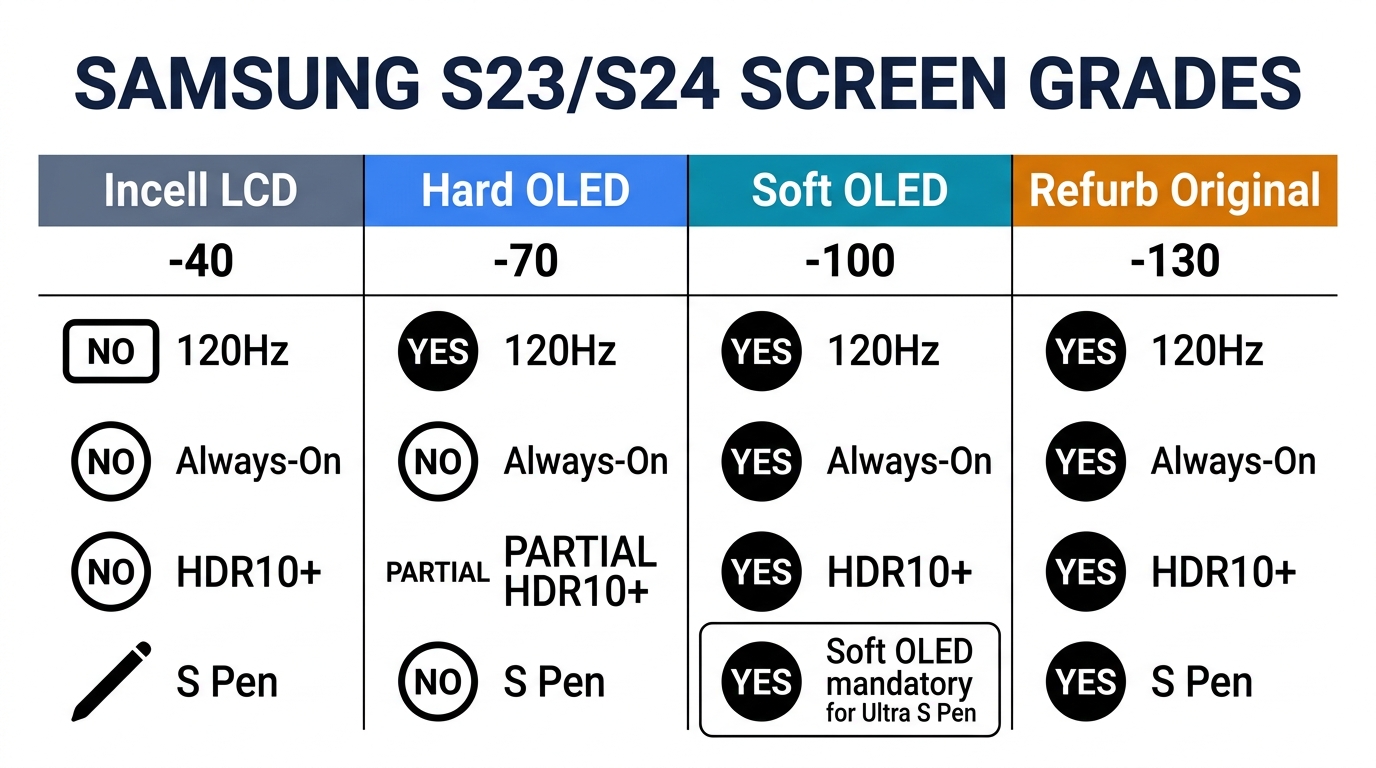
The aftermarket screen market for Samsung flagships is different from iPhone. Samsung manufactures its own AMOLED panels, which means the original screen technology is Samsung-made OLED — and aftermarket alternatives have to match or approximate that technology.
Incell LCD — Budget Option (Significant Downgrade)
Wholesale cost: $25–$40 (S23 standard), $35–$55 (Ultra models).
Incell LCD on a Samsung S23 or S24 is a major downgrade. The original Dynamic AMOLED 2X display runs at 120Hz with adaptive refresh, HDR10+ support, and peak brightness over 1,750 nits. An Incell LCD delivers none of these.
The problems: no true blacks, contrast ratio drops from millions-to-one to roughly 1,500:1, 120Hz is not supported (locked to 60Hz), colours appear muted, and the always-on display feature doesn't work. Samsung's One UI software is designed around AMOLED — dark mode, edge panels, and notification indicators all look wrong on LCD.
When Incell works: Only for customers who explicitly want the cheapest functional screen, understand the trade-offs, and don't need 120Hz or always-on display. In practice, this means very few Samsung flagship customers accept Incell — Samsung users who bought an S23 or S24 chose it partly for the display quality.
Hard OLED — Mid-Tier OLED
Wholesale cost: $45–$70 (S23 standard), $65–$100 (Ultra models).
Hard OLED provides the AMOLED experience — true blacks, high contrast, vivid colours — on a rigid glass substrate. For the standard S23 and S24, Hard OLED handles 120Hz adequately, though some panels show slight inconsistency at lower brightness levels.
For Ultra models, Hard OLED is riskier. The S23 Ultra and S24 Ultra have larger, curved-edge displays with S Pen digitizer integration. Hard OLED panels for Ultra models sometimes have issues with edge touch sensitivity and S Pen precision near the screen borders.
Best for: Standard S23 and S24 repairs where the customer wants OLED quality without paying premium prices. Avoid on Ultra models unless you've tested your supplier's panels specifically for S Pen compatibility.
Soft OLED — Premium Aftermarket
Wholesale cost: $65–$100 (S23 standard), $90–$150 (Ultra models).
Soft OLED matches Samsung's original display construction — flexible AMOLED on a plastic substrate. Display quality is near-identical to the original: full 120Hz support, HDR10+ compatible, accurate colours, and proper always-on display rendering.
For Ultra models, Soft OLED is the best aftermarket option because the flexible substrate conforms properly to the curved edges, maintaining S Pen accuracy and edge touch responsiveness.
Best for: All Samsung S23/S24 repairs where quality matters. The default recommendation for Ultra models. Premium option for standard models.
Refurbished Original — Samsung OEM Panels
Wholesale cost: $80–$130 (S23 standard), $120–$200 (Ultra models).
Refurbished original screens are genuine Samsung AMOLED panels recovered from used or returned devices, re-bonded with new glass and tested. Quality is effectively identical to OEM, but supply is inconsistent and quality varies by refurbisher.
Best for: Customers who specifically want original Samsung quality. Shops that position themselves as "OEM-quality" repair providers.
Grade Comparison
| Grade | Wholesale (S23) | Wholesale (S24) | 120Hz | Always-On | HDR10+ | S Pen (Ultra) |
|---|---|---|---|---|---|---|
| Incell LCD | $25–$40 | $30–$45 | No | No | No | No |
| Hard OLED | $45–$70 | $55–$80 | Yes | Yes | Partial | Inconsistent |
| Soft OLED | $65–$100 | $75–$110 | Yes | Yes | Yes | Yes |
| Refurb Original | $80–$130 | $90–$150 | Yes | Yes | Yes | Yes |
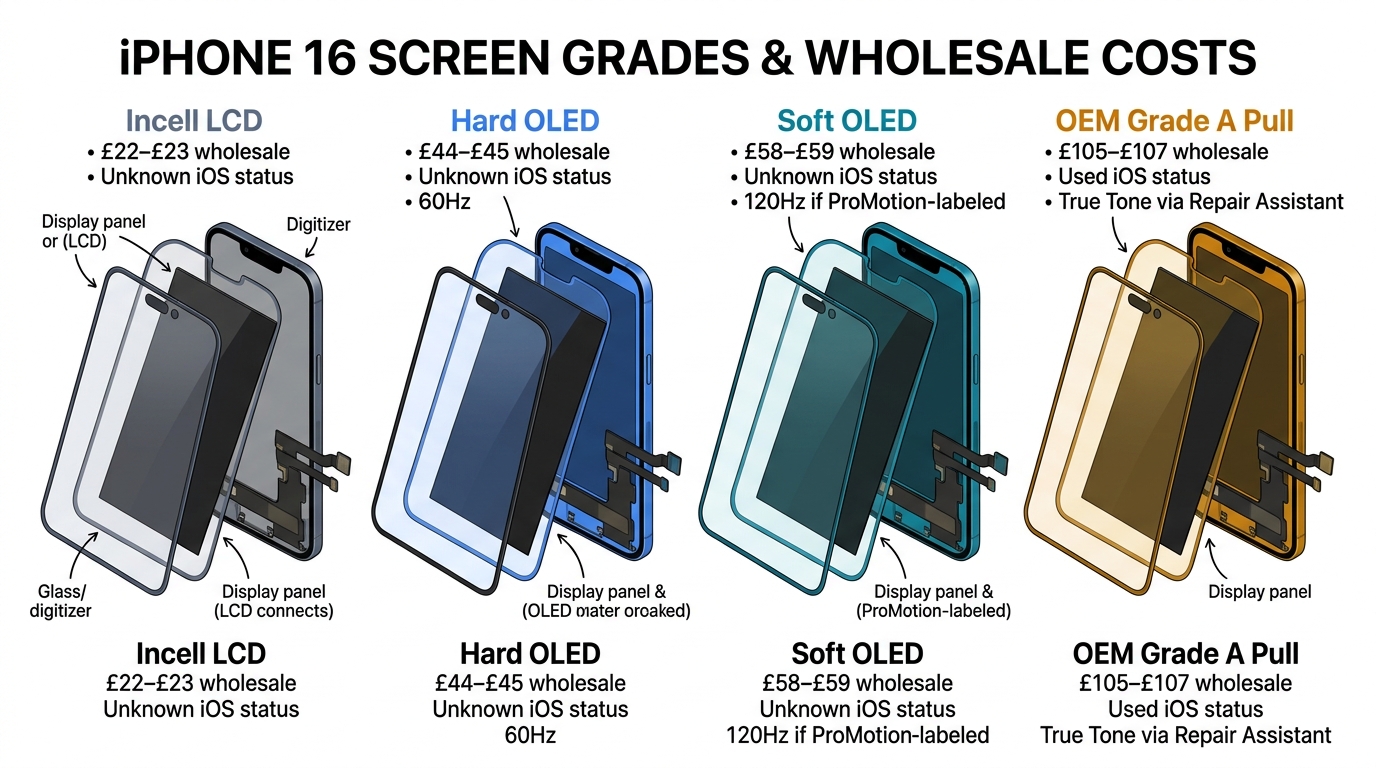
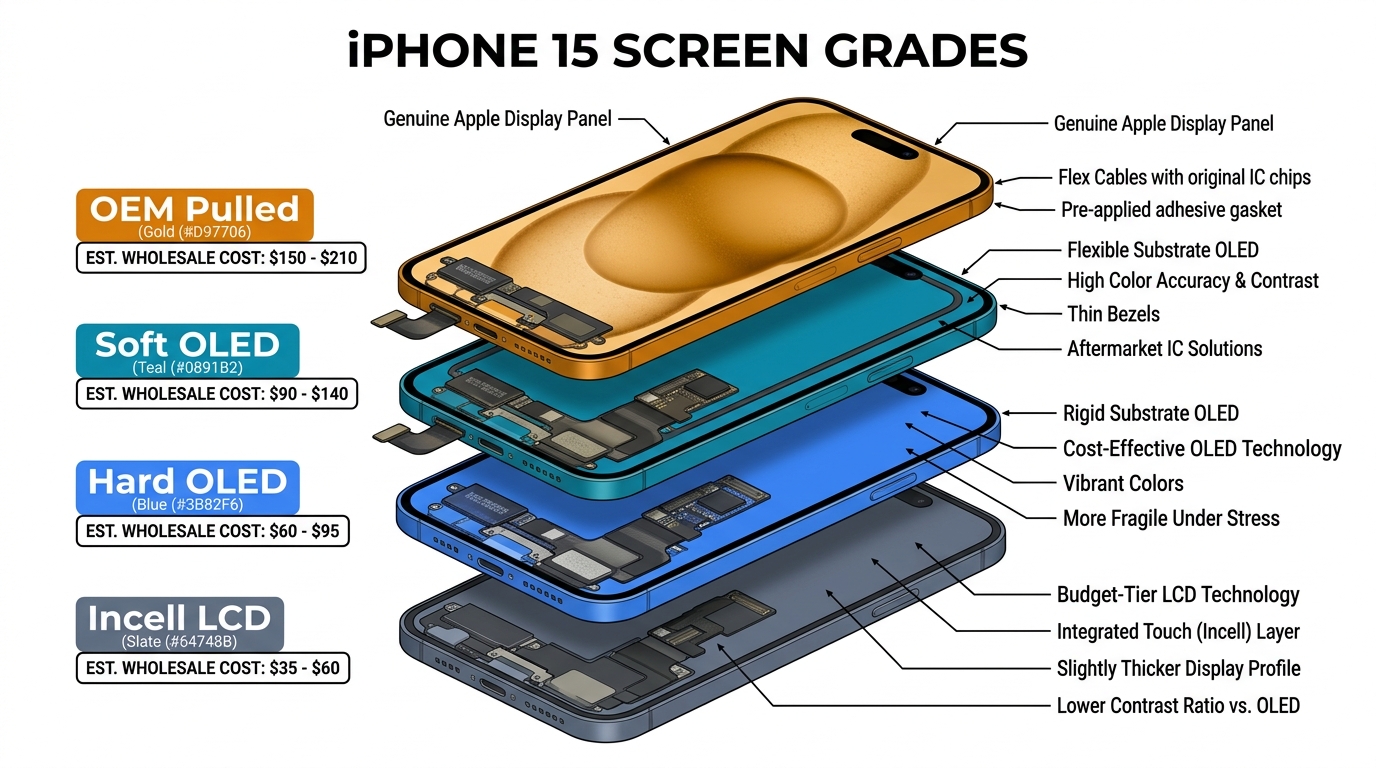
See the full four-grade comparison with live wholesale prices: iPhone Screen Grade Guide
For a broader comparison of screen technologies across Samsung and iPhone, see our Soft OLED vs Hard OLED vs Incell guide.
Are Samsung S23/S24 Screen Repairs Worth It? Residual Value Analysis
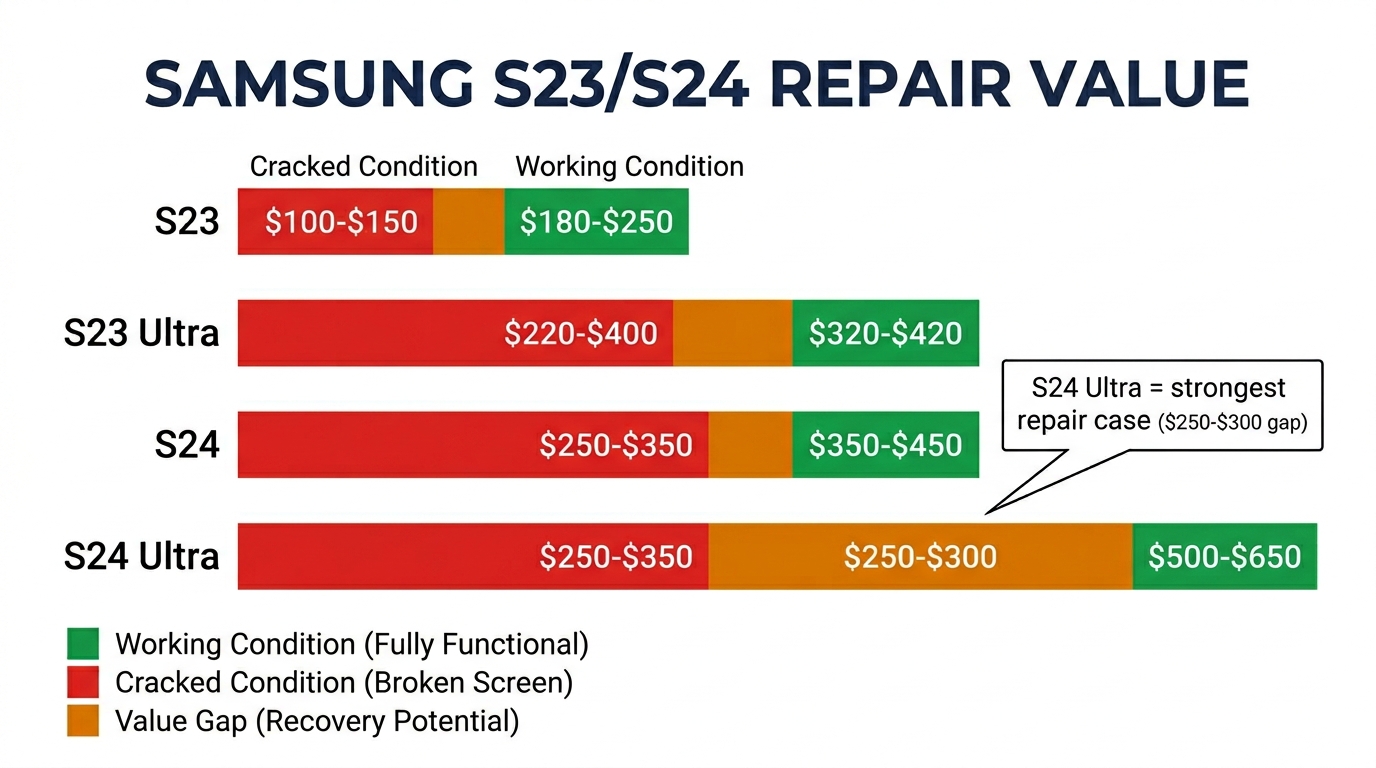
Current Residual Values (Early 2026)
| Model | Working Condition | Cracked Screen | Value Gap |
|---|---|---|---|
| Galaxy S23 | $180–$250 | $70–$120 | $110–$130 |
| Galaxy S23 Ultra | $320–$420 | $150–$220 | $170–$200 |
| Galaxy S24 | $350–$450 | $180–$250 | $170–$200 |
| Galaxy S24 Ultra | $500–$650 | $250–$350 | $250–$300 |
The value gap on Samsung S24 Ultra is $250–$300 — more than enough room for a Soft OLED repair at $200–$300 and still leave the customer ahead. Even the S23, at a $110–$130 gap, supports a Hard OLED repair at $120–$180.
Key insight: Samsung S24 Ultra repairs are among the most financially justified in any shop. The phone is still worth $500+ in working condition, and customers know it. A $250 screen repair on a $600 phone is an easy decision.
The S23 standard is tighter — the phone's declining value means shops need to use Hard OLED (not Soft OLED) to keep the repair cost well below the value gap. By late 2026, S23 standard repairs may approach the same economics as iPhone 12 — still viable, but with less margin room.
Margin Analysis for Repair Shops
US Market — Samsung S23 Series
| Model | Grade | Wholesale | Charge | Gross Margin | Margin % |
|---|---|---|---|---|---|
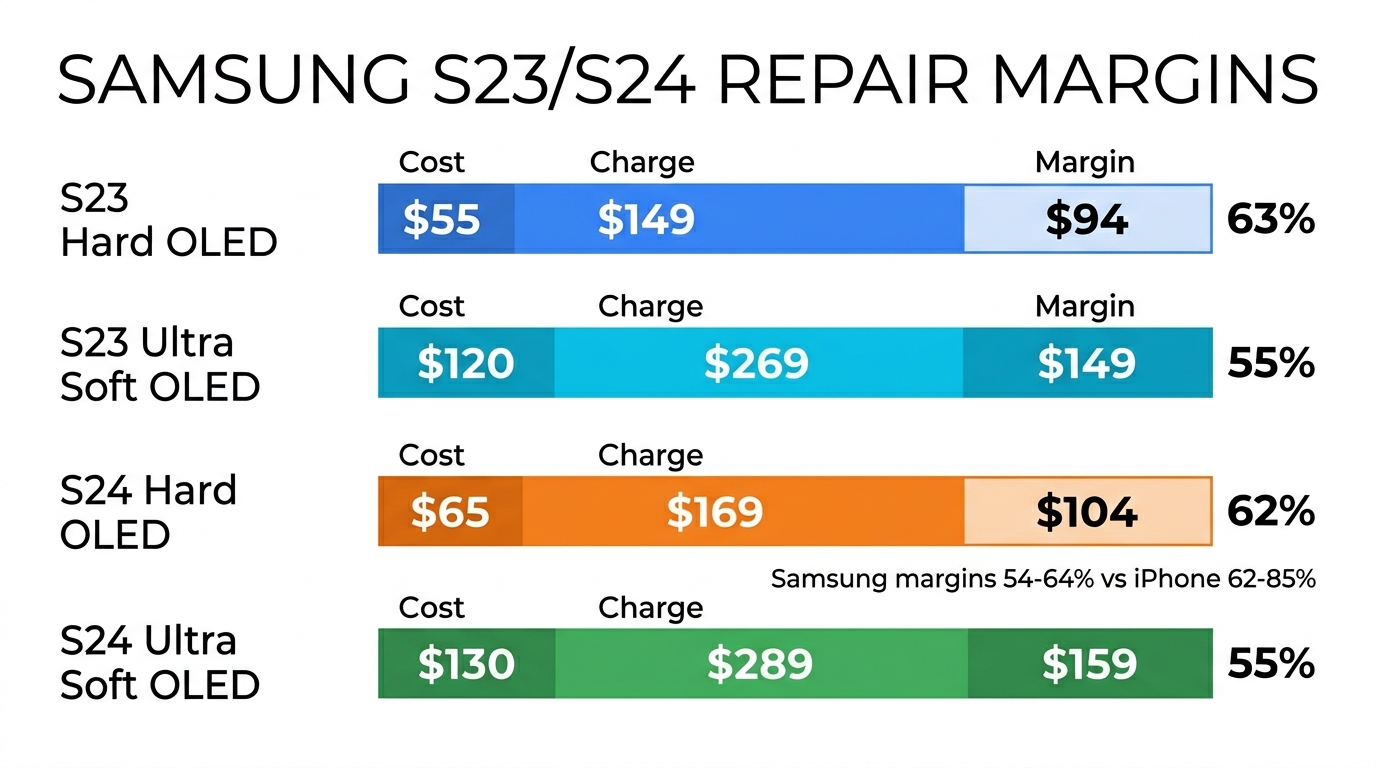
| S23 | Hard OLED | $55 | $149 | $94 | 63% |
| S23 | Soft OLED | $82 | $179 | $97 | 54% |
| S23 Ultra | Hard OLED | $80 | $219 | $139 | 63% |
| S23 Ultra | Soft OLED | $120 | $269 | $149 | 55% |
US Market — Samsung S24 Series
| Model | Grade | Wholesale | Charge | Gross Margin | Margin % |
|---|---|---|---|---|---|
| S24 | Hard OLED | $65 | $169 | $104 | 62% |
| S24 | Soft OLED | $90 | $199 | $109 | 55% |
| S24 Ultra | Hard OLED | $90 | $249 | $159 | 64% |
| S24 Ultra | Soft OLED | $130 | $289 | $159 | 55% |
Samsung margins are lower than iPhone margins. The percentage margins on Samsung screens (54–64%) are notably below iPhone (62–85%). This is because Samsung screens cost more at wholesale relative to what shops can charge, and Samsung's own competitive repair pricing compresses the third-party price ceiling.
However, the absolute dollar margins are still strong. S24 Ultra Soft OLED produces $159 per repair — comparable to iPhone 15 Pro. And Ultra models are high-ticket jobs that justify the parts investment.
UK Market — Samsung S23/S24
| Model | Grade | Wholesale | Charge | Gross Margin | Margin % |
|---|---|---|---|---|---|
| S23 | Hard OLED | £45 | £119 | £74 | 62% |
| S23 Ultra | Soft OLED | £98 | £219 | £121 | 55% |
| S24 | Hard OLED | £52 | £139 | £87 | 63% |
| S24 Ultra | Soft OLED | £105 | £239 | £134 | 56% |
Stocking Samsung screens? We supply Hard OLED and Soft OLED screens for the Galaxy S23 and S24 full series, including Ultra-compatible panels tested for S Pen accuracy and curved edge sensitivity. Request a quote for wholesale pricing and sample options.
For pricing strategy across all models, see our phone screen repair pricing strategy guide.
Samsung vs iPhone Repair Economics: Key Differences
Shops that primarily service iPhones need to adjust their approach for Samsung repairs.
Higher parts cost, lower margins. Samsung flagship screens cost 30–60% more at wholesale than comparable iPhone screens. An iPhone 13 Soft OLED costs $55–$90; a Samsung S23 Soft OLED costs $65–$100. The charge-out price difference doesn't fully compensate, so margins are tighter.
Samsung's competitive pricing. Apple charges $279–$329 for iPhone screen repairs, creating a wide margin window for third-party shops. Samsung charges $174–$340, which is often closer to third-party pricing. Shops need to compete on speed and convenience rather than price alone.
Curved displays on Ultra models. iPhone screens are flat. Samsung Ultra screens have curved edges that make repair more complex and increase the risk of adhesive failure. Factor in slightly more labour time for Ultra models.
Fewer grade options. The iPhone aftermarket screen market has a wider range of suppliers and grades. Samsung flagship screens have fewer suppliers, and quality varies more between batches. Build a relationship with a consistent Samsung screen supplier rather than buying from whoever is cheapest.
What to Stock: Samsung Inventory Recommendations
Samsung repairs are typically 15–25% of a shop's volume. Stock accordingly — don't over-invest, but have enough on hand to serve walk-in demand.
For a shop doing 5–10 Samsung repairs/week:
| Model | Grade | Stock Quantity |
|---|---|---|
| Galaxy S23 | Hard OLED | 2–3 |
| Galaxy S23 Ultra | Soft OLED | 1–2 |
| Galaxy S24 | Hard OLED | 2–3 |
| Galaxy S24 Ultra | Soft OLED | 1–2 |
| Galaxy S24+ | On-demand | — |
| Galaxy S23+ | On-demand | — |
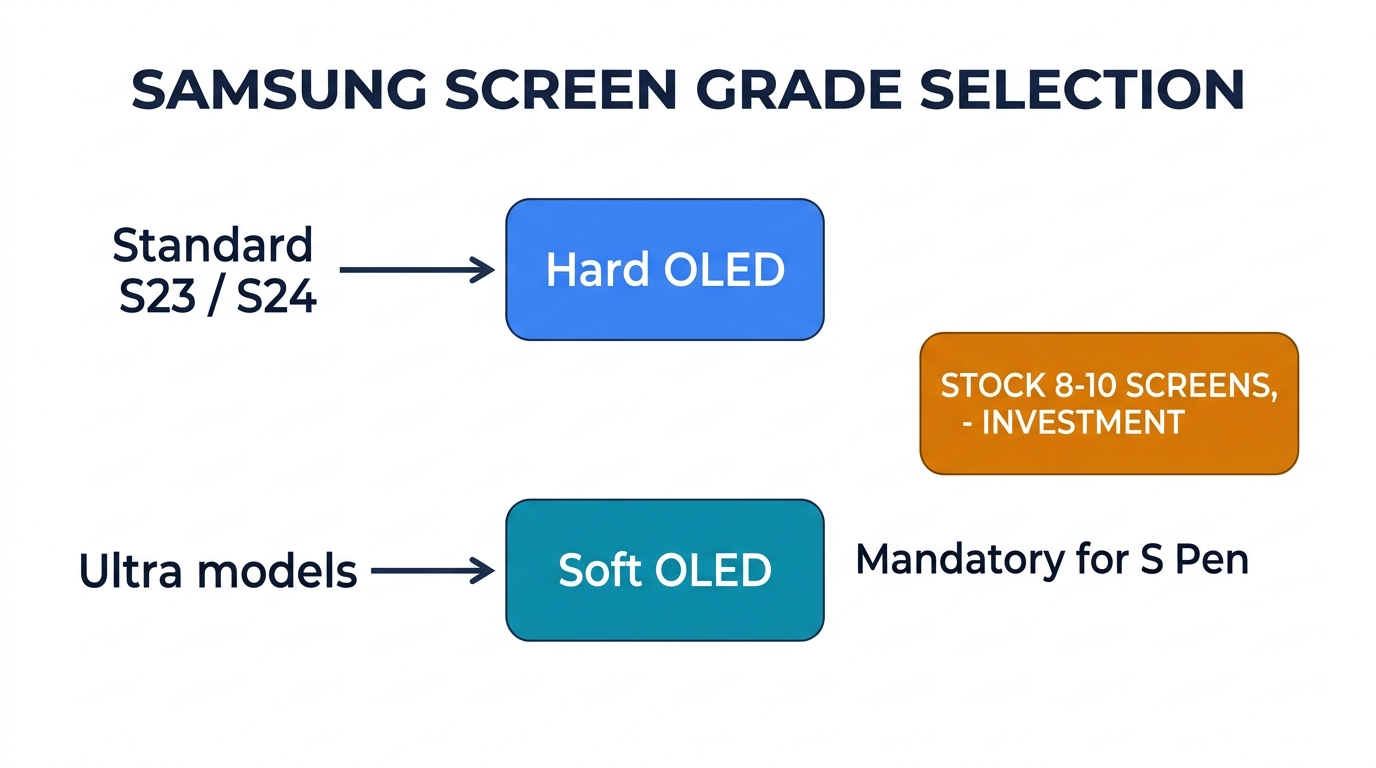
Stock Hard OLED for standard models, Soft OLED for Ultra models. The Plus models sell in lower volume — order on-demand unless your shop sees consistent Plus repair traffic.
Keep Incell LCD only if you specifically serve a budget-focused customer base. Most Samsung flagship customers reject the LCD downgrade once they see it.
For a complete inventory framework including Samsung, see our small repair shop stock guide. If this would be your first order from a China supplier, what a first order actually involves covers MOQ, samples and lead time — there is no single-model MOQ, so Samsung and iPhone lines count toward the same 10-piece order threshold.
Common Samsung Screen Replacement Mistakes
Underpricing Relative to Samsung Official
Some shops try to undercut Samsung's $174 S23 repair by pricing at $120–$130. At those prices with Soft OLED parts, you're making $30–$50 margin — barely worth the labour. Instead, match or slightly beat Samsung's price while offering faster turnaround: "Same quality, done in 30 minutes, no appointment needed."
Using iPhone-Grade Logic for Samsung
The iPhone Incell/Hard OLED/Soft OLED grade hierarchy doesn't map perfectly to Samsung. Samsung AMOLED panels have different characteristics — the colour calibration, refresh rate handling, and edge rendering all differ. Test Samsung-specific panels from your supplier before stocking in volume. Don't assume a supplier who makes good iPhone Hard OLEDs also makes good Samsung Hard OLEDs.
Ignoring the S Pen on Ultra Models
S Pen digitizer integration depends on the screen's touch layer. Budget aftermarket screens for S23 Ultra and S24 Ultra sometimes have S Pen latency issues or dead zones near the edges. Always test S Pen functionality across the full screen surface before returning an Ultra model to the customer.
Not Offering Samsung at All
Some iPhone-focused shops ignore Samsung entirely. In most markets, Samsung makes up 15–25% of walk-in traffic. Carrying 8–10 Samsung screens ($500–$800 inventory) captures this revenue without significant capital commitment.
📲 Sourcing Samsung screens for a repair business? Message us on WhatsApp — send your model list and get a written wholesale quote by grade. No forms needed.
Frequently Asked Questions
How much does Samsung S23 screen replacement cost in 2026?
Samsung charges $174–$257 for Galaxy S23 screen replacement (varies by specific damage and location). Third-party shops charge $80–$180 depending on screen grade. Hard OLED repairs typically run $120–$180, which delivers OLED quality close to the original. For the S23 Ultra, costs are higher: $180–$280 at third-party shops and $259–$340 through Samsung.
Is it worth replacing the screen on a Samsung S23?
Yes, for most cases. A working Galaxy S23 is worth $180–$250 in 2026. A Hard OLED screen repair at $120–$180 is well below the phone's value and restores it to full functionality. The Galaxy S24 is even more worth repairing — the phone retains $350–$450 in value, making screen repair a clear financial win at any grade.
Which screen grade should I use for Samsung S23/S24?
For standard S23 and S24 models (flat screen, no S Pen), Hard OLED offers the best balance of quality and cost. For S23 Ultra and S24 Ultra (curved screen, S Pen), use Soft OLED — it handles the curved edges and S Pen digitizer properly. Avoid Incell LCD on any Samsung flagship unless the customer explicitly requests the cheapest option after understanding the trade-offs.
How do Samsung screen repair margins compare to iPhone?
Samsung margins are lower by percentage (54–64% vs 62–85% on iPhone) because Samsung screens cost more wholesale and Samsung's own competitive repair pricing limits what third-party shops can charge. However, absolute margins are still strong — S24 Ultra Soft OLED generates $159 per repair. The key difference is margin efficiency: iPhone repairs produce more profit per dollar invested in parts.
Should my repair shop stock Samsung screens?
Yes, if Samsung makes up more than 10% of your repair inquiries. Most Western-market shops see 15–25% Samsung volume. Start with 8–10 screens covering S23 and S24 standard and Ultra models ($500–$800 investment). Track which models sell and adjust. Order Plus models and older Galaxy models on-demand.
Samsung Repairs: Lower Margins, Real Revenue
Samsung S23 and S24 screen repairs are a meaningful revenue stream that iPhone-focused shops shouldn't ignore. The margins are tighter than iPhone — that's the reality of Samsung's competitive official pricing and higher wholesale screen costs. But the absolute dollar margins ($94–$159 per repair) justify carrying Samsung inventory, especially for Ultra models.
Stock Hard OLED for standard S23/S24 models and Soft OLED for Ultra models. Price to match or slightly beat Samsung's official rate while competing on speed and convenience. And don't apply iPhone-grade logic to Samsung panels — test Samsung-specific screens from your supplier before committing to volume orders. If you are still choosing that supplier, our map of the ten China supplier channels explains why the same S23 Ultra panel legitimately sells at very different prices depending on which channel it came from.
For Samsung grade lanes and July 2026 price-index examples (A25 TFT vs Original, S23 Ultra tiers), see the Incell vs Hard OLED vs Soft OLED order guide.
Need wholesale Samsung screens for your shop? We supply Hard OLED and Soft OLED screens for the Galaxy S23, S24, and Ultra series with tested S Pen compatibility on Ultra panels. Request a wholesale quote to compare grades and get volume pricing.