
iPhone 8 Screen Replacement: Why This One Screen Fits Three Phones (And the 3D Touch Scam You're Paying For)
A technician in Manchester ordered 50 iPhone 8 screens last month. Standard order — nothing unusual. Except he ordered them as three separate SKUs: "iPhone 8," "iPhone SE 2020," and "iPhone SE 2022." Three product listings. Three prices. Three shipping charges.
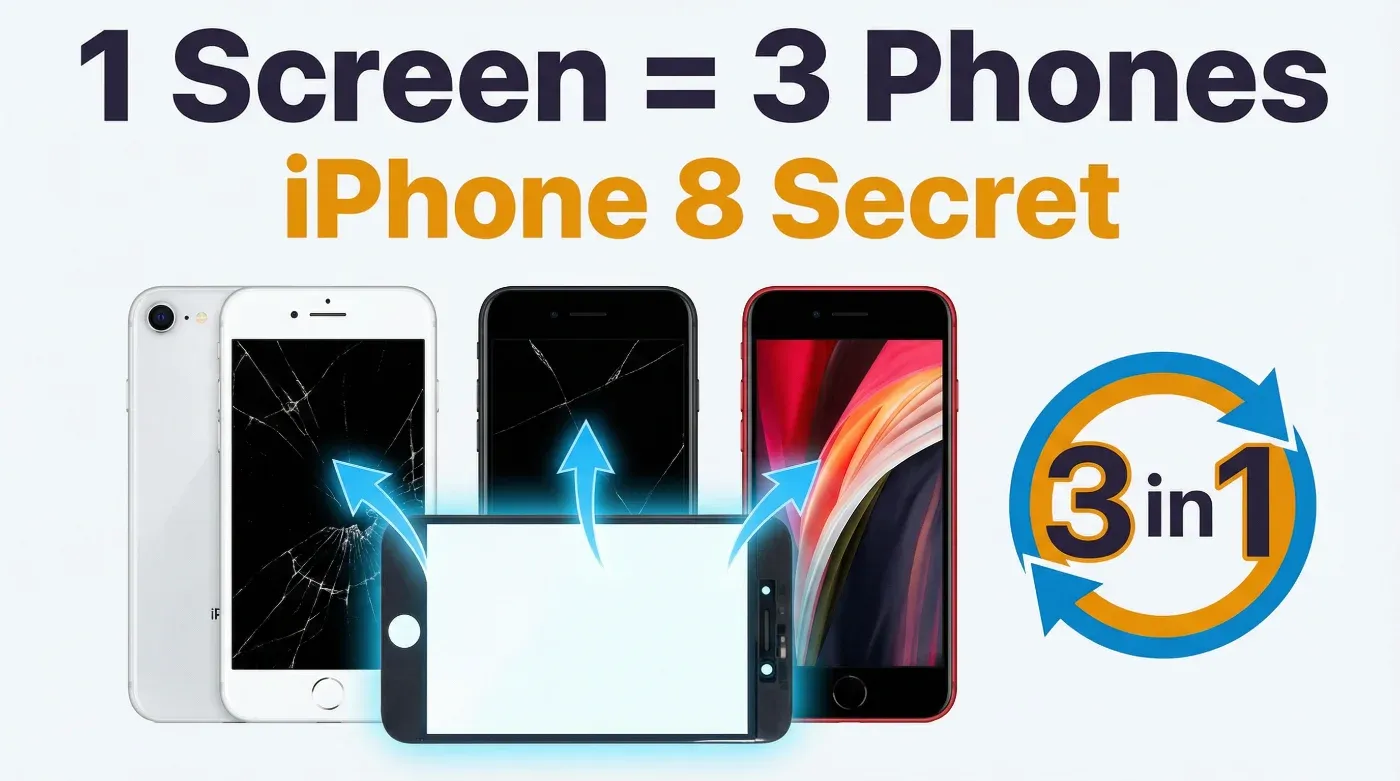
They were the exact same screen.
Same LCD panel. Same digitiser. Same flex cable routing. Same 4.7-inch 750×1334 resolution. The only difference was the label on the box and the £3-£8 markup per unit for the "SE" branding.
This is one of the repair industry's worst-kept secrets — and one of its most profitable markups. The iPhone 8 screen is the universal donor of the Apple repair world. One part covers three phone models spanning six years of production (2017-2022). If you're running a repair shop and not exploiting this, you're leaving money on the table. If you're a DIY repairer, you're probably overpaying.
We've been supplying these screens from Huaqiangbei for over a decade. Here's what the listings won't tell you.
Sourcing Replacement Screens in Bulk?
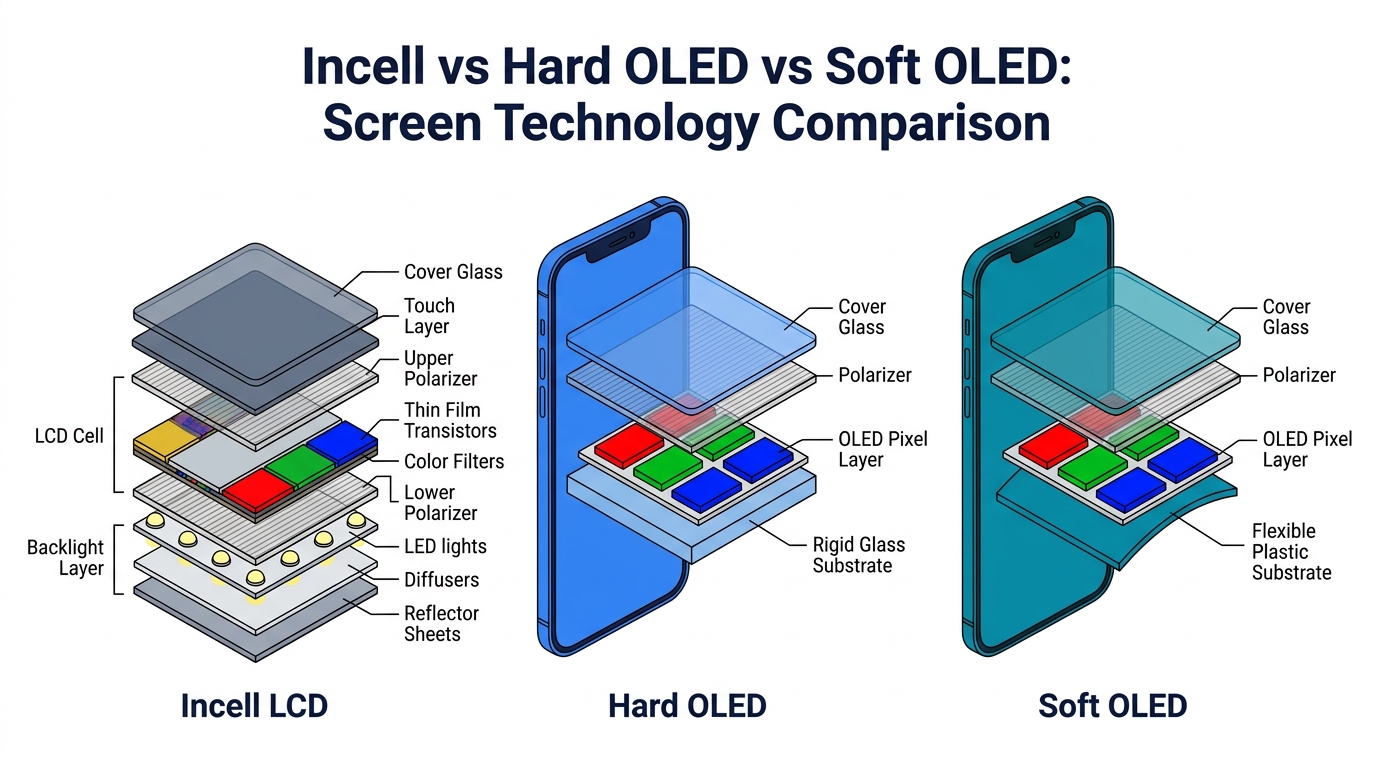
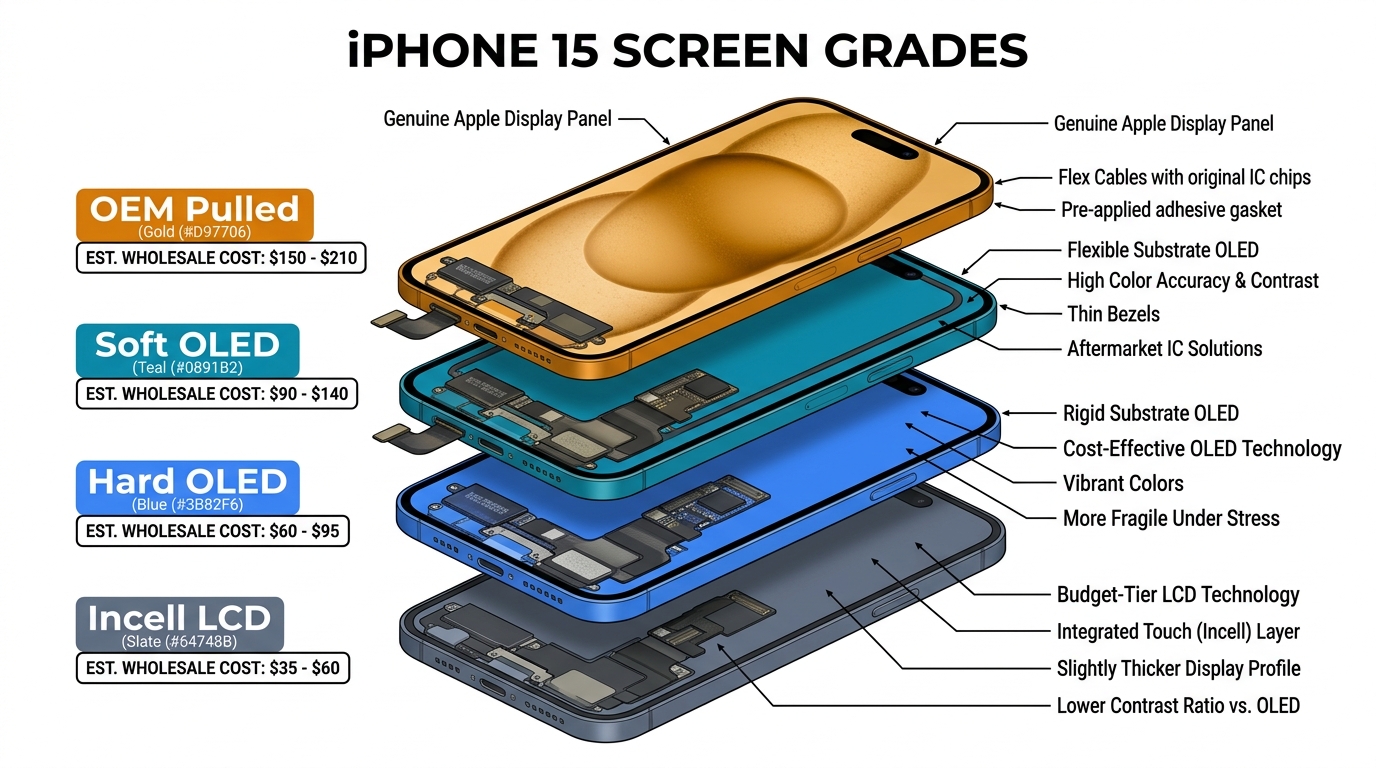
Incell / Hard OLED / Soft OLED grades — wholesale pricing, grade comparison on request.
Get Wholesale QuoteWhat an iPhone 8 Screen Replacement Actually Costs in 2026
The iPhone 8 is the cheapest modern iPhone to repair. Full stop. Here's the breakdown:
| Route | iPhone 8 | iPhone 8 Plus |
|---|---|---|
| Apple Official (with AppleCare+) | Service ended | Service ended |
| Apple Official (without AppleCare+) | £159 (if available) | £169 (if available) |
| High Street Repair Shop (Standard LCD) | £35–£55 | £40–£65 |
| High Street Repair Shop (Premium LCD) | £50–£75 | £55–£85 |
| DIY — Standard LCD Part | £12–£20 | £15–£25 |
| DIY — Premium LCD Part | £18–£30 | £22–£35 |
Apple officially ended iPhone 8 repair support in many regions, pushing customers toward third-party options. This is actually good news for independent shops — there's zero official competition on this model.
The critical detail: At £12-£20 for a standard LCD, the iPhone 8 screen is the highest-margin repair in most shops. A 10-minute swap at £45 labour gives you roughly £25-£30 pure profit per repair. Multiply that across the SE 2020 and SE 2022 customers using the same part, and this "old phone" becomes your most profitable line item.
The One Screen, Three Phones Secret
This is the single most important thing to understand about iPhone 8 screen replacement, and most suppliers deliberately obscure it:
The iPhone 8, iPhone SE (2nd generation, 2020), and iPhone SE (3rd generation, 2022) use the same screen assembly.
Same dimensions. Same connector. Same digitiser layout. Same LCD panel specifications. The internal chassis mounting points are identical because Apple reused the iPhone 8 body design for both SE models.
Here's what this means in practice:
- For repair shops: Stock ONE SKU instead of three. Buy in bulk at iPhone 8 prices (the cheapest listing). Your per-unit cost drops 15-25% compared to buying "model-specific" screens.
- For DIY repairers: Search for "iPhone 8 screen" even if you're repairing an SE 2020 or SE 2022. The iPhone 8 listing is almost always cheaper because suppliers know SE owners will pay more for the "correct" label.
- For suppliers reading this: Yes, we're giving away the game. But honest pricing builds repeat customers. We learned this the hard way in Huaqiangbei — the stalls that relabeled iPhone 8 screens as "SE exclusive" made quick money and lost long-term buyers.
The one exception: The home button. The iPhone 8 and SE 2020 have a physical home button with Touch ID. The SE 2022 also has a physical home button with Touch ID. The home button is paired to the logic board and cannot be swapped between phones. When you buy a screen assembly, it typically comes without the home button — you transfer the original from the broken screen. If a listing says "with home button included," that button won't activate Touch ID on your phone.
The 3D Touch Premium: You're Paying for Dead Technology
Here's where the industry quietly takes your money.
Many suppliers still list two versions of the iPhone 8 screen:
- "Standard" (without 3D Touch) — £12-£18
- "With 3D Touch" (pressure-sensitive layer) — £20-£30
The premium sounds reasonable. 3D Touch was a genuine hardware feature — a pressure-sensitive layer beneath the display that let you "peek and pop" into content. It required an additional component in the screen assembly.
But Apple killed 3D Touch in iOS 13 (September 2019).
The feature was replaced by Haptic Touch, which uses long-press timing instead of pressure sensitivity. Every iPhone 8 running iOS 13 or later — which is virtually all of them in 2026 — doesn't use the 3D Touch hardware at all. The pressure-sensitive layer sits there doing absolutely nothing.
Yet suppliers still charge a 40-60% premium for it.
We see this constantly in factory orders. The "3D Touch" screens cost more to manufacture because they include an extra component layer. But that layer provides zero functional benefit to the end user. It's like paying extra for a car radio that only receives AM stations — technically present, practically useless.
Our recommendation: Buy the standard (non-3D Touch) screen every time. Save £5-£12 per unit. Your customer will never notice the difference because the software doesn't use it.
The only scenario where 3D Touch matters: if a customer is running iOS 12 or earlier (released 2018) and refuses to update. In six years of supplying UK repair shops, we've encountered this exactly twice.
iPhone 8 vs 8 Plus: The Differences That Actually Matter
The iPhone 8 and 8 Plus screens are NOT interchangeable. Despite the naming, they're completely different parts:
| Specification | iPhone 8 | iPhone 8 Plus |
|---|---|---|
| Screen Size | 4.7 inches | 5.5 inches |
| Resolution | 750 × 1334 | 1080 × 1920 |
| Compatible With | SE 2020, SE 2022 | 8 Plus only |
| Typical Part Cost | £12–£30 | £15–£35 |
| Repair Difficulty | Easy (15 min) | Easy (15 min) |
The 8 Plus is a standalone SKU with no cross-compatibility. It's still a straightforward LCD repair, but you can't use the "universal donor" trick — it only fits the 8 Plus.
Quality Grades: What the Factory Labels Actually Mean
Even at the iPhone 8's low price point, quality varies. Here's the real grading system from the production line:
Grade A (优质): £18-£30
Tight colour tolerance, consistent backlight uniformity, digitiser responds accurately across all edges. These screens pass our batch testing with less than 1% rejection rate. Suitable for any customer-facing repair.
Grade B (良品): £12-£18
Minor colour temperature variation — slightly warmer or cooler than original. Backlight is uniform but may be 5-10% dimmer at maximum brightness. Digitiser works correctly. Fine for budget repairs where the customer prioritises cost over perfection.
Grade C (通货): £8-£12
Noticeable colour shift. Possible minor backlight bleeding at corners. Digitiser functional but may have slightly reduced sensitivity at screen edges. These are the screens that end up in "£25 screen replacement" offers on Facebook Marketplace.
The quick test: Display a pure white image at full brightness. Grade A screens show clean, even white. Grade B shows slight warmth or coolness. Grade C shows visible unevenness or a yellowish tint, especially in the corners.
At PRSPARES, we supply Grade A and Grade B with batch-level QC documentation. Every shipment includes test results so you know exactly what you're fitting. Our return rate on iPhone 8 screens sits below 0.8% — because we reject the Grade C stock before it ships.
Step-by-Step: iPhone 8 Screen Replacement (15-Minute Guide)
The iPhone 8 is one of the easiest iPhones to repair. If you've never done a screen swap before, this is the model to learn on.
Tools needed: Pentalobe screwdriver, Y000 tri-point screwdriver, suction cup, plastic spudger, tweezers, heat gun or hair dryer.
- Power off the phone completely. Remove the two pentalobe screws at the bottom.
- Heat the edges gently (60-70°C) for 30 seconds to soften the adhesive seal.
- Apply suction cup near the home button. Pull gently while inserting a thin pick into the gap. Work the pick around the edges to release the clips.
- Open like a book — the screen hinges from the left side. Don't pull it past 90 degrees or you'll stress the flex cables.
- Disconnect the battery first. Always. This prevents short circuits during the swap. Remove the metal bracket (three Y000 screws) and disconnect the battery connector.
- Disconnect the screen cables — there are three connectors under a metal bracket near the top. Remove the bracket screws, then gently pry each connector upward.
- Transfer the home button from the old screen to the new one. This is the most delicate step — the home button flex cable is fragile. Use a hair dryer to warm the adhesive, then peel slowly.
- Transfer the earpiece speaker and front camera assembly if your new screen doesn't include them.
- Connect the new screen — reverse the disconnection order. Battery last.
- Test before sealing — power on and check: display colours, touch response across all areas, home button/Touch ID, front camera, earpiece.
- Apply new adhesive strips around the frame edge and press the screen into place. Reinstall the pentalobe screws.
Common mistake: Forgetting to transfer the metal backplate from the old screen. This thin metal shield sits behind the LCD and provides structural support. Without it, the screen flexes under pressure and can crack the LCD from behind within weeks.
Where to Get Your iPhone 8 Screen in the UK
For a single repair, most online retailers deliver within 1-2 days. Search for "iPhone 8 LCD screen" (not "iPhone 8 screen replacement" — the word "replacement" often returns full-service repair listings rather than parts).
For repair shops buying in volume, direct-from-manufacturer pricing starts at quantities of 10+. At PRSPARES, we offer bulk pricing on iPhone 8/SE screens with free shipping on orders over £100. Every batch ships with QC test documentation and our standard 12-month warranty.
Pro tip for shops: Order iPhone 8 screens and use them for SE 2020 and SE 2022 repairs too. Stock one SKU, serve three customer segments. At 10+ units, you're looking at £10-£14 per Grade A screen — giving you £30+ margin on a standard £45-£55 repair charge.
Frequently Asked Questions
Is the iPhone 8 screen the same as the iPhone SE 2020 and SE 2022?
Yes. The iPhone 8, iPhone SE 2nd generation (2020), and iPhone SE 3rd generation (2022) all use the same 4.7-inch LCD screen assembly. Same dimensions, same connector, same digitiser. You can use any iPhone 8 screen for all three models.
Does iPhone 8 screen replacement affect Touch ID?
No — as long as you transfer the original Home button from the old screen to the new one. The Touch ID sensor is paired to the phone's logic board and cannot be replaced with a third-party button. Handle the Home button flex cable carefully during transfer; it's the most fragile part of the repair.
Should I buy a 3D Touch iPhone 8 screen?
No. Apple disabled 3D Touch in iOS 13 (September 2019). Every iPhone 8 running iOS 13 or later — which is virtually all of them in 2026 — doesn't use the 3D Touch hardware at all. Buy the standard (non-3D Touch) screen and save £5-£12 per unit.
How long does iPhone 8 screen replacement take?
15-20 minutes for an experienced technician. 30-45 minutes for a first-timer. The iPhone 8 is one of the easiest iPhones to repair — it's a good model to learn on.
What's the difference between Grade A and Grade B iPhone 8 screens?
Grade A screens have tight colour tolerance, consistent backlight uniformity, and accurate digitiser response across all edges. Grade B screens may have slight colour temperature variation (warmer or cooler than original) and backlight that's 5-10% dimmer at maximum brightness. Both are functional; Grade A is recommended for customer-facing repairs.
Can I use an iPhone 7 screen on an iPhone 8?
No. Despite looking similar, the iPhone 7 and iPhone 8 screens are not compatible. The iPhone 7 uses a different 3D Touch haptic layer and the flex cable connector is positioned differently. Always order screens specifically listed for iPhone 8 or SE 2nd/3rd gen.
Monday Morning Action Plan
Here's exactly what to do with this information:
If you run a repair shop:
- Check your current inventory. If you're stocking separate iPhone 8, SE 2020, and SE 2022 screens, consolidate to one iPhone 8 SKU immediately.
- Stop ordering "3D Touch" versions. Switch to standard LCD and pocket the £5-£12 per unit savings.
- Price your iPhone 8/SE repairs at £45-£55. At £10-£14 per screen, that's your highest-margin repair.
If you're doing a DIY repair:
- Search specifically for "iPhone 8 LCD screen" regardless of whether you have an 8, SE 2020, or SE 2022.
- Skip the 3D Touch premium. It does nothing on any current iOS version.
- Budget 15-20 minutes for your first attempt. Watch one teardown video before starting.
If you're sourcing screens for resale: Contact us at PRSPARES for bulk pricing. We'll send samples with QC documentation so you can verify quality before committing to volume. We speak Mandarin and English — if you want to verify factory specs directly, we can facilitate that conversation.
PRSPARES supplies iPhone 8 and SE compatible screens direct from Huaqiangbei manufacturers with batch-level quality testing. View our current pricing or request a bulk quote for volume orders.