
How Small Repair Shops Can Buy Cell Phone Parts Wholesale in Mixed Orders
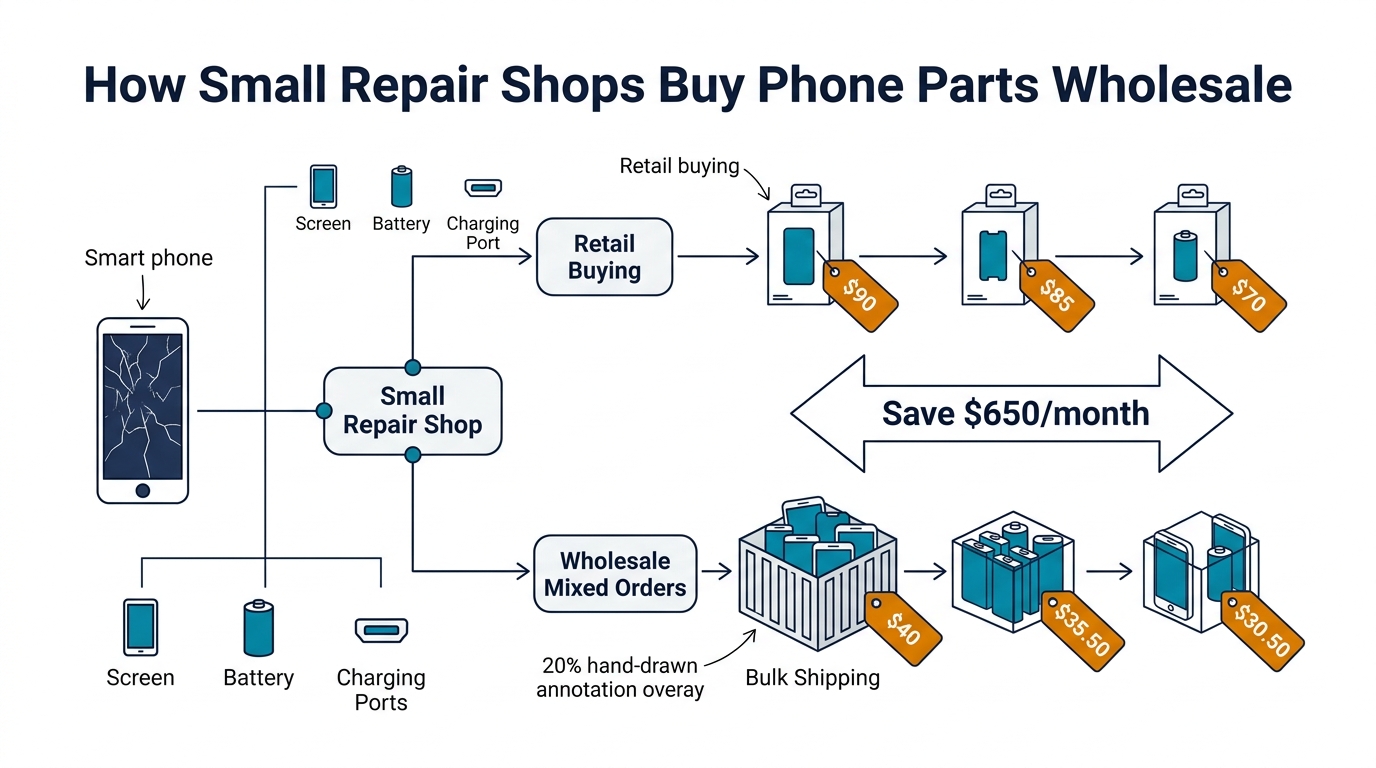
Most small repair shops start by buying parts one at a time from Amazon, eBay, or local distributors. It works when you're doing 5-10 repairs a week, but the moment you scale past 20 repairs weekly, buying retail eats your margins alive. A screen that costs $25 retail might cost $12-18 wholesale. Over 100 repairs per month, that difference is $700-1,300 in lost profit — money going to middlemen instead of your business.
The barrier for most small shops isn't awareness that cell phone parts wholesale pricing exists — it's figuring out how to actually start. Wholesale suppliers typically have minimum order quantities (MOQs), longer lead times, and payment terms that feel designed for big operations. You need 20 iPhone 13 screens, not 200. You want to mix batteries and charging ports in the same order, not commit to 100 units of a single SKU.
This guide is specifically for small repair shops doing 50-200 repairs per month. It covers how to structure your first wholesale order, which suppliers work with small businesses, how mixed orders keep your inventory lean, and the exact math on when wholesale buying starts making sense for your shop.
Looking for a Reliable Wholesale Parts Supplier?
Factory-direct from Shenzhen — transparent grades, invoices & 12-month warranty.
Get Wholesale QuoteWhen Does Wholesale Actually Save You Money?
Not every shop benefits from wholesale immediately. Here's the breakpoint:
| Monthly Repair Volume | Buying Strategy | Why |
|---|---|---|
| Under 30 repairs/month | Retail or local distributor | Order quantities are too small for meaningful wholesale savings |
| 30-80 repairs/month | Start wholesale — mixed orders, low MOQ suppliers | Savings of $300-800/month on parts costs |
| 80-200 repairs/month | Dedicated wholesale account, larger orders | Savings of $800-2,000/month, better per-unit pricing |
| 200+ repairs/month | Direct factory relationships or high-volume wholesale | Maximum price breaks, bulk shipping rates |
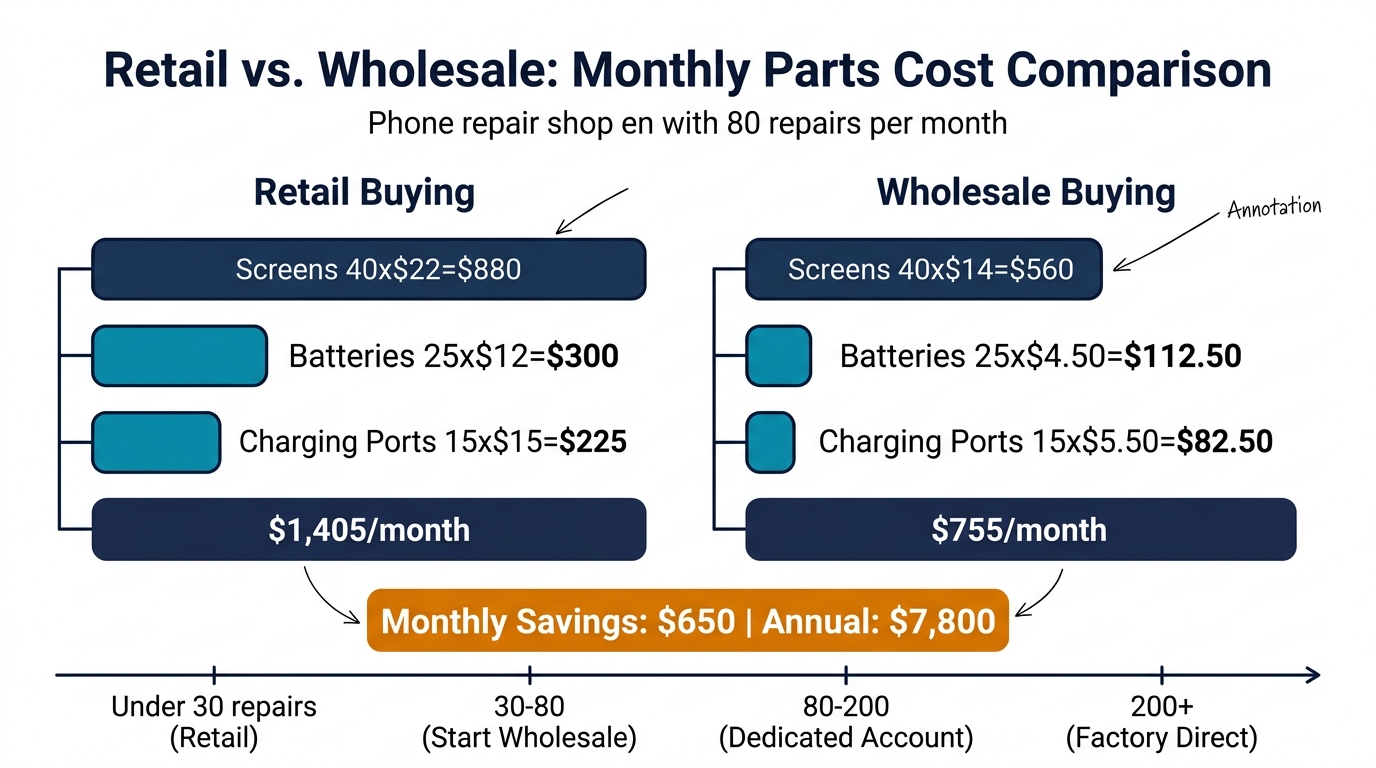
The magic number is around 30 repairs per month. Below that, the shipping costs and minimum order requirements don't justify wholesale. Above that, every repair done with retail-priced parts is leaving money on the table.
The Real Math
Let's say you do 80 repairs per month with this mix:
- 40 screen replacements
- 25 battery replacements
- 15 charging port repairs
Buying retail (Amazon/eBay/local):
- Screens: 40 × $22 avg = $880
- Batteries: 25 × $12 avg = $300
- Charging ports: 15 × $15 avg = $225
- Total parts cost: $1,405/month
Buying wholesale (cell phone parts wholesale supplier):
- Screens: 40 × $14 avg = $560
- Batteries: 25 × $4.50 avg = $112.50
- Charging ports: 15 × $5.50 avg = $82.50
- Total parts cost: $755/month
Monthly savings: $650. That's $7,800 per year — enough to fund a new workstation, marketing, or simply take home more profit.
What Is a Mixed Order and Why It Matters for Small Shops
A mixed order means combining multiple product types, models, and quantities in a single wholesale purchase. Instead of ordering 100 × iPhone 13 Hard OLED screens (which might take you 3 months to use), you order:
- 10 × iPhone 12 screens (Hard OLED)
- 10 × iPhone 13 screens (Hard OLED)
- 8 × iPhone 14 screens (Soft OLED)
- 20 × iPhone 11 batteries
- 20 × iPhone 12 batteries
- 15 × iPhone 13 batteries
- 10 × iPhone 12 charging ports
- 10 × iPhone 13 charging ports
Total: 103 units across 8 SKUs — all in one order, one shipment, one payment.
Why Mixed Orders Are Critical for Small Shops
- Cash flow protection: You're not locking $2,000 into one product that takes months to sell through
- Broader coverage: You can offer same-day repairs for more models with less total investment
- Lower waste: Ordering 2-3 weeks of stock per SKU means parts don't sit on shelves aging
- Faster testing: When trying a new supplier, you can test across multiple product categories simultaneously
Not Every Supplier Offers Mixed Orders
This is the single biggest differentiator between suppliers who work with small shops and those who don't. Many wholesale suppliers require MOQs per SKU — 50 screens of one model, 100 batteries of one model. That's fine for a chain with 10 locations. It's impractical for a solo shop.
Look for suppliers who set their MOQ on the total order quantity, not per individual SKU. An MOQ of "50 units total" is vastly more useful than "50 units per model."
For detailed guidance on MOQ structures and how to negotiate them, see our MOQ and sample orders guide.
How to Structure Your First Wholesale Order
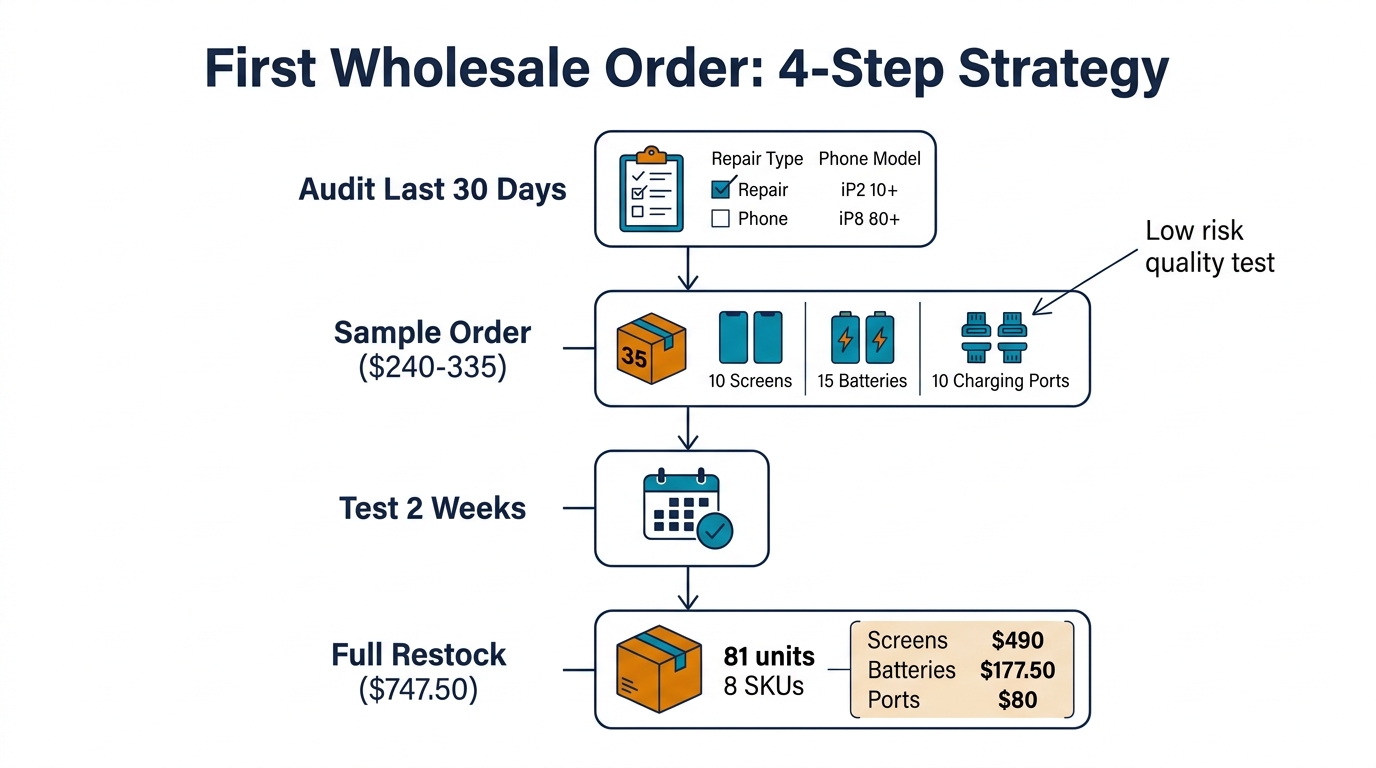
Your first order from a new cell phone parts wholesale supplier should be strategic — not just "order everything cheap." Here's a step-by-step approach:
Step 1: Audit Your Last 30 Days of Repairs
Go through your repair records and count:
- How many of each repair type (screen, battery, charging port) you did
- Which phone models appeared most frequently
- Which repairs you had to delay or turn away because you didn't have parts
This data tells you exactly what to order — not what you think you need, but what your customers actually needed.
Step 2: Start With a Sample Order
Before committing to a large wholesale order, place a sample order of 20-50 units across your top models. This lets you:
- Test the supplier's actual quality (not just what their website claims)
- Verify shipping time and packaging
- Install the parts and check for issues before committing more money
A sample order should include your top 3-4 models in the categories you repair most. For example:
| Category | Models | Quantity | Estimated Cost |
|---|---|---|---|
| Screens (Hard OLED) | iPhone 12, 13 | 5 each = 10 | $150-200 |
| Batteries | iPhone 11, 12, 13 | 5 each = 15 | $55-75 |
| Charging Ports | iPhone 12, 13 | 5 each = 10 | $35-60 |
| Total | 35 units | $240-335 |
That's your first wholesale order for under $350 — enough to test quality across three categories without major financial risk.
Step 3: Install, Test, Wait 2 Weeks
Install the sample parts in customer phones and track:
- Any quality issues (screen color, battery health reading, charging port fit)
- Customer feedback or callbacks
- Whether the parts match what you were using from retail sources
If the quality passes your 2-week test, scale up to a full restock order.
Step 4: Place Your First Full Restock Order
Based on your 30-day repair audit and confirmed quality, order 2-3 weeks of inventory for each SKU. A typical first restock for a shop doing 80 repairs/month might look like:
| Category | Model | Qty | Unit Cost | Line Total |
|---|---|---|---|---|
| Screen (Hard OLED) | iPhone 12 | 10 | $16 | $160 |
| Screen (Hard OLED) | iPhone 13 | 10 | $18 | $180 |
| Screen (Soft OLED) | iPhone 14 | 5 | $30 | $150 |
| Battery | iPhone 11 | 15 | $4 | $60 |
| Battery | iPhone 12 | 15 | $4.50 | $67.50 |
| Battery | iPhone 13 | 10 | $5 | $50 |
| Charging Port | iPhone 12 | 8 | $4.50 | $36 |
| Charging Port | iPhone 13 | 8 | $5.50 | $44 |
| Total | 81 units | $747.50 |
See the full four-grade comparison with live wholesale prices: iPhone Screen Grade Guide
Under $750 for 2-3 weeks of parts across your core models. Compare that to buying the same parts retail at $1,400+ — you're saving nearly 50%.
What to Look for in a Wholesale Supplier
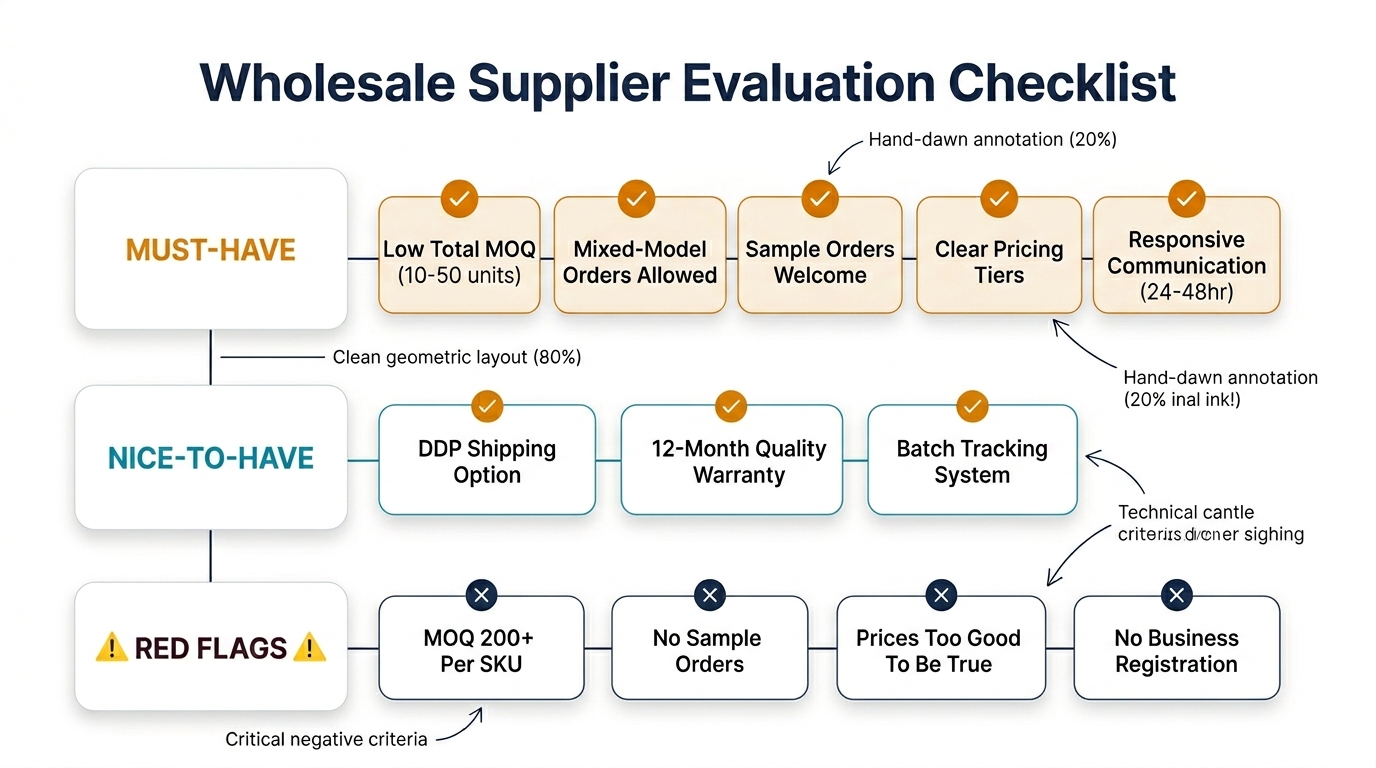
Not all cell phone parts wholesale suppliers are built for small shops. Here's what to evaluate:
Must-Have for Small Shop Buyers
- Low total MOQ (not per-SKU): Look for 10-50 unit minimums on the total order
- Mixed-model orders: Can you combine screens, batteries, and charging ports in one order?
- Sample orders welcome: Suppliers who refuse small test orders are a red flag
- Clear pricing tiers: You should know exactly what 10 units costs vs. 50 units vs. 100 units
- Responsive communication: Can you get a quote within 24-48 hours? Slow response = slow everything
Nice-to-Have
- DDP shipping option: Delivered Duty Paid means the supplier handles customs and import duties — you receive the package without surprise fees
- Quality warranty: 12-month warranty on batteries and screens shows supplier confidence
- Batch tracking: If a quality issue appears, can they trace it back to the factory batch?
Red Flags
- Minimum 200+ units per SKU: They're not set up for small businesses
- No sample order option: They don't want you to test before committing
- Prices that seem too good: A $6 iPhone 13 Soft OLED screen is either not Soft OLED or not reliable
- No physical address or business registration: Legitimate suppliers are traceable
For a comprehensive supplier evaluation framework, see our how to choose a reliable phone parts supplier guide.
Managing Cash Flow With Wholesale Buying
Small shops often worry about the upfront cost of wholesale orders. Here's how to manage it:
The 2-3 Week Rule
Never order more than 2-3 weeks of inventory for any single SKU. This keeps your cash flowing instead of sitting on shelves. Exception: if a supplier offers a significant price break at a higher quantity and the parts won't expire or lose demand, consider ordering 4-6 weeks — but only for your top 2-3 highest-volume models.
Reorder Before You Run Out
Set a reorder point for each product: when you have 5-7 days of stock left, place the next order. This accounts for shipping time (international wholesale typically takes 5-10 business days via express, 15-25 days via economy). Running out of a popular screen model means turning away same-day repairs — that costs more than the inventory.
Start With One Supplier, Then Diversify
For your first 2-3 months of wholesale buying, stick with one supplier. This simplifies payment, communication, and quality tracking. Once you've established a reliable supply chain, consider adding a second supplier for backup — especially if your primary supplier is overseas and shipping delays could leave you without parts.
Common Mistakes New Wholesale Buyers Make
Mistake 1: Ordering Too Much of One Model
Excitement about low per-unit prices leads shops to order 100 batteries for one model. If you only replace 15 of that model per month, you're sitting on 6+ months of inventory. Order based on your actual repair data, not on price breaks.
Mistake 2: Skipping the Sample Order
Every supplier looks professional online. The only way to verify quality is to test their parts in real repairs. A $200-350 sample order is cheap insurance against committing $1,500+ to a supplier whose parts cause callbacks.
Mistake 3: Not Accounting for Shipping Costs
A $14 screen from China plus $3 in shipping per unit is still cheaper than a $25 retail screen. But if you order 10 screens and pay $50 flat rate shipping, that's $5 per unit — factor it into your per-unit cost calculation. Larger orders spread shipping costs across more units.
Mistake 4: Ignoring Color Variants
Ordering "iPhone 13 screens" without specifying colors means you might get all Midnight when 30% of your repairs are on Blue or Pink models. Check your repair records for the most common phone colors and specify when ordering.
Mistake 5: Comparing Wholesale to Retail Without Including Margins
A retail screen at $25 that you charge $90 for gives you $65 margin. A wholesale screen at $15 with the same $90 charge gives you $75 margin. That extra $10 per repair adds up fast — $400+/month on screen repairs alone. Always compare final margin, not just purchase price.

FAQ
How do I find cell phone parts wholesale suppliers?
The main channels are: direct Shenzhen/China suppliers (lowest prices, higher MOQs, international shipping), US-based distributors (faster shipping, higher prices), and wholesale platforms like Alibaba. For small shops, the best option is often a China-based supplier who caters to small businesses with mixed-model orders and low total MOQs (10-50 units). Always request samples before placing a large order.
What is the minimum order for wholesale phone parts?
It varies widely by supplier. Large factory suppliers may require 500-1,000 units per SKU. Small-business-focused wholesale suppliers typically set MOQs at 10-50 total units (not per SKU), allowing mixed orders. The key is finding suppliers whose MOQ structure matches your shop size — don't force yourself into a 500-unit order when 50 units would last you 3 months.
Is it worth buying phone parts from China?
Yes, for most repair shops. Chinese wholesale suppliers — particularly those based in Shenzhen — offer parts at 40-60% below US retail prices. The trade-offs are longer shipping times (5-25 days depending on method) and the need to verify quality through sample orders. For shops doing 30+ repairs per month, the savings significantly outweigh the logistics complexity.
How long does shipping take for wholesale phone parts?
Express shipping (DHL, FedEx, UPS) from China: 5-10 business days. Economy air shipping: 15-25 business days. Sea freight (large orders): 25-40 business days. Most small shops use express or economy air. Factor shipping time into your reorder schedule — order when you have 7-10 days of stock remaining, not when you run out.
Can I return defective wholesale phone parts?
Return policies vary by supplier. Reputable wholesale suppliers offer replacement for defective units — typically deducted from your next order rather than requiring international return shipping. Before ordering, confirm the supplier's defect handling policy. A 12-month warranty that covers both dead-on-arrival and premature failure is the industry standard for quality suppliers.
Start Small, Scale Smart
Transitioning from retail to wholesale cell phone parts buying doesn't require a massive upfront investment or a warehouse full of inventory. Start with a 35-50 unit sample order across your top models, test the quality for 2 weeks, then scale to regular restock orders of 80-100 mixed units every 2-3 weeks.
The math is straightforward: at 80+ repairs per month, wholesale buying saves $500-800 monthly on parts costs alone. That compounds over a year into $6,000-10,000 — real money that either grows your business or goes straight to your bottom line.
We work with small repair shops worldwide, offering mixed-model orders starting at just 10 units total. Combine screens, batteries, and charging ports in a single order and get wholesale pricing without the big-box commitment.