
Introduction: Why Supplier Selection Matters More Than Ever in 2026
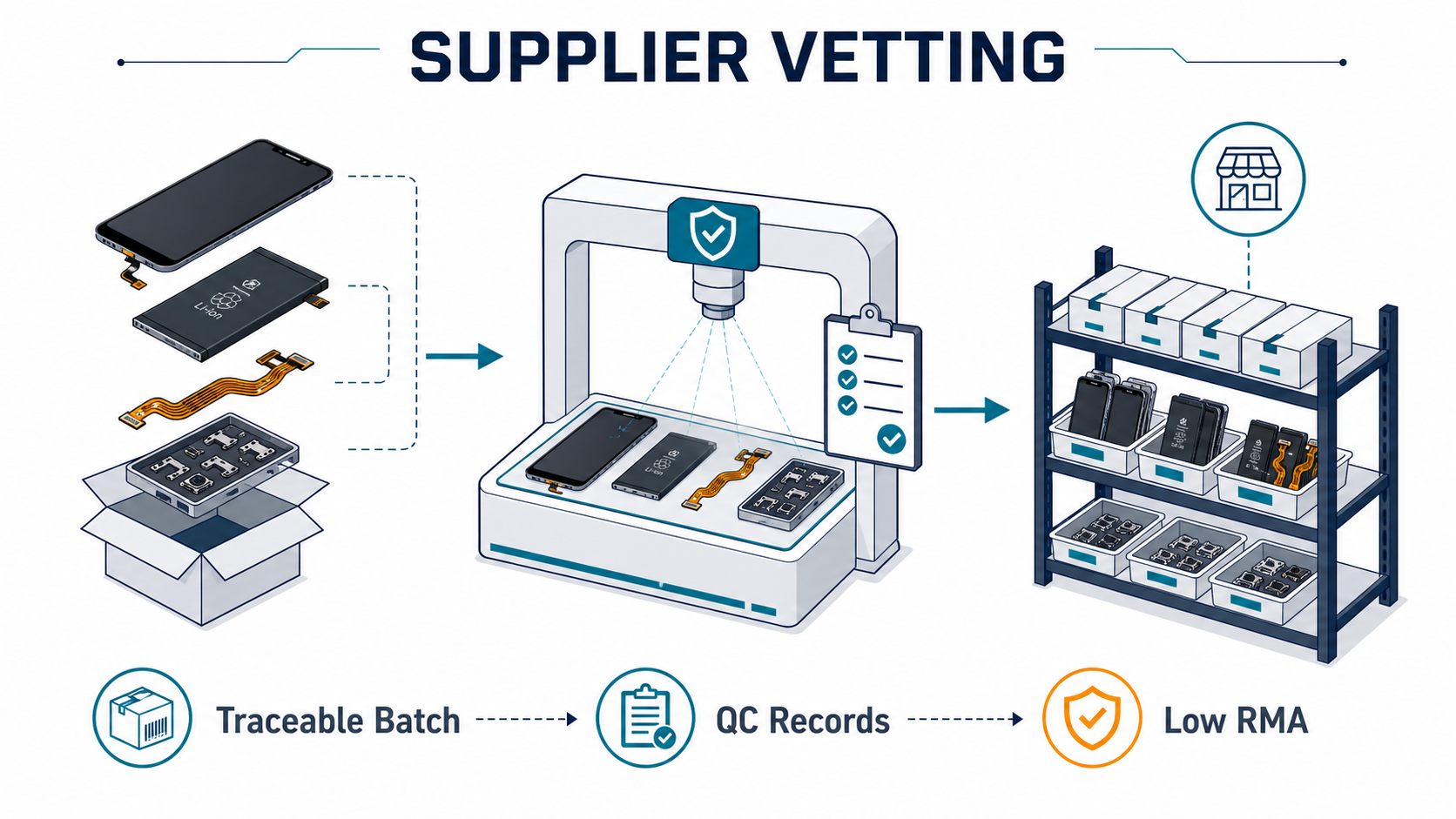
A cell phone parts supplier checklist is a structured set of criteria—certifications, quality grades, pricing, warranty, and support—used to vet a wholesaler before you commit to an order. In practice, it matters more than ever because the global mobile phone repair market is projected to reach $82 billion by 2027, growing at a 6.4% annual rate. According to recent industry analysis, this explosive growth has flooded the market with suppliers, making it harder to identify reliable partners who deliver consistent quality and value. For example, a single $5 difference per unit means nothing if 5% of those units fail in the field.
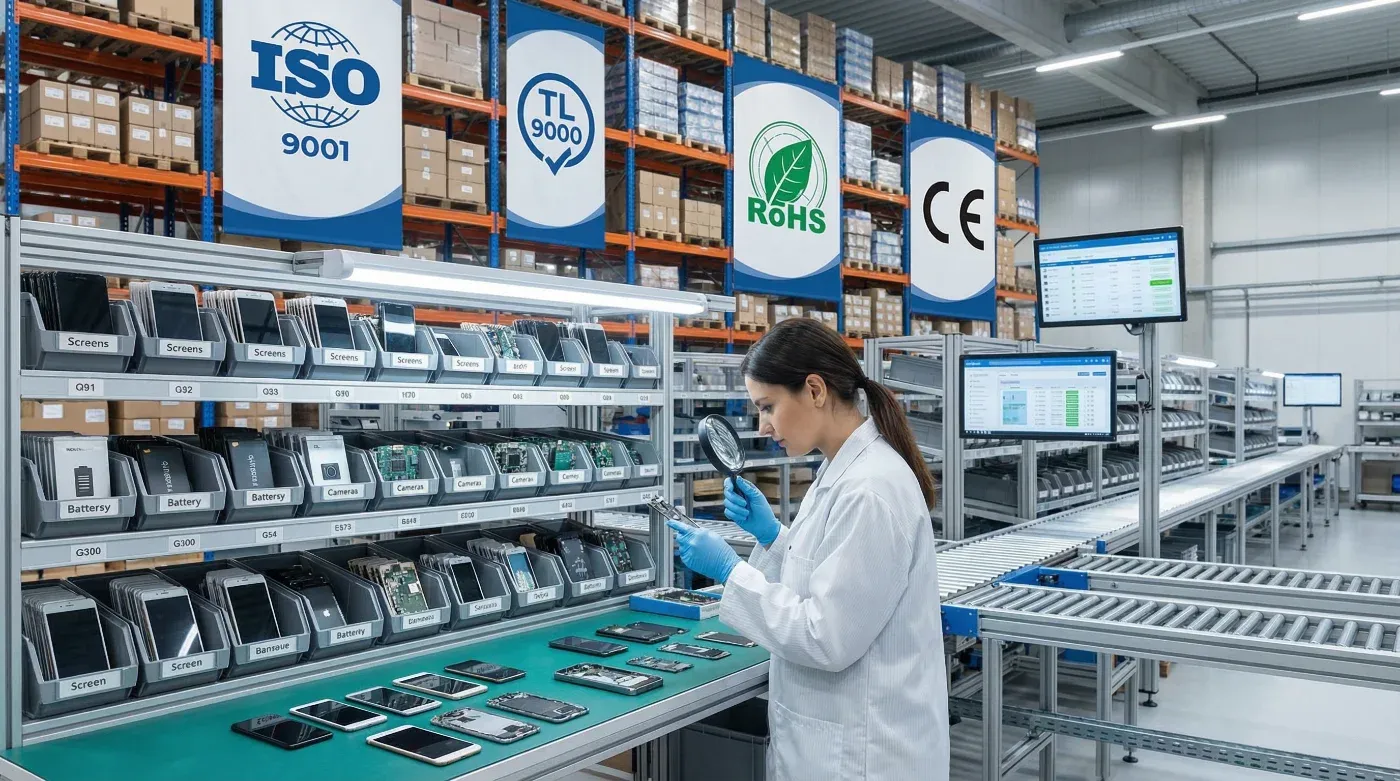
![Featured Image: Professional warehouse facility with organized mobile phone parts inventory]
The stakes are higher than ever in 2026's competitive landscape. A single subpar component can result in costly reworks, damaged customer relationships, and potential liability issues that threaten your business's survival. With the increasing complexity of modern smartphones—including foldable displays, 5G components, and advanced biometric features—the margin for error has narrowed significantly.
The Financial Impact of Poor Supplier Selection:
The financial impact of poor supplier selection is the total hidden cost a bad vendor adds beyond the unit price, and it routinely runs 8-20% of revenue. In practice, five cost categories compound on every faulty part. For example, each negative review can cost you 5-10 potential customers:
- Direct Costs: Failed parts result in free re-repairs (labor + replacement parts)
- Reputation Damage: Each negative review can cost you 5-10 potential customers
- Inventory Issues: Stock inconsistencies lead to 15-20% lost revenue opportunities
- Hidden Expenses: Unexpected fees can erode profit margins by 8-12%
- Legal Risks: Non-compliant components may result in regulatory penalties
Beyond these immediate costs, poor supplier relationships can compromise your ability to scale operations, adapt to new technologies, and maintain the quality standards that customers expect in today's premium repair market.
This comprehensive 2026 guide provides repair shop owners with a systematic approach to evaluating and selecting cell phone parts suppliers, incorporating the latest industry standards, quality metrics, and best practices.
Looking for a Reliable Wholesale Parts Supplier?
Factory-direct from Shenzhen — transparent grades, invoices & 12-month warranty.
Get Wholesale QuoteThe Foundation: Understanding 2026 Industry Standards & Regulatory Requirements
An industry standard is a certified baseline—such as ISO 9001 or RoHS—that defines the minimum quality and safety a parts supplier must meet to sell legally. In practice, you cannot evaluate a supplier before you understand the regulatory landscape that shapes these standards. For example, a component sold into the US market without FCC Part 15 compliance is a legal liability, not a bargain.
Essential Certifications for 2026: The New Baseline
An essential certification is a mandatory compliance mark that a supplier must hold to sell parts legally in major markets, and in 2026 there are six baseline marks. In practice, these are non-negotiable, and a missing one is an automatic disqualifier. For example, RoHS and CE marking are the minimum for any EU shipment:
Mandatory Certifications (Non-Negotiable):
- ISO 9001:2015 - Quality Management Systems
- ISO 14001:2015 - Environmental Management Systems
- FCC Part 15 compliance - For all electronic components sold in the US market
- CE marking - Essential for European Union market access
- RoHS compliance - Restriction of Hazardous Substances
- UL 94 flammability rating - Critical for plastic components and casings
Advanced Quality Standards (Premium Suppliers):
- IATF 16949:2016 - Automotive-grade quality for electronics components
- AS9100D - Aerospace quality management
- IPC-A-610 - Electronics assembly standards
- REACH compliance - Chemical safety regulations for EU markets
- UN38.3 certification - Battery transport safety
The Complete Supplier Evaluation Checklist for 2026
The complete supplier evaluation checklist is a six-section framework that scores a wholesaler across quality, testing, pricing, logistics, warranty, and support. In practice, you work through all six sections before signing any order. For example, a supplier that aces pricing but fails Section 1 certifications should still be rejected.
Section 1: Quality Assurance & Certifications
Quality assurance is the documented system—anchored by ISO 9001—that proves a supplier manufactures parts consistently rather than by luck. In practice, five certifications form the baseline you verify first. For example, a battery supplier without UN38.3 cannot legally ship lithium cells by air.
![Quality Assurance Laboratory: Professional technician examining smartphone components with ISO 9001 certification badges visible]
| Certification | What It Means | Why It Matters |
|---|---|---|
| ISO 9001 | Quality management system | Consistent manufacturing processes |
| CE Marking | European safety compliance | Product meets EU standards |
| RoHS | Restriction of hazardous substances | Environmental compliance |
| UN38.3 | Battery transport safety | Required for lithium battery shipping |
| FCC | US electromagnetic compliance | Legal requirement for US market |
Section 2: Advanced Product Quality Assessment & Testing Protocols
Product quality assessment is the set of measurable tests—color accuracy, brightness, contrast, and failure rate—that separates a real OEM-quality part from a relabeled copy. In practice, professional-grade screens hit Delta E below 2.0 and at least 400 nits. For example, a Standard Copy screen with a 5% failure rate costs far more in reworks than an OEM-Quality part at under 1%.
![Display Lab Testing: Professional testing equipment with color accuracy and brightness measurement tools]
Comprehensive Screen Quality Assessment:
Visual Performance Testing:
- Color accuracy verification with Delta E < 2.0 (professional grade)
- Brightness levels tested at minimum 400 nits (outdoor visibility)
- Contrast ratio verification (minimum 1000:1 for LCD, 1,000,000:1 for OLED)
- Viewing angle testing (minimal color shift at 178 degrees)
Enhanced Quality Grades for 2026:
| Grade | Description | Failure Rate | Best For | Price Premium |
|---|---|---|---|---|
| OEM Original | Genuine manufacturer parts | <0.1% | Premium repairs, warranty work | 100-150% |
| OEM-Quality Plus | Premium aftermarket exceeding OEM specs | <0.5% | Professional repairs, commercial clients | 80-120% |
| OEM-Quality | Aftermarket matching OEM specs | <1% | Standard professional repairs | 60-80% |
| Premium Copy | High-quality aftermarket with minor differences | <2% | Budget-conscious quality repairs | 40-60% |
| Standard Copy | Basic aftermarket quality | <5% | Lowest price point, economy repairs | 20-40% |
Section 3: Pricing Transparency & Structure
Pricing transparency is a supplier's willingness to publish a clear volume-discount structure rather than negotiate ad hoc. In practice, a transparent vendor offers 5-10% off at 10-25 units, scaling to 20-30% past 100 units. For example, a supplier that refuses to quote tiered pricing is usually hiding margin or inconsistent stock.
Volume Pricing Expectations:
| Order Size | Typical Discount |
|---|---|
| 10-25 units | 5-10% |
| 26-50 units | 10-15% |
| 51-100 units | 15-20% |
| 100+ units | 20-30% |
Section 4: Supply Chain Transparency & Advanced Logistics Management
Supply chain transparency is a supplier's ability to show where parts are made and how they ship, with tracking at every step. In practice, you weigh three shipping methods by transit time and cost. For example, Express Air lands in 1-3 days at $50-100/kg, while Ocean Freight takes 15-35 days at $2-8/kg.
![Global Supply Chain Logistics: Cargo containers, delivery trucks, freight airplane, and warehouse operations showing logistics network]
Shipping Method Comparison for 2026:
| Method | Transit Time | Cost Range | Best For | Risk Level | Tracking |
|---|---|---|---|---|---|
| Express Air | 1-3 days | $50-100/kg | Urgent repairs, critical inventory | Low | Real-time |
| Standard Air | 3-7 days | $15-40/kg | Regular inventory replenishment | Low | Daily |
| Ocean Freight | 15-35 days | $2-8/kg | Bulk orders, planned inventory | Medium | Weekly |
Section 5: Warranty & Return Policies
A warranty policy is a supplier's written commitment to replace defective parts within a set window, and 30 days is the floor for screens and batteries. In practice, the warranty length should scale with the part. For example, a screen should carry 90-180 days while a small part may carry just 14-30 days.
Standard Warranty Expectations:
| Part Type | Minimum Warranty | Ideal Warranty |
|---|---|---|
| Screens | 30 days | 90-180 days |
| Batteries | 30 days | 90 days |
| Charging Ports | 30 days | 60 days |
| Cameras | 30 days | 60 days |
| Small Parts | 14 days | 30 days |
Section 6: Customer Support & Communication
Customer support is the speed, clarity, and proactivity of a supplier's communication when something goes wrong. In practice, an excellent vendor replies in under 24 hours with proactive solutions, while a poor one takes over 48 hours and turns defensive. For example, a supplier that solves a defect claim before you escalate is worth a small price premium.
![Supplier Evaluation Meeting: Professional business team evaluating suppliers with quality metrics dashboard and performance evaluation charts]
| Factor | Poor | Acceptable | Excellent |
|---|---|---|---|
| Response Time | >48 hours | 24-48 hours | <24 hours |
| Language | Difficult to understand | Adequate | Clear, professional |
| Problem Solving | Defensive, unhelpful | Reactive | Proactive solutions |
| Availability | Limited hours | Business hours | Extended/24-7 |
Supplier Evaluation Scorecard for 2026
Use this comprehensive scorecard to compare potential suppliers objectively across multiple dimensions:
| Category | Weight | Supplier A | Supplier B | Supplier C |
|---|---|---|---|---|
| Quality & Certifications | 25% | /10 | /10 | /10 |
| Product Quality | 20% | /10 | /10 | /10 |
| Pricing Transparency | 15% | /10 | /10 | /10 |
| Shipping & Logistics | 15% | /10 | /10 | /10 |
| Warranty & Returns | 10% | /10 | /10 | /10 |
| Customer Support | 10% | /10 | /10 | /10 |
| Business Stability | 5% | /10 | /10 | /10 |
| Weighted Total | 100% | /10 | /10 | /10 |
Scoring Guide:
- 9-10: Exceptional, industry-leading
- 7-8: Good, meets professional standards
- 5-6: Acceptable, room for improvement
- 3-4: Below average, concerns exist
- 1-2: Poor, significant issues
Quick Reference: Supplier Red Flags
A supplier red flag is a warning signal that a vendor is hiding quality, legal, or financial problems, and some flags are immediate disqualifiers. In practice, you sort them into two tiers. For example, no verifiable business registration is an instant rejection, while a company under 2 years old is a proceed-with-caution signal.
Immediate Disqualifiers:
- No verifiable business registration
- Refuses to provide samples
- No warranty policy
- Cash-only payment requirements
- Pressure for large upfront payments
Proceed with Caution:
- Very new company (<2 years)
- Prices significantly below market
- Limited communication channels
- No physical address
- Inconsistent information
Frequently Asked Questions
What certifications should a cell phone parts supplier have?
A supplier certification is a mandatory compliance mark that proves a vendor meets a quality or safety standard. The six baseline marks for 2026 are ISO 9001 for quality management, RoHS for hazardous-substance restriction, CE marking for EU access, FCC Part 15 for the US market, ISO 14001 for environmental management, and UN38.3 for battery transport. In practice, these six are non-negotiable, and premium suppliers add IATF 16949 or IPC-A-610. For example, a battery vendor without UN38.3 cannot legally air-ship lithium cells, an instant disqualifier that can cost over $2,000 in seized shipments.
How do I verify a cell phone parts supplier is reliable?
Supplier verification is the process of checking a vendor's registration, certifications, samples, and warranty before you place a bulk order. First, confirm a verifiable business registration and physical address. Second, request ISO 9001, CE, and RoHS documentation. Third, order samples and test color accuracy (Delta E below 2.0) and brightness (400+ nits). For example, a supplier that refuses to provide samples or insists on cash-only payment should be rejected immediately.
What warranty should a phone parts supplier offer?
A phone parts warranty is a written commitment to replace defective parts within a set window, and 30 days is the absolute minimum. In practice, the period scales with the part type. First, screens warrant 90-180 days. Second, batteries and charging ports warrant 60-90 days. Third, small parts warrant 14-30 days. For example, on a $50 premium OLED, PRSPARES backs its screens with up to a 12-month warranty, because a longer warranty both reassures the buyer and forces the supplier to stock genuinely reliable parts.
What discount should I expect for bulk phone parts orders?
A bulk phone parts discount is a volume-based price reduction that runs from 5% to 30% depending on order size. In practice, the tiers are predictable. First, expect 5-10% off at 10-25 units. Second, 10-15% at 26-50 units. Third, 15-20% at 51-100 units, rising to 20-30% past 100 units. For example, a 20% discount on a $40 screen saves $8 per unit, so a transparent supplier publishes this structure up front while a vendor that negotiates every quote ad hoc is often hiding inconsistent stock.
What are the biggest red flags when choosing a parts supplier?
The biggest red flags are no verifiable business registration, refusal to provide samples, no warranty policy, cash-only payment, and pressure for large upfront payments—each an immediate disqualifier. In practice, a second tier of caution signals includes a company under 2 years old, prices far below market, and no physical address. For example, a quote 30% under market almost always signals counterfeit internals or recycled components, not a genuine deal.
Conclusion
The bottom line on supplier selection is that it is one of the most critical decisions you make for your repair business in 2026, because a single bad batch can erase a year of margin. In practice, following this six-section checklist reduces risk, improves margins, and protects customer satisfaction. For example, a supplier scoring 9-10 on the scorecard typically returns under 1% defects versus 5% from an unvetted vendor.
Remember: the cheapest parts are rarely the best parts. Invest time in thoroughly vetting your suppliers using the standards and metrics outlined in this guide. Your business—and your customers—will thank you for it.
About PRSPARES:
PRSPARES is your trusted partner for high-quality mobile phone replacement parts. We meet all the criteria in this checklist and are committed to helping repair professionals succeed.