
Cell Phone Parts Wholesale: How to Pick a Supplier That Won't Wreck Your RMA Rate
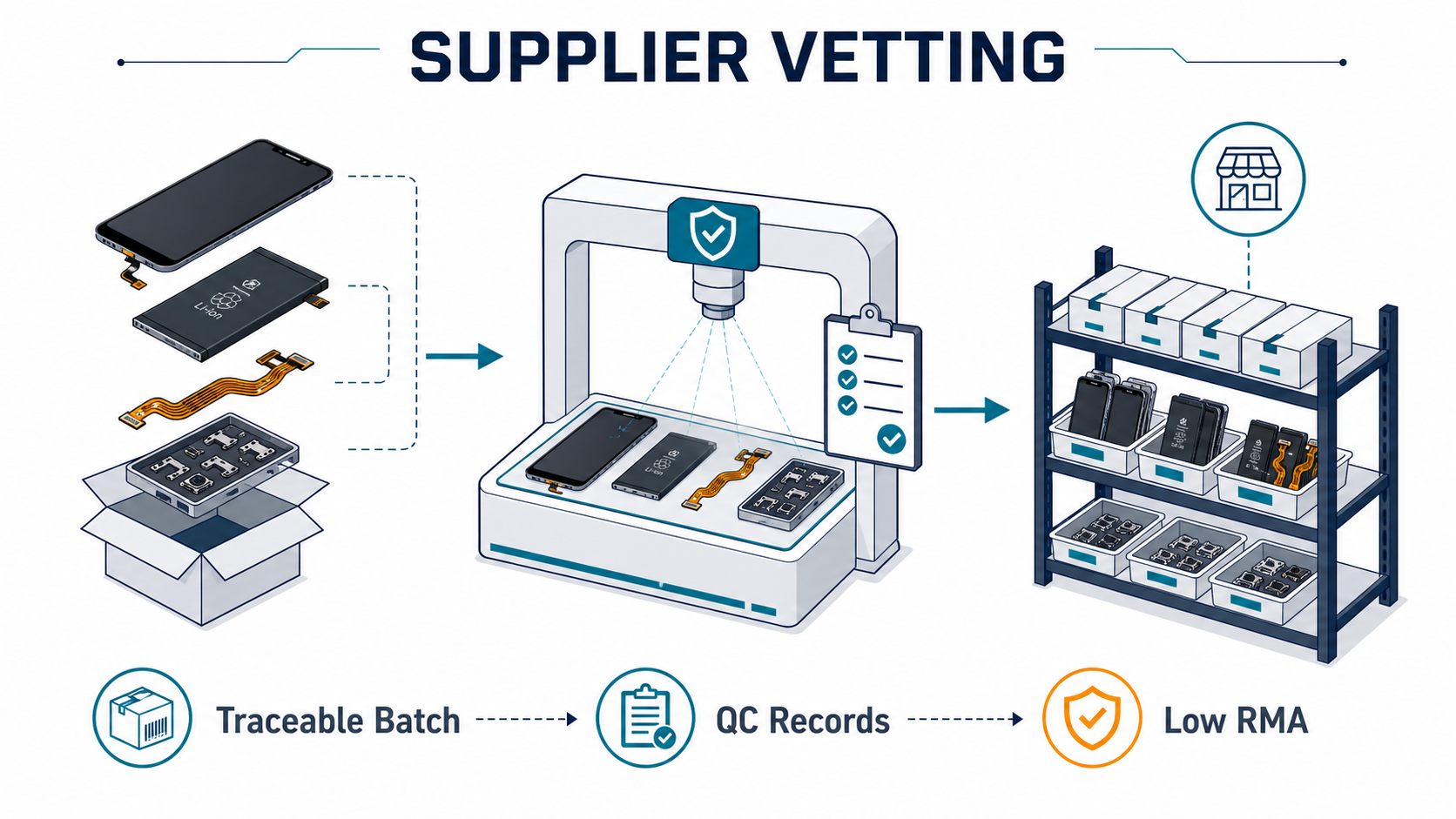
You found a supplier offering iPhone screens 20% under everyone else. The samples looked perfect. The first batch installed fine. Then, three weeks later, the returns started — "weird colors," "screen feels laggy," "battery drains overnight." Suddenly you're eating refunds, redoing installs for free, and watching your reviews slide.
Here's the part nobody tells you when they hand you a list of "best wholesale cell phone parts suppliers": the cheapest price almost always hides the highest total cost. Not because the screen looks worse on day one — because of what happens on day 30.
I sell phone parts wholesale out of Shenzhen. That means I see this market from the seller's side — the side you don't get to see when you're scrolling a catalog page. This guide is the thing I wish every buyer knew before they sent me (or my competitors) their first order: how to tell a real factory-direct supplier from a middleman or a gray-market reseller, how the grade terminology is used to confuse you, and exactly how to run a first order so a bad supplier can only hurt you a little instead of a lot.
Looking for a Reliable Wholesale Parts Supplier?
Factory-direct from Shenzhen — transparent grades, invoices & 12-month warranty.
Get Wholesale QuoteWhy "Cheapest Wholesale" Is the Most Expensive Mistake
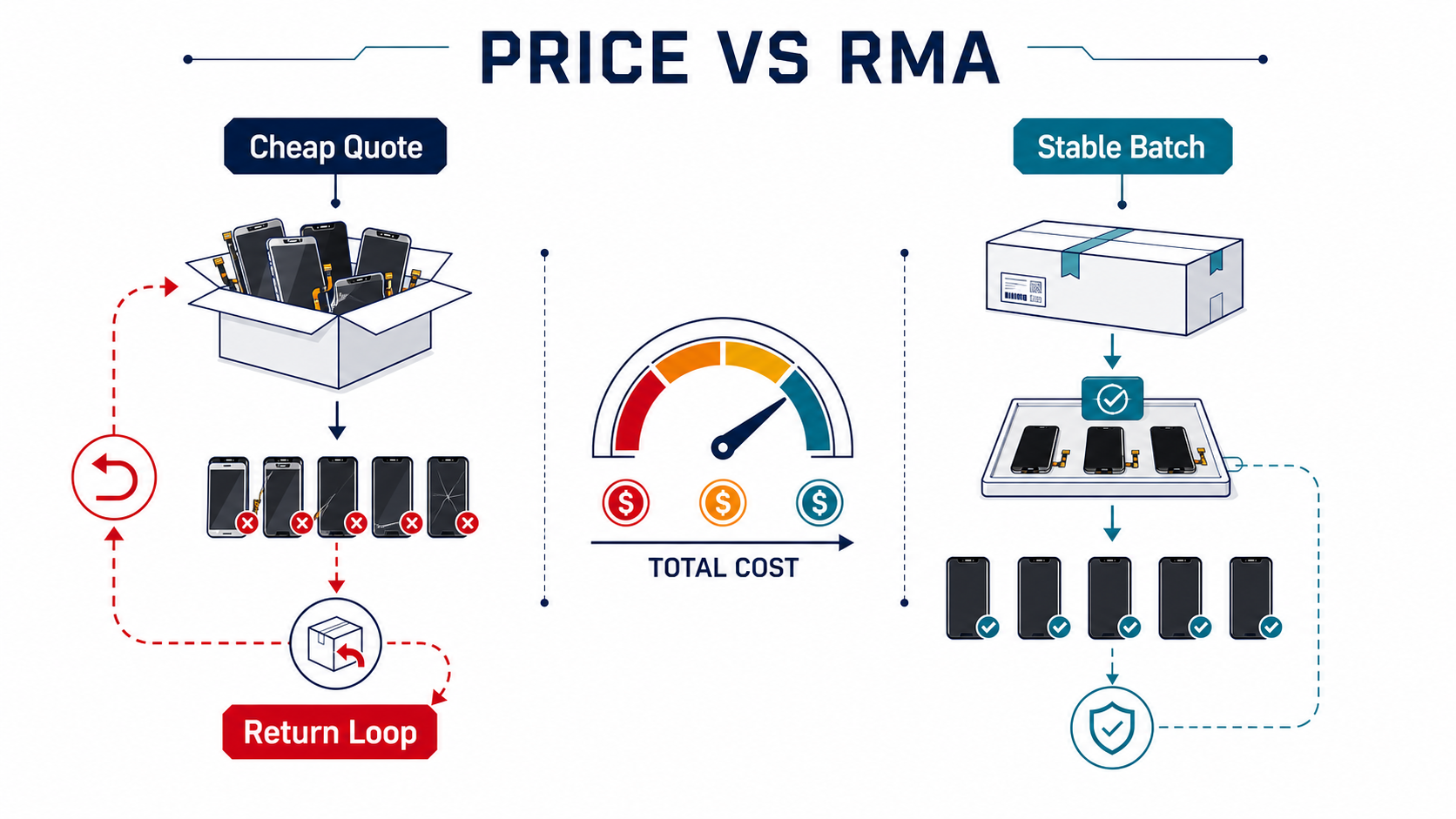
Walk the search results for cell phone parts wholesale and you'll find a wall of catalog pages — MobileSentrix, Injured Gadgets, etech, dozens more. Every one of them wants you to start adding parts to a cart. None of them tells you the one number that actually decides whether you make money: your return rate.
Do the math on a single screen model. Say you buy 100 units:
- Supplier A (documented, batch-tested): ~$35/unit, ~1.1% return rate
- Supplier B (mixed / gray reseller): ~$25/unit — $10 cheaper! — but a 3–8%+ return rate (higher on bad batches)
The $10 saving on 100 screens is $1,000. Tempting. But every return costs you the replacement part, the labor to reinstall, sometimes a full refund, and the thing you can't put on a spreadsheet — a customer who won't come back and tells three friends. Run the math: at a 5-point RMA gap on 100 screens, the reinstall labor and refunds alone erase that $1,000 and then some. (Full worked example at the end of this guide.)
The real cost of wholesale phone parts isn't the unit price — it's the return rate. A screen that's $10 cheaper with 3x the RMA eats your savings with interest.
This is why "who has the lowest price" is the wrong first question. The right one is: what tier of supplier am I actually talking to?
The Three Tiers of Cell Phone Parts Suppliers (and How to Tell Them Apart)
Every wholesale phone parts seller is one of three things, even when they all use the word "wholesale." Knowing which one you're dealing with is the single most useful skill in this business.
Tier 1: The Factory (or genuine factory-direct)
They make the parts, or they have a locked, exclusive relationship with the line that does. Signs:
- They can name the factory and the specific production line for a batch.
- They talk about QC process, not just price.
- Their pricing is stable batch-to-batch — because their source is stable.
- They can show you test documentation (and don't get nervous when you ask).
Tier 2: The Distributor / consolidator
They buy from multiple factories and resell. Legitimate and useful — they give you selection and one invoice across many part types. The risk: batch-to-batch consistency, because the underlying factory can change without you knowing.
Tier 3: The Middleman / gray-market reseller (the one that hurts you)
They own nothing. They buy whatever is cheap this week — including factory rejects, "混货" (mixed-quality batches), and 后压屏 (aftermarket relaminated glass sold as better than it is). Tells:
- They answer your WeChat in 5 minutes at 2am. A real factory contact (a "Keyman") has a day job running production — instant 24/7 replies usually mean a reseller whose whole job is chasing orders.
- When you ask "which factory is this batch from?" (这批货是哪个厂的?), they can't answer, or they get vague.
- The price swings every time you order. That's because their source swings every time.
The hidden rule most buyers never learn: the difference between a $40 screen and a $25 "same" screen often isn't quality at all — it's whether the unit passed the factory's QC or was rejected and resold by a Tier-3 reseller. Same factory. Same line. One passed; one didn't. The reseller relabels the reject and sells it as a bargain.
How to Decode Grade Terminology Before It Decodes Your Wallet
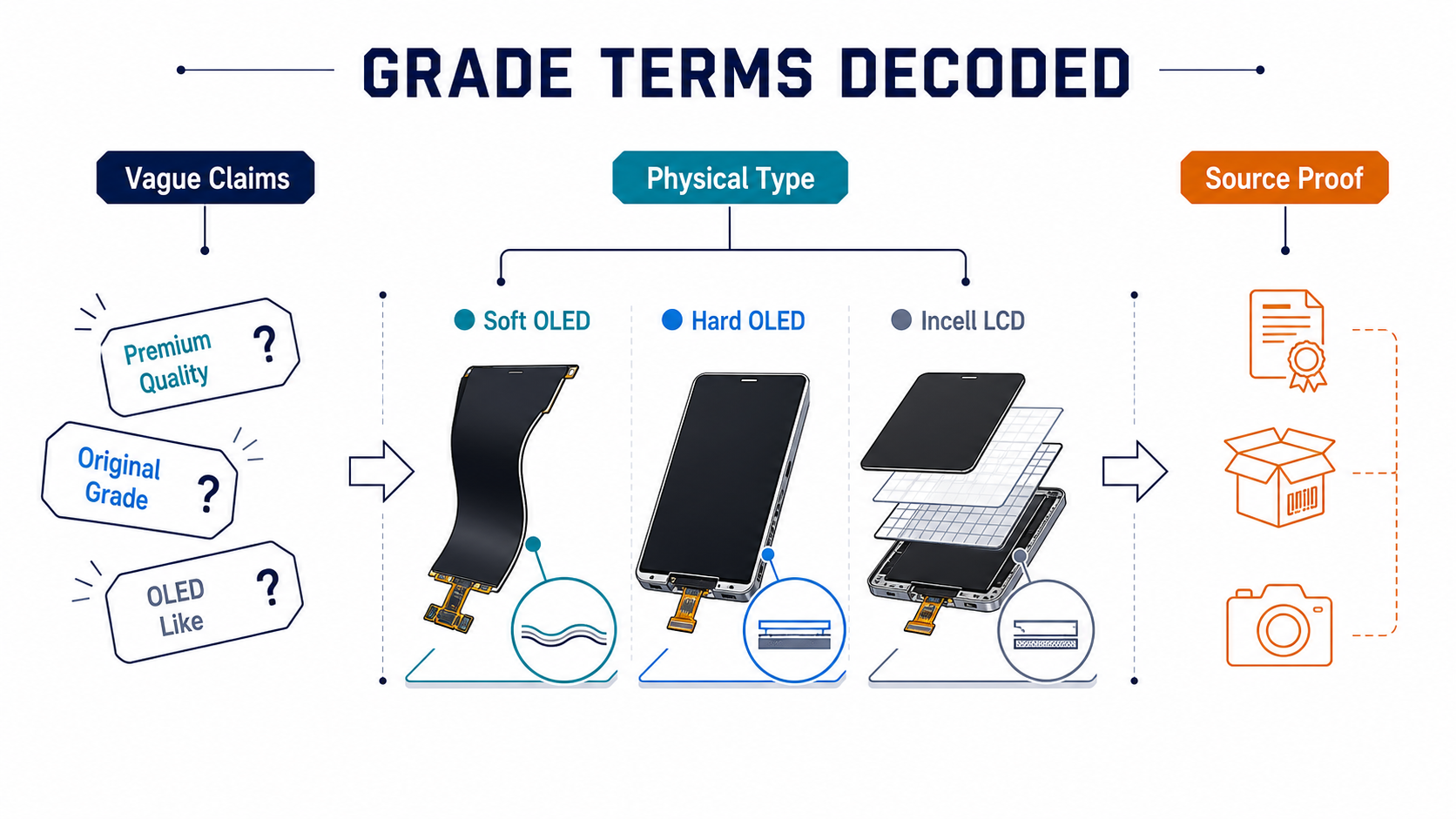
"OEM quality." "Original." "AAA grade." "Premium aftermarket." Most of these words mean nothing standardized — every seller defines them differently on purpose, because vague terms are easier to sell.
Here's how to cut through it. For screens specifically, ignore the marketing word and ask which physical category it actually is:
| What they say | What to actually ask | Why it matters |
|---|---|---|
| "OEM" / "Original" | "Original which OEM? Pulled, refurbished, or new?" | "OEM" is meaningless without the factory name. Refurb ≠ new. |
| "Hard OLED" | "Rigid OLED — what price vs Soft OLED?" | Hard (rigid) OLED is durable and saves money up front. The trade-off vs Soft OLED: it can show color/viewing-angle differences and the panel is more fragile to handle on install. Solid for budget jobs and older devices — for modern flagships and repeat customers, weigh it against Soft OLED ("省小钱亏大钱" — penny-wise, pound-foolish if returns climb). See also our Hard OLED vs Soft OLED vs LCD guide for repair shops. |
| "Soft OLED" | "Flexible OLED — is it original-pulled film or new?" | Closest to genuine feel; price/return tradeoff usually best. |
| "Incell / LCD" | "Incell for which models, what warranty?" | Budget tier — fine for older models, set customer expectations. |
See the full four-grade comparison with live wholesale prices: iPhone Screen Grade Guide
The move that separates pros from tourists: don't accept a grade word. Make the supplier name the physical part and the source. A Tier-1 supplier answers immediately. A Tier-3 reseller stalls — because they don't actually know.
The First-Order Protocol: How to Test a Supplier Without Betting the Business
You will never know a supplier is good from samples. Samples are cherry-picked. You find out from a batch. So the goal of your first order isn't to stock up — it's to test the supplier cheaply.
Here's the protocol:
-
Keep the first order small. Order at or just above their MOQ (for PRSPARES: no per-model minimum — 10 pieces in total for a mixed order that includes screens, 20 for batteries or small parts on their own) — enough to see batch behavior, small enough that a bad batch is a bruise, not a wound. This is standard for serious first-order testing; pure "sample" 1-5 pcs are often cherry-picked and don't reveal real batch variance.
-
Test units from the actual batch, not the cherry-picked samples. With a 10-piece first order, test all 10; on larger orders, pull a random handful per model. Either way you're checking the shipment, not the sample they hand-picked. For screens, run these fast checks:
- Black-screen test: full black at 100% brightness in a dark room. Any backlight glow on something sold as OLED = LCD mislabeled. Reject the batch.
- Slow-mo flicker test: phone camera at 240fps, pointed at the screen at ~25% brightness. Heavy visible flicker = aggressive PWM = the eye-strain complaints that wreck your reviews.
- Color/touch sanity check across several units — consistency between units matters more than any single unit looking good.
-
Ask the WeChat question. Message the supplier: "这批屏幕是哪个厂的?有没有检测报告?" (Which factory is this batch from? Is there a test report?) A Tier-1 supplier answers with a name and a document. A reseller can't.
-
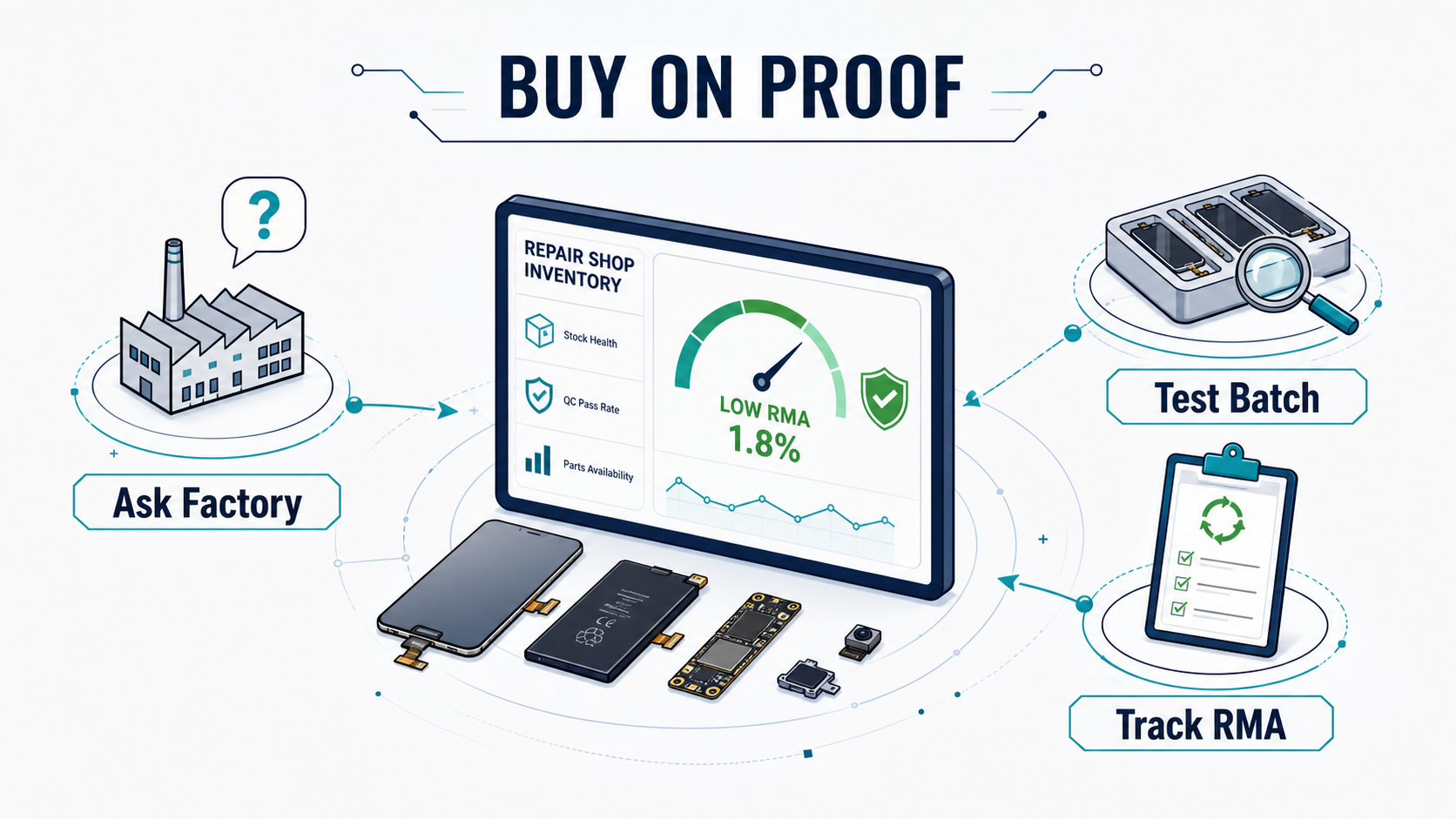
Log the RMA. Track returns on that first batch by model. This number — not the price — tells you whether to scale up with this supplier or walk away.
-
Only then, scale. Once a supplier survives a first-order test, then you negotiate volume pricing and consolidate. Never the other way around.
What This Looks Like Done Right
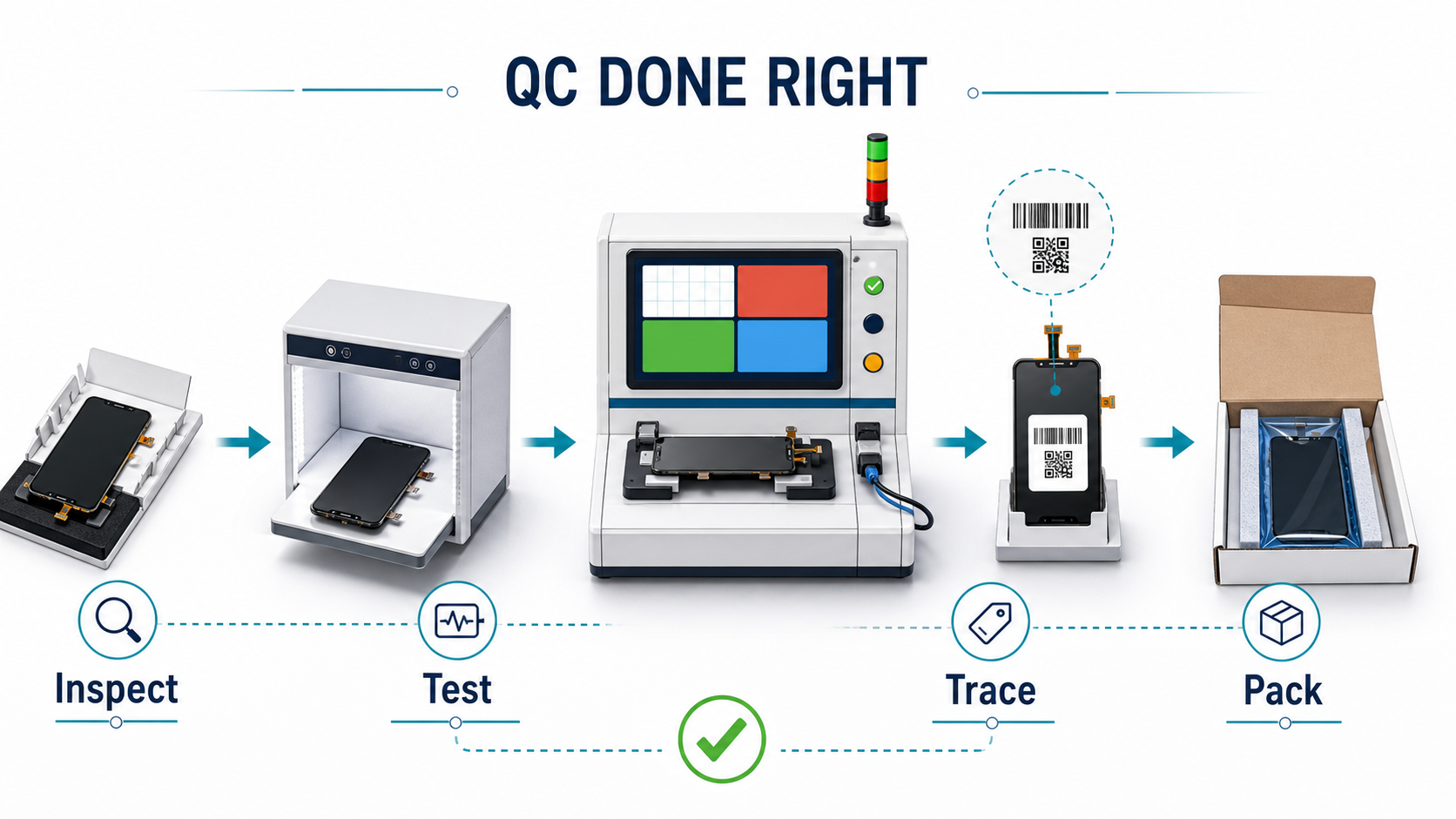
We run every batch through a documented 7-step incoming QC before it leaves Shenzhen:
- Display uniformity / brightness check
- Black-screen test (no backlight glow on OLED)
- Touch response & linearity
- Color accuracy & viewing-angle check
- Physical fit & frame alignment
- Visual defect scan (scratches, dead pixels, dust)
- Packing / label verification + batch traceability
Checklists and factory/batch details are available on request. This is why buyers who value predictability stay: not because we're always the absolute cheapest quote, but because the total cost (parts + labor + refunds + reputation) ends up lower. See current stock, grades and our batch QC approach on the full products catalog.
Our tracked return rate on screens: 1.1% over the last 6 months (warranty/RMA cases, excluding installation damage). For context, aftermarket screen RMA is commonly discussed in the 3–5% range — and runs far higher on unvetted mixed batches.
Wholesale price bands give you a feel for where each grade sits. The figures below are iPhone 16 Pro / Pro Max examples, 10+ units, EXW USD, May 2026 — older models run lower, and 50+/200+ tiers drop further:
| Grade | Price band (EXW) |
|---|---|
| Incell / HD+ LCD touch assembly | ~$29–45 |
| Hard / rigid OLED (DD, GX, JK variants) | ~$55–75 |
| Premium / higher-grade OLED (soft-feel) | ~$110–130 |
| Original / LTPO XDR-grade | ~$180–240 |
A pattern repeatedly described by repair technicians on forums such as r/mobilerepair: shops ordering 100–300 unit batches of lower-cost "hard OLED" or mixed aftermarket screens at 20–30% below vetted pricing often see problems surface within 4–8 weeks. Commonly reported issues include color shift and poor off-angle viewing on hard panels, touch failures, black screens, and higher breakage rates during installation due to the more fragile construction. With reinstall labor typically $30–60 per unit plus replacement parts and customer refunds or lost goodwill, the downstream costs frequently exceed the upfront savings by several times. Many shops report tracking the numbers on one or two such batches, then switching to suppliers with clear factory traceability and documented incoming QC — after which their screen-related RMA rates drop into the low single digits (matching the ~1.1% range we track on vetted supply).
The point isn't that we're the only good option. It's that the criteria above are how you'd evaluate us — or anyone — instead of sorting a list by lowest price. Ask the factory question, run the first-order protocol on a real batch (not samples), log the actual RMA, then decide.
What to Do Monday Morning
-
Test one screen from your current inventory with the slow-mo flicker method. 30 seconds. If it flickers hard, you just found out why some customers complain about eye strain — and why some don't come back.
-
Before your next wholesale order, send your supplier this message: "这批货是哪个厂的?有没有检测报告?" (Which factory is this batch from? Do you have a test report?) The quality of the answer tells you the tier of the supplier.
-
Make your next order a first-order test, not a stock-up. Small batch, test the whole batch, log the RMA, then decide.
If you want a supplier you can actually run this test on — factory-direct, batch-tested, with the documentation to back it up — that's exactly what we do. Send us a wholesale inquiry with the models and volumes you're sourcing and we'll reply with pricing plus the test reports so you can verify before you commit.
12-Point Quick Vetting Checklist (Shenzhen Seller View)
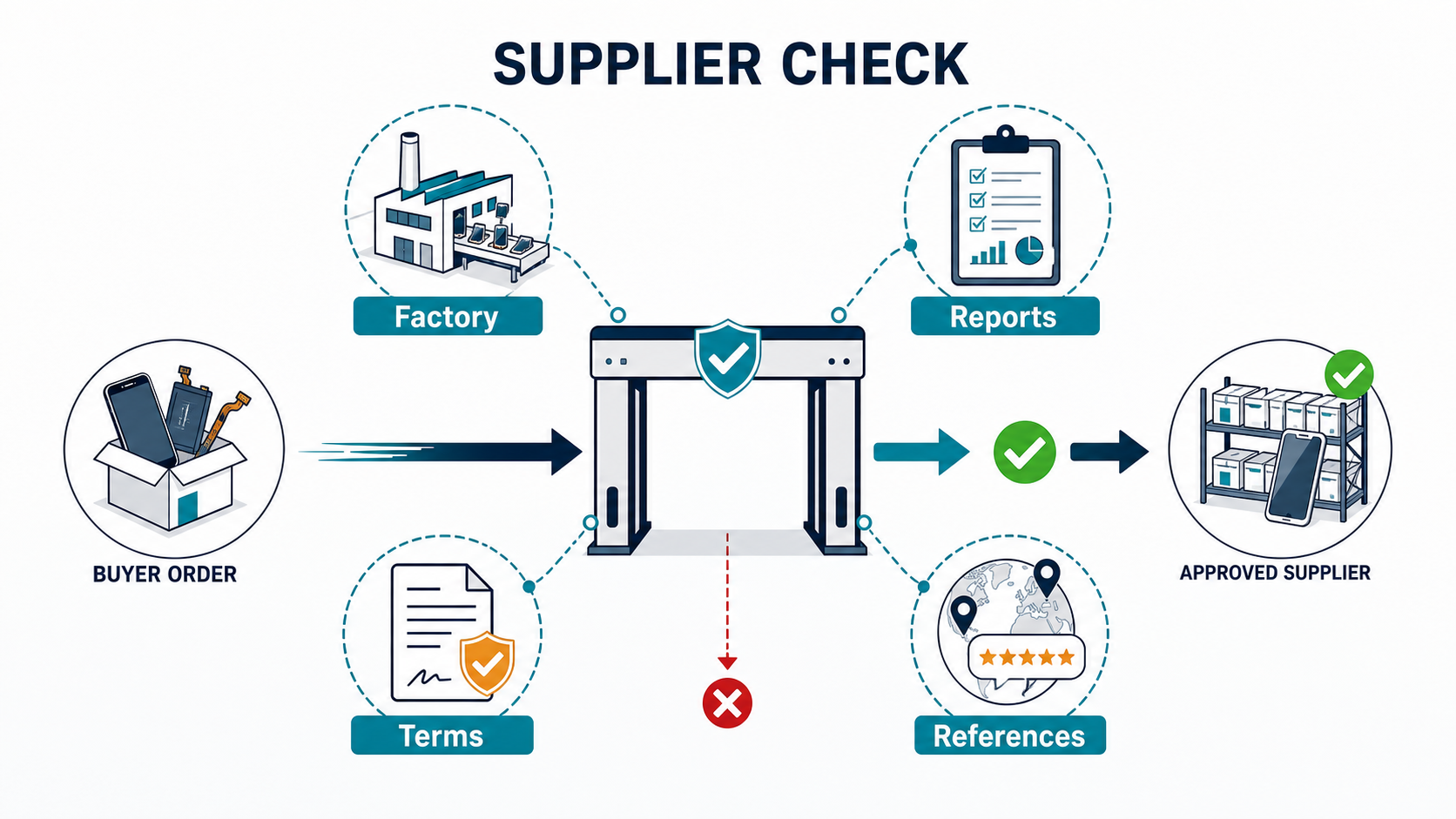
Before you wire money or place the first container, run this mental or literal list. Tier-1 suppliers answer most without hesitation; Tier-3 stall or deflect.
- Can they name the exact factory / production line for this batch (not "we have many sources")?
- Will they provide (or let you reference) batch test reports / QC records?
- Is pricing stable batch-to-batch, or does it swing wildly with "market"?
- Do they push samples hard but resist small first batch orders?
- Do they use vague grade words ("OEM", "AAA", "premium") or name the physical type + supplier (incell / JK OLED / DD / Soft film etc.)?
- Response time at 2am China time: instant = reseller; normal business hours + Keyman contact = better signal.
- MOQ and mixing policy transparent? (10 pcs/model mixable is common and buyer-friendly for testing.)
- Warranty / RMA terms clear in writing, and do they stand behind with process (not just "contact us")?
- Can they show real warehouse / QC / packing process (photos, video, or live call)?
- Payment terms: do they demand 100% upfront on first order, or offer reasonable split after relationship?
- Shipping / export docs experience for your country (US/UK/EU duties, labeling)?
- Ask for 2-3 recent buyer references in your region or similar volume — and actually message one.
Run the first-order protocol on top of this. One bad batch that survives this filter is rare; one that doesn't is cheap education.
Quick Math Most Buyers Ignore
Take 100 iPhone 16-series screens — the same two suppliers from the top of this guide.
- "Bargain" mixed at $25/unit = $2,500. At a ~6% effective return rate (parts + labor + refunds + a couple of lost reviews), add roughly $800–1,500 in downstream cost.
- Documented at $35/unit = $3,500. At ~1.1%, add roughly $150–250.
The $1,000 you "saved" on purchase price gets wiped out — and then some — once returns are counted. This is why shops that scale profitably treat RMA rate as the primary KPI, not headline unit price.
FAQ
What is the typical MOQ for cell phone parts wholesale from China?
10 pieces per model is a common, buyer-friendly threshold for serious Shenzhen suppliers (mix models OK). Pure samples (1-5) are possible but often cherry-picked and poor predictors of real production batches.
Hard OLED or Soft OLED for repair shops?
Hard/rigid OLED (JK/DD/GX) is durable and cheaper up front — good for budget work and older devices. Soft/premium flexible OLED is closer to the genuine feel and usually wins on total cost for recent flagships where customers notice color and viewing angles. Match the grade to the device and the customer.
How do I know if a supplier is selling mixed or rejected stock ("混货" / 后压)?
Price swings, vague factory answers, 24/7 instant replies, and resistance to batch testing + reports are strong signals. The real test is always the first real shipment + logged RMA, not the quote or samples.
What RMA rate should I target on screens?
Aftermarket screen RMA is commonly discussed in the 3–5%+ range; vetted supply chains track lower (we track 1.1% over the last 6 months, excluding install damage). Independent resources like iFixit's iPhone screen repair guide are useful for understanding part grades and failure modes. Track your own RMA by supplier and model — that's the only number that matters for your business.
Do I need to go to Huaqiangbei in person?
Many successful buyers never do. Factory-direct or strong Tier-1/2 relationships + remote batch QC + the first-order protocol work well. In-person helps for very large or custom orders, but the vetting rules above apply either way.